
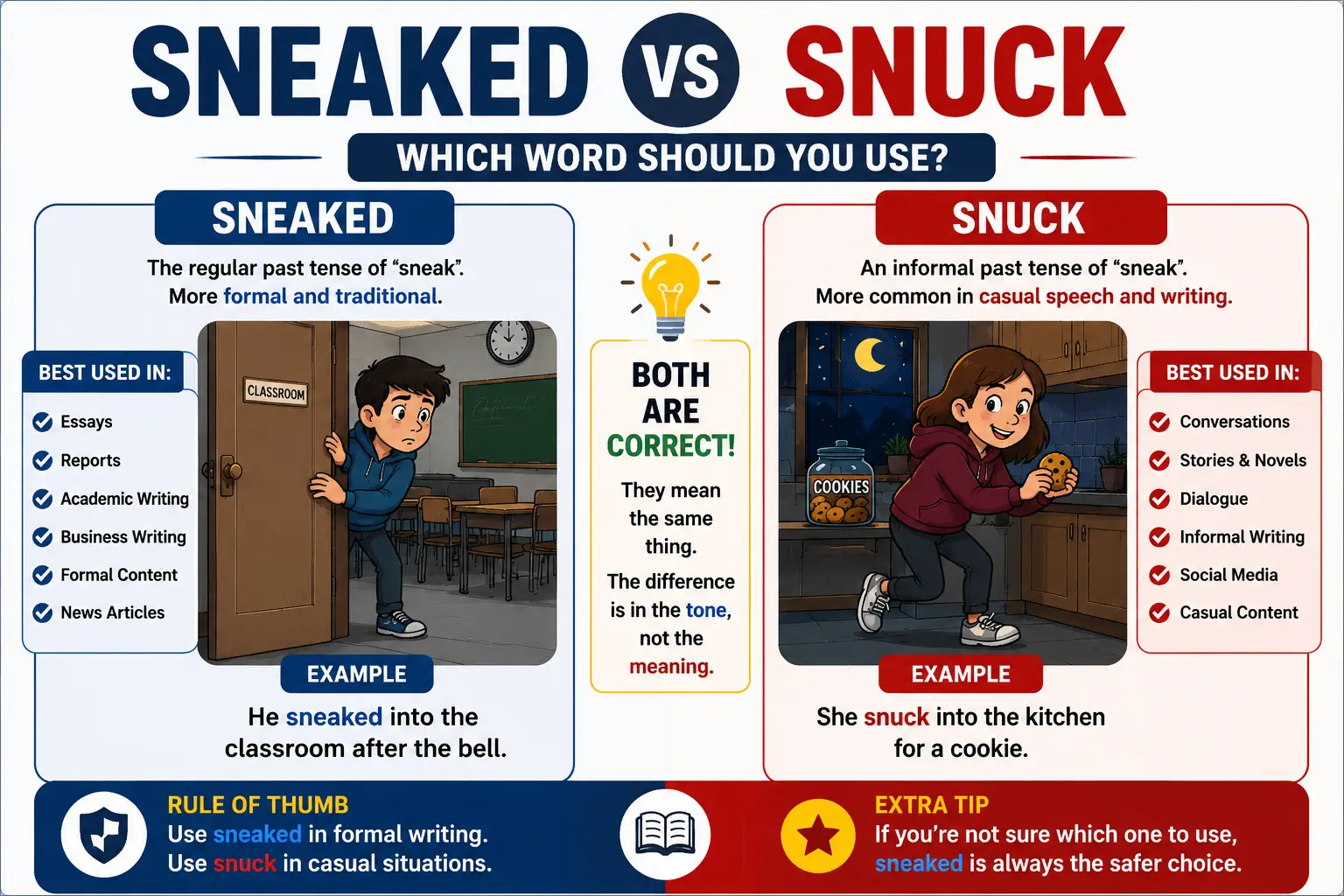
The sneaked vs snuck debate is a common English grammar question, but the difference is easier than it seems. Both sneaked and snuck are past-tense forms of the verb sneak, meaning to move or act quietly, often without being noticed. So, which one is correct? Both are acceptable, but they differ in usage, tone, and regional preference.
Sneaked is the regular past-tense form and remains a safe choice in formal or careful writing. You may see it more often in academic, professional, or edited English. Snuck, meanwhile, is an irregular past-tense form that is especially common in informal American English and everyday speech.
The choice usually comes down to style and context rather than meaning. If you want a more formal or traditional tone, sneaked is a reliable option. If you’re writing naturally or reflecting casual American speech, snuck sounds perfectly normal. In this guide, you’ll see clear examples of both forms and learn when to use each one.
Quick Answer: Sneaked or Snuck?
Both sneaked and snuck are past forms of the verb sneak.
The meaning is almost the same. The difference comes from style and formality.
| Word | Correct? | Best Use | Tone |
| Sneaked | Yes | Essays, reports, formal writing | Traditional and safe |
| Snuck | Yes | Speech, stories, dialogue | Casual and natural |
Use sneaked when you want the safest option.
Use snuck when you want your sentence to sound more conversational.
For example:
- Formal: She sneaked into the classroom.
- Casual: She snuck into the kitchen for cookies.
Both sentences work. Still, they feel different.
That difference matters more than most people think.
What Does “Sneak” Mean?
The verb sneak means to move, enter, leave, or do something quietly and secretly.
You usually sneak because you don’t want someone to notice you.
For example, a child may sneak downstairs at night. A cat may sneak under the couch. A student may sneak a look at the answer key.
The word can also describe something that happens quietly or unnoticed.
For example:
- A mistake can sneak into a report.
- Doubt can sneak into your mind.
- Extra costs can sneak into a budget.
- A small typo can sneak into an article.
So, sneak does not always mean physical movement. Sometimes, it describes a quiet change, hidden action, or unnoticed problem.
Common Uses of “Sneak”
| Phrase | Meaning | Example |
| Sneak in | Enter quietly or secretly | He tried to sneak in late. |
| Sneak out | Leave quietly or secretly | She wanted to sneak out early. |
| Sneak past | Pass without being noticed | The dog tried to sneak past the gate. |
| Sneak up on | Approach quietly | The cat likes to sneak up on birds. |
| Sneak a look | Look secretly or quickly | I tried to sneak a look at the gift. |
| Sneak into | Appear without notice | A typo can sneak into a draft. |
This meaning stays the same whether you use sneaked or snuck in the past tense.
What Is the Past Tense of Sneak?
The past tense of sneak can be sneaked or snuck.
That may sound odd because most verbs have one clear past form. For example:
- walk becomes walked
- jump becomes jumped
- talk becomes talked
So, by that regular pattern, sneak becomes sneaked.
However, English also has many irregular verbs. These verbs change their form in a less predictable way.
For example:
- stick becomes stuck
- strike becomes struck
- dig becomes dug
- sling becomes slung
That same sound pattern helped snuck become popular.
Read this also: Segway or Segue: Meaning, Difference, Examples, and Easy Usage Guide
Verb Forms of Sneak
| Form | Regular Version | Irregular Version |
| Base verb | sneak | sneak |
| Present tense | sneaks | sneaks |
| Past tense | sneaked | snuck |
| Past participle | sneaked | snuck |
| Present participle | sneaking | sneaking |
You can use both forms in simple past tense.
Examples:
- She sneaked into the room.
- She snuck into the room.
You can also use both forms as past participles.
Examples:
- She has sneaked into that room before.
- She has snuck into that room before.
Both sentences are understandable. Yet, one may sound better than the other, depending on the context.
What Does “Sneaked” Mean?
Sneaked is the regular past tense of sneak.
It means someone moved, entered, left, acted, or appeared quietly and secretly.
Because sneaked follows the normal -ed pattern, it sounds more traditional. It also feels more formal.
That makes it a smart choice for polished writing.
For example:
The student sneaked into the classroom after the lesson began.
This sentence sounds clear and formal. It would fit well in an essay, report, or edited article.
When to Use “Sneaked”
Use sneaked when your writing needs to sound careful, formal, or professional.
It works best in:
- School essays
- Academic writing
- Business emails
- Reports
- News-style articles
- Legal writing
- Professional website content
- Formal storytelling
- International English
If you’re unsure, choose sneaked. It is the safer option.
Examples of “Sneaked” in Sentences
- The cat sneaked under the table.
- He sneaked into the office before sunrise.
- She sneaked a glance at the final page.
- A spelling error sneaked into the article.
- The child sneaked out of bed.
- They sneaked past the guard.
- Doubt sneaked into his mind.
- Extra fees sneaked into the contract.
- The dog sneaked into the kitchen.
- A small mistake sneaked through the final review.
Notice something important. Sneaked works with people, animals, thoughts, errors, and hidden changes.
That makes it useful in many kinds of writing.
What Does “Snuck” Mean?
Snuck is another past tense and past participle form of sneak.
It means the same basic thing as sneaked. However, it sounds more informal.
People often use snuck in speech, stories, jokes, dialogue, and relaxed writing.
For example:
I snuck downstairs for cake after everyone went to bed.
That sentence sounds natural. It feels like real conversation.
Why “Snuck” Sounds Casual
Snuck sounds short and punchy. It has a quick rhythm.
That makes it useful in casual writing.
Compare these two sentences:
- He sneaked out before dinner.
- He snuck out before dinner.
Both are correct. Still, the second one sounds more like everyday speech.
That’s why many American English speakers prefer snuck in conversation.
Examples of “Snuck” in Sentences
- He snuck out before the speech ended.
- The dog snuck onto the couch again.
- She snuck a cookie from the jar.
- They snuck into the theater late.
- I snuck a look at the surprise gift.
- The kids snuck downstairs after midnight.
- We snuck away for lunch.
- A tiny smile snuck onto her face.
- My brother snuck into my room.
- The cat snuck behind the curtains.
These sentences sound relaxed. They also feel more personal.
That’s the strength of snuck.
Main Difference Between Sneaked and Snuck
The main difference is not meaning. The main difference is tone.
Both words describe a secret or quiet action. However, they do not carry the same feeling.
| Difference | Sneaked | Snuck |
| Meaning | Secret or quiet action | Secret or quiet action |
| Tone | Formal | Casual |
| Style | Traditional | Conversational |
| Best for | Essays and reports | Speech and stories |
| Risk level | Very safe | Sometimes too informal |
Think of it this way:
Sneaked sounds polished. Snuck sounds spoken.
That one line solves most of the confusion.
Is “Snuck” a Real Word?
Yes, snuck is a real word.
Some people still believe it is wrong. Usually, they learned that sneaked was the only proper form.
That advice is too strict for modern English.
Today, many speakers and writers use snuck, especially in American English. It appears often in conversation, fiction, movies, and casual writing.
However, that does not mean snuck belongs everywhere.
A word can be real and still feel too casual for a formal sentence.
For example:
- Casual: He snuck out early.
- Formal: He sneaked out before the meeting ended.
Both are correct. The formal sentence sounds more professional.
Why Some People Dislike “Snuck”
Some people avoid snuck because:
- It sounds informal.
- It does not follow the regular -ed pattern.
- They learned older grammar rules.
- They associate it with casual American speech.
- They prefer traditional usage.
Their concern is not always useless. In formal writing, reader expectations matter.
If your reader may dislike snuck, use sneaked. That choice avoids unnecessary friction.
Is “Sneeked” Correct?
No, sneeked is not correct.
The correct spelling is sneak, not sneek. So the correct regular past tense is sneaked.
The irregular past form is snuck.
Do not write:
- sneek
- sneeked
- snuk
- snucked
- sneakd
These forms are incorrect.
Incorrect vs Correct Forms
| Incorrect | Correct |
| sneek | sneak |
| sneeked | sneaked |
| snuk | snuck |
| snucked | snuck |
| sneakd | sneaked |
Correct Examples
- She sneaked into the room.
- She snuck into the room.
- He tried to sneak past the guard.
- They had snuck out quietly.
- A mistake sneaked into the report.
Incorrect Examples
- She sneeked into the room.
- He snucked out early.
- They snuk past the guard.
- I tried to sneek a look.
If you remember one rule here, remember this: sneeked is always wrong.
Sneaked or Snuck in Formal Writing
In formal writing, sneaked is usually the best choice.
Formal writing needs clarity. It also needs a tone that most readers accept without question.
That’s why sneaked works better in serious contexts.
Use sneaked in:
- School assignments
- College essays
- Research papers
- Business reports
- Legal documents
- News articles
- Professional emails
- Formal blog posts
Academic Writing
In school or college writing, choose sneaked.
Example:
The character sneaked into the garden to avoid the guards.
This sentence sounds formal and safe. It won’t distract your teacher or reader.
Now compare it with this:
The character snuck into the garden to avoid the guards.
The sentence still makes sense. However, some teachers may find snuck too casual.
In academic writing, don’t take that risk. Use sneaked.
Business Writing Business writing should sound clear and professional. It should not sound stiff, but it should avoid words that feel too casual.
Better:
A small error sneaked into the final proposal.
Less formal:
A small error snuck into the final proposal.
The second sentence may work in a friendly company email. Still, the first one sounds more polished.
Use sneaked when writing for clients, managers, editors, or formal readers.
Legal and Technical Writing
Legal and technical writing needs precision. It also needs a neutral tone.
Use sneaked in this kind of sentence:
An extra clause sneaked into the contract during revision.
Avoid snuck in legal or technical writing unless you have a strong style reason.
It may sound too casual for the setting.
Sneaked or Snuck in Casual Writing
In casual writing, snuck often sounds better.
It feels natural. It also gives the sentence a quick, human rhythm.
Use snuck in:
- Personal stories
- Text messages
- Social media captions
- Fiction dialogue
- Casual blog posts
- Humor writing
- Informal newsletters
Example:
I snuck downstairs at midnight for one slice of cake. Somehow, one slice became three.
That sentence sounds like a real person speaking.
Now compare it with this:
I sneaked downstairs at midnight for one slice of cake.
This version is still correct. However, it sounds less casual.
That difference is not about grammar. It is about voice.
Dialogue
Dialogue should sound like real speech.
Many characters, especially American characters, would naturally say snuck.
Example:
“I snuck out because I didn’t want Mom to ask questions,” he said.
This sounds believable.
However, sneaked can work if the character speaks more formally.
Example:
“I sneaked out because I had no other choice,” she said.
Both versions can work. Choose the word that fits the speaker.
Storytelling
Stories need rhythm. Snuck often adds energy.
Example:
We snuck into the backyard, hid behind the shed, and waited for the fireworks.
This sentence feels lively.
Sneaked would also work, but it would feel more formal.
American English Usage
In American English, snuck is very common in casual speech.
People often say:
- I snuck out early.
- She snuck into the kitchen.
- He snuck a peek.
- We snuck past the line.
- The dog snuck into the bedroom.
These sentences sound normal in everyday American English.
However, American formal writing still often favors sneaked.
That means you can use both words in American English. Just match the word to the setting.
American English Examples
| Situation | Better Choice | Example |
| Casual speech | snuck | I snuck out for coffee. |
| Formal report | sneaked | A minor error sneaked into the report. |
| Dialogue | snuck | “She snuck in late,” he said. |
| School essay | sneaked | The spy sneaked across the border. |
| Personal blog | snuck | My dog snuck onto the couch again. |
American English gives you room to use snuck. Still, room does not mean freedom from judgment.
Use it where it fits.
British English Usage
In British English, sneaked is usually the safer choice.
British speakers may use snuck, especially in casual speech. However, sneaked often sounds more standard in formal British writing.
If you write for a UK audience, choose sneaked when you want to sound polished.
British English Examples
| Context | Better Choice | Example |
| Formal writing | sneaked | The boy sneaked through the gate. |
| Casual speech | snuck | He snuck out before dinner. |
| School writing | sneaked | The prisoner sneaked past the guards. |
| Dialogue | snuck or sneaked | “I snuck in late,” she whispered. |
For international readers, sneaked is usually safer.
It works well across the United States, the United Kingdom, Canada, Australia, and other English-speaking regions.
Past Participle: Has Sneaked or Has Snuck?
Both sneaked and snuck can work as past participles.
A past participle often appears after helping verbs like has, have, and had.
Examples:
- She has sneaked out before.
- She has snuck out before.
- They had sneaked past the camera.
- They had snuck past the camera.
Again, the difference is tone.
Use sneaked when the sentence needs a formal style. Use snuck when the sentence sounds conversational.
Past Tense and Past Participle Table
| Sentence Type | Sneaked Example | Snuck Example |
| Simple past | She sneaked into the room. | She snuck into the room. |
| Present perfect | She has sneaked in before. | She has snuck in before. |
| Past perfect | He had sneaked past the guard. | He had snuck past the guard. |
| Casual speech | I sneaked out early. | I snuck out early. |
Both forms can fit. Still, sneaked feels safer when the writing is formal.
Read this also: Frances vs Francis: Meaning, Spelling, and Correct Use
Common Phrases With Sneaked and Snuck
Some phrases appear often with sneak. These phrases help you understand how the words work in real sentences.
Sneaked or Snuck Out
This means someone left quietly or secretly.
Formal:
He sneaked out of the meeting before the final vote.
Casual:
He snuck out of the party before anyone noticed.
Both sentences work. The first sounds polished. The second sounds conversational.
Sneaked or Snuck In
This means someone entered quietly or secretly.
Formal:
The student sneaked in after the lecture began.
Casual:
My brother snuck in through the back door.
Use sneaked in for formal writing. Use snuck in when the tone feels relaxed.
Sneaked or Snuck Past
This means someone passed someone or something without being noticed.
Formal:
The fox sneaked past the sleeping dog.
Casual:
The kids snuck past their parents and ran outside.
The choice depends on tone.
Sneaked or Snuck a Look
This means someone looked quickly or secretly.
Formal:
She sneaked a look at the confidential file.
Casual:
I snuck a look at my birthday gift.
This phrase sounds especially natural with snuck in casual speech.
Sneaked or Snuck Up On
This means someone approached quietly.
Formal:
The cat sneaked up on the bird.
Casual:
My little sister snuck up on me and yelled, “Boo!”
The casual version works well in funny or personal stories.
Common Mistakes to Avoid
The biggest mistake is not using snuck. The biggest mistake is using the wrong word in the wrong place.
A word can be correct and still sound wrong for the situation.
Don’t Think “Snuck” Is Always Wrong
Many people still believe snuck is incorrect.
That belief is outdated.
A better rule is:
Snuck is accepted, but it sounds informal.
So, don’t remove it automatically. First, check the tone.
Don’t Write “Sneeked”
This is always incorrect.
Incorrect:
He sneeked into the garage.
Correct:
He sneaked into the garage.
Also correct:
He snuck into the garage.
Don’t Write “Snucked”
Snucked is incorrect.
Because snuck is already a past form, you do not add -ed.
Incorrect:
She snucked out after dinner.
Correct:
She snuck out after dinner.
Don’t Switch Randomly
Do not jump between sneaked and snuck without a clear reason.
Weak:
He snuck into the room, then sneaked out through the window.
Better:
He snuck into the room, then snuck out through the window.
Also better:
He sneaked into the room, then sneaked out through the window.
Consistency helps your writing feel smooth.
Don’t Use “Snuck” in Very Formal Sentences
Sometimes snuck feels too casual.
Less polished:
A compliance issue snuck into the final audit document.
Better:
A compliance issue sneaked into the final audit document.
The second sentence sounds more professional.
Case Study: School Essay
Let’s test the words in a school sentence.
Sentence:
The character ___ into the garden to escape the guards.
Best choice:
The character sneaked into the garden to escape the guards.
Why?
A school essay needs a formal tone. Sneaked sounds safer and more academic. It also avoids debate.
Could you use snuck? Yes, but it may sound too casual for an essay.
Case Study: Text Message Now look at a casual message.
Sentence:
I ___ out early because the party was boring.
Best choice:
I snuck out early because the party was boring.
Why?
This sounds like normal speech. Snuck fits the casual tone.
Using sneaked would still be correct, but it may sound a little stiff.
Case Study: Business Email
Here is a professional example.
Sentence:
A small typo ___ into the client deck.
Best choice:
A small typo sneaked into the client deck.
Why?
A business email needs polish. Sneaked sounds more professional.
However, a casual brand might write:
A small typo snuck into yesterday’s deck, but we fixed it.
That sentence sounds friendly. It may work for a relaxed brand voice.
Case Study: Fiction Dialogue
Dialogue should sound like a real person.
Sentence:
“I ___ through the window,” she whispered.
Best choice:
“I snuck through the window,” she whispered.
Why?
Many people use snuck in everyday speech. It sounds natural in dialogue.
Still, you can use sneaked if the character speaks formally.
Case Study: News Writing
News writing needs a neutral tone.
Sentence:
The suspect ___ into the building through a side entrance.
Best choice:
The suspect sneaked into the building through a side entrance.
Why?
News-style writing usually sounds more formal. Sneaked fits that tone better.
How Tone Changes the Sentence
Tone changes how a sentence feels.
Look at these examples:
- The boy sneaked into the kitchen.
- The boy snuck into the kitchen.
Both sentences mean the same thing.
However, sneaked sounds more polished. Snuck sounds more casual.
Now compare these:
- A serious flaw sneaked into the report.
- A serious flaw snuck into the report.
The first sentence sounds professional. The second sounds more relaxed.
That’s why context matters.
Grammar is not only about correct words. It is also about the right word for the right moment.
When “Sneaked” Sounds Better
Use sneaked when your sentence needs a serious or polished tone.
It works well with:
- Formal subjects
- Serious topics
- Professional settings
- Academic analysis
- Abstract ideas
- International audiences
Strong Examples With “Sneaked”
- A serious error sneaked into the final version.
- Doubt sneaked into her thoughts.
- The thief sneaked through the alley.
- The student sneaked into class late.
- Extra fees sneaked into the contract.
- A strange silence sneaked into the room.
These sentences sound clean and mature.
When “Snuck” Sounds Better
Use snuck when your sentence needs a casual, quick, or spoken rhythm.
It works well with:
- Stories
- Dialogue
- Social media captions
- Personal essays
- Humorous examples
- American English speech
Strong Examples With “Snuck”
- I snuck downstairs for cake.
- The dog snuck onto the bed again.
- We snuck out before the awkward speeches started.
- She snuck a look at the surprise.
- My brother snuck into my room and stole my charger.
- The kids snuck outside after dinner.
These sentences sound natural. They also feel more alive.
Why English Has Both Forms
English allows both forms because language changes over time.
Sneaked follows the regular pattern. It adds -ed to the base verb.
That is simple and predictable.
Snuck follows a different pattern. It sounds like other irregular verbs, such as stuck and struck.
That sound likely helped it spread in speech.
English has many word pairs like this:
| Regular Form | Irregular Form |
| dreamed | dreamt |
| leaped | leapt |
| burned | burnt |
| dived | dove |
| pleaded | pled |
| sneaked | snuck |
These pairs often differ by region, tone, or formality.
That’s why English can feel messy. Still, the mess has patterns.
Best Choice for Online Writing
If you write online content, your goal is simple. You want readers to understand the answer fast.
For grammar content, explain both forms. Don’t pretend snuck is wrong.
Readers want the real answer, not an old grammar myth.
Best Practice for Bloggers
Use this approach:
- Put the direct answer near the top.
- Use sneaked as the safer formal choice.
- Use snuck as the casual choice.
- Add examples for both words.
- Mention American and British usage.
- Include common mistakes.
- Add a quiz or FAQ section.
This structure helps readers. It also supports SEO because it answers related search questions.
Read this also: Too Many or To Many: Correct Usage, Grammar Rules, and Examples
Mini Style Guide
Here is a quick style guide for choosing the right word.
| Writing Type | Better Choice | Reason |
| School essay | sneaked | More formal |
| College paper | sneaked | Safer academic tone |
| Business report | sneaked | More professional |
| Legal writing | sneaked | Less casual |
| News article | sneaked | Neutral tone |
| Fiction narration | sneaked or snuck | Depends on voice |
| Fiction dialogue | snuck | Sounds natural |
| Text message | snuck | Casual and quick |
| Personal blog | snuck or sneaked | Depends on style |
| Social media caption | snuck | Conversational |
If you feel unsure, use sneaked.
If the sentence sounds stiff, try snuck.
More Examples of “Sneaked”
Here are more formal examples.
- The editor noticed that a repeated phrase had sneaked into the article.
- The boy sneaked into the hallway after the lights went out.
- A strange silence sneaked into the conversation.
- She sneaked past the gate without waking the dog.
- The issue sneaked into the final report.
- He sneaked a look at the confidential letter.
- They sneaked across the field before sunrise.
- The cat sneaked behind the curtain.
- A feeling of fear sneaked into the room.
- Extra charges sneaked into the final invoice.
These examples work well in formal or polished writing.
More Examples of “Snuck”
Here are more casual examples.
- I snuck out for coffee before anyone noticed.
- The puppy snuck under the blanket.
- She snuck a fry from my plate.
- We snuck into the room late.
- He snuck a peek at the surprise party.
- My sister snuck my hoodie from the laundry basket.
- The kids snuck downstairs to watch TV.
- A tiny smile snuck onto his face.
- The dog snuck into the bedroom again.
- I snuck one last cookie before dinner.
These examples sound like real conversation.
Same Meaning, Different Feeling
Sometimes, the best way to understand the difference is to compare sentence pairs.
| Formal | Casual |
| She sneaked out after dinner. | She snuck out after dinner. |
| He sneaked past the guard. | He snuck past the guard. |
| I sneaked a look at the notes. | I snuck a look at the notes. |
| The dog sneaked into the room. | The dog snuck into the room. |
| Doubt sneaked into her mind. | Doubt snuck into her mind. |
Read the pairs out loud.
You’ll notice that sneaked sounds more careful. Snuck sounds more relaxed.
Quick Memory Trick
Use this simple rule:
Sneaked is safe. Snuck is spoken.
Here is another easy trick:
Sneaked wears dress shoes. Snuck wears sneakers.
That may sound silly, but it works.
When your writing needs polish, choose sneaked. When your writing can sound relaxed, snuck is fine.
Practice Quiz
Choose the better word for each sentence.
| Sentence | Better Choice |
| The child ___ into the kitchen for candy. | snuck |
| A new clause ___ into the contract. | sneaked |
| I’ve ___ a look at the last page. | snuck |
| The soldier ___ past the camp. | sneaked |
| A spelling error ___ into the final article. | sneaked |
| My dog ___ onto the couch again. | snuck |
| The student ___ into class after the bell. | sneaked |
| We ___ out before the party got awkward. | snuck |
Quiz Answers Explained
The child snuck into the kitchen for candy.
This sentence sounds casual and playful.
I’ve snuck a look at the last page.
This sentence sounds conversational.
The soldier sneaked past the camp.
This sentence has a serious tone.
A spelling error sneaked into the final article.
This sentence works better with a polished word.
My dog snuck onto the couch again.
This sounds like everyday speech.
The student sneaked into class after the bell.
This sounds better in a school context.
We snuck out before the party got awkward.
This sounds natural and casual.
FAQs About Sneaked and Snuck
Yes, snuck is grammatically correct in modern English. It works as the past tense and past participle of sneak. However, it sounds more informal than sneaked.
No, sneaked is not always more correct. Still, it is often safer in formal writing. Use it for essays, reports, and professional content.
Use sneaked in school writing. It sounds more formal, and teachers are less likely to mark it as too casual.
Yes, snuck is especially common in American English. People use it often in speech, casual writing, and dialogue.
No, sneeked is not a correct word. The correct words are sneaked and snuck.
You can use snuck in casual business writing, but sneaked is usually better. It sounds more professional.
The past participle can be sneaked or snuck. For example, you can write “has sneaked” or “has snuck.”
Both can work in fiction. Use snuck in casual dialogue. Use sneaked if the narration sounds formal or literary.
Final Answer: Which One Should You Use?
Sneaked or Snuck both describe the past tense of the verb sneak, but they fit different tones. Sneaked is the proper past tense in formal writing, so it is the safer word choice for school, business, essays, reports, and careful grammar.
Snuck is also correct, especially in casual American English. Many people use it when describing sneaky events, quick actions, or relaxed stories. It sounds natural in speech, while sneaked feels more polished. That small difference matters because readers judge tone fast.
The best grammatical choice depends on context, audience, and purpose. Use sneaked when you want an always acceptable and formal style. Use snuck when you prefer a casual, spoken tone. Both are acceptable, but correct usage means choosing the right word for your reader, not just the word that sounds familiar in everyday conversation or friendly personal writing.