
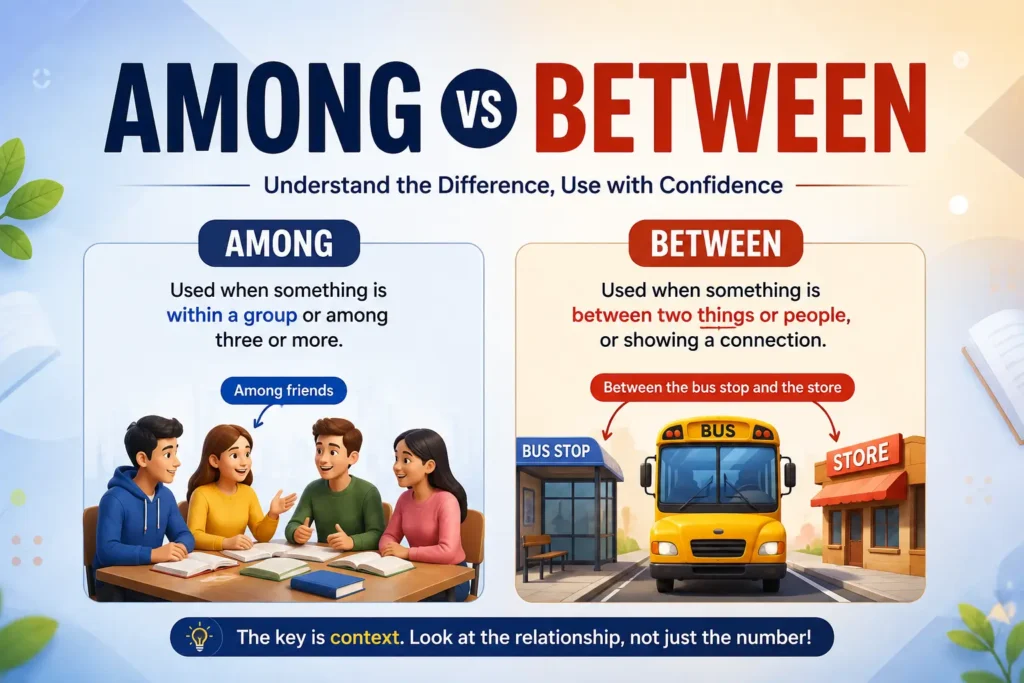
Among vs. between can be confusing because both words describe relationships involving people, things, places, and ideas. The key is simple: between usually highlights separate or clearly identified relationships, while among usually places someone or something within a group. Both words are prepositions, but they don’t always work in the same situations.
The old rule that says “between is for two and among is for three or more” is too simple. Between can correctly refer to three or more people or things when the relationship is considered separately. For example, you can talk about negotiations between three countries. By contrast, among often emphasizes a group as a whole, such as “She felt comfortable among her classmates.
The easiest way to choose is to look at the meaning and context. If you’re talking about distinct connections, choices, or boundaries, between is often the better choice. If you’re describing something surrounded by, included in, or distributed within a group, among usually fits better.
Quick Answer: Among vs. Between
Here is the simplest way to remember the difference:
| Word | Main idea | Example |
|---|---|---|
| Between | A relationship among separate, identifiable people or things | The agreement was between the three companies. |
| Among | Something within, surrounded by, or distributed through a group | She was sitting among her classmates. |
So, don’t choose based only on the number of people or things. Instead, ask what the sentence emphasizes.
Between commonly expresses:
- A relationship
- A comparison
- A choice
- A connection
- A boundary
- A position separating things
- A time or number range
Among commonly expresses:
- Being within a group
- Being surrounded by others
- Group membership
- Distribution within a group
- A shared feeling or condition
- Something included in a larger set
Cambridge Dictionary similarly distinguishes between for clearly separated things from among for things viewed as part of a group or crowd.
Read this also: He Is Risen vs He Has Risen
What Does “Between” Mean?
Between is a preposition that can describe something in the space, time, or relationship that separates or connects distinct people or things.
For example:
The café is between the bank and the library.
The café has a position relative to two clearly identified places.
You can also use between for relationships:
There is a strong connection between exercise and better sleep.
Here, the sentence connects two ideas.
The word also appears with choices:
I can’t decide between the red dress and the blue dress.
In this sentence, the speaker is considering separate options.
Common Uses of “Between”
1. Relationships
Use between when you want to show a relationship involving distinct people or things.
- The conversation between the teacher and student was helpful.
- There is a difference between these two products.
- The relationship between the companies has improved.
- A dispute developed between the neighbors.
Common nouns that frequently appear with between include relationship, difference, connection, distinction, link, and choice.
2. Choices and Comparisons
Between works naturally when you choose or compare separate options.
She had to choose between two job offers.
However, the options don’t have to number only two:
She had to choose between three universities.
This is correct because the universities are treated as separate choices.
3. Physical Position
Use between when something sits in a position separating two or more clearly identified things.
The pharmacy is between the grocery store and the bank.
A small table sits between the two chairs.
You can also use it for several distinct locations:
The road runs between the three villages.
The important point is not simply the number. The sentence presents the villages as separate locations.
4. Time and Numbers
Between is also used for ranges of time and numbers.
The meeting is between 2 p.m. and 4 p.m.
The temperature stayed between 60 and 70 degrees.
She lived there between 2018 and 2022.
You don’t normally replace between with among in these constructions.
What Does “Among” Mean?
Among usually means in or surrounded by a group, in the company of others, or included within a larger group.
For example:
She felt relaxed among friends.
The sentence focuses on her being within a group of friends.
Consider another example:
The cabin was hidden among the trees.
The cabin was surrounded by trees. The trees aren’t being treated as separate locations in a direct relationship with the cabin.
Common Uses of “Among”
1. Being Part of a Group
Use among when someone or something is part of a group.
He was popular among his classmates.
The issue caused concern among employees.
She found several familiar faces among the crowd.
The focus is on the larger group rather than separate one-to-one relationships.
2. Being Surrounded by Things
Among can describe something surrounded by many similar things.
The house stood among tall trees.
I found my keys among the papers.
A small flower grew among the rocks.
Here, among gives the sense of being inside or surrounded by a collection.
3. Distribution Within a Group
Use among when something gets distributed throughout a group.
The teacher divided the worksheets among the students.
The prize money was shared among the winners.
The emphasis is on the group receiving or sharing something.
4. Shared Feelings or Opinions
Among can also describe a feeling, opinion, or condition shared within a group.
There was excitement among the fans.
The decision caused concern among employees.
The new policy created disagreement among the members.
The focus is on the group experiencing the same general condition.
The Real Difference Between Among and Between
The most useful distinction is individual relationships versus group relationships.
Between often treats people or things as separate points in a relationship.
Among often treats them collectively as a group.
Compare these sentences:
The negotiations were between the three countries.
There was disagreement among the three countries.
Both sentences can be grammatical. However, the emphasis changes.
In the first sentence, the countries are treated as separate participants in negotiations. In the second, the disagreement exists within the group of countries.
Merriam-Webster notes that between can refer to more than two items, especially when it expresses individual or one-to-one relationships. It also explains that among is more suitable when the emphasis falls on distribution or a group relationship.
Can You Use “Between” With Three or More?
Yes. This is one of the most important points to understand.
The traditional rule says:
Between = two
Among = three or more
That shortcut can help beginners, but it doesn’t describe modern English accurately.
You can use between with three or more people or things when you consider them as distinct participants.
Correct examples
- The agreement was between the three companies.
- The competition between the four teams was intense.
- The road runs between the three towns.
- There was a clear difference between the five models.
- The negotiations between the countries continued.
Merriam-Webster describes the two-item-only rule as an unfounded notion and gives examples of between used with more than two items. (Merriam-Webster)
Why does this work?
Imagine three companies negotiating a contract.
You aren’t treating them as one large group. Instead, you’re considering their separate relationships within the negotiation.
Therefore:
negotiations between three companies
works naturally.
By contrast:
concern among three companies
focuses more on a shared condition within the group.
When to Use “Between” or “Among”
When you’re unsure, look at what the sentence emphasizes.
| Situation | Better choice | Example |
|---|---|---|
| Separate relationships | Between | The relationship between the departments improved. |
| A group as a whole | Among | The announcement caused excitement among employees. |
| A clear choice | Between | Choose between these three options. |
| Something surrounded by others | Among | The cabin sits among the trees. |
| A time range | Between | Call me between 9 and 11. |
| Distribution within a group | Among | The teacher shared the books among the students. |
| A difference or connection | Between | What’s the difference between the two words? |
| A feeling within a group | Among | There was concern among parents. |
This table gives you a practical shortcut, but context still matters.
Examples That Make the Difference Clear
Sometimes the easiest way to learn among vs. between is to compare similar sentences.
Example 1: Students
The teacher divided the class between two groups.
Here, the sentence identifies two separate groups.
The teacher distributed the worksheets among the students.
Here, the worksheets are distributed throughout a group.
Example 2: Companies
The contract was negotiated between the three companies.
The companies are separate parties.
The new policy caused confusion among the three companies.
The confusion exists within the group.
Example 3: Friends
The secret stayed between Maria, James, and Alex.
The three people are treated as individual participants in the relationship.
Maria felt comfortable among her friends.
The focus is on the group surrounding her.
Example 4: Places
The village lies between the mountains and the river.
The mountains and river are separate landmarks.
The cabin is hidden among the mountains.
The cabin is surrounded by or situated within the mountain area.
Common Mistakes With Among and Between
Mistake 1: Thinking “between” always means two
Incorrect idea:
“There are three companies, so between must be wrong.”
That’s not true.
Correct:
The agreement was between the three companies.
The companies are separate participants.
Mistake 2: Using “among” whenever there are three or more
The number alone doesn’t determine the answer.
Less natural:
She had to choose among three colleges.
More natural when the colleges are separate choices:
She had to choose between three colleges.
Both words can occur in real English, but between clearly fits a set of distinct choices here.
Mistake 3: Using “among” for time ranges
Don’t say:
We met among 3 and 5 p.m.
Use:
We met between 3 and 5 p.m.
Between is the standard choice for this kind of range.
Mistake 4: Confusing “between” with “among” in group situations
Compare:
There was a disagreement between the two managers.
There was disagreement among the managers.
The first emphasizes the relationship between two specific people. The second treats the managers as a group.
A Simple Test for Choosing the Right Word
When you’re stuck, ask yourself three questions.
1. Am I connecting separate people or things?
If yes, between will often work.
The difference between the two plans is small.
2. Am I talking about something within a group?
If yes, among will often work.
The new rule caused concern among workers.
3. Am I describing a time or number range?
Use between.
The price is between $50 and $75.
This test won’t solve every unusual sentence, but it works well for everyday American English.
Among vs. Between in Everyday American English
You’ll encounter between and among in many common situations.
At school
The discussion between the students continued after class.
There was excitement among the students before the game.
At work
The manager had a meeting between the sales and marketing teams.
The announcement caused concern among employees.
In conversation
Keep this between you and me.
I felt comfortable among old friends.
In writing
There is a difference between these two approaches.
The survey found strong support among younger voters.
These examples show why context matters more than simply counting nouns.
“Between You and Me,” Not “Between You and I”
There’s another common grammar issue involving between.
In standard edited English, say:
Between you and me, I think the plan needs work.
Not:
Between you and I, I think the plan needs work.
Why? Between is a preposition, so the pronouns that follow it normally take the objective form. That gives us me, not I. Merriam-Webster notes that “between you and I” remains common in speech but is generally avoided in edited prose.
Other correct examples include:
- between him and me
- between her and us
- between them and me
- between you and me
This point is separate from the main difference between among and between, but it’s useful because learners often encounter the phrase.
Among vs. Amongst
Amongst is a variant of among. Merriam-Webster describes it as less common than among.
For modern American English, among is usually the safer and more natural choice.
Compare:
She was sitting among her friends.
She was sitting amongst her friends.
Both can be understood, but among is more common in everyday US English.
If you’re writing a school assignment, business email, website, or general American English content, among is usually the better default.
Common Collocations With “Between”
A collocation is a combination of words that English speakers commonly use together.
Some common combinations with between include:
- difference between
- relationship between
- connection between
- link between
- distinction between
- choice between
- divide between
- choose between
- decide between
- agreement between
- communication between
- conflict between
Examples
What’s the difference between these products?
We need better communication between departments.
She couldn’t decide between the two options.
These combinations are especially common in academic, professional, and everyday English.
Common Collocations With “Among”
Common combinations with among include:
- popular among
- common among
- concern among
- disagreement among
- discussion among
- support among
- excitement among
- divide among
- shared among
- distributed among
- hidden among
- found among
Examples
The app is popular among college students.
There was concern among parents.
The prize was divided among the winners.
The cabin was hidden among the trees.
These uses reflect the main idea of among: something exists within, surrounds, includes, or is distributed through a group.
Read this also: Eventhough vs Even Though
Among vs. Between: A Quick Memory Trick
Don’t memorize:
“Two means between; three means among.”
That rule is too limited.
Instead, remember:
Between = separate relationships.
Among = within a group.
For example:
Between
The choice between three colleges was difficult.
Think: three separate options.
Among
She searched among the books.
Think: one collection of books.
This memory trick is more reliable because it focuses on meaning rather than arithmetic.
Among vs. Between: Practice
Choose between or among in each sentence.
- The discussion ___ the three managers lasted an hour.
- The child disappeared ___ the crowd.
- I had to choose ___ four apartments.
- There was excitement ___ the fans.
- The store is ___ the bank and the post office.
- The teacher divided the prizes ___ the students.
- What’s the difference ___ these two plans?
- The house is hidden ___ the trees.
- The negotiations ___ the four companies continued.
- The new rule created confusion ___ employees.
Answer Key
- between
- among
- between
- among
- between
- among
- between
- among
- between
- among
The key is to look beyond the number. In sentences 1, 3, and 9, the people or things are treated as distinct participants. In the other examples, the sentence focuses on a group or something within it.
Related Words: Amid and In Between
Two related expressions can sometimes cause confusion.
Amid
Amid means “in the middle of” or “surrounded by.” It is often similar to among.
The house stood amid the trees.
The announcement came amid growing concern.
However, amid often has a more formal or literary tone.
In Between
In between means in an intermediate position or space.
The pharmacy is in between the bank and the restaurant.
There were several houses in between.
Merriam-Webster defines in between as meaning “between” and also uses it to describe something intermediate.
FAQs About Among vs. Between
1. What is the main difference between among and between?
Between usually focuses on separate or clearly identified relationships. Among usually focuses on something within or surrounded by a group.
2. Is between only used for two people or things?
No. Between can refer to three or more people or things when they are treated as separate participants.
3. Is among always used for three or more?
No. The number alone isn’t the deciding factor. Among usually emphasizes a group, while between can emphasize individual relationships.
4. Can I say “between the three”?
Yes. For example:
The agreement was between the three companies.
This is correct when the companies are treated as separate parties.
5. Can I say “among the three”?
Yes. For example:
There was disagreement among the three members.
Here, the members are viewed collectively as a group.
6. Should I use between or among for three choices?
Between is often appropriate when the choices are separate and clearly identified.
I had to choose between three colleges.
7. Should I say “divide between” or “divide among”?
Both can be correct.
The money was divided between the two brothers.
The money was divided among the five children.
The first focuses on separate recipients, while the second emphasizes distribution throughout a group.
8. Is “between you and me” correct?
Yes. Between you and me is the standard form in edited English. Because between is a preposition, use the object pronoun me, not I.
9. Is among or between more common in American English?
Both are standard American English words. Neither is automatically better. The correct choice depends on the relationship and meaning in the sentence.
10. What is the easiest way to remember among vs. between?
Remember:
Between usually highlights separate relationships, choices, or boundaries. Among usually highlights something within or surrounded by a group.
Conclusion
Understanding among vs. between becomes much easier when you focus on meaning, not just the number of people or things. Between usually highlights separate relationships, choices, connections, boundaries, or clearly identified participants. Among usually shows that someone or something is within, surrounded by, included in, or distributed through a group.
The old “two versus three” rule can help at first, but it isn’t a complete grammar rule. You can use between with three or more clearly identified people or things, while among works naturally when the sentence treats people or things as a group.
When you’re unsure, look at the context. Ask whether you’re connecting separate things or describing something within a group. That simple habit will help you make better word choices, write clearer sentences, and use American English more naturally.
