
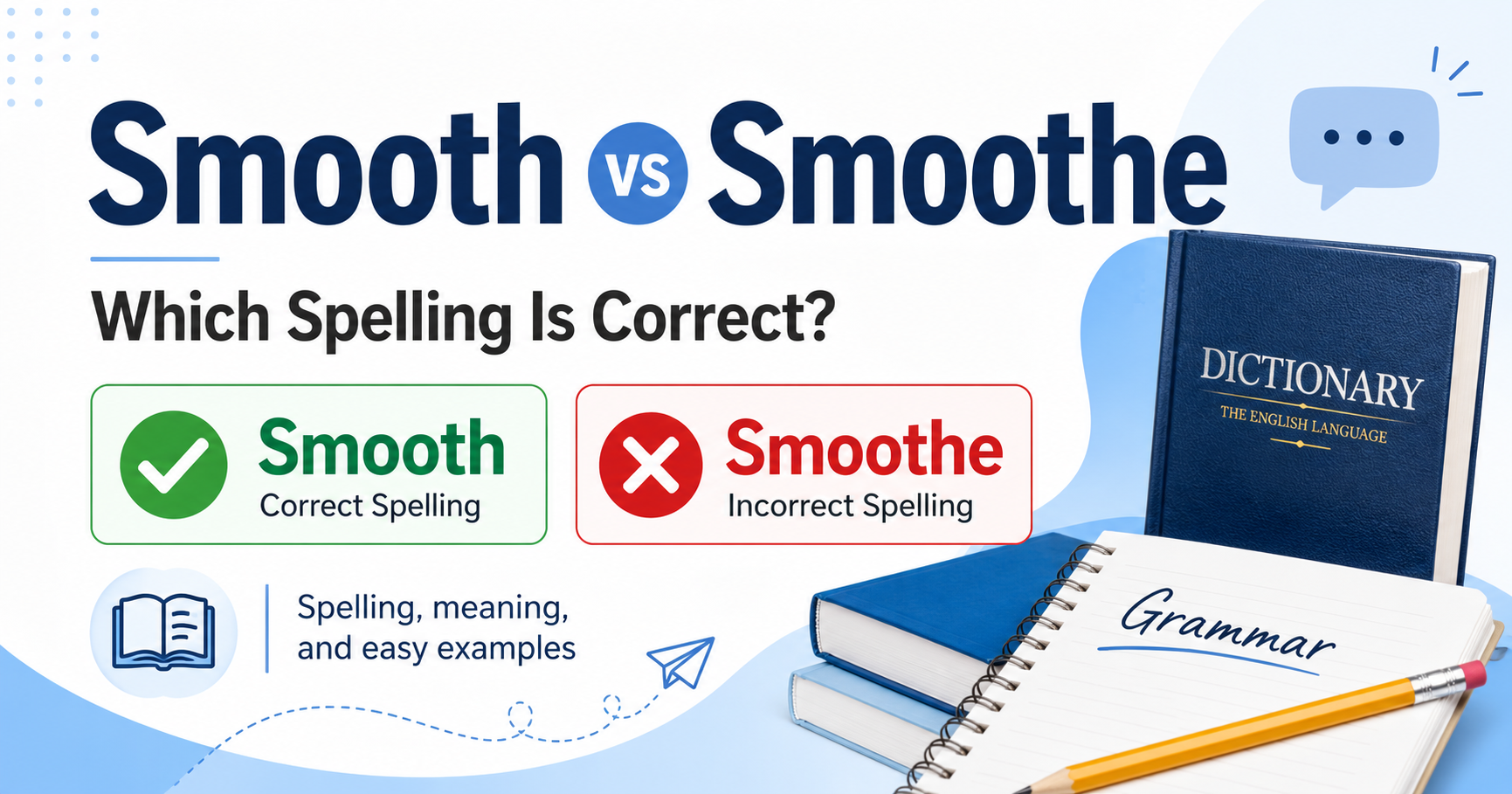
When you compare smooth vs smoothe, the safest answer is simple: smooth is the correct word, the correct spelling, and the correct form in modern English. At first glance, these two words may look almost identical because they share the same root, have a similar sound, show word resemblance, and carry related ideas. Still, that small letter, the extra letter, or the extra e changes how many readers judge the sentence. In real writing, whether it’s an important email, school assignment, academic writing, professional writing, informal writing, digital writing, online writing, or social media writing, the better spelling choice is smooth, not smoothe.
The real word difference comes from word function, word form, word usage, and word meaning. Smooth works as a standard word in written English, while smoothe is usually treated as a nonstandard word, wrong form, wrong spelling, or incorrect usage. Some confusion, grammar confusion, usage confusion, and sometimes a full spelling debate.
From my experience with English grammar, practical grammar, and SEO-style grammar guide writing, this is one of those common mistakes that looks small but affects clarity, reader understanding, polished writing, polished communication, writing accuracy, and writing confidence. Even spell-checkers may not always catch the spelling error, so writers, students, professionals, English learners, beginner English users, ESL learners, English speakers, native speakers, and native English speakers need a clear grammar lesson.
Smooth or Smoothe: Quick Answer
Use smooth almost every time.
Smooth is the standard spelling. It works as an adjective and as a verb. Smoothe appears as a rare spelling in some places, but most modern readers see it as a mistake.
Here’s the simple rule:
When you’re unsure, use “smooth.” It is the clean, standard, and trusted spelling.
Read this also: TMO Meaning in Text: What Does TMO Mean?
| Word | Is It Standard? | Main Use | Example | Best Choice |
| Smooth | Yes | Adjective and verb | The surface is smooth. | Yes |
| Smoothe | Rare or nonstandard | Sometimes used as a variant | Please smoothe the fabric. | No |
| Smooths | Yes | Verb form | She smooths the cream onto her skin. | Yes |
| Smoothes | Accepted, but less common | Verb form | This cream smoothes dry skin. | Sometimes |
| Smoothen | Real, but less common | Verb | The cream may smoothen rough skin. | Sometimes |
For most writing, choose smooth. It looks natural, reads clearly, and avoids confusion.
What Does Smooth Mean?
Smooth means even, soft, flat, flowing, calm, or free from roughness.
The meaning changes slightly with context. Still, the main idea stays the same. Something smooth has no rough spots, sharp breaks, awkward bumps, or harsh movement.
A table can feel smooth.
A singer can have a smooth voice.
A project can have a smooth launch.
A person can give a smooth answer.
In each case, smooth suggests ease, flow, or polish.
Smooth as an Adjective
Most people use smooth as an adjective. An adjective describes a person, place, thing, or idea.
For example:
- smooth skin
- smooth glass
- smooth writing
- smooth jazz
- smooth ride
- smooth meeting
- smooth transition
In these phrases, smooth tells you what something is like.
Smooth for Physical Texture
The most basic meaning of smooth relates to touch. If something has no roughness, bumps, cracks, or lumps, it feels smooth.
Examples:
- The marble counter felt smooth.
- The silk scarf had a smooth texture.
- The soup became smooth after blending.
- The wall felt smooth after sanding.
- The lotion left her skin feeling smooth.
This use appears often in beauty, food, fashion, furniture, and home improvement writing.
For example, a skincare product may promise a smooth finish. A recipe may tell you to blend a sauce until smooth. A furniture description may mention a smooth wood surface.
In each case, the word helps the reader imagine the feel.
Smooth for Easy Movement
Smooth can also describe movement. If something moves without shaking, stopping, or feeling rough, it moves smoothly.
Examples:
- The car gave us a smooth ride.
- The elevator made a smooth stop.
- Her dance moves looked smooth.
- The video had smooth camera motion.
- The website had smooth scrolling.
This meaning matters in technology and design. When people say an app has a smooth experience, they mean it works without lag, confusion, or annoying steps.
A smooth system feels easy. It does not fight the user.
Smooth for a Calm Process
You can also use smooth for plans, meetings, systems, and events.
Examples:
- The launch was smooth.
- The checkout process felt smooth.
- The meeting had a smooth flow.
- The team made a smooth transition.
- The event started with a smooth opening.
However, don’t use smooth as empty praise. Add detail when you can.
Weak sentence:
- The process was smooth.
Better sentence:
- The checkout process was smooth because it used clear buttons, fewer steps, and fast payment loading.
The second sentence gives proof. That makes the writing more useful.
Smooth for Sound, Taste, and Style
People also use smooth for things they hear, taste, or enjoy.
Examples:
- The singer has a smooth voice.
- The coffee tasted smooth and mild.
- The chocolate had a smooth finish.
- The music had a smooth jazz feel.
- The article had a smooth writing style.
Here, smooth suggests comfort. Nothing feels harsh, bitter, broken, or hard to follow.
Still, be specific when possible.
Instead of writing:
- The coffee is smooth.
Try:
- The coffee tastes smooth, with low bitterness and a soft cocoa finish.
That extra detail helps the reader.
Smooth for Social Charm
A person can also be smooth. This means they speak or act with charm, confidence, and control.
Examples:
- He gave a smooth answer.
- She handled the question with a smooth smile.
- The host gave a smooth introduction.
- He is a smooth talker.
Be careful with this meaning. A smooth speaker may sound confident. A smooth talker, however, may sound too clever or even dishonest.
Context decides the tone.
For example:
- Positive: She gave a smooth, confident answer during the interview.
- Negative: He sounded like a smooth talker who avoided the real issue.
So, use this meaning with care.
Smooth as a Verb
Smooth also works as a verb.
As a verb, smooth means to make something even, softer, calmer, easier, or less rough.
Examples:
- Smooth the frosting with a spatula.
- Smooth the paper before you fold it.
- Smooth the wall before painting.
- Smooth the fabric with your hand.
- Smooth the cream across your skin.
The key point is simple: smooth stays the same as the base verb.
You do not need to add e.
Correct:
- Please smooth the surface.
Incorrect or weak:
- Please smoothe the surface.
Smooth a Physical Surface
When you smooth a surface, you make it flatter or more even.
This use appears in many practical topics, such as:
- cooking
- sewing
- painting
- skincare
- woodworking
- construction
- home repair
Examples:
- Smooth the dough before baking.
- Smooth the icing over the cake.
- Smooth the wall with sandpaper.
- Smooth the fabric before cutting it.
- Smooth the clay with wet fingers.
This meaning is easy to remember. If your hand, tool, brush, or machine removes roughness, the verb is smooth.
Smooth Out Problems
The phrase smooth out means to fix small problems or remove rough spots.
It can refer to real surfaces. More often, it refers to plans, writing, systems, and relationships.
Examples:
- We need to smooth out the schedule.
- The team smoothed out the final issues.
- The editor smoothed out the weak paragraph.
- The update smoothed out several app bugs.
- A short call can smooth out the confusion.
This phrase sounds practical. It does not create drama. It simply says something needs improvement.
| Phrase | Meaning | Example |
| Smooth the surface | Make a physical thing even | Smooth the wall before painting. |
| Smooth out the problem | Fix a rough issue | We smoothed out the payment error. |
| Smooth out the writing | Improve flow | The editor smoothed out the paragraph. |
| Smooth out the plan | Make details clearer | Let’s smooth out the timeline. |
Smooth Over a Conflict
The phrase smooth over means to reduce tension or make a problem seem less serious.
Examples:
- She tried to smooth over the argument.
- His apology helped smooth over the mistake.
- The manager smoothed over the awkward moment.
- They tried to smooth over the disagreement before the meeting.
This phrase can be positive or negative.
Sometimes, it means someone handled a tense moment well. However, it can also mean someone tried to hide a real problem.
Compare these sentences:
| Sentence | Meaning |
| The apology smoothed over the awkward moment. | The apology helped people move on. |
| The company smoothed over the complaint. | The company may have avoided the real issue. |
| The manager smoothed over the misunderstanding. | The manager reduced tension. |
If someone truly fixed the issue, use a stronger verb.
Better options include:
- resolved
- corrected
- addressed
- clarified
- repaired
For example:
- The manager resolved the conflict.
- The company addressed the complaint.
- The team corrected the mistake.
Use smooth over only when the idea is about reducing tension.
What Does Smoothe Mean?
Smoothe is the confusing spelling. It looks like it should work, but it usually does not.
In modern writing, most people treat smoothe as a spelling mistake. Some references may list it as a rare form, but that does not make it a good everyday choice.
Most readers expect smooth.
If they see smoothe, they may think:
- typo
- weak editing
- brand name
- old spelling
- nonstandard English
That reaction matters. Good writing should not make readers stop for the wrong reason.
Is Smoothe a Real Word?
This question needs a careful answer.
Smoothe may appear as a rare variant in some references. Still, it is not the standard spelling most people use today.
That means you should avoid it in:
- school essays
- blog posts
- business emails
- resumes
- product pages
- ad copy
- academic writing
- professional documents
A rare spelling can exist and still be a bad writing choice.
That is the real point.
Your reader does not care that a rare spelling appears somewhere. Your reader cares whether your sentence looks clear, natural, and trustworthy.
So, use smooth.
Why People Confuse Smooth and Smoothe
The confusion is understandable. English spelling is messy. Some words follow patterns. Others break them without warning.
Here are the main reasons people add the extra e.
Words Like Breathe, Bathe, and Clothe
Many English verbs end with a silent e.
Examples:
- breathe
- bathe
- clothe
- soothe
- wreathe
Because of these words, some writers think smooth should become smoothe when used as a verb.
That guess feels logical. However, it is not standard.
Correct:
- I will smooth the surface.
- She smooths the blanket.
- He smoothed the edge.
- They are smoothing the wall.
Avoid:
- I will smoothe the surface.
- She smoothes the blanket.
- They will smoothe the wall.
The first group sounds cleaner and more natural.
The Extra E Looks “More Correct”
Sometimes, writers add e because smoothe looks more formal. It may also look softer or more elegant.
That is why some brands may use it in product names.
For example, a beauty brand might write:
- Smoothe Skin Serum
- Smoothe Touch Cream
- Smoothe Finish Lotion
A brand can use creative spelling. Normal grammar does not work that way.
Brand names can bend rules. Your article, essay, or email should not.
Smoothe Looks Like Soothe
The word soothe also creates confusion.
Soothe means to calm, comfort, or reduce pain.
Examples:
- The music soothed the baby.
- The cream helped soothe the burn.
- Her kind words soothed his nerves.
Smooth means even, flowing, easy, or to make something less rough.
Examples:
- The surface is smooth.
- Smooth the cream across your skin.
- The update helped smooth the process.
Here is the difference:
| Word | Meaning | Example |
| Smooth | Even, easy, or to make even | Smooth the surface. |
| Soothe | Calm, comfort, or relieve | Soothe the pain. |
| Smoothe | Rare or nonstandard spelling | Avoid in normal writing. |
If you mean calm or comfort, use soothe.
If you mean even, easy, or flowing, use smooth.
Spell Check Can Miss the Problem
Spell check helps, but it is not perfect.
Sometimes, it may not flag rare words. Sometimes, it accepts brand names. Also, it cannot always understand style or reader expectations.
So, don’t trust spell check blindly.
Ask yourself:
- Would this spelling look normal in a school essay?
- Would an editor keep it?
- Would my reader pause?
- Is there a simpler standard spelling?
For this word, the safer answer is always smooth.
Smooth vs Smooths vs Smoothes vs Smoothe
These forms look similar, but they do not work the same way.
| Form | What It Is | Example | Best Advice |
| Smooth | Standard adjective and base verb | The road is smooth. Smooth the wall. | Use it confidently. |
| Smooths | Standard verb form | She smooths the fabric. | Best modern choice. |
| Smoothes | Accepted verb form, but less common | This cream smoothes dry skin. | Use carefully. |
| Smoothe | Rare or nonstandard spelling | Please smoothe the edge. | Avoid it. |
The safest pattern is:
- I smooth
- you smooth
- he or she smooths
- we smooth
- they smooth
- I smoothed
- I am smoothing
This pattern works in nearly every normal sentence.
Smooth vs Smoothen vs Smoothe
Smoothen is another word that causes confusion.
Unlike smoothe, smoothen is a real word. It means “to make smooth.” However, it is less common than smooth, especially in everyday American English.
| Word | Status | Meaning | Example | Best Use |
| Smooth | Standard and common | Make even or easy | Smooth the surface. | Best default |
| Smoothen | Real, but less common | Make smooth | This cream may smoothen rough skin. | Use rarely |
| Smoothe | Rare or nonstandard | Variant spelling | Avoid it. | Avoid |
Most of the time, smooth sounds better.
Natural:
- This conditioner helps smooth frizzy hair.
- The tool smooths rough edges.
- The new update smooths the user experience.
Less natural:
- This conditioner helps smoothen frizzy hair.
- The tool smoothens rough edges.
- The new update smoothens the user experience.
Smoothen is not always wrong. It just sounds heavier.
Smooth vs Sleek
Smooth and sleek can look similar in meaning, but they are different.
Smooth focuses on texture, flow, or ease.
Sleek focuses on style, shine, and modern design.
| Word | Main Idea | Best For | Example |
| Smooth | Even, easy, soft, or flowing | Texture, process, movement | The app has smooth navigation. |
| Sleek | Stylish, glossy, modern | Design, fashion, vehicles | The app has a sleek interface. |
Examples:
- A smooth table feels even.
- A sleek table looks stylish.
- A smooth ride feels comfortable.
- A sleek car looks fast and modern.
Use smooth for feel or function.
Use sleek for appearance and style.
Smooth vs Polished
Smooth and polished can also overlap.
Smooth means something flows well or has no roughness.
Polished means something feels finished, refined, and professional.
| Word | Main Idea | Example |
| Smooth | Easy, even, or flowing | The speech had a smooth flow. |
| Polished | Finished and refined | The speech sounded polished. |
A draft becomes smoother when you fix weak transitions.
A draft becomes polished when you improve grammar, word choice, structure, and tone.
Here is the easy rule:
Smooth removes friction. Polished adds shine.
Smooth vs Soft
Smooth and soft can describe similar things, but they do not mean the same thing.
Smooth means even and not rough.
Soft means gentle, flexible, cushioned, or not hard.
| Word | Meaning | Example |
| Smooth | No rough spots | smooth glass |
| Soft | Not hard or harsh | soft cotton |
| Both | Pleasant to touch | soft, smooth skin |
Examples:
- Glass can be smooth but not soft.
- A pillow can be soft but not smooth.
- Skin can feel both soft and smooth.
- Bread can be soft inside but rough on the crust.
Use smooth for surface quality.
Use soft for comfort or pressure.
Correct Examples of Smooth
Here are clear examples of smooth in different contexts.
Texture
- The stone felt smooth after polishing.
- The fabric had a smooth finish.
- Blend the mixture until smooth.
- The lotion made her skin feel smooth.
- The sanded wood became smooth to the touch.
Movement
- The car gave us a smooth ride.
- The elevator made a smooth stop.
- The dancer’s movement looked smooth.
- The camera followed the subject with smooth motion.
- The animation looked smooth on screen.
Process
- The checkout process felt smooth.
- The team made a smooth transition.
- The meeting had a smooth flow.
- The launch was smooth because the team tested each step.
- The new system created a smooth customer experience.
Verb Use
- Smooth the frosting before adding toppings.
- Smooth the paper before folding it.
- The editor smoothed the paragraph.
- The update smooths the checkout process.
- We smoothed out the final issues before publishing.
Common Mistakes With Smooth or Smoothe
Writers usually make these mistakes because the wrong spelling looks believable. Still, the fix is simple.
Using Smoothe as an Adjective
Incorrect:
- The silk feels smoothe.
- The road is smoothe.
- The cream has a smoothe texture.
Correct:
- The silk feels smooth.
- The road is smooth.
- The cream has a smooth texture.
As an adjective, always use smooth.
Using Smoothe as the Main Verb
Incorrect:
- Please smoothe the fabric.
- The update will smoothe the process.
- She tried to smoothe over the conflict.
Correct:
- Please smooth the fabric.
- The update will smooth the process.
- She tried to smooth over the conflict.
Again, smooth already works as a verb.
Confusing Smooth With Smoothly
Smooth can be an adjective or a verb.
Smoothly is an adverb. It describes how something happens.
| Sentence | Correct? | Reason |
| The meeting was smooth. | Yes | Smooth describes the meeting. |
| The meeting went smoothly. | Yes | Smoothly describes how it went. |
| The meeting went smooth. | Weak | Use smoothly after “went.” |
| She gave a smooth answer. | Yes | Smooth describes the answer. |
| She answered smoothly. | Yes | Smoothly describes how she answered. |
Use smoothly with verbs like:
- went
- ran
- moved
- worked
- performed
- continued
Examples:
- The event ran smoothly.
- The plan worked smoothly.
- The machine moved smoothly.
- The conversation continued smoothly.
Overusing Smooth in Your Writing
Smooth is useful, but don’t repeat it too much.
Weak sentence:
- The smooth design creates a smooth experience with a smooth checkout process.
Better sentence:
- The clean design helps users find products, review their cart, and check out without confusion.
The better sentence explains the benefit.
Here are stronger alternatives:
| Context | Better Options |
| Design | sleek, clean, refined, streamlined |
| Writing | clear, flowing, polished, readable |
| Process | simple, efficient, frictionless, well-organized |
| Texture | even, soft, flat, polished |
| Sound | mellow, warm, fluid, gentle |
| Movement | steady, graceful, controlled, fluid |
| Behavior | charming, confident, tactful, diplomatic |
Use smooth when it fits. But when a clearer word exists, use that instead.
How to Remember Smooth or Smoothe

You do not need a complex grammar rule. You need a simple memory shortcut.
Use Smooth for the Standard Word
If you are choosing between smooth and smoothe, choose smooth.
It works for:
- descriptions
- actions
- surfaces
- sounds
- movement
- writing
- processes
- conflict
- product copy
Examples:
- smooth skin
- smooth the wall
- smooth voice
- smooth ride
- smooth out the issue
- smooth over the mistake
One spelling covers all of these uses.
Don’t Add E to Make It a Verb
This is the biggest trap.
Writers often think smooth is only an adjective. Then they add e to make it look like a verb.
That is not needed.
Correct:
- I will smooth the surface.
- She will smooth her hair.
- They will smooth out the plan.
Incorrect:
- I will smoothe the surface.
- She will smoothe her hair.
- They will smoothe out the plan.
The word smooth already does the job.
Use Smoothly for “How” Something Happens
If you mean “in a smooth way,” use smoothly.
Examples:
- The meeting went smoothly.
- The car runs smoothly.
- The software performs smoothly.
- The event ended smoothly.
But if you describe a noun, use smooth.
Examples:
- It was a smooth meeting.
- The car gave a smooth ride.
- The software offers a smooth experience.
- The event had a smooth ending.
Here is a quick guide:
| Question | Use This Word |
| What kind of thing is it? | smooth |
| What action should someone do? | smooth |
| How did it happen? | smoothly |
| Is it the rare spelling? | smoothe, but avoid it |
Real-Life Examples of Smooth in Writing
Grammar becomes easier when you see real situations. Here are examples from common writing tasks.
Academic Writing
Weak:
- The author creates a smoothe transition between ideas.
Better:
- The author creates a smooth transition between ideas.
Stronger:
- The author creates a smooth transition by connecting the first argument to the second with clear evidence.
The stronger sentence explains how the transition works.
Business Emails
Weak:
- Let’s smoothe out the remaining details before Friday.
Better:
- Let’s smooth out the remaining details before Friday.
Stronger:
- Let’s smooth out the pricing, delivery timeline, and approval steps before Friday.
The stronger version gives clear action points.
Product Descriptions
Weak:
- This lotion helps smoothe dry skin.
Better:
- This lotion helps smooth dry skin.
Stronger:
- This lotion helps dry skin feel smoother, softer, and more comfortable after daily use.
That version sounds more natural. It also avoids awkward spelling.
Read this also: SU Meaning in Text: What Does SU Mean in Texting and Social Media?
Home Improvement Writing
Weak:
- Smoothe the wall before adding primer.
Better:
- Smooth the wall before adding primer.
Stronger:
- Smooth the wall with fine-grit sandpaper before adding primer, so the paint sits evenly.
The stronger sentence explains the reason behind the step.
Website and UX Writing
Weak:
- The app has a smoothe checkout.
Better:
- The app has a smooth checkout.
Stronger:
- The app has a smooth checkout with fewer fields, clear buttons, and fast payment loading.
Specific details help the reader understand the benefit.
Case Study: Product Page Copy
A skincare brand writes this line:
“Our daily cream helps smoothe rough skin and improve texture.”
The meaning is clear, but the spelling looks weak. A customer may still understand it. However, the mistake can make the brand look careless.
A better version would be:
“Our daily cream helps smooth rough-feeling skin and leaves it looking softer, fresher, and more comfortable.”
This version works better because it:
- uses the standard spelling
- sounds more natural
- avoids overclaiming
- focuses on the customer’s experience
- builds more trust
That small spelling fix improves the whole sentence.
Case Study: Student Essay
A student writes:
“The writer uses a smoothe style to connect personal memories with historical facts.”
The idea makes sense. Still, the spelling distracts the reader.
Better version:
“The writer uses a smooth style to connect personal memories with historical facts.”
Stronger version:
“The writer uses a smooth style by moving from personal memories into historical facts without breaking the emotional tone.”
The stronger version does more than fix spelling. It also explains the point.
Case Study: Workplace Message
A manager writes:
“We need to smoothe over the issue with the client.”
This sentence has two problems.
First, smoothe looks wrong.
Second, smooth over may sound like the team wants to hide the issue.
Better version:
“We need to address the client’s concern and smooth out the next steps.”
This sounds more honest. It also tells the team what to do.
Why Correct Spelling Matters
Some people say spelling does not matter if the reader understands the meaning.
That sounds nice. It is also lazy.
Spelling shapes trust. Readers notice small errors. A single mistake may not ruin your message, but it can weaken your credibility.
Reader Trust
Readers want to feel safe with your writing. When they see smoothe, they may pause.
That pause breaks the flow.
It also creates doubt:
“Did the writer check this?”
That is not the question you want in the reader’s mind.
Academic Credibility
In school or college writing, standard spelling matters. Teachers expect clean language because it shows care.
A spelling mistake can make a strong idea look weaker.
Correct word choice helps your writing feel more reliable.
Business Professionalism
In business, small details matter.
This includes:
- emails
- resumes
- proposals
- product pages
- landing pages
- reports
- ad copy
- sales decks
A spelling mistake may not destroy a deal. However, it can chip away at trust.
Professional writing should feel clean, clear, and checked.
SEO and Content Quality
Search engines can understand many misspellings. Readers still matter more.
If your article teaches spelling, the writing must be accurate. Otherwise, the trust gap becomes obvious.
A strong grammar article should:
- answer the question early
- use the focus keyword naturally
- explain the difference clearly
- show correct examples
- include useful tables
- avoid keyword stuffing
- use short paragraphs
- add helpful FAQs
- keep headings clear
That structure helps both readers and search engines.
Final Verdict on Smooth vs Smoothe
Use smooth.
It is the standard spelling. It works as an adjective and as a verb.
Use smooth for:
- smooth skin
- smooth glass
- smooth writing
- smooth movement
- smooth checkout
- smooth transition
- smooth the fabric
- smooth out problems
- smooth over tension
Avoid smoothe unless you are quoting a brand name, title, or unusual source.
Here is the final rule:
If you are writing for school, work, clients, customers, or a public audience, choose “smooth.”
That one choice keeps your writing clear and professional.
FAQs About Smooth or Smoothe
The correct standard spelling is smooth. Use smooth as an adjective and as a verb.
Examples:
The surface is smooth.
Please smooth the surface.
Smoothe appears rarely as a variant spelling, but most modern readers see it as nonstandard. Use smooth in normal writing.
No. You should avoid smoothe in academic writing. Use smooth instead.
Yes. Smooth can be a verb. It means to make something even, softer, calmer, easier, or less rough.
Examples:
Smooth the wall before painting.
Smooth the frosting with a spatula.
Smooth out the final details.
Yes. Smooths is correct.
Examples:
She smooths the blanket.
This brush smooths the paint.
The update smooths the checkout process.
Smoothes can work as a verb form, but smooths often sounds cleaner and more modern.
Better:
This product smooths dry skin.
Less clean:
This product smoothes dry skin.
Yes, smoothen is a real word. However, it is less common than smooth.
Better:
This cream helps smooth rough skin.
Less common:
This cream helps smoothen rough skin.
Smooth out means to fix rough parts, remove small problems, or make something work better.
Examples:
We need to smooth out the schedule.
The editor smoothed out the paragraph.
The update smoothed out several bugs.
Smooth over means to reduce tension or make a problem seem less serious.
Examples:
His apology helped smooth over the conflict.
She tried to smooth over the awkward moment.
The manager smoothed over the misunderstanding.
People write smoothe because words like breathe, bathe, clothe, and soothe end with e. The pattern looks tempting, but smooth does not need an extra e.
Conclusion
When comparing Smooth vs Smoothe, the safest choice is smooth. It is the correct spelling, correct word, and standard word in modern English. At first glance, smoothe may look right because it has a similar sound and word resemblance to smooth, but the extra e often creates a spelling error.
In real writing, this mistake can hurt clarity, reader understanding, and polished communication. Whether you’re writing an important email, school assignment, academic writing, professional writing, online writing, or social media writing, use smooth for clear and correct English.
The confusion usually comes from similar words like breathe and bathe. These words create a false spelling pattern, so many English learners, students, and even native speakers make this common spelling mistake in everyday usage. For better communication skills, remember this simple grammar lesson: smooth is correct; smoothe is usually the wrong spelling.
4 thoughts on “Smooth vs Smoothe: Correct Spelling, Meaning, and Easy Examples”