
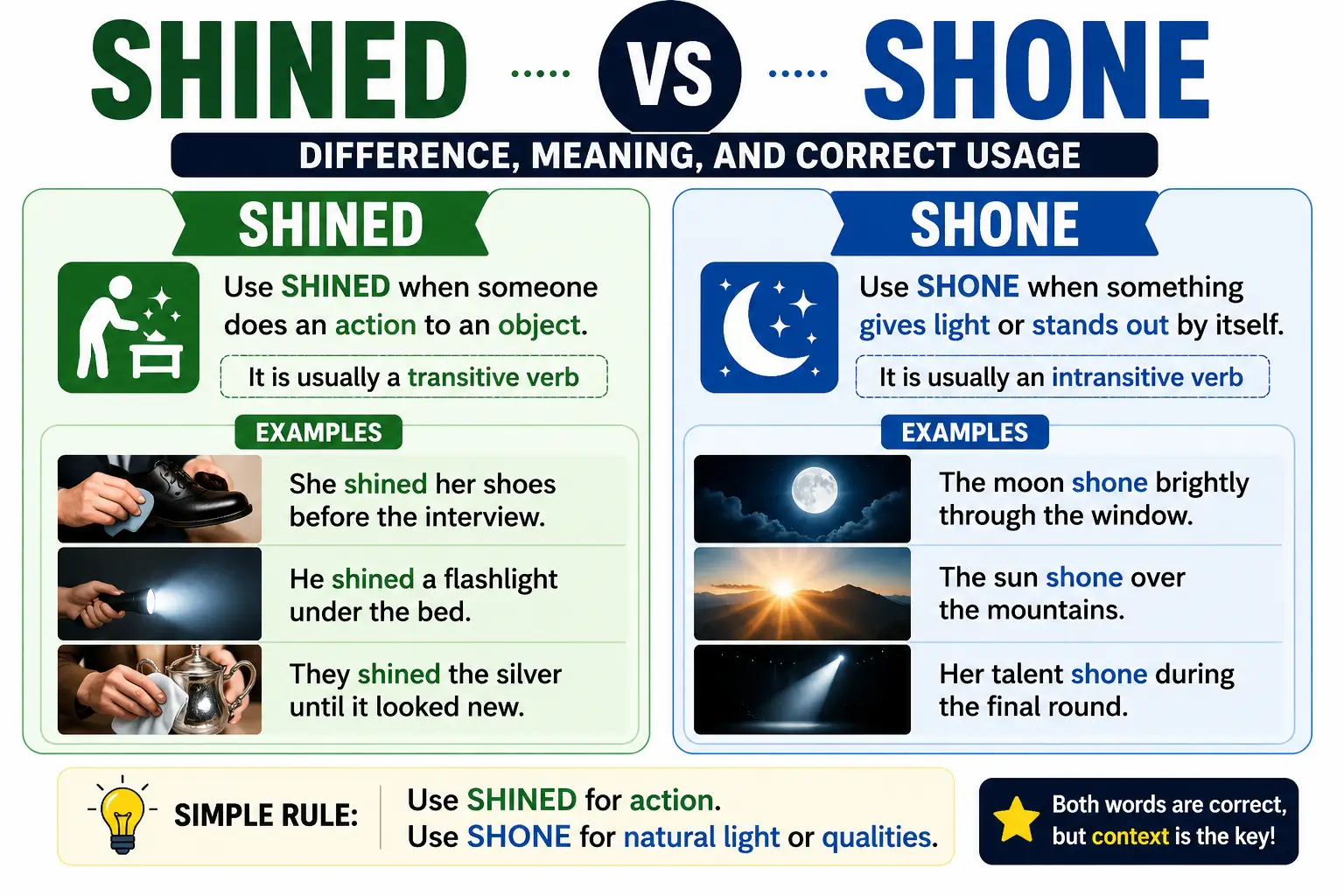
Shined vs. shone is a common English grammar question that can confuse language learners and even native speakers. Both forms come from the verb shine, but they are generally used differently depending on how the verb works in a sentence.
Shined is usually used when someone directs light onto an object. In grammar, this is called transitive use because the verb has a direct object. For example, “He shined his flashlight into the room.” Here, his flashlight is the object receiving the action.
Shone is commonly used when something gives off or reflects light without a direct object. This is called intransitive use. For example, “The moon shone brightly.” The moon produces or reflects light on its own, so there is no direct object.
A simple rule can help: use shined when someone shines something; use shone when something shines by itself.However, English usage can vary by region and context. Both forms are correct in the right sentence. Understanding whether shine has a direct object makes choosing between shined and shone much easier.
Quick Answer: Shined or Shone?
Use shined when someone does something to an object.
Use shone when something gives light or stands out by itself.
Here is the fastest rule:
Shined usually means someone did the action.
Shone usually means something gave off light or became clear.
Read this also: FYI Meaning in Text: What Does FYI Mean in Texting?
Quick Examples
| Sentence | Correct Word | Reason |
| She ___ her shoes. | shined | She polished them. |
| The moon ___ through the window. | shone | The moon gave light. |
| He ___ a flashlight under the bed. | shined | He aimed the light. |
| Her talent ___ during the final round. | shone | Her talent stood out. |
| The wet road ___ after the rain. | shone | The road reflected light. |
So, if someone controls the action, choose shined.
If something glows, appears bright, or becomes visible, choose shone.
What Does “Shine” Mean?
The verb shine has more than one meaning. That is why its past tense confuses people.
At its simplest, shine means to give off light.
For example:
- The sun shines in the morning.
- The stars shine at night.
- The lamp shines over the desk.
However, shine can also mean to polish something.
For example:
- He shines his boots.
- She shines the silver spoons.
- The cleaner shines the marble floor.
It can also mean to aim light at something.
For example:
- The guard shines a flashlight.
- I shine my phone light under the couch.
- The mechanic shines a lamp into the engine.
Finally, shine can mean to perform well or stand out.
For example:
- She shines on stage.
- His confidence shines in interviews.
- The team shines under pressure.
As you can see, one verb does several jobs. Therefore, the past tense depends on the job the verb performs.
Basic Verb Forms of Shine
The verb shine has two common past tense forms: shined and shone.
Both are real words. Both can be correct. Still, they don’t always sound natural in the same sentence.
| Verb Form | Word | Example |
| Base form | shine | The stars shine at night. |
| Present tense | shines | The lamp shines brightly. |
| Past tense | shined / shone | She shined her shoes. / The moon shone. |
| Past participle | shined / shone | The shoes had been shined. / The light had shone for hours. |
This is where many writers freeze.
They wonder, “Which one is correct?”
The better question is, “Which one fits the meaning?”
That question gives you a clearer answer.
Why Does Shine Have Two Past Tense Forms?
English has regular verbs and irregular verbs.
Regular verbs usually add -ed in the past tense.
For example:
- walk → walked
- clean → cleaned
- polish → polished
- shine → shined
Irregular verbs change in a different way.
For example:
- write → wrote
- sing → sang
- drive → drove
- shine → shone
So, shined follows the regular pattern. Shone follows the irregular pattern.
Over time, English speakers began using each form in different ways. Shined became common for polishing and directing light. Shone stayed common for natural light and figurative brightness.
Think of them like two tools in the same toolbox.
They belong to the same family. However, each one handles a different job better.
The Main Difference Between Shined and Shone
The main difference is simple.
Shined often works best when someone acts on something.
Shone often works best when something gives light or stands out by itself.
Look at these examples:
- She shined her shoes.
- The stars shone above the field.
In the first sentence, someone does an action to an object. She polishes her shoes.
In the second sentence, the stars simply give light. Nobody acts on them.
That difference matters.
Easy Rule
| Meaning | Best Choice | Example |
| Someone polished something | shined | He shined his boots. |
| Someone aimed light | shined | She shined a flashlight. |
| The sun gave light | shone | The sun shone all day. |
| The moon gave light | shone | The moon shone through the trees. |
| A talent stood out | shone | His talent shone on stage. |
This rule will help you in most cases.
What Is a Transitive Verb?
A transitive verb has a direct object.
That sounds technical, but the idea is easy.
A direct object receives the action.
For example:
- She opened the door.
- He washed the car.
- They painted the wall.
- I shined the lamp.
In each sentence, someone does something to something.
| Subject | Verb | Direct Object |
| She | opened | the door |
| He | washed | the car |
| They | painted | the wall |
| I | shined | the lamp |
Now ask a simple question:
What received the action?
She opened what? The door.
He washed what? The car.
I shined what? The lamp.
When shine works this way, shined usually sounds best.
Examples with Shined as a Transitive Verb
- She shined the mirror before guests arrived.
- He shined his shoes for the interview.
- The cleaner shined the lobby floor.
- I shined my flashlight into the shed.
- The jeweler shined the ring until it looked new.
Each sentence has an object.
That object receives the action. Therefore, shined is the natural choice.
Read this also: YK Meaning in Text: What Does YK Mean in Texting?
What Is an Intransitive Verb?
An intransitive verb does not need a direct object.
The action stays with the subject.
For example:
- The baby slept.
- The flowers bloomed.
- The dog barked.
- The stars shone.
You don’t ask, “The stars shone what?”
That question doesn’t work. The stars simply gave light.
This is where shone often fits best.
Examples with Shone as an Intransitive Verb
- The sun shone over the hills.
- The moon shone through the curtains.
- The stars shone in the dark sky.
- Her eyes shone with joy.
- His courage shone during the crisis.
Nothing receives the action in these sentences.
The subject gives light, shows emotion, or stands out. As a result, shone feels natural.
A Simple Test You Can Use
Here is a quick test.
Ask: Can I put “what?” after the verb?
If yes, use shined.
If no, use shone.
Test Examples
| Sentence | Question | Better Word |
| She ___ her shoes. | Shined what? Her shoes. | shined |
| The sun ___ brightly. | Shined what? No object. | shone |
| He ___ a flashlight. | Shined what? A flashlight. | shined |
| Her confidence ___ during the speech. | Shined what? No object. | shone |
| The silver cup ___ on the shelf. | Shined what? No object. | shone |
This test is not perfect for every rare sentence. However, it works well for everyday writing.
When to Use Shined
Use shined when a person, tool, or device actively does something.
Most often, shined works in three cases:
- Polishing something
- Directing light
- Performing well, especially in American English
Let’s look at each one.
Use Shined for Polishing
When someone polishes something, use shined.
This is the clearest rule.
Correct examples:
- He shined his shoes before the wedding.
- She shined the silver spoons.
- The worker shined the marble counter.
- I shined the old trophy.
- The doorman shined the brass rail.
Avoid these versions:
- He shone his shoes.
- She shone the silver spoons.
Those sentences sound wrong to most readers because shone usually means gave off light. It does not usually mean polished.
Why Shined Works Here
Polishing is an action.
Someone uses effort. Someone touches the object. Someone makes it bright.
That hands-on action calls for shined.
Use Shined for Pointing or Directing Light
Use shined when someone points light at something.
Examples:
- The officer shined a light into the car.
- She shined the flashlight down the hallway.
- I shined my phone light behind the couch.
- The mechanic shined a lamp under the hood.
- He shined the beam toward the gate.
In each sentence, someone controls the light.
The person aims it. The person moves it. The person uses it.
That active meaning makes shined the better choice.
Use Shined for Strong Performance
In American English, shined often means someone performed well.
Examples:
- The rookie shined in his first game.
- She shined during the interview.
- He shined in the final round.
- The singer shined on opening night.
- The team shined under pressure.
This use sounds direct and modern.
It works well in sports writing, business writing, reviews, and casual articles.
However, shone can also work in this meaning.
For example:
- The rookie shone in his first game.
- Her leadership shone during the crisis.
Both sentences work. Still, the tone changes.
Shined sounds energetic and casual.
Shone sounds more polished and literary.
When to Use Shone
Use shone when something gives light, reflects light, or stands out naturally.
This form often sounds smoother in polished writing.
It works especially well with:
- the sun
- the moon
- stars
- candles
- lamps
- eyes
- jewelry
- talent
- courage
- kindness
- truth
Use Shone for Natural Light
When you write about the sun, moon, or stars, shone usually sounds best.
Examples:
- The sun shone over the valley.
- The moon shone through the window.
- The stars shone above the desert.
- Morning light shone across the kitchen.
- The lighthouse shone through the fog.
You may hear “the sun shined” in American speech. It can appear in casual writing too.
However, the sun shone sounds better in formal writing.
If you want the safer choice, use shone for natural light.
Use Shone for Reflected Light
Use shone when something looks bright because light hits it.
Examples:
- The glass shone in the sunlight.
- Her ring shone under the chandelier.
- The wet road shone after the rain.
- His badge shone on his jacket.
- The lake shone like silver at sunset.
The object is not being polished in these sentences.
It simply looks bright. Therefore, shone fits better.
Compare These Two Sentences
| Sentence | Meaning |
| He shined the badge before the ceremony. | He polished it. |
| The badge shone during the ceremony. | It looked bright. |
The first sentence shows action.
The second sentence shows appearance.
That is the key difference.
Use Shone for Emotion and Character
Writers often use shone when an inner quality becomes clear.
Examples:
- Her kindness shone through her words.
- His courage shone during the rescue.
- Their honesty shone in a difficult moment.
- Her joy shone on her face.
- His patience shone during the meeting.
This use feels warm and natural.
It suggests that a quality became visible without being forced.
For example, kindness does not need a spotlight. It shows itself through action.
That is why shone works so well.
Use Shone for Talent and Excellence
Use shone when someone’s talent, skill, or brilliance stands out.
Examples:
- She shone in the final act.
- His talent shone from the first note.
- The young designer shone at the fashion show.
- Her intelligence shone in every answer.
- The team’s discipline shone in the second half.
This form sounds polished.
It fits essays, storytelling, biographies, and professional articles.
Shined and Shone Side-by-Side
Here is a quick comparison table.
| Use Case | Better Word | Example |
| Polishing shoes | shined | He shined his shoes. |
| Polishing silver | shined | She shined the silver. |
| Aiming a flashlight | shined | He shined a flashlight. |
| Sun giving light | shone | The sun shone. |
| Moon giving light | shone | The moon shone. |
| Stars giving light | shone | The stars shone. |
| Talent becoming clear | shone | Her talent shone. |
| Emotion showing | shone | His joy shone. |
| Sports performance | shined or shone | He shined in the game. / He shone in the game. |
This table gives you the practical answer fast.
Is It “Shined a Light” or “Shone a Light”?
In American English, shined a light is usually the better choice.
Examples:
- The detective shined a light into the basement.
- The nurse shined a light in his eyes.
- The guard shined a light across the yard.
- The teacher shined a light on a common mistake.
- The report shined a light on poor safety rules.
This phrase can work literally or figuratively.
Literal Meaning
A person points real light somewhere.
Example:
- The officer shined a light through the window.
Figurative Meaning
A person explains, reveals, or exposes something.
Example:
- The article shined a light on hidden fees.
In both cases, someone directs attention.
That is why shined works well.
Is It “Shined Through” or “Shone Through”?
Shone through usually sounds better.
This phrase often describes light, emotion, truth, or character becoming visible.
Examples:
- Sunlight shone through the curtains.
- Her kindness shone through in every conversation.
- His nervousness shone through despite his smile.
- The truth shone through after the evidence appeared.
- A little hope shone through the sadness.
Why does this work?
Because the subject becomes visible by itself. Nobody forces it.
Light passes through. Emotion appears. Truth becomes clear.
That natural feeling makes shone through the smoother choice.
When “Shined Through” Can Work
“Shined through” can work when someone directs actual light.
Example:
- The flashlight shined through the tent wall.
Still, for emotion, truth, and natural light, choose shone through.
American English vs British English
American and British English both use shined and shone.
However, they use them a little differently.
American English uses shined more often. British English prefers shone more strongly for natural light and figurative meaning.
American English
In American English, these sentences sound normal:
- She shined her shoes.
- He shined a flashlight.
- The rookie shined in the game.
- The sun shone all morning.
- Her talent shone during the show.
American writers often use shined for active actions.
They may also use it for performance.
British English
British English usually prefers shone for natural light and qualities.
Examples:
- The sun shone all afternoon.
- The moon shone over the garden.
- Her talent shone at once.
- His courage shone through.
British English still uses shined for polishing.
Examples:
- He shined his shoes.
- She shined the silver.
So, the safest global rule is simple:
Use shined for polishing and directed light. Use shone for natural light, emotion, and qualities.
US vs UK Usage Table
| Sentence Idea | US English | British English |
| Someone polished shoes | shined | shined |
| Someone aimed a flashlight | shined | shined / shone |
| The sun gave light | shone | shone |
| Stars gave light | shone | shone |
| A person performed well | shined / shone | shone |
| A quality became clear | shone | shone |
If you write for a global audience, keep the rule clean. It will sound natural almost everywhere.
Formal Writing vs Casual Writing
Tone matters.
A word can sound fine in conversation but awkward in formal writing.
In casual American speech, people may say:
- The sun shined all day.
- He really shined at work.
- Her smile shined in every photo.
Those sentences are understandable.
However, polished writing often sounds better with shone:
- The sun shone all day.
- He really shone at work.
- Her smile shone in every photo.
The difference is small, but readers feel it.
Shined sounds practical and active.
Shone sounds smooth and polished.
Choose the word that matches your tone.
Common Patterns with Shined
These phrases usually use shined.
| Pattern | Example |
| shined his shoes | He shined his shoes before work. |
| shined her boots | She shined her boots for inspection. |
| shined the silver | They shined the silver before dinner. |
| shined a flashlight | I shined a flashlight into the closet. |
| shined a light | The officer shined a light into the car. |
| shined the floor | The cleaner shined the floor. |
| shined under pressure | The player shined under pressure. |
Most of these examples involve action.
Someone does something. That is why shined fits.
Common Patterns with Shone
These phrases usually use shone.
| Pattern | Example |
| sun shone | The sun shone over the rooftops. |
| moon shone | The moon shone through the trees. |
| stars shone | The stars shone above the lake. |
| light shone | A soft light shone from the cabin. |
| eyes shone | Her eyes shone with pride. |
| talent shone | His talent shone during rehearsal. |
| courage shone | Her courage shone in the crisis. |
| truth shone through | The truth shone through at last. |
These examples focus on light, beauty, emotion, or character.
That is why shone sounds natural.
Common Mistakes with Shined and Shone
Many writers confuse these words because both sound familiar.
The problem usually comes from choosing by instinct instead of meaning.
Let’s fix the most common mistakes.
Mistake: Using Shone for Polishing
Incorrect:
He shone his shoes before the ceremony.
Correct:
He shined his shoes before the ceremony.
Why?
He polished the shoes. The shoes received the action.
So, use shined.
More correct examples:
- She shined the mirror.
- The cleaner shined the floor.
- He shined the old watch.
Mistake: Using Shined for Natural Light in Formal Writing
Casual:
The moon shined over the ocean.
Better:
The moon shone over the ocean.
Why?
The moon gives or reflects light naturally. No one acts on it.
Therefore, shone sounds cleaner.
More examples:
- The sun shone through the clouds.
- The stars shone in the cold sky.
- A candle shone in the window.
Mistake: Mixing Both Forms Without a Reason
Weak:
The sun shone in the morning, and the moon shined at night.
Better:
The sun shone in the morning, and the moon shone at night.
Why?
Both parts describe natural light.
Keep the form consistent.
Mistake: Choosing Shone Because It Sounds Fancy
Some writers choose shone because it sounds more literary.
That can backfire.
Weak:
The janitor shone the hallway floor.
Better:
The janitor shined the hallway floor.
Fancy does not always mean correct.
The janitor polished the floor. So, shined is the right word.
Real-Life Examples You Can Use

Examples make the rule stick. Here are natural sentences for common situations.
Everyday Conversation
- I shined my phone light behind the couch.
- The porch light shone across the driveway.
- She shined her boots before the trip.
- His face shone when he saw the surprise.
- The sun shone through the kitchen window.
Workplace Writing
- The technician shined a light into the machine.
- Her leadership shone during the launch.
- The report shined a light on budget issues.
- His attention to detail shone in the presentation.
- The team shined the lobby floors before inspection.
School Writing
- The moon shone over the village.
- The character’s bravery shone in the final chapter.
- The author shined a light on social inequality.
- The students shined flashlights during the activity.
- Her creativity shone in the group project.
Creative Writing
- The lantern shone like a small star.
- He shined the flashlight toward the gate.
- Her eyes shone with a secret.
- Rainwater shone on the black road.
- The old man shined the silver frame.
Notice how shined often creates movement.
Meanwhile, shone often creates mood.
That difference helps your sentence feel right.
Figurative Uses of Shined and Shone
English often uses light as a metaphor.
A person’s talent can shine. A smile can shine. Kindness can shine too.
This does not mean light comes out of someone like a lamp. It means a quality becomes visible.
Figurative Examples with Shone
- Her talent shone during the final performance.
- His confidence shone in the interview.
- Their kindness shone through their actions.
- The truth shone through the lies.
- Hope shone in her voice.
Shone works well here because the quality appears naturally.
No one polishes kindness. No one aims courage like a flashlight.
The quality simply becomes clear.
Figurative Examples with Shined
Shined also works in some figurative uses, especially in American English.
Examples:
- The player shined in the final game.
- She shined during the debate.
- He shined in his new role.
- The team shined after halftime.
- The young actor shined on stage.
This use sounds active and modern.
It works well for performance, sports, and workplace success.
Idioms and Common Phrases
Some phrases strongly prefer one form.
Phrases with Shined
| Phrase | Example |
| shined a light on | The report shined a light on the issue. |
| shined his shoes | He shined his shoes before the event. |
| shined the flashlight | She shined the flashlight into the shed. |
| shined under pressure | The goalie shined under pressure. |
| shined on stage | The comedian shined on stage. |
Phrases with Shone
| Phrase | Example |
| shone brightly | The stars shone brightly. |
| shone through | Her patience shone through. |
| shone like gold | The wheat field shone like gold. |
| shone with pride | His face shone with pride. |
| shone in the darkness | One candle shone in the darkness. |
These phrases help your ear.
The more you read them, the more natural the choice feels.
Pronunciation of Shined and Shone
Shined sounds like it looks.
It rhymes with:
- signed
- lined
- fined
- mined
Shone can sound different depending on the speaker.
Many American speakers pronounce it like shown.
Many British speakers pronounce it like shon, rhyming with gone.
Both pronunciations are common.
The spelling does not change.
Memory Tricks That Actually Work
A good memory trick saves time.
Here are three simple ones.
Object Means Shined
If the sentence has an object, think shined.
Examples:
- shined the shoes
- shined the silver
- shined the flashlight
- shined the lamp
- shined the floor
Something receives the action.
That usually means shined.
Glow Means Shone
If something glows or stands out naturally, think shone.
Examples:
- the moon shone
- the stars shone
- her eyes shone
- his courage shone
- the truth shone through
Nothing needs polishing or aiming.
That usually means shone.
Hands vs Halo Trick
Use this quick image:
Hands = shined
Halo = shone
If someone uses their hands to polish or point, use shined.
If something glows like a halo, use shone.
It sounds a little silly. That is why it works.
Read this also: TMP Meaning in Text: What Does TMP Mean in Texting?
Case Study: One Small Word, Better Clarity
Let’s look at a sentence that uses both words badly.
Weak Version
The young officer shone his flashlight into the warehouse, and the silver badge shined on his coat.
The sentence is understandable, but the word choice feels off.
The officer points the flashlight. That action needs shined.
The badge appears bright. That appearance needs shone.
Improved Version
The young officer shined his flashlight into the warehouse, and the silver badge shone on his coat.
Now the sentence works.
The first verb shows action.
The second verb shows appearance.
Why This Fix Works
| Sentence Part | Meaning | Better Word | |
| Officer points a flashlight | Active action | shined | |
| Badge appears bright | Reflected brightness | shone |
A small word choice can sharpen the image.
That is what good grammar does. It removes friction.
Before-and-After Examples
Here are more examples you can learn from quickly.
| Weak Sentence | Better Sentence | Reason |
| He shone his boots. | He shined his boots. | Polishing takes shined. |
| The sun shined through the clouds. | The sun shone through the clouds. | Natural light takes shone. |
| She shone the flashlight under the bed. | She shined the flashlight under the bed. | Someone aimed light. |
| His honesty shined through. | His honesty shone through. | A quality became visible. |
| The cleaner shone the floor. | The cleaner shined the floor. | Someone polished the floor. |
| The stars shined above us. | The stars shone above us. | Stars give light naturally. |
Use this table when you edit your own writing.
It catches the most common errors fast.
Practice: Choose the Correct Word
Test yourself before checking the answers.
Questions
| Sentence | Choose One |
| The moon ___ over the quiet lake. | shined / shone |
| He ___ his shoes before the interview. | shined / shone |
| She ___ a flashlight into the attic. | shined / shone |
| Her talent ___ during the final performance. | shined / shone |
| The wet road ___ after the storm. | shined / shone |
| The mechanic ___ a lamp under the car. | shined / shone |
| His courage ___ when everyone else froze. | shined / shone |
| The waiter ___ the glasses before dinner. | shined / shone |
Answers
| Sentence | Correct Answer | Reason |
| The moon shone over the quiet lake. | shone | Natural light. |
| He shined his shoes before the interview. | shined | Polishing. |
| She shined a flashlight into the attic. | shined | Directed light. |
| Her talent shone during the final performance. | shone | A quality stood out. |
| The wet road shone after the storm. | shone | Reflected light. |
| The mechanic shined a lamp under the car. | shined | Directed light. |
| His courage shone when everyone else froze. | shone | Inner quality became clear. |
| The waiter shined the glasses before dinner. | shined | Polishing. |
Quick Cheat Sheet
Need the answer fast? Use this table.
| If You Mean | Use | Example |
| Polished something | shined | She shined the silver. |
| Aimed light | shined | He shined the flashlight. |
| Gave off light | shone | The sun shone. |
| Reflected light | shone | The diamond shone. |
| Emotion appeared | shone | Her joy shone. |
| Talent stood out | shone | His talent shone. |
| Performed well in casual US English | shined | The player shined. |
FAQs About Shined and Shone
The difference depends on meaning. Use shined when someone polishes something, aims light, or acts on an object. Use shone when something gives off light, reflects light, or stands out naturally.
For example, “She shined her shoes” means she polished them. “The moon shone” means the moon gave light.
“The sun shined” appears in American English, especially in casual speech. However, “the sun shone” sounds better in formal and polished writing.
If you want the safer choice, write:
The sun shone all day.
The sun shone through the clouds.
In American English, “shined a light” is usually better.
Example:
The officer shined a light into the car.
This phrase works because someone directs the light. It can also mean someone explained or exposed a problem.
Example:
The report shined a light on the issue.
“Shone through” usually sounds better.
Use it for light, emotion, truth, or character.
Examples:
Sunlight shone through the window.
Her kindness shone through her actions.
The truth shone through at last.
“Shined through” can work when someone directs real light, but shone through is safer for polished writing.
s, both can be correct. The right word depends on the sentence.
Use shined for polishing and directing light. Use shone for natural light, emotion, and qualities.
For performance, both can work.
Examples:
The player shined in the final game.
The player shone in the final game.
The first sounds more casual and American. The second sounds more polished.
Use shined when someone polishes or directs light.
Use shone when something gives light or stands out naturally.
Examples:
She shined her shoes.
The moon shone over the lake.
His courage shone during the rescue.
This style sounds clear and professional.
Yes, shined is more common in American English, especially for performance and action.
However, American writers still use shone often for natural light and polished writing.
Examples:
She shined in the debate.
The stars shone above the field.
Conclusion
Shined vs Shone confuses many English learners because both words come from shine and both work as past tense forms. Still, they do not always carry the same meaning in a sentence.
Use shined when someone does an action to an object. For example, he shined his flashlight into the room. Here, the subject controls the action, so this is transitive use.
Use shone when something gives off light by itself. The moon shone brightly because no one was shining it. This is intransitive use. In simple terms, shined fits action, while shone fits natural brightness.
2 thoughts on “Shined vs Shone: Difference, Meaning, and Correct Usage”