
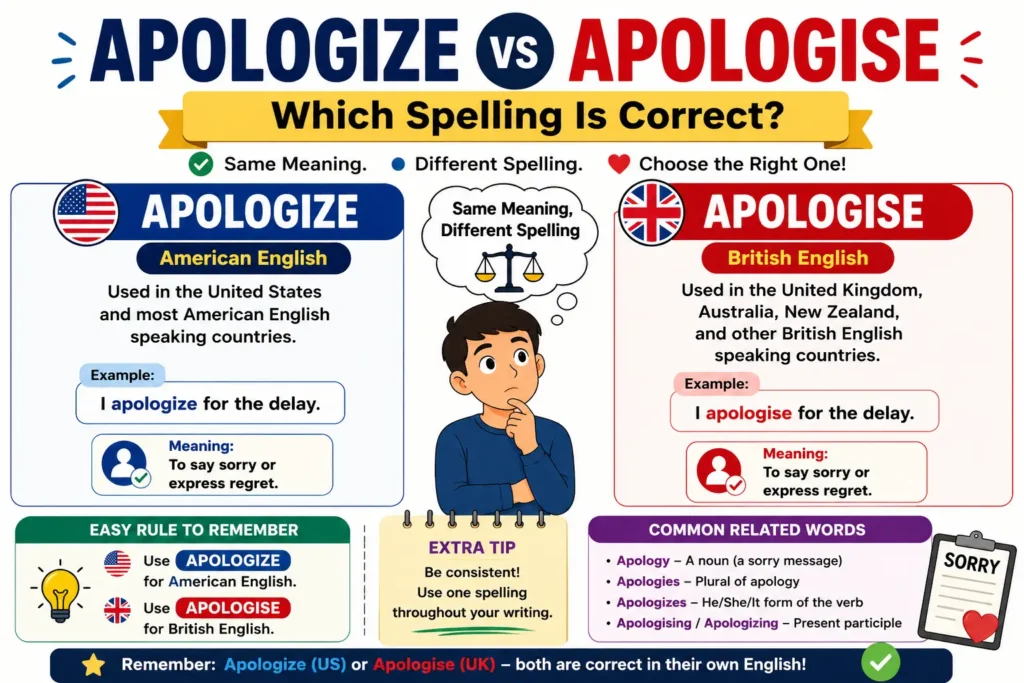
Choosing between apologize or apologise can be confusing because both spellings are correct and express the same idea: saying sorry or showing regret. The key distinction in apologize vs. apologise is the variety of English being used.
The form ending in -ize is standard in American English, while the -ise form is widely used in British English and in many regions that follow British conventions. However, some British dictionaries and publishers also accept the -ize form, so context and consistency matter more than treating one spelling as universally right or wrong.
Understanding the apologize meaning, the apologise meaning, and their shared grammar will help you select the correct spelling for emails, essays, websites, and professional documents. This guide explains the regional spelling difference, related word forms, common grammar patterns, and practical examples. It also shows how apology, apologies, apologizes, and apologises differ, helping students, professionals, and everyday writers communicate clearly and confidently with their intended audience.
Quick Answer: Apologize or Apologise?
Use apologize in American English.
Use apologise in British English.
Both words mean to say sorry or to express regret. The difference is spelling, not meaning.
| Word | English Style | Meaning | Example |
| Apologize | American English | To say sorry | I apologize for the delay. |
| Apologise | British English | To say sorry | I apologise for the delay. |
Here is the easiest rule:
Use “apologize” for American readers. Use “apologise” for British readers.
This rule works for emails, essays, blog posts, resumes, business messages, and website copy.
However, do not mix both spellings in the same article or document. That makes your writing look careless.
Read this also: Persue or Pursue: Correct Spelling, Meaning, and Easy Examples
What Does Apologize Mean?
Apologize means to say you are sorry for something you did, said, caused, or failed to do.
You can apologize for a mistake. You can apologize for being late. A company can apologize to customers. A student can apologize to a teacher. A friend can apologize after saying something hurtful.
The word shows regret, responsibility, or politeness.
Here are some simple examples:
- I apologize for the late reply.
- She apologized for missing the meeting.
- We apologize for the mistake in your order.
- He apologized to his friend.
- The company apologized to its customers.
In American English, apologize is the normal spelling. You will see it in schools, offices, news articles, customer service emails, and professional writing.
It also sounds more formal than sorry.
For example:
| Sentence | Tone |
| I’m sorry I forgot. | Natural and personal |
| I apologize for forgetting. | Formal and serious |
Both sentences are correct. Still, they do not feel the same.
Use I’m sorry when you want to sound warm and personal. Use I apologize when you want to sound professional or serious.
What Does Apologise Mean?
Apologise has the same meaning as apologize.
The only difference is the spelling.
People usually use apologise in British English. You may also see it in countries that often follow British spelling, such as Australia, New Zealand, South Africa, and many Commonwealth regions.
Examples:
- I apologise for the confusion.
- We apologise for any inconvenience.
- The manager apologised to the customer.
- She apologised for sending the wrong file.
- They apologised after the complaint.
The spelling apologise does not make the apology stronger or weaker. It does not make it more polite either. It simply follows a different spelling style.
Think about these spelling pairs:
| American English | British English |
| color | colour |
| favor | favour |
| organize | organise |
| realize | realise |
| apologize | apologise |
The meaning stays the same. The spelling changes.
Main Difference Between Apologize and Apologise
The main difference between apologize and apologise is regional spelling.
It is not a grammar difference. It is not a meaning difference. It is not usually a pronunciation difference either.
Both words are verbs. Both mean to say sorry.
| Feature | Apologize | Apologise |
| Meaning | To say sorry | To say sorry |
| Part of speech | Verb | Verb |
| Common in | American English | British English |
| Ending | -ize | -ise |
| Example | I apologize for the delay. | I apologise for the delay. |
The real issue is consistency.
For example, this sentence looks mixed:
We apologise for the delay and will organize a replacement.
It uses British spelling in apologise but American spelling in organize.
A cleaner American version would be:
We apologize for the delay and will organize a replacement.
A cleaner British version would be:
We apologise for the delay and will organise a replacement.
Readers may still understand the mixed version. However, polished writing should follow one spelling style from start to finish.
Why Are There Two Spellings?
English has more than one spelling system because it developed in different places over time.
American English often uses shorter or simplified spellings. British English often keeps older spelling patterns.
That is why you see pairs like these:
| American English | British English |
| apologize | apologise |
| analyze | analyse |
| defense | defence |
| behavior | behaviour |
| center | centre |
| traveling | travelling |
Many American spellings use z, while British spellings often use s.
However, English is not always perfectly neat. Some British dictionaries accept -ize spellings in certain words. Even so, in everyday writing, apologize usually looks American and apologise usually looks British.
For most writers, that is the only rule they need.
When to Use Apologize
Use apologize when you write in American English.
This is the best choice for:
- US blog posts
- US business emails
- US resumes
- US cover letters
- US school papers
- US customer service pages
- American website content
- American social media captions
Examples:
- I apologize for the delay.
- We apologize for the inconvenience.
- She apologized after the meeting.
- He apologized for his mistake.
- The company apologizes for the service issue.
If your readers are in the United States, apologize will look natural. It also matches other American spellings like organize, realize, and recognize.
For example, a US business should write:
We apologize for the shipping delay. Your order is now on its way.
A US student should write:
The character apologizes after realizing his mistake.
A US job applicant may write:
I apologize for the delayed response and appreciate your patience.
These sentences sound clean, clear, and natural for American readers.
When to Use Apologise
Use apologise when you write in British English.
This is the better choice for:
- UK blog posts
- UK business emails
- British academic writing
- UK customer service pages
- British-style school assignments
- UK website content
- Content for readers who expect British spelling
Examples:
- I apologise for the delay.
- We apologise for any inconvenience.
- She apologised after the meeting.
- He apologised for his behaviour.
- The company apologises for the service issue.
If your readers expect British spelling, apologise will feel more natural.
For example, a UK business may write:
We apologise for the delay and appreciate your patience.
A British student may write:
The character apologises after realising his mistake.
A UK customer support team may write:
We apologise for any inconvenience caused by this issue.
Again, the meaning does not change. Only the spelling changes.
Apologize or Apologise in Emails
Emails need clear and polite language. This spelling choice appears often in email writing.
For American English, write:
I apologize for the late reply.
For British English, write:
I apologise for the late reply.
Both are correct. The best choice depends on the reader.
| Situation | American English | British English |
| Late reply | I apologize for the late response. | I apologise for the late response. |
| Mistake | I apologize for the mistake. | I apologise for the mistake. |
| Delay | We apologize for the delay. | We apologise for the delay. |
| Confusion | I apologize for the confusion. | I apologise for the confusion. |
| Missed meeting | I apologize for missing the meeting. | I apologise for missing the meeting. |
A strong apology email should not stop at “sorry.” It should also tell the reader what happened and what you will do next.
Weak example:
I apologize for the issue.
Better example:
I apologize for the delay. Your order was held during processing, but it has now been shipped. You’ll receive the tracking update today.
The second version works better because it gives useful information. It does not leave the reader guessing.
Apologize or Apologise in Business Writing
Business apologies need care. A customer, client, or partner wants a clear answer, not a vague line.
A good business apology should explain:
- What happened
- Why it matters
- What action you are taking
- What the reader should expect next
Here is a weak business apology:
We apologize for any inconvenience this may have caused.
This sentence is common, but it feels cold. It does not explain the real problem.
Here is a better version:
We apologize for the delay. Your order should have arrived yesterday, and we understand how frustrating that is. We’ve refunded your shipping fee and upgraded your replacement order.
This version sounds more human because it names the issue and gives a solution.
British English version:
We apologise for the delay. Your order should have arrived yesterday, and we understand how frustrating that is. We’ve refunded your shipping fee and upgraded your replacement order.
The spelling changes. The structure stays the same.
Read this article also: Frances vs Francis: Meaning, Spelling, and Correct Use
Apologize or Apologise in Academic Writing
In academic writing, your spelling should match the required style.
Use apologize if your school, teacher, journal, or university follows American English.
Use apologise if it follows British English.
Do not switch between both spellings in the same essay.
American English:
The speaker apologizes for his earlier statement and tries to rebuild trust.
British English:
The speaker apologises for his earlier statement and tries to rebuild trust.
Academic writing values consistency. That means your spelling should match the rest of the paper.
If you write color, organize, and analyze, then use apologize.
If you write colour, organise, and analyse, then use apologise.
Apologize, Apologise, Apology, Apologies, and Apologizes
Many learners confuse these words because they look similar.
However, they do different jobs in a sentence.
| Word | Part of Speech | Meaning | Example |
| apologize | Verb | To say sorry, American spelling | I apologize for the delay. |
| apologise | Verb | To say sorry, British spelling | I apologise for the delay. |
| apology | Noun | A statement of regret | She gave an apology. |
| apologies | Plural noun | More than one apology, or a polite phrase | Please accept my apologies. |
| apologizes | Verb | Third-person singular, American spelling | He apologizes when he is wrong. |
| apologises | Verb | Third-person singular, British spelling | She apologises when she is wrong. |
Here is the simple difference:
Apologize and apologise are verbs.
Apology and apologies are nouns.
So, these sentences are correct:
- I apologize.
- I apologise.
- She gave an apology.
- Please accept my apologies.
These sentences are wrong:
- Please accept my apologize.
- She apologies for being late.
- He gave me an apologize.
- I am apology.
The fix is simple. Use the verb when you mean the action. Use the noun when you mean the apology itself.
Apology vs Apologize
Apology is a noun. Apologize is a verb.
A noun names a thing. A verb shows an action.
So, an apology is something you give. To apologize is something you do.
| Sentence | Correct? | Reason |
| I apologize for the mistake. | Correct | Apologize is a verb. |
| I gave an apology. | Correct | Apology is a noun. |
| Please accept my apologize. | Incorrect | You need the noun “apology.” |
| She apology for the delay. | Incorrect | You need a verb. |
Correct examples:
- Please accept my apology.
- I apologize for my mistake.
- His apology sounded sincere.
- She apologized after the argument.
Here is an easy way to remember it:
You give an apology. You apologize with words.
That one line solves a lot of confusion.
Apologies vs Apologizes
Apologies and apologizes are different words.
Apologies is usually a plural noun. It can also work as a polite phrase in emails.
Example:
Please accept my apologies for the delay.
Apologizes is a verb form. Use it with he, she, or it in American English.
Example:
She apologizes when she makes a mistake.
| Word | Grammar Role | Example |
| Apologies | Plural noun | My apologies for the confusion. |
| Apologizes | Verb | He apologizes after every mistake. |
Common mistake:
She apologies for being late.
Correct American English:
She apologizes for being late.
Correct British English:
She apologises for being late.
If the word shows an action, use apologizes or apologises.
If the word names the apology, use apology or apologies.
Common Mistakes to Avoid
Small mistakes can make your writing look weak. Here are the most common ones.
Using “apologies” as a verb
Incorrect:
She apologies for the delay.
Correct:
She apologizes for the delay.
British English:
She apologises for the delay.
Why?
Because apologies is not the verb form for she. You need apologizes or apologises.
Using “apologize” as a noun
Incorrect:
Please accept my apologize.
Correct:
Please accept my apology.
Also correct:
Please accept my apologies.
Why?
Because apologize is a verb. After my, you need a noun.
Writing “I am apologize”
Incorrect:
I am apologize for the mistake.
Correct:
I apologize for the mistake.
Also correct:
I am sorry for the mistake.
Why?
Because apologize is already the main verb. You do not need am before it.
Mixing American and British spelling
Mixed:
We apologise for the delay and will organize a refund.
Better American version:
We apologize for the delay and will organize a refund.
Better British version:
We apologise for the delay and will organise a refund.
The mixed version is understandable. Still, it looks less polished.
Correct Grammar Patterns with Apologize
The verb apologize follows a few common patterns.
| Pattern | Example |
| apologize for something | I apologize for the delay. |
| apologize to someone | She apologized to her teacher. |
| apologize to someone for something | He apologized to me for his comment. |
| apologize in advance | I apologize in advance for any confusion. |
| sincerely apologize | We sincerely apologize for the mistake. |
The most useful pattern is:
apologize to someone for something
Examples:
- I apologize to you for the misunderstanding.
- She apologized to her boss for missing the deadline.
- The company apologized to customers for the billing error.
- He apologized to his parents for lying.
This pattern works well because it gives the apology a full shape. It tells the reader who received the apology and why.
How to Use Apologize in a Sentence
Here are natural examples in American English.
| Situation | Sentence |
| Late reply | I apologize for the late reply. |
| Mistake | I apologize for the mistake in the report. |
| Customer issue | We apologize for the inconvenience. |
| Missed call | I apologize for missing your call. |
| Wrong information | I apologize for giving you the wrong details. |
| Workplace issue | I apologize for missing the deadline. |
| Formal statement | The company apologizes for the outage. |
Most examples use for after apologize.
That is the most common structure.
You can also add one adverb if needed:
- I sincerely apologize for the mistake.
- We deeply apologize for the inconvenience.
- I truly apologize for my behavior.
However, do not overdo it.
Better:
I sincerely apologize for the mistake.
Too much:
I deeply, truly, sincerely, and honestly apologize for the mistake.
That sounds fake. One strong word is enough.
Read this also: Too Many or To Many: Correct Usage, Grammar Rules, and Examples
How to Use Apologise in a Sentence
Here are natural examples in British English.
| Situation | Sentence |
| Late reply | I apologise for the late reply. |
| Mistake | I apologise for the mistake in the report. |
| Customer issue | We apologise for the inconvenience. |
| Missed call | I apologise for missing your call. |
| Wrong information | I apologise for giving you the wrong details. |
| Workplace issue | I apologise for missing the deadline. |
| Formal statement | The company apologises for the outage. |
The grammar stays the same. Only the spelling changes.
British English also changes other forms:
| American English | British English |
| apologize | apologise |
| apologized | apologised |
| apologizing | apologising |
| apologizes | apologises |
Examples:
American English:
- She apologized after the argument.
- He is apologizing to his friend.
- The manager apologizes for the delay.
British English:
- She apologised after the argument.
- He is apologising to his friend.
- The manager apologises for the delay.
Does Apologise Sound More Formal Than Apologize?
No. Apologise does not sound more formal than apologize.
The full sentence creates the tone.
For example:
I apologise for the inconvenience.
This sounds formal.
But this sentence sounds casual:
Sorry, I apologise. My mistake.
The same rule applies to apologize.
Formal:
I apologize for the inconvenience.
Casual:
Oops, I apologize. I read that wrong.
So, spelling does not control tone. Word choice and context do.
If you want a warmer apology, be specific.
Cold:
We apologize for any inconvenience this may have caused.
Warmer:
We apologize for the delay. We know you expected the update today, and we should have replied sooner.
The second version sounds better because it feels real.
When “Sorry” Works Better Than “I Apologize”
Sometimes sorry sounds better than I apologize.
Use sorry in personal, casual, or emotional situations.
Examples:
- I’m sorry I hurt you.
- Sorry I forgot to call.
- I’m sorry about yesterday.
- Sorry for the mess.
- I’m really sorry you had to deal with that.
Use apologize in formal, serious, or professional situations.
Examples:
- I apologize for the error in the report.
- We apologize for the service interruption.
- The company apologizes for the delay.
- I apologize for missing the deadline.
- We apologize for the incorrect charge.
Here is a simple comparison:
| Situation | Better Choice |
| Talking to a close friend | I’m sorry |
| Writing to a customer | I apologize |
| Sending a formal email | I apologize |
| Comforting someone | I’m sorry |
| Public business statement | We apologize |
| Small casual mistake | Sorry about that |
Good writing fits the situation. A message to your friend should not sound like a legal notice.
Case Study: Customer Service Apology
Imagine a customer ordered a product with two-day shipping. The package arrived six days late. The customer feels annoyed and wants a clear answer.
Weak response:
We apologize for any inconvenience.
This response sounds empty. It does not name the problem. It does not explain the fix.
Better response:
We apologize for the late delivery. Your order should have arrived within two business days, but it reached you after six days. We’ve refunded your shipping fee and sent a discount code for your next order.
This version works because it includes:
- A clear apology
- The exact problem
- A useful solution
- A human tone
- A next step
British English version:
We apologise for the late delivery. Your order should have arrived within two business days, but it reached you after six days. We’ve refunded your shipping fee and sent a discount code for your next order.
The lesson is simple. Correct spelling matters, but a clear apology matters more.
Case Study: Workplace Apology
Now imagine an employee missed a deadline. The delay affected the whole team.
Weak response:
I apologize. Things got busy.
This sounds careless.
Better response:
I apologize for missing the deadline. I underestimated the time needed for the final edits, and I should have flagged the delay sooner. I’ve completed the first draft now, and I can send the final version by 3 p.m. today.
This apology works because it does not hide behind excuses. It accepts responsibility and gives a clear next step.
A strong workplace apology should include:
- What went wrong
- Your role in the problem
- What you are doing now
- When you will fix it
- How you will avoid repeating it
Useful template:
I apologize for [problem]. I should have [better action]. I’ve now [current fix], and I’ll [next step] by [time or date].
Example:
I apologize for sending the wrong file. I should have checked the attachment before sending the email. I’ve attached the correct version now, and I’ll double-check future files before sharing them.
That sounds clear and responsible.
Case Study: Student Writing Mistake
A student writes:
The character apology to his family after the conflict.
This sentence is wrong because apology is a noun. The sentence needs a verb.
Correct American English:
The character apologizes to his family after the conflict.
Correct British English:
The character apologises to his family after the conflict.
Now look at this sentence:
His apologize shows that he regrets his actions.
This is also wrong because apologize is a verb. The sentence needs the noun apology.
Correct:
His apology shows that he regrets his actions.
This mistake happens because learners often know the word family but choose the wrong form.
The fix is easy:
- Use apologize or apologise for the action.
- Use apology or apologies for the noun.
Is Apologize More Correct Than Apologise?
No. Apologize is not more correct everywhere.
It is the standard spelling in American English. However, apologise is correct in British English.
English has several accepted spelling differences.
| American English | British English |
| color | colour |
| honor | honour |
| favor | favour |
| traveler | traveller |
| canceled | cancelled |
| apologize | apologise |
So, the better question is not “Which spelling is always correct?”
The better question is:
Which spelling fits my audience?
That question gives you the right answer.
Is Apologise Wrong in American English?
In American English, apologise looks unusual.
Most American readers will understand it. Still, some may see it as British spelling or even a typo.
For example, a US company should not usually write:
We apologise for the delay.
The better US version is:
We apologize for the delay.
This matters for:
- US websites
- US school papers
- US resumes
- US business emails
- US legal documents
- US marketing copy
A small spelling mismatch will not destroy your message. However, it can make your writing feel less polished.
Is Apologize Accepted in British English?
British readers understand apologize. Some British style systems also accept -ize spellings in certain words.
However, many everyday UK readers expect apologise.
If your full article uses British spellings like colour, favour, and organise, then apologise fits better.
Example:
We apologise for the delay in processing your application.
If your document uses American spellings, then apologize fits better.
Example:
We apologize for the delay in processing your application.
Consistency should guide your choice.
How to Remember the Difference
Here is the easiest memory trick:
Apologize has a “z,” which often points to American English.
Apologise has an “s,” which often points to British English.
You can remember it this way:
Z for the US. S for the UK.
This trick is not perfect for every English word, but it works well here.
Also, look at similar pairs:
| American Pattern | British Pattern |
| apologize | apologise |
| organize | organise |
| realize | realise |
| recognize | recognise |
Once you see the pattern, the spelling becomes much easier.
Real-Life Examples by Context
Examples help more than rules. Here is how both spellings work in real writing.
Customer Service
American English:
We apologize for the delay. Your replacement order has already been shipped.
British English:
We apologise for the delay. Your replacement order has already been shipped.
Workplace Email
American English:
I apologize for missing the meeting. I reviewed the notes and will send my update today.
British English:
I apologise for missing the meeting. I reviewed the notes and will send my update today.
School Assignment
American English:
The narrator apologizes after realizing that his actions hurt others.
British English:
The narrator apologises after realising that his actions hurt others.
Social Media
American English:
I apologize for my earlier post. I should have checked the facts first.
British English:
I apologise for my earlier post. I should have checked the facts first.
Public Statement
American English:
We apologize to everyone affected by the outage. Our team has restored service and is reviewing the cause.
British English:
We apologise to everyone affected by the outage. Our team has restored service and is reviewing the cause.
Better Ways to Write an Apology
Correct spelling helps, but it does not make an apology good by itself.
A strong apology usually has five parts:
- A direct apology
- A clear mention of the mistake
- Responsibility without excuses
- A fix or next step
- A better action for the future
Use this structure:
I apologize for [mistake]. I should have [better action]. I’ve [solution], and I’ll [future action].
Example:
I apologize for sending the wrong file. I should have checked the attachment before sending the email. I’ve attached the correct version now, and I’ll review future files more carefully.
This sounds much better than:
Sorry for any inconvenience.
Why?
Because the first version shows ownership. The second version sounds vague.
A good apology does not need drama. It needs honesty, clarity, and action.
Other Ways to Say Apologize
You do not always need to use apologize. Sometimes another phrase sounds better.
| Phrase | Tone | Example |
| I’m sorry | Natural and personal | I’m sorry I missed your call. |
| Please forgive me | Emotional and serious | Please forgive me for what I said. |
| My apologies | Polite and brief | My apologies for the delay. |
| I regret | Formal | I regret the confusion this caused. |
| I take responsibility | Direct and mature | I take responsibility for the mistake. |
| Please accept my apology | Very formal | Please accept my apology for the oversight. |
Be careful with I regret. It can sound formal and distant.
For example:
I regret the error.
This is correct, but it may sound cold.
Warmer version:
I apologize for the error. We should have caught it before sending the report.
That sounds more human.
Read this also: Inter vs Intra: Meaning, Difference, Examples, and Easy Rules
Quick Practice Section
Choose the correct word: apologize, apologise, apology, apologies, apologizes, or apologises.
| Sentence | Best Answer |
| I ______ for the late reply. | apologize/apologise |
| Please accept my ______. | apology/apologies |
| She ______ whenever she makes a mistake. | apologizes/apologises |
| His ______ sounded sincere. | apology |
| We ______ for the inconvenience. | apologize/apologise |
| The company issued a public ______. | apology |
| My ______ for the confusion. | apologies |
| He never ______ after the argument. | apologizes/apologises |
Here is the simple logic:
If the sentence needs an action, use a verb:
- apologize
- apologise
- apologizes
- apologises
If the sentence needs a thing or statement, use a noun:
- apology
- apologies
That one grammar check prevents most mistakes.
Simple Decision Guide
Use this table when you feel unsure.
| Question | Choose |
| Am I writing for a US audience? | apologize |
| Am I writing for a UK audience? | apologise |
| Am I following American spelling? | apologize |
| Am I following British spelling? | apologise |
| Do I need a noun? | apology or apologies |
| Do I need a verb? | apologize or apologise |
| Am I writing to a customer? | Match the customer’s market |
| Am I writing an academic paper? | Follow the required style guide |
Here is another quick test.
Can you replace the word with say sorry?
If yes, you probably need apologize or apologise.
Example:
I apologize for the delay.
This means:
I say sorry for the delay.
That works.
Now test this sentence:
Please accept my apologize.
This would mean:
Please accept my say sorry.
That does not work. So, you need a noun:
Please accept my apology.
FAQs About Apologize and Apologise
Both spellings are correct. Apologize is the standard spelling in American English, while apologise is widely used in British English. Your choice should match the spelling style used throughout the rest of your document.
Apologize is the standard American spelling. However, it is also accepted by some British dictionaries, publishers, and style guides that prefer -ize endings. Therefore, it should not always be considered incorrect in British English.
Apologise is generally not the preferred spelling in American English. American readers normally expect apologize, particularly in business documents, academic assignments, websites, resumes, and professional emails.
Apology is a noun, while apologize is a verb. An apology is something you give or offer, while to apologize is the action of expressing regret.
Correct examples:
Please accept my apology.
I apologize for the mistake.
Use the spelling that matches your audience, organisation, or required style guide. Choose apologize for American English and apologise for a British -ise style. Most importantly, do not switch between the two spelling systems within the same document.
Final Answer on Apologize vs Apologise
The choice between apologize or apologise is mainly a matter of audience, style, and consistency. Use the -ize form when following American English, and the -ise form when following a British -ise style. In British English, the -ize ending may also be accepted by dictionaries and publishers, so check the required house style before writing. The apologize meaning and apologise meaning are identical: both verbs mean to express regret or say sorry. When comparing apologize vs. apologise, consider the spelling conventions used throughout the rest of your document. Understanding this regional spelling difference will help you select the correct spelling without changing the tone or meaning of your sentence. Whichever version you choose, apply it consistently to related forms, including the past tense, present participle, and third-person form. Consistent spelling makes emails, assignments, articles, and documents look clear and trustworthy.

2 thoughts on “Apologize vs Apologise: Which Spelling Is Correct?”