
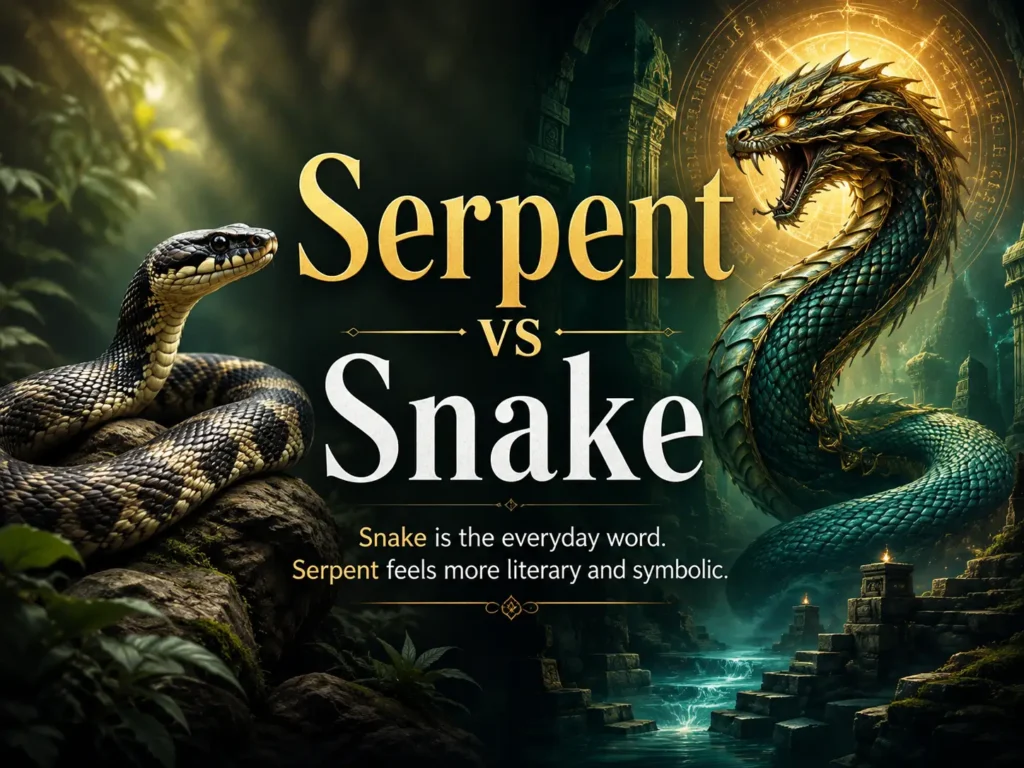
Serpent vs snake describes the difference between two words that can name the same reptile but often carry different tones. A snake is the standard term used in modern English, science, conversation, and wildlife writing. A serpent usually sounds more literary, symbolic, religious, or mythical.
The key difference is therefore not biological. Instead, it comes from meaning, tone, and context. You would normally say “a snake crossed the road,” but a fantasy story might describe “a serpent guarding an ancient temple.”
Understanding this word choice helps you write more clearly. It also prevents common mistakes, such as treating a serpent as a separate species or using the word in a scientific context where snake would sound more natural.
Quick Answer: What Is the Difference Between a Serpent and a Snake?
A snake is a long, legless reptile. It’s the standard word for the animal in everyday and scientific English.
A serpent is usually a literary, old-fashioned, religious, or symbolic word for a snake. It can describe a real snake, but it may also refer to a mythical snake-like creature.
Simple rule: Use snake when you’re identifying the animal. Use serpent when you want to add symbolism, mystery, history, or drama.
Consider these examples:
- “A snake crossed the hiking trail.”
- “A giant serpent guarded the temple.”
The first sentence sounds factual. The second sounds like a scene from a legend or fantasy story.
Serpent vs Snake Comparison Table
The following table shows the main differences at a glance.
| Feature | Snake | Serpent |
| Basic meaning | A long, legless reptile | A snake or snake-like creature |
| Normal tone | Neutral and modern | Literary, dramatic, ancient, or symbolic |
| Everyday conversation | Very common | Uncommon |
| Scientific writing | Standard term | Rare outside names or historical wording |
| Religious use | Possible | Very common |
| Mythological use | Possible | Very common |
| Figurative meaning | A dishonest or treacherous person | A threatening, deceptive, or symbolic figure |
| Verb form | Yes | Not normally |
| Typical example | “A snake is under the porch.” | “The serpent rose from the sea.” |
In many sentences, the words can name the same animal. However, replacing one with the other often changes the sentence’s mood.
What Does “Snake” Mean?
A snake is a limbless, scaled reptile with a long body. The word includes many different animals, such as rattlesnakes, cobras, pythons, boas, garter snakes, and sea snakes.
The animal’s size doesn’t determine whether it’s a snake. A tiny threadsnake and a large python are both snakes.
Likewise, venom isn’t part of the definition. Some snakes are venomous, while many others aren’t.
Snake as the Standard Name for the Animal
In ordinary American English, snake is the default term. It sounds natural in almost every factual situation.
For example:
- “A snake was hiding near the shed.”
- “The ranger identified the snake.”
- “Some snakes hunt at night.”
- “The class studied snake habitats.”
- “We saw a snake beside the road.”
These sentences describe real animals directly. Using serpent would make most of them sound theatrical or old-fashioned.
Compare:
- Natural: “There’s a snake in the garage.”
- Unusually dramatic: “There’s a serpent in the garage.”
The second sentence isn’t necessarily incorrect. However, it sounds as though the animal is mysterious, dangerous, or connected to a story.
Snake in Everyday American English
You’ll commonly see snake in:
- Casual conversation
- Text messages
- School assignments
- Wildlife reports
- Safety notices
- News articles
- Scientific descriptions
- Pet-care information
- Nature documentaries
For instance, a park sign might say:
“Watch for snakes near rocks and tall grass.”
It probably wouldn’t say “Watch for serpents” because a public warning should be direct and easy to understand.
Snake as a Figurative Noun
The noun snake can also describe a dishonest, disloyal, or untrustworthy person.
For example:
- “He pretended to support us, but he was a snake.”
- “Don’t trust her with that information. She’s a snake.”
This meaning is informal and insulting. Therefore, you should use it carefully.
It may appear in conversation, social media posts, movies, and fiction. However, it usually isn’t suitable for professional emails or formal workplace discussions.
Instead of writing “He’s a snake” in a professional setting, describe the behavior:
- “He shared confidential information.”
- “She acted dishonestly.”
- “He broke the team’s trust.”
Specific wording is clearer and less emotional.
Snake as a Verb
Unlike serpent, snake can function as a verb.
As a verb, snake means to move, bend, or extend along a twisting path.
Examples include:
- “The road snakes through the mountains.”
- “A long line snaked around the building.”
- “The river snakes across the valley.”
- “She snaked the cable behind the desk.”
In these sentences, nothing is necessarily an actual snake. Instead, the movement or shape resembles one.
You normally can’t replace the verb snake with serpent.
- Correct: “The path snakes through the forest.”
- Incorrect in standard usage: “The path serpents through the forest.”
What Does “Serpent” Mean?
A serpent is a snake or snake-like creature. In modern English, however, the word usually carries a special tone.
Writers often choose serpent when they want the animal to seem:
- Ancient
- Powerful
- Mysterious
- Dangerous
- Sacred
- Evil
- Supernatural
- Symbolic
As a result, the word appears frequently in religion, mythology, poetry, fantasy, and historical storytelling.
Serpent as a Literary Word for Snake
A real snake may be called a serpent in literary writing.
For example:
- “A dark serpent coiled around the broken statue.”
- “The serpent moved silently through the reeds.”
- “A golden serpent was painted across the shield.”
In each sentence, snake would still make literal sense. However, serpent creates a stronger image.
Compare the tone:
- “A large snake emerged from the cave.”
- “A great serpent emerged from the cave.”
The first sentence sounds like a wildlife report. The second sounds like fantasy, mythology, or dramatic fiction.
Can a Serpent Be a Real Animal?
Yes. A serpent can be a real snake described in elevated or literary language.
For example:
“The serpent rested beneath the tree.”
This sentence may describe an ordinary snake. The writer has simply chosen a more dramatic noun.
However, context matters. In another story, the serpent might be magical, enormous, winged, or able to speak.
Therefore, the word doesn’t automatically tell you whether the creature is real.
Can a Serpent Be Mythical?
Yes. Serpent commonly refers to an imaginary or legendary snake-like creature.
Examples include:
- Sea serpents
- Winged serpents
- Giant temple guardians
- Fire-breathing snake creatures
- Magical underground monsters
- Divine or supernatural beings with snake-like bodies
In fantasy and mythology, a serpent may not fit the biological definition of a snake. It might have horns, wings, multiple heads, or supernatural powers.
That broader imaginative use is one reason writers choose serpent instead of snake.
Why Does “Serpent” Sound Ancient?
The word snake comes from Old English and has remained the ordinary English term for the animal.
Serpent entered English through French and ultimately came from Latin. Over time, it became strongly associated with formal writing, translated religious texts, legends, and older literature.
Still, a word’s history doesn’t control every modern use. Today, serpent sounds ancient mainly because of the contexts in which English speakers continue to encounter it.
Are Serpents and Snakes Scientifically Different?
No. Serpent isn’t a separate biological class, family, species, or type of snake.
Scientists commonly use snake as the English name for reptiles classified within the suborder Serpentes.
These terms shouldn’t be confused:
| Term | Meaning |
| Snake | The standard English name for the animal |
| Serpent | A literary, symbolic, or traditional word for a snake |
| Serpentes | The scientific name of the snake suborder |
Notice the capitalization and spelling. Serpentes is a formal taxonomic name. Serpent is an ordinary English noun.
Does Serpent Mean a Large Snake?
Some dictionary definitions connect serpent especially with a large snake. However, there’s no scientific size rule.
A snake doesn’t become a serpent when it reaches a certain length.
These statements are false:
- Small snakes are snakes, but large snakes are serpents.
- A snake becomes a serpent when it grows.
- Serpents belong to a larger biological group.
A writer may call a huge python a serpent to emphasize its size or power. That choice is stylistic, not scientific.
Does Serpent Mean a Venomous Snake?
No. Serpent doesn’t mean “venomous snake.”
A venomous snake can be called a serpent in literary writing. However, a nonvenomous snake can also be called one.
For example, both of these sentences are possible:
- “The venomous serpent raised its head.”
- “The harmless serpent disappeared into the grass.”
The surrounding information tells you whether the snake is dangerous. The word serpent alone doesn’t.
Does Serpent Refer to a Different Species?
No animal has the biological category “serpent” simply because it looks dramatic or grows large.
Species have specific scientific names. For example, rattlesnakes, pythons, and cobras belong to different groups, but they’re all snakes.
A writer might call any of them a serpent in a literary context.
When Are Serpent and Snake Interchangeable?
The words can sometimes refer to the same animal. However, they aren’t perfect synonyms because they create different expectations.
Consider this pair:
- “A snake lay beneath the tree.”
- “A serpent lay beneath the tree.”
Both sentences may describe the same reptile. Yet the first is plain and factual. The second feels more literary or symbolic.
Therefore, the words are only partly interchangeable.
Literal Descriptions
You can use either word when describing a real snake, provided the tone fits.
Neutral description:
“The snake moved across the path.”
Literary description:
“The serpent glided across the moonlit path.”
The second sentence uses more vivid language. In that setting, serpent supports the mood.
Creative Writing
Serpent often works well in:
- Fantasy novels
- Poetry
- Horror stories
- Historical fiction
- Myth retellings
- Religious fiction
- Symbolic descriptions
For example:
“The jeweled serpent lifted its head from the ruined throne.”
Here, snake would sound less grand:
“The jeweled snake lifted its head from the ruined throne.”
The sentence remains grammatical, but its tone changes.
When Shouldn’t You Replace Snake With Serpent?
Even close synonyms can’t replace each other in every expression.
Several common uses require snake.
Scientific and Wildlife Writing
Use snake when you’re discussing:
- Snake anatomy
- Snake species
- Snake habitats
- Snake behavior
- Snake venom
- Snake conservation
- Snake identification
- Snake bites
Natural example:
“Researchers tracked the snake’s movement for six weeks.”
Less natural in standard scientific prose:
“Researchers tracked the serpent’s movement for six weeks.”
A scientist may use Serpentes when discussing classification. However, serpent isn’t the usual everyday scientific label.
Established Names and Compound Terms
Many phrases contain snake as a fixed part of the name.
Examples include:
- Snake plant
- Snake venom
- Snake bite
- Snake charmer
- Snake eyes
- Snake River
- Drain snake
- Snake species
- Snake skin
You generally can’t replace snake with serpent in these terms.
- Correct: “She bought a snake plant.”
- Incorrect: “She bought a serpent plant.”
- Correct: “The doctor treated the snake bite.”
- Unnatural: “The doctor treated the serpent bite.”
The second version may appear in a fantasy story, but it isn’t the standard expression.
Snake as a Verb
As noted earlier, snake can describe winding movement.
- “The trail snakes through the hills.”
- “Traffic snaked around the construction site.”
Serpent doesn’t normally work as a verb in modern English.
Sea Snake vs Sea Serpent
This pair has an important difference.
A sea snake is a real marine reptile. Sea snakes live in ocean environments and have physical features that help them swim.
A sea serpent, in contrast, usually means a legendary or unverified ocean creature. Stories often describe it as enormous and snake-like.
| Term | Meaning | Real or Mythical? |
| Sea snake | A marine snake | Real |
| Sea serpent | A large legendary snake-like sea creature | Usually mythical |
Therefore, these terms aren’t interchangeable.
How Tone Changes the Meaning
Word choice affects more than dictionary meaning. It also shapes the reader’s emotional response.
Snake Sounds Direct and Neutral
Use snake when clarity is your main goal.
It works best in:
- News reports
- Safety warnings
- School papers
- Scientific articles
- Casual speech
- Wildlife guides
- Professional communication
For example:
“A snake was reported near the school playground.”
This sentence gives readers useful information quickly. Calling the animal a serpent could make the report sound exaggerated.
Serpent Sounds Dramatic or Symbolic
Use serpent when the animal carries more than a literal meaning.
For example:
“The serpent represented temptation and betrayal.”
In this sentence, the writer isn’t merely identifying an animal. The creature has symbolic importance.
Serpent may suggest danger, deception, wisdom, rebirth, power, or mystery. However, its symbolism depends on the culture and context.
It doesn’t always mean evil.
Tone Comparison by Context
| Context | Better Choice | Reason |
| Backyard conversation | Snake | Natural and direct |
| Biology textbook | Snake | Standard factual term |
| Fantasy battle | Serpent | Adds scale and drama |
| Religious discussion | Serpent | Matches traditional wording |
| Wildlife warning | Snake | Clear and immediate |
| Ancient temple scene | Serpent | Supports the historical mood |
| Winding road | Snake | Works as a verb |
| Legendary ocean monster | Sea serpent | Established mythical term |
Serpent and Snake in Religion and Mythology
The word serpent appears often in religious and mythological language. That history has shaped its modern tone.
Why Religious Texts Often Use “Serpent”
Many traditional English Bible translations use serpent in the story of the Garden of Eden. Some modern translations use snake instead.
The difference doesn’t mean the translations describe separate animals. Rather, it reflects translation style.
Serpent sounds traditional, solemn, and literary. Snake sounds modern and direct.
Because many readers know the older wording, serpent has developed strong associations with temptation, deception, and evil.
Does Serpent Always Mean Evil?
No. Serpent symbolism varies across cultures, religions, and historical periods.
Depending on the context, a serpent may represent:
- Temptation
- Danger
- Deception
- Wisdom
- Healing
- Renewal
- Fertility
- Protection
- Divine power
- The cycle of life and death
Therefore, you shouldn’t assume that every serpent image has the same meaning.
A serpent in one story may be a villain. In another, it may protect a sacred place or symbolize healing.
Serpents in Fantasy and Folklore
Fantasy writers often choose serpent because the word allows more imagination than snake.
A fictional serpent may be:
- Larger than any real snake
- Able to speak
- Covered in feathers
- Equipped with wings
- Connected to magic
- A guardian of treasure
- A god or supernatural spirit
- A monster living in the ocean
In these cases, serpent tells the reader to expect something more than an ordinary reptile.
Grammar of Serpent and Snake
Both words are countable nouns, but snake has more grammatical uses.
Parts of Speech
| Word | Noun | Verb | Related Adjectives |
| Snake | Yes | Yes | snakelike, snake-shaped |
| Serpent | Yes | Not normally | serpent-like, serpentine |
Examples:
- Noun: “The snake entered the garden.”
- Verb: “The path snakes around the lake.”
- Noun: “The serpent guarded the gate.”
- Adjective: “A serpentine road climbed the hill.”
Singular and Plural Forms
Both nouns form their plurals regularly.
- One snake → two snakes
- One serpent → two serpents
Examples:
- “A snake lives under the shed.”
- “Several snakes live in the desert.”
- “The mural shows a serpent.”
- “Winged serpents appear in the legend.”
Possessive Forms
Use an apostrophe and s for a singular possessive noun.
- “The snake’s skin”
- “The serpent’s head”
For regular plural possessives, place the apostrophe after the final s.
- “The snakes’ habitat”
- “The serpents’ markings”
Pronunciation
In American English:
- Snake sounds like “snayk.”
- Serpent is pronounced “SUR-puhnt.”
The first syllable of serpent receives the stress.
Serpentine vs Snakelike
Snakelike means resembling a snake in shape, movement, or behavior.
- “The creature had a snakelike body.”
- “He made a snakelike movement through the crowd.”
Serpentine commonly describes something winding, twisting, or curving.
- “A serpentine road climbed the mountain.”
- “The river followed a serpentine course.”
It can also describe something that resembles a serpent in form or movement.
However, serpentine often sounds more formal than snakelike.
Correct Examples With Explanations
| Sentence | Best Word | Why It Works |
| “A snake is hiding beneath the porch.” | Snake | Everyday, literal description |
| “The serpent wrapped around the ancient pillar.” | Serpent | Creates a dramatic, historical tone |
| “The road snakes through the forest.” | Snake | Functions as a verb |
| “The ranger identified the snake species.” | Snake | Standard wildlife terminology |
| “The sea serpent followed the ship.” | Serpent | Refers to a legendary creature |
| “The mural shows a feathered serpent.” | Serpent | Describes a symbolic or mythological figure |
| “A line of customers snaked around the store.” | Snake | Describes winding movement |
| “Several snakes live in this region.” | Snake | Neutral scientific statement |
Common Serpent vs Snake Mistakes
The basic definitions are simple. Still, writers often make mistakes when they focus only on literal meaning.
Treating Serpent as a Scientific Category
Incorrect:
“Serpents are biologically different from snakes.”
Correct:
“Serpent is usually a literary word for a snake, not a separate biological category.”
The scientific term Serpentes may cause confusion. However, Serpentes is the taxonomic name for the group that includes snakes. It doesn’t create a second group called serpents.
Assuming Every Serpent Is Mythical
Incorrect:
“A serpent can only be an imaginary creature.”
Correct:
“A serpent may be a real snake described in literary language or a mythical snake-like creature.”
Context determines the intended meaning.
Assuming Serpent Means Venomous
Incorrect:
“A serpent is a venomous snake.”
Correct:
“The word serpent doesn’t tell you whether a snake is venomous.”
You need additional information to determine whether the animal has venom.
Replacing Snake in a Fixed Expression
Incorrect:
“She keeps a serpent plant in her office.”
Correct:
“She keeps a snake plant in her office.”
Snake plant is the established name. Synonyms can’t always replace words inside fixed terms.
Using Serpent as a Verb
Incorrect:
“The river serpents across the valley.”
Correct:
“The river snakes across the valley.”
Modern English uses snake as the verb for winding movement.
Overusing Serpent to Sound Sophisticated
Writers sometimes replace every use of snake with serpent because it sounds more impressive.
However, that choice can make clear writing feel unnatural.
For example:
“The animal control officer removed the serpent from the suburban garage.”
This sentence sounds overly dramatic unless the writer wants humor or suspense.
A clearer version is:
“The animal control officer removed the snake from the garage.”
Good word choice depends on context, not how formal a word sounds.
Real-Life Usage Examples
The correct term often becomes obvious when you consider the purpose of the sentence.
Everyday Conversation
“I saw a snake near the mailbox.”
Snake is best because the speaker is reporting a normal event.
Saying “I saw a serpent near the mailbox” may sound humorous, exaggerated, or theatrical.
School and Academic Writing
“Snakes belong to the suborder Serpentes.”
This sentence correctly uses snakes as the common English name and Serpentes as the scientific classification.
Workplace Communication
“A snake was reported near the storage building. Please use the main entrance.”
Direct language matters in safety messages. Therefore, snake is the practical choice.
News Reporting
“Wildlife officers relocated the snake to a protected area.”
News writing usually favors neutral, accurate terms. Serpent might make the report sound sensational.
Fiction and Storytelling
“The jeweled serpent rose from beneath the throne.”
Here, serpent supports the magical setting and creates a strong visual image.
Texting and Social Media
Literal use:
“There’s a snake in my yard!”
Figurative use:
“He leaked the group chat. What a snake.”
In the second sentence, snake describes an untrustworthy person.
A Practical Word-Choice Case Study
Imagine that three writers describe the same large python.
A wildlife educator writes:
“The snake can detect heat from nearby animals.”
A novelist writes:
“The enormous serpent watched from the shadows.”
A person texting a friend writes:
“You won’t believe the size of this snake!”
All three writers may be describing the same animal. However, each chooses a word that matches the situation.
The educator needs accuracy and clarity. The novelist wants atmosphere. The person texting wants natural conversation.
This case shows why the serpent and snake difference isn’t mainly about the animal. It’s about what the writer wants the reader to feel and understand.
Memory Tricks for Choosing the Right Word
Use these quick memory tools when you’re unsure.
Think “Science Uses Snake”
Both science and snake begin with s.
That can remind you to use snake in biology, wildlife writing, school reports, and factual explanations.
Think “Serpent Sounds Like a Story”
Serpent often belongs in a story, symbol, sacred text, or supernatural scene.
The repeated s sound can help you remember:
Serpent = story, symbol, sacred, supernatural
Use the Drama Test
Ask yourself:
“Does this sentence need extra drama or symbolism?”
- If no, choose snake.
- If yes, serpent may work.
Use the Replacement Test
Replace serpent with snake and read the sentence again.
If the basic meaning stays the same but the mood becomes less dramatic, then your choice is stylistic.
If the sentence stops making sense, you may be dealing with a fixed expression such as sea serpent or snake plant.
Synonyms and Related Words
No synonym matches every use of snake or serpent. Still, several related terms may fit specific contexts.
| Word | Meaning or Use |
| Reptile | A broad animal category that includes snakes, lizards, turtles, and crocodilians |
| Ophidian | A formal or technical word relating to snakes |
| Serpentine | Winding, twisting, or resembling a serpent |
| Snakelike | Similar to a snake in shape, movement, or behavior |
| Viper | A member of a specific family of venomous snakes |
| Cobra | A type of venomous snake |
| Python | A type of large, nonvenomous constricting snake |
| Boa | A type of constricting snake |
| Sea snake | A real marine snake |
| Sea serpent | A legendary snake-like ocean creature |
Avoid using a specific animal name unless you know the species or group.
For example, not every snake is a viper, cobra, python, or boa.
How to Choose Between Serpent and Snake
Use snake when:
- You’re describing a real animal plainly.
- You’re writing scientific or educational content.
- You’re speaking casually.
- You’re giving a safety warning.
- You’re writing a news report.
- The word acts as a verb.
- You’re using a fixed phrase such as snake plant.
- Clarity matters more than atmosphere.
Use serpent when:
- You want a literary or dramatic tone.
- You’re discussing religion or mythology.
- The creature is legendary or supernatural.
- You’re describing a symbolic image.
- You want the snake to seem ancient, powerful, or mysterious.
- The surrounding writing already uses elevated language.
A quick five-second test can help:
- Is it a factual animal description? Choose snake.
- Is it scientific writing? Choose snake.
- Is the word a verb? Choose snake.
- Is the setting mythical, religious, or literary? Consider serpent.
- Would serpent sound needlessly dramatic? Choose snake.
Frequently Asked Questions
Q1: Are a serpent and a snake the same animal?
Yes, both words can refer to the same animal. However, snake is the usual modern term, while serpent often has a literary, religious, or symbolic tone.
Q2: Is a serpent a special type of snake?
No. A serpent is not a separate scientific type of snake. It is mainly another word for a snake, especially in stories, myths, and older texts.
Q3: Why do writers use serpent instead of snake?
Writers use serpent to create a more dramatic, ancient, mysterious, or symbolic feeling. The word often fits fantasy, mythology, poetry, and religious writing.
Q4: Is serpent a scientific word?
Not in normal scientific writing. Scientists usually use snake as the common name and Serpentes as the formal taxonomic name for the snake suborder.
Q5: Does serpent mean a large snake?
It can suggest a large or impressive snake, especially in literature. However, there is no scientific size rule that separates a serpent from a snake.
Q6: Does serpent mean a venomous snake?
No. The word serpent does not tell you whether the animal is venomous. Both venomous and nonvenomous snakes may be called serpents in literary writing.
Q7: Can serpent and snake be used interchangeably?
Sometimes, but the tone may change. Snake sounds neutral and factual, while serpent sounds more dramatic, symbolic, or old-fashioned.
Q8: Why does the Bible use the word serpent?
Many traditional English Bible translations use serpent because it matches their formal and literary style. Some modern translations use snake instead.
Q9: Is a sea serpent the same as a sea snake?
No. A sea snake is a real marine reptile. A sea serpent usually refers to a legendary or mythical sea creature.
Q10: Which word should I use in everyday English?
Use snake in normal conversation, schoolwork, news, science, and practical writing. Use serpent when you intentionally want a literary, religious, historical, or mythical tone.
Conclusion
The main serpent vs snake difference comes from usage and tone, not biology. A snake is the clear, neutral word for the real reptile in everyday and scientific English.
A serpent may describe the same animal, but it usually adds mystery, symbolism, history, or drama. It can also refer to a mythical snake-like creature.
For most writing, choose snake. Use serpent when its stronger literary or symbolic meaning fits the context.
