
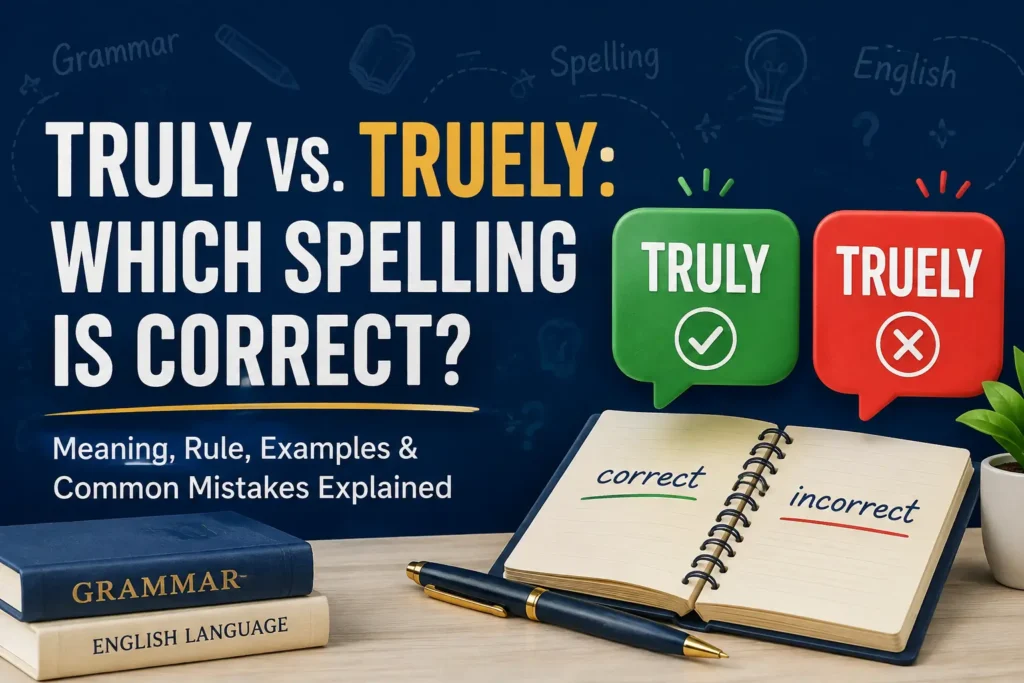
If you’re searching for Truely vs Truly, the answer is simple: truly is the only correct spelling. In standard English, the word true drops the final e before adding -ly. I once caught myself writing truely in an important email, and proofreading helped me remember the correct spelling rule. Understanding this small grammar rule makes your writing more accurate and professional.
Many people expect true to become truely because many adverbs simply add -ly to an adjective. That makes the spelling look logical, but English has exceptions. Whether you’re a student, teacher, blogger, writer, or content creator, learning this rule improves everyday, formal, and professional writing. It also helps you write with better clarity, accuracy, credibility, and confidence for readers in both American and British English.
Using truly instead of truely is important in emails, essays, articles, and professional content. Search trends show that many people still confuse these spellings, but the rule never changes in the past, present, or future tense. Choosing the correct form keeps your writing clear, trustworthy, and easy to understand. It also prevents mistakes that can confuse readers and helps you communicate your ideas honestly, confidently, and effectively.
Quick Answer
If you’re looking for a fast answer, here it is:
| Word | Correct? | Meaning |
| Truly | ✅ Yes | In a truthful, genuine, or sincere way |
| Truely | ❌ No | Incorrect spelling |
Correct examples
- ✅ I truly appreciate your help.
- ✅ She was truly surprised.
- ✅ Yours truly, John Smith.
Incorrect examples
- ❌ I truely appreciate your help.
- ❌ She was truely excited.
- ❌ Yours truely.
Quick Rule: Although the adjective is true, the adverb becomes truly, not truely.
What Does “Truly” Mean?
Truly is an adverb. It describes how something happens or emphasizes that something is genuine, honest, complete, or sincere.
Definition
Truly means:
- In a truthful way
- Honestly or sincerely
- Genuinely
- Really or actually (for emphasis)
The exact meaning depends on the sentence.
Pronunciation
Truly is pronounced:
/ˈtruː.li/ (TROO-lee)
Notice that although the word true ends with a silent e, the pronunciation of truly doesn’t change after the e is removed.
Part of Speech
| Word | Part of Speech | Example |
| True | Adjective | The statement is true. |
| Truly | Adverb | She truly believes it. |
An adverb usually modifies:
- A verb
- An adjective
- Another adverb
- Sometimes an entire sentence
Common Meanings in Everyday English
Depending on the context, truly can express different ideas.
Showing sincerity
When you want to show honest feelings, truly emphasizes that you’re being genuine.
Examples:
- I truly appreciate everything you’ve done.
- We are truly grateful for your support.
- She truly cares about her students.
Here, truly means sincerely.
Emphasizing something
Sometimes truly simply adds emphasis.
Examples:
- That movie was truly amazing.
- This is truly one of the best restaurants in town.
- It was truly unforgettable.
In these examples, truly works similarly to really, but often sounds slightly more formal or expressive.
Showing something is genuine
You can also use truly to describe something authentic or real.
Examples:
- He is truly talented.
- The team is truly committed to success.
- This painting is truly original.
Here, the word stresses that something is real rather than pretending to be.
Expressing honesty
Sometimes truly means truthfully.
Examples:
- She truly believed she was doing the right thing.
- I can truly say this was my best experience.
- He spoke truly about what happened.
Common Synonyms of “Truly”
Depending on the meaning, truly can often be replaced by other words.
| Synonym | Best Used When |
| Really | Informal emphasis |
| Genuinely | Showing authenticity |
| Honestly | Expressing honesty |
| Sincerely | Showing genuine feelings |
| Actually | Clarifying facts |
| Truthfully | Talking about facts honestly |
| Indeed | Formal emphasis |
Although these words are similar, they aren’t always interchangeable. The context determines which one sounds most natural.
Is “Truely” a Real Word?
Many people assume truely is simply another accepted spelling. However, that’s not the case.
The spelling truely is considered an incorrect spelling in standard English.
Major dictionaries, educational resources, and grammar references recognize truly as the only correct form.
If you write truely in:
- a school assignment,
- a business email,
- a resume,
- a research paper,
- a website article,
it will generally be marked as a spelling error.
Why “Truely” Is Considered a Misspelling
The confusion comes from the way many English adverbs are formed.
For example:
- safe → safely
- complete → completely
- polite → politely
Because these words keep the e, many writers naturally expect true to become truely.
However, true follows a different spelling rule.
Instead of:
true + ly = ❌ truely
English changes it to:
true → truly ✅
This spelling has been standard for centuries.
Do Dictionaries Accept “Truely”?
No.
Modern dictionaries list truly as the standard spelling.
They either:
- don’t list truely at all, or
- identify it as a misspelling of truly.
That means truely isn’t considered a correct alternative in:
- American English
- British English
- Canadian English
- Australian English
No major English variety treats truely as standard spelling.
Can You Ever Use “Truely”?
The only time you’ll usually see truely is:
- in typing mistakes,
- in old internet posts,
- in social media comments,
- in unedited writing.
Even in casual communication, it’s better to use truly because it looks more polished and professional.
Why Is “Truly” Spelled Without the “E”?
This is the question that confuses most learners.
At first glance, true + ly seems like it should become truely. However, English spelling follows a different pattern here.
The Spelling Rule Explained
When certain adjectives ending in a silent e become adverbs ending in -ly, the silent e is dropped.
That’s exactly what happens here.
Rule:
true → truly
The silent e disappears before adding -ly.
This isn’t a random exception. It’s a historical spelling convention that has become the accepted standard.
Why the Silent “E” Is Dropped
The final e in true isn’t pronounced.
Removing it doesn’t change how the word sounds.
Compare these pronunciations:
- true → /truː/
- truly → /ˈtruː.li/
Because the pronunciation stays almost identical, English removes the unnecessary letter.
This creates a cleaner spelling without affecting meaning or pronunciation.
The Exception Behind the Rule
One reason people struggle with truly is that English doesn’t apply one spelling rule to every word.
For example:
| Base Word | Adverb |
| safe | safely |
| polite | politely |
| complete | completely |
| extreme | extremely |
| true | truly |
Notice something interesting:
Most adjectives keep the e before -ly, but true does not.
That’s why truly is often described as a spelling exception that you simply need to remember.
Truly vs. Truely: Key Differences
Although the two spellings look very similar, only one is correct.
| Feature | Truly | Truely |
| Correct spelling | ✅ Yes | ❌ No |
| Dictionary entry | ✅ Yes | ❌ No |
| Accepted in American English | ✅ Yes | ❌ No |
| Accepted in British English | ✅ Yes | ❌ No |
| Used in professional writing | ✅ Yes | ❌ No |
| Appears in school writing | ✅ Yes | ❌ No |
| Means “genuinely” or “sincerely” | ✅ Yes | ❌ Not recognized |
Key Takeaways
- Truly is the only correct spelling.
- Truely is always considered a misspelling in standard English.
- The spelling doesn’t change between American and British English.
- Understanding the silent e rule makes this word much easier to remember.
Remember: If you’re writing for school, work, publishing, or everyday communication, always choose truly. It is the accepted spelling across all major varieties of English.
Examples of “Truly” in Sentences
Understanding grammar becomes much easier when you see words used in real situations. Below are examples that show how truly fits into different types of writing and conversation.
Everyday Conversation
In daily speech, truly often emphasizes sincerity or strong feelings.
Examples:
- I truly enjoyed spending time with your family.
- She is truly one of my closest friends.
- We truly hope everything goes well.
- That was truly the funniest movie I’ve seen this year.
- He’s truly passionate about helping others.
In these sentences, truly adds emphasis without changing the basic meaning.
Professional Emails
In business communication, truly helps express appreciation or professionalism without sounding overly emotional.
Examples:
- We truly appreciate your continued partnership.
- I truly value your feedback on this project.
- Our team is truly grateful for your support.
- Thank you for your patience. We truly apologize for the inconvenience.
- We truly look forward to working with you again.
Using truly in emails sounds polite and sincere, making it common in customer service and workplace communication.
Academic Writing
Academic writing usually avoids emotional language. However, truly is appropriate when emphasizing an important conclusion.
Examples:
- These findings truly highlight the importance of early intervention.
- The results truly demonstrate the effectiveness of the method.
- Researchers cannot truly understand the issue without additional data.
Notice that truly is used carefully rather than repeatedly.
Social Media and Texting
On social media, truly often expresses excitement, gratitude, or genuine emotion.
Examples:
- I’m truly thankful for everyone who supported me.
- This vacation was truly unforgettable!
- You truly made my day.
- That concert was truly amazing.
Even in casual writing, the correct spelling is still truly, not truely.
Formal Writing
Formal documents often use truly because it sounds respectful and professional.
Examples:
- We are truly honored to receive this award.
- This organization remains truly committed to serving the community.
- Your contribution is truly appreciated.
Common Phrases That Use “Truly”
Some expressions with truly appear so often that they’re considered fixed phrases. Learning them helps you sound more natural.
Yours Truly
Yours truly is a traditional closing in letters.
Example:
Yours truly,
Sarah Johnson
Today, it appears less often in emails but remains common in formal letters.
Truly Sorry
This phrase expresses a sincere apology.
Examples:
- I’m truly sorry for the misunderstanding.
- We are truly sorry for the delay.
Adding truly makes the apology sound more heartfelt.
Truly Grateful
People often use this phrase when thanking someone sincerely.
Examples:
- I’m truly grateful for your kindness.
- We’re truly grateful for your generosity.
Truly Appreciate
Businesses and individuals frequently use this expression.
Examples:
- We truly appreciate your patience.
- I truly appreciate your advice.
Truly Believe
This phrase emphasizes genuine belief.
Examples:
- I truly believe you’ll succeed.
- She truly believes education changes lives.
Why Do People Misspell “Truly” as “Truely”?
Since truely looks logical, many English learners—and even native speakers—write it by mistake.
Here are the most common reasons.
Adding “-ly” Automatically
Most people learn that many adverbs are formed by adding -ly.
Examples include:
- quick → quickly
- slow → slowly
- happy → happily
As a result, writers naturally assume:
true + ly = truely
However, English changes true to truly, making it an exception worth remembering.
Pronunciation Confusion
Pronunciation doesn’t reveal the spelling.
When you say truly, you don’t hear the missing e.
Because spoken English provides no clue, many people simply guess.
Typing Habits and Autocorrect
Fast typing can lead to accidental misspellings.
Examples include:
- truely
- truley
- trulee
- turly
Fortunately, most spellcheck tools automatically suggest truly.
Confusing It with Similar Words
English contains many words that keep the final e before -ly.
Examples:
- polite → politely
- complete → completely
- extreme → extremely
Seeing these patterns makes truely seem reasonable, even though it isn’t correct.
Words That Follow Similar Spelling Patterns
English spelling isn’t perfectly consistent. Looking at similar words helps explain why truly causes confusion.
| Base Word | Correct Form |
| due | duly |
| whole | wholly |
| true | truly |
Each of these words changes slightly before adding another ending.
Due → Duly
Instead of duely, English uses duly.
Examples:
- The payment was duly recorded.
- She was duly recognized for her work.
Whole → Wholly
The spelling changes again.
Examples:
- I wholly agree.
- The company is wholly owned by investors.
True → Truly
Likewise:
- true → truly
- not truely
These examples show that English spelling often follows historical conventions rather than perfectly predictable rules.
Why These Words Don’t Follow Exactly the Same Pattern
English developed over hundreds of years by borrowing words from several languages.
Because of that history:
- some words keep the final e
- some drop it
- others change completely
That’s why memorizing common spelling patterns is often more useful than expecting one rule to fit every word.
Common Mistakes to Avoid
Learning what not to do is just as valuable as learning the correct form.
Using “Truely” in Professional Writing
This is the most common mistake.
❌ We truely appreciate your business.
✅ We truly appreciate your business.
A single spelling error can make otherwise professional writing look less polished.
Assuming It’s the British Spelling
Some writers believe:
- American English uses truly
- British English uses truely
This is incorrect.
Both varieties use truly.
| English Variety | Correct Spelling |
| American English | Truly |
| British English | Truly |
| Canadian English | Truly |
| Australian English | Truly |
There is no regional difference.
Trusting Your Instinct Instead of the Rule
Many spelling mistakes happen because a word “looks right.”
Unfortunately, English spelling doesn’t always follow intuition.
Instead of relying on appearance, remember the correct pattern:
True → Truly
Confusing Spelling with Pronunciation
Because truly sounds almost identical whether the e is present or not, pronunciation doesn’t help.
Always think about the written form instead.
Is “Truly” Different in American and British English?
One question appears frequently:
Does British English spell it truely?
The answer is no.
American English
American English always uses:
- truly
Examples:
- I truly appreciate your help.
- That’s truly remarkable.
British English
British English uses exactly the same spelling.
Examples:
- She was truly delighted.
- We truly understand your concerns.
There is no accepted British spelling of truely.
Canadian and Australian English
Canadian and Australian English also follow the standard spelling:
- truly
This consistency makes the word easy to remember across English-speaking countries.
Fact: Unlike words such as color/colour or center/centre, truly has no American vs. British spelling difference.
Truly vs. Really vs. Truthfully
Although these words are related, they aren’t interchangeable in every sentence.
| Word | Primary Meaning | Best Used For |
| Truly | Genuinely or sincerely | Emphasis, sincerity, authenticity |
| Really | Very or actually | Everyday conversation and informal emphasis |
| Truthfully | Honestly and without lying | Speaking about facts honestly |
When to Use “Truly”
Choose truly when emphasizing sincerity or authenticity.
Examples:
- I truly appreciate your kindness.
- She is truly talented.
- This experience changed my life truly.
When “Really” Sounds More Natural
Really is more conversational.
Examples:
- That’s really interesting.
- I’m really tired.
- She did really well.
In casual conversation, really often sounds more natural than truly.
When “Truthfully” Is the Better Choice
Use truthfully when discussing honesty or facts.
Examples:
- Truthfully, I didn’t expect to win.
- He answered the question truthfully.
- Please speak truthfully during the interview.
Unlike truly, truthfully focuses on telling the truth rather than emphasizing sincerity.
Quick Comparison
Consider these examples:
- I truly appreciate your support. ✅ (sincere gratitude)
- I really appreciate your support. ✅ (casual gratitude)
- I truthfully appreciate your support. ❌ (unnatural in this context)
Likewise:
- She answered truthfully. ✅
- She answered truly. ❌ (incorrect usage)
Choosing the right word depends on what you want to express—sincerity, emphasis, or honesty.
Grammar Tips for Using Truly Correctly
Knowing that truly is the correct spelling is only part of the story. You should also know how to use it naturally in different kinds of sentences.
Position in a Sentence
Truly is flexible. It can appear at the beginning, in the middle, or at the end of a sentence, depending on what you want to emphasize.
At the beginning
This position adds emphasis to the entire statement.
Examples:
- Truly, this was an unforgettable experience.
- Truly, everyone deserves a second chance.
In the middle
This is the most common position.
Examples:
- I truly appreciate your support.
- She truly understands the problem.
- They are truly committed to quality.
At the end
Ending with truly is less common, but it can sound natural in certain contexts.
Examples:
- I thank you, truly.
- He meant every word, truly.
Using “Truly” for Emphasis
One of the main jobs of truly is to strengthen a statement.
Compare these sentences:
- The book was interesting.
- The book was truly interesting.
The second sentence expresses stronger feeling without exaggerating.
Similarly:
- She is talented.
- She is truly talented.
The meaning stays the same, but truly makes the compliment more sincere.
Formal vs. Informal Writing
Truly works well in both formal and informal English.
| Writing Style | Is “Truly” Appropriate? | Example |
| Formal | ✅ Yes | We truly appreciate your cooperation. |
| Business | ✅ Yes | Your feedback is truly valuable. |
| Academic | ✅ Yes | The study truly demonstrates the effect. |
| Informal | ✅ Yes | That’s truly awesome! |
| Text Messages | ✅ Yes | I truly missed you. |
Although really is more common in casual speech, truly often sounds more thoughtful and sincere.
Punctuation Tips
Normally, truly does not require commas.
Correct
- I truly appreciate your kindness.
- She is truly excited.
However, when truly introduces the whole sentence, a comma may improve readability.
Example
- Truly, this opportunity changed my life.
This punctuation choice is stylistic rather than mandatory.
How to Remember the Correct Spelling
English spelling can be challenging, but a few simple techniques make truly easy to remember.
Simple Memory Trick
Think of this sentence:
“True becomes truly by losing the silent e.”
If you remember that the silent e disappears, you’ll rarely make the mistake again.
Easy Spelling Checklist
Before you write truly, ask yourself:
- ✅ Did I remove the final e from true?
- ✅ Did I write truly, not truely?
- ✅ Does spellcheck recognize the word?
- ✅ Does the sentence still sound natural?
If the answer is yes, you’ve probably spelled it correctly.
Visual Reminder
Here’s an easy way to remember the difference:
| Incorrect | Correct |
| ❌ Truely | ✅ Truly |
Sometimes seeing the correct spelling repeatedly is the fastest way to build the habit.
Synonyms and Related Words
Using the same word too often can make your writing repetitive. Depending on the context, several words can replace truly.
Common Synonyms
| Word | Meaning | Example |
| Really | Very; actually | I really enjoyed the concert. |
| Genuinely | In an authentic way | She is genuinely happy. |
| Honestly | In an honest manner | Honestly, I don’t know. |
| Sincerely | With genuine feelings | We sincerely thank you. |
| Indeed | Used for emphasis | It was indeed remarkable. |
| Actually | In fact | That’s actually correct. |
| Truthfully | Honestly | He answered truthfully. |
Each synonym has its own nuance. For example, really is common in everyday conversation, while sincerely is often used in formal writing.
Related Words
Understanding related forms also helps strengthen your vocabulary.
| Word | Part of Speech | Example |
| True | Adjective | The statement is true. |
| Truth | Noun | Please tell the truth. |
| Truthful | Adjective | She is always truthful. |
| Truthfully | Adverb | He spoke truthfully. |
| Truly | Adverb | We truly appreciate your help. |
Notice that each word serves a different grammatical purpose.
Conclusion
Choosing between Truly vs. Truely is easier once you know the spelling rule. Truly is the only correct spelling in standard English, while truely is always a misspelling. Although true ends with a silent e, that e is dropped before adding -ly, giving us truly.
This spelling stays the same in American English, British English, Canadian English, and Australian English. It doesn’t change based on the tense, writing style, or situation. Whether you’re writing an email, essay, blog post, social media caption, or business document, you should always use truly.
Remember this simple tip: True loses its silent “e” before becoming truly. Once you know this rule, you’ll avoid one of the most common English spelling mistakes and write with greater confidence. Whenever you’re unsure, choose truly—it’s the correct, professional, and widely accepted spelling.
Frequently Asked Questions
Q1: Is it truly or truely?
Truly is the correct spelling. Truely is an incorrect spelling and should not be used in standard English.
Q:2 Why is truly spelled without the letter “e”?
The word true drops its silent e before adding the suffix -ly. This follows the accepted spelling pattern for this word.
Q3: Is truely a real English word?
No. Truely is not recognized as a correct English word in standard dictionaries. It is considered a common misspelling of truly.
Q4: Is truly correct in both American and British English?
Yes. Truly is the standard spelling in both American English and British English, as well as Canadian and Australian English.
Q5: What part of speech is truly?
Truly is an adverb. It modifies verbs, adjectives, other adverbs, or entire sentences to express sincerity, genuineness, or emphasis.
Q6: How do you use truly in a sentence?
Here are a few examples:
- I truly appreciate your help.
- She is truly talented.
- We are truly grateful for your support.
Q7: What does truly mean?
Truly means genuinely, honestly, sincerely, or really, depending on the context in which it is used.
Q8 : Is truly more formal than really?
Generally, yes. Truly often sounds more sincere and formal, while really is more common in everyday conversation.
Q9: How can I remember the correct spelling of truly?
A simple memory trick is:
“True loses the silent ‘e’ before becoming truly.”
Remembering this rule will help you avoid writing truely.
Q10: Does the spelling of truly change in different tenses?
No. Truly is an adverb, so its spelling never changes with the past, present, or future tense. It is always spelled truly.

1 thought on “Truly vs. Truely: Which Spelling Is Correct? (Meaning, Rule, Examples & Common Mistakes)”