
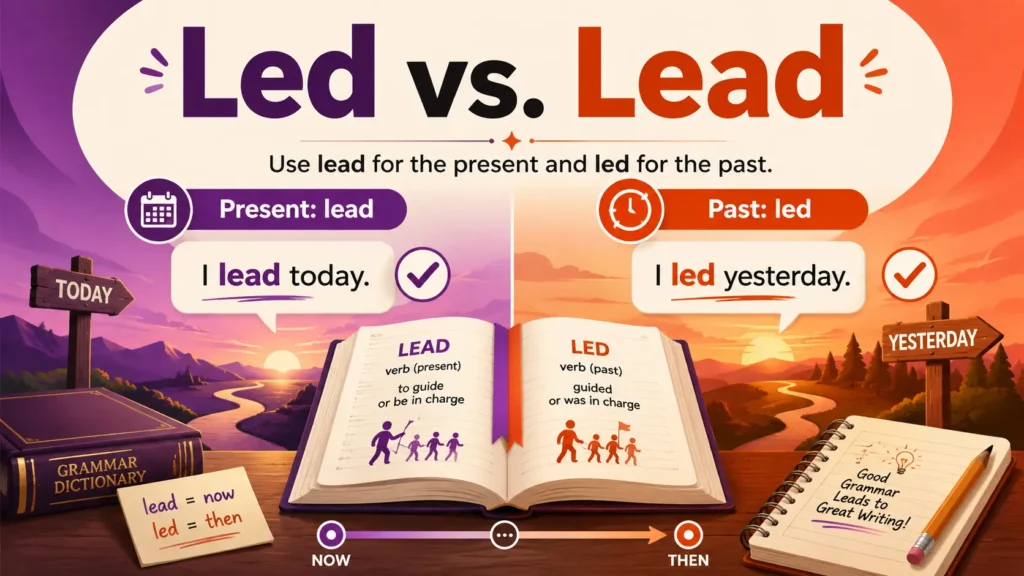
If you’ve ever wondered whether to write led vs. lead, you’re not alone. These two words are easy to confuse because lead has two different pronunciations, while led is the past tense of the verb lead. The correct choice depends on the word’s meaning, grammatical role, and tense.
Quick answer: Use lead when you mean “to guide” or “to direct” in the present or future: I lead the team or I will lead the team. Use led for the past tense: I led the team yesterday. However, lead can also be a noun meaning an advantage or the heavy metal, and in those cases it’s pronounced like led.
This guide explains led vs. lead in detail, including pronunciation, verb forms, common mistakes, professional examples, memory tricks, and related words.
Quick Answer: Led vs. Lead
The easiest way to remember the difference is to focus on time when lead means “guide” or “direct.”
- Lead — present or base form, pronounced “leed”
- I lead the marketing team.
- Leads — present tense with he, she, or it
- She leads the marketing team.
- Led — past tense and past participle, pronounced “led”
- She led the marketing team last year.
- Will lead — future form
- She will lead the marketing team tomorrow.
- Has/have/had led — perfect forms
- She has led several successful projects.
There are also two important noun meanings of lead:
- Lead = an advantage in a race, game, competition, or other contest.
- Our team has the lead.
- Lead = a heavy metal, pronounced “led.”
- The old paint contained lead.
So, when the verb means “to guide,” the basic rule is:
Present: lead
Past: led
Led vs. Lead at a Glance
| Word | Pronunciation | Part of Speech | Meaning | Example |
| lead | “leed” | Verb | To guide or direct | I lead the team. |
| leads | “leeds” | Verb | Present form with he, she, or it | She leads the team. |
| led | “led” | Verb | Past tense of lead | She led the team yesterday. |
| led | “led” | Past participle | Used with has, have, or had | He has led the team before. |
| lead | “led” | Noun | An advantage | We have the lead. |
| lead | “led” | Noun | A heavy metal | The paint contains lead. |
The most important detail is the pronunciation. Lead doesn’t always sound the same.
When lead means “guide,” it sounds like need. When lead means an advantage or the metal, it sounds like led.
What Does Lead Mean?
The word lead has several meanings. However, the most common use is as a verb meaning to guide, direct, manage, or be in charge of someone or something.
When used this way, lead is pronounced /liːd/, like need or feed.
Lead as a verb
You can use lead when someone guides people, manages a group, directs an activity, or takes responsibility for something.
For example:
- I lead a team of five employees.
- She leads the sales department.
- They lead weekly meetings.
- Who will lead the discussion?
- Good teachers lead students by example.
- The coach hopes to lead the team to victory.
In each case, lead means to guide or direct.
The word can also describe a cause-and-effect relationship:
- Poor planning can lead to delays.
- Lack of sleep may lead to poor concentration.
- Regular practice can lead to better performance.
Here, lead to means cause or result in.
Lead in the present tense
The basic present-tense forms are:
- I lead
- You lead
- He leads
- She leads
- It leads
- We lead
- They lead
Notice that leads is used with third-person singular subjects.
Correct: She leads the department.
Incorrect: She lead the department.
However, the form changes when you’re talking about the past.
She led the department last year.
What Does Led Mean?
Led is the simple past tense and past participle of the verb lead when it means “to guide,” “direct,” or “be in charge.”
Unlike lead as a verb, led is pronounced like red.
Examples include:
- She led the team to victory.
- He led the meeting yesterday.
- The teacher led the students through the exercise.
- Our manager led the project last year.
- The scientist led the research team.
- They led us to the correct building.
Each sentence describes an action that happened in the past.
Compare these sentences:
Present: She leads the team.
Past: She led the team.
Future: She will lead the team.
This simple comparison explains the most common use of led vs. lead.
Why Are Led and Lead So Confusing?
The confusion comes from both spelling and pronunciation.
First, the past tense of the verb lead isn’t spelled lead. It’s spelled led.
Second, the word lead has two pronunciations.
Lead meaning “to guide”
Lead = pronounced “leed”
She will lead the meeting.
Lead meaning “an advantage”
Lead = pronounced “led”
Our team has the lead.
Lead meaning the metal
Lead = pronounced “led”
The old paint contained lead.
Led as the past tense
Led = pronounced “led”
She led the meeting yesterday.
Therefore, lead and led can sound exactly alike in some situations.
That’s why pronunciation alone isn’t always enough to determine the spelling. You need to consider the meaning and grammatical role of the word.
The Key Difference Between Lead and Led
When you’re using the verb that means “to guide” or “direct,” the difference is mainly about tense.
| Time | Correct Form | Example |
| Present | lead | I lead the team. |
| Present, third person | leads | She leads the team. |
| Past | led | She led the team yesterday. |
| Future | will lead | She will lead the team tomorrow. |
| Present perfect | has/have led | She has led the team before. |
| Past perfect | had led | She had led the team before. |
| Infinitive | to lead | She wants to lead the team. |
| -ing form | leading | She is leading the team. |
The key rule is simple:
Lead is the base form.
Led is the past tense and past participle.
Lead vs. Led Across Verb Tenses
Understanding the verb forms makes it much easier to choose the correct word.
Present tense: Lead or Leads
Use lead for the base form and with I, you, we, and they.
I lead a team of designers.
They lead weekly meetings.
Use leads with he, she, and it.
She leads the marketing department.
He leads the discussion.
Simple past: Led
Use led for completed actions in the past.
I led the meeting yesterday.
She led the project last year.
They led the company through a difficult period.
The subject doesn’t change the past-tense form.
I led
You led
He led
She led
We led
They led
Future: Will Lead
After will, use the base form lead.
I will lead the meeting tomorrow.
She will lead the training session next week.
They will lead the project.
A common mistake is writing will led.
Incorrect: He will led the discussion.
Correct: He will lead the discussion.
Present perfect: Has or Have Led
Use led after has or have.
She has led several successful projects.
They have led the organization for years.
I have led teams in both small and large companies.
Past perfect: Had Led
Use led after had.
She had led the team before becoming director.
They had led the project for two years before it ended.
When to Use Lead as a Verb
Use lead when you mean guide, direct, manage, or take charge.
To guide people
The tour guide will lead us through the museum.
To manage a team
I lead a team of eight employees.
To direct a meeting
Sarah will lead the meeting.
To take responsibility
He wants to lead the new project.
To cause a result
Poor communication can lead to misunderstandings.
To guide someone toward a place
This path will lead you to the main entrance.
The exact meaning changes slightly with context, but the central idea is usually direction or guidance.
When to Use Led as the Past Form of Lead
Use led when someone guided, directed, or managed something in the past.
For example:
She led the team during the company’s expansion.
The teacher led a discussion about the novel.
Our manager led the project to completion.
The coach led the team to a championship.
If the action is clearly finished, led is usually the right choice.
However, led can also appear in a perfect tense:
She has led the department for three years.
Here, has provides the present-tense auxiliary verb, while led is the past participle.
Lead as a Noun: An Advantage
The word lead isn’t always a verb. It can also be a noun meaning an advantage or position ahead.
In this sense, lead is pronounced like led.
Examples
- Our team has the lead.
- She took the lead in the final lap.
- The company is in the lead.
- He lost his lead in the second half.
- The runner built a comfortable lead.
This meaning appears frequently in sports, elections, competitions, business, and other situations involving a comparison or contest.
Common expressions with lead
You may hear these expressions in everyday American English:
- take the lead
- have the lead
- hold the lead
- lose the lead
- build a lead
- extend the lead
- maintain the lead
- be in the lead
For example:
The home team took the lead in the fourth quarter.
Here, lead means an advantage in the score.
In business, you might read:
The company has a significant lead over its competitors.
In this sentence, lead means an advantage over competing companies.
Lead as a Noun: The Heavy Metal
Another meaning of lead is the chemical element, a heavy metal with the symbol Pb.
In this sense, lead is pronounced like led.
Examples include:
- The old paint contained lead.
- The pipes were tested for lead.
- The building was inspected for lead.
- Children should not be exposed to unsafe levels of lead.
This meaning has nothing to do with the verb lead, even though the spelling is identical.
Compare:
The teacher will lead the class.
Here, lead means “guide” and is pronounced leed.
The old paint contains lead.
Here, lead refers to the metal and is pronounced led.
The surrounding words tell you which meaning is intended.
Pronunciation: Lead vs. Led
Pronunciation is one of the biggest reasons these words cause confusion.
Lead as a verb: “leed”
When lead means “to guide” or “direct,” pronounce it like need.
Lead → /liːd/
Examples:
- lead a team
- lead a meeting
- lead a project
- lead a discussion
Led: “led”
Led → /lɛd/
It rhymes with red, bed, and said.
Examples:
- She led the team.
- He led the meeting.
- They led the discussion.
Lead as a noun: “led”
When lead means an advantage or the metal, pronounce it like led.
The team has the lead.
The paint contains lead.
This is why the spelling lead can’t be pronounced correctly without considering context.
Lead vs. Led in Real-Life American English
The difference appears in many everyday situations.
At work
I lead the customer support team.
This describes a current responsibility.
I led the customer support team last year.
This describes a past responsibility.
I will lead the team during the upcoming project.
This describes a future responsibility.
On a resume
Past accomplishments commonly use led:
Led a cross-functional team of 12 employees.
Led a successful product launch.
Led research on customer behavior.
For a current role, the present form may be appropriate:
Lead a team of 12 employees.
The correct form depends on whether the responsibility is current or belongs to a previous position.
At school
Ms. Garcia leads the science club.
Mr. Brown led the class discussion yesterday.
The student will lead the presentation tomorrow.
In sports
Our team leads by five points.
Our team led by five points at halftime.
Our team has a five-point lead.
These three sentences use related words in different grammatical roles.
In everyday conversation
Who will lead the group?
Jenna led us through the museum.
Our group is in the lead.
The first two use the verb. The third uses the noun.
Common Mistakes With Led and Lead
Mistake: Using lead as the past tense
Incorrect: She lead the team last year.
Correct: She led the team last year.
The action happened in the past, so the correct form is led.
Mistake: Using led after will
Incorrect: He will led the meeting.
Correct: He will lead the meeting.
The modal verb will is followed by the base form of the verb.
Mistake: Using lead after has or have
Incorrect: She has lead several projects.
Correct: She has led several projects.
The past participle is led, not lead.
Mistake: Confusing the verb and noun
She leads the team.
Here, leads is a verb.
She has the lead.
Here, lead is a noun meaning an advantage.
Mistake: Assuming lead always sounds like “leed”
That’s not true.
Lead the team. → “leed”
The team has the lead. → “led”
The paint contains lead. → “led”
Context determines the pronunciation.
How to Remember the Difference Between Led and Lead
A few simple memory tricks can make this word pair much easier.
Use the time test
Ask yourself:
Is this happening now or in the future?
Use lead.
I lead the team.
I will lead the team.
Ask:
Did this happen in the past?
Use led.
I led the team yesterday.
Remember the pronunciation
When the verb means guide, lead sounds like need.
lead → leed
When talking about the past, led sounds like red.
led → led
Use the three-time shortcut
Today: I lead.
Yesterday: I led.
Tomorrow: I will lead.
This is one of the easiest ways to remember the basic verb distinction.
Watch for helping verbs
Some words can quickly tell you which form you need.
- will lead
- to lead
- can lead
- should lead
- has led
- have led
- had led
For example:
She will lead the team.
She has led the team.
The helping verb provides a useful clue.
A Practical Decision Guide for Choosing Lead or Led
When you’re unsure, follow these steps.
First, ask what the word means.
If it means guide or direct, you’re dealing with the verb lead.
Next, check the tense.
- Present/base form → lead
- Third-person singular present → leads
- Past → led
- Future → will lead
- Perfect tenses → has/have/had led
Then, check whether it’s a noun.
If it means an advantage, use lead.
If it refers to the metal, use lead.
Finally, check pronunciation:
- Guide or direct → lead, pronounced “leed”
- Past tense → led, pronounced “led”
- Advantage → lead, pronounced “led”
- Metal → lead, pronounced “led”
Related Forms of Lead
Understanding related words can help you recognize the word family.
Leads
Leads is the third-person singular present form of lead.
She leads the department.
He leads the team.
Leading
Leading is the present participle and can also function as a gerund.
She is leading the meeting.
Leading a team requires patience.
Leader
A leader is a person who guides or manages others.
She is an effective leader.
Leadership
Leadership refers to the ability, role, or process of guiding others.
Strong leadership can improve team performance.
These words are related, but they aren’t interchangeable.
She leads the team.
She is the team’s leader.
Her leadership is highly respected.
Synonyms for Lead
The best synonym depends on the context.
When lead means “guide”
Possible alternatives include:
- guide
- direct
- steer
- conduct
- escort
The teacher guided the students through the activity.
When lead means “manage”
Possible alternatives include:
- manage
- supervise
- oversee
- run
- head
She manages the marketing department.
When lead means “cause”
Possible alternatives include:
- cause
- result in
- contribute to
- bring about
Poor planning can result in delays.
When lead means “be ahead”
Possible alternatives include:
- be ahead
- have an advantage
- be in first place
- dominate
The team is ahead by five points.
However, these synonyms aren’t always perfect replacements. The best choice depends on the sentence and intended meaning.
Quick Reference: Correct Examples
Here are the main patterns to remember:
- I lead the team.
- She leads the team.
- She led the team yesterday.
- She will lead the team tomorrow.
- She has led the team before.
- She had led the team for two years.
- She is leading the team now.
- She wants to lead the team.
- Our team has the lead.
- The old paint contained lead.
These examples cover the most common uses of lead, leads, led, and leading.
Frequently Asked Questions About Led vs. Lead
Is “led” the past tense of “lead”?
Yes. Led is the simple past tense and past participle of lead when the verb means “to guide,” “direct,” or “be in charge.”
Present: She leads the team.
Past: She led the team.
Should I use lead or led for something that happened yesterday?
Use led.
She led the meeting yesterday.
Because the action happened in the past, led is the correct form.
Is it “will lead” or “will led”?
The correct phrase is will lead.
He will lead the meeting tomorrow.
After will, use the base form of the verb.
Is it “has led” or “has lead”?
The correct phrase is has led.
She has led several successful projects.
Here, led is the past participle of lead.
Why does “lead” sometimes sound like “led”?
The word lead has different meanings and pronunciations. As a verb meaning “to guide,” it’s pronounced leed. As a noun meaning an advantage or the heavy metal, it’s pronounced led.
Is lead a noun or a verb?
It can be both.
As a verb, lead means to guide, direct, or manage.
She leads the team.
As a noun, lead can mean an advantage or the heavy metal.
The team has the lead.
The paint contains lead.
What is the difference between lead and led in a sentence?
When lead means “guide,” it generally refers to the present or base form of the verb.
I lead the team.
Led is the past form.
I led the team yesterday.
However, lead can also be a noun, so the context matters.
How do you pronounce lead and led?
When lead means “guide,” pronounce it “leed.”
When led is the past tense, pronounce it “led,” like red.
When lead means an advantage or the metal, pronounce it “led.”
Can lead mean an advantage?
Yes. As a noun, lead can mean an advantage in a competition, race, game, election, or business situation.
Our team has the lead.
She took the lead in the race.
What is the easiest way to remember led vs. lead?
Use this simple pattern:
Today: I lead.
Yesterday: I led.
Tomorrow: I will lead.
Then remember that lead as a noun can also mean an advantage or the metal, and both of those meanings are pronounced like led.
Conclusion: Lead or Led?
The difference between led vs. lead becomes much clearer when you look at tense and meaning. When lead means “to guide,” “direct,” or “manage,” use lead for the base or present form and led for the past tense. For example, you might say, “I lead the team today,” but “I led the team yesterday.”
Also, remember that lead has two pronunciations. As a verb meaning to guide, lead sounds like “leed.” As a noun meaning an advantage or the heavy metal, lead sounds like “led.” If you check the tense, grammatical role, and context, you’ll usually know whether lead or led is the correct choice.
The simplest rule to keep in mind is this: lead today, led yesterday, and will lead tomorrow. That one pattern will help you avoid most common mistakes with these confusing words.

1 thought on “Led vs. Lead: What’s the Difference? Meaning, Pronunciation, Grammar, and Examples”