
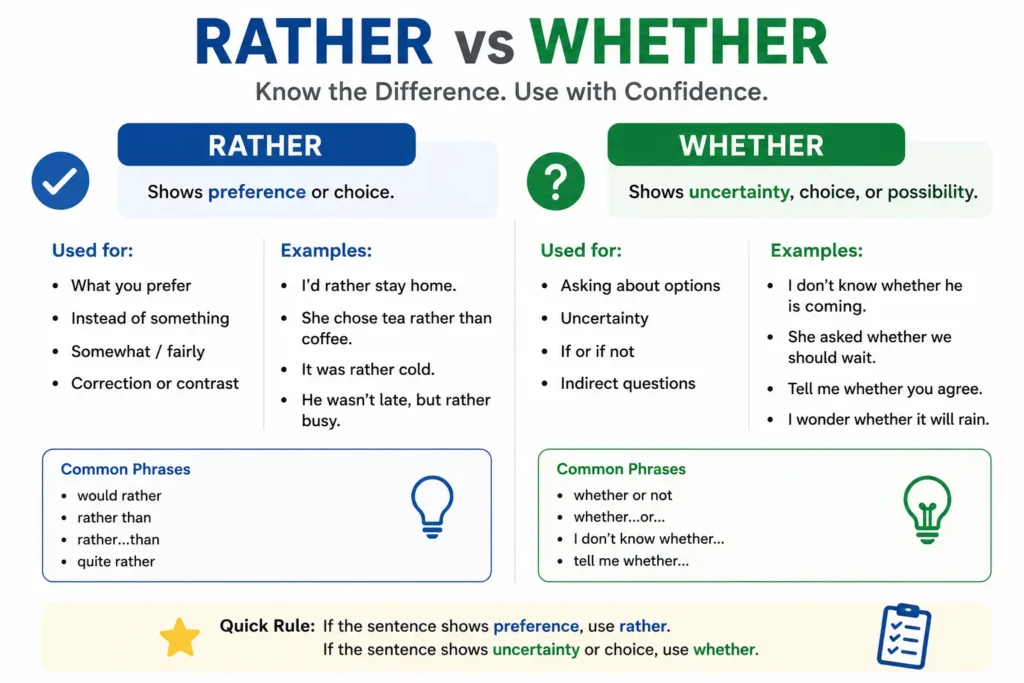
When writing, many people have paused and wondered which word to use: rather or whether. You are not alone because these words look different, but they appear in similar sentences, which can confuse learners. If you feel confused, the short answer is this: rather shows preference or choice, while whether shows doubt, options, or uncertainty.
In my experience, this confusion usually happens in emails, exams, and daily communication, where one wrong sentence can make the meaning unclear. The correct way depends on knowing the exact role each word plays. Use rather when you want to indicate what someone prefers, and use whether when you want to introduce two possible options or express uncertainty. On the other hand, rather can often show a contrasting idea, while whether typically helps you ask about a possibility.
This guide will help you learn the difference and the small differences between their uses and meanings in a simple, clear, and easy way. With practical rules, examples, and helpful tips, you will know exactly when each word is appropriate, how to clarify your meaning, and how to choose the proper word without second-guessing yourself by the end of this article as we explore each unique use.
Rather or Whether: Quick Answer
Use rather when you want to show preference.
Use whether when you want to show uncertainty or choice.
| Word | Main Use | Simple Meaning | Example |
| Rather | Preference, degree, correction, or contrast | Preferably, somewhat, instead | I’d rather wait. |
| Whether | Choice, possibility, or indirect question | If, if or not | I don’t know whether she’ll call. |
Here’s the easiest rule:
Rather tells what you prefer. Whether shows what is possible.
That one sentence will fix most mistakes.
Read this also: Shined vs Shone: Difference, Meaning, and Correct Usage
Use “Rather” for Preference
You use rather when someone prefers one thing over another.
Examples:
- I’d rather drink tea.
- She’d rather work from home.
- We’d rather leave early.
- They’d rather not talk about it.
In these examples, the speaker has a preference. The sentence does not show uncertainty. It shows a choice the speaker already prefers.
Use “Whether” for Choice or Uncertainty
You use whether when something is unclear, undecided, or possible.
Examples:
- I don’t know whether he is coming.
- She asked whether we needed help.
- We must decide whether to continue.
- Tell me whether you agree.
In these sentences, the speaker does not show preference. Instead, the speaker asks about a possibility.
What Does “Rather” Mean?
Rather is usually an adverb. It can show preference, degree, correction, or contrast.
That sounds like a lot, but don’t worry. Most people use rather in a few common ways.
You may use it to say:
- what you prefer
- what you would choose instead
- that something is somewhat true
- that you want to correct or clarify an idea
Examples:
- I’d rather wait.
- It was rather cold.
- She chose tea rather than coffee.
- It wasn’t a failure, but rather a lesson.
Each sentence uses rather differently. However, none of them shows uncertainty in the same way whether does.
Rather as a Word of Preference
The most common phrase is would rather.
It means would prefer to.
Examples:
- I would rather sleep early.
- He would rather drive.
- She would rather study alone.
- I’d rather be honest than comfortable.
The structure is simple:
Subject + would rather + base verb
Correct examples:
- I’d rather go.
- She’d rather eat.
- We’d rather stay.
- They’d rather wait.
Avoid adding to after would rather.
Incorrect:
- I’d rather to go.
- She’d rather to eat.
Correct:
- I’d rather go.
- She’d rather eat.
This mistake happens often because many English phrases use “to” before a verb. But would rather does not need it.
“Rather Than” Means “Instead Of”
The phrase rather than compares two choices. It means instead of.
Examples:
- I’ll walk rather than wait.
- She chose water rather than soda.
- He studied rather than guessed.
- We should solve the problem rather than blame others.
This phrase shows a clear preference.
| Sentence | Meaning |
| I chose tea rather than coffee. | I preferred tea. |
| She worked rather than complained. | She chose action. |
| We saved money rather than spent it. | We chose saving. |
| He listened rather than argued. | He chose listening. |
Try to keep both sides of the sentence balanced.
Better:
- She prefers reading rather than watching TV.
- He decided to wait rather than to complain.
Awkward:
- She prefers reading rather than to watch TV.
- He decided to wait rather than complaining.
Good grammar should feel smooth. If the sentence sounds bumpy, check whether both parts match.
Rather as a Word of Degree
Rather can also mean somewhat, fairly, or quite.
Examples:
- The test was rather easy.
- The room felt rather warm.
- The answer was rather surprising.
- His tone sounded rather serious.
This use often softens a statement.
Compare these sentences:
| Sentence | Feeling |
| The room was cold. | Direct |
| The room was rather cold. | Softer but still clear |
| The room was very cold. | Strong |
| The room was freezing. | Very strong |
The phrase rather cold does not always mean extremely cold. It often means “more cold than expected.”
This use can sound polite. For example, instead of saying “Your answer is confusing,” you might say, “Your answer is rather confusing.”
That still makes the point. It just lands more gently.
Rather as Correction or Clarification
Sometimes rather corrects an idea.
Examples:
- He wasn’t angry, but rather disappointed.
- It wasn’t a mistake, but rather a poor decision.
- The problem is not price, but rather trust.
- This is not a complaint, but rather a suggestion.
This use sounds formal and polished. It works well in essays, reports, emails, and professional writing.
The phrase but rather is useful when you want to correct something without sounding harsh.
Example:
- The issue is not the product, but rather the way it was explained.
That sentence feels balanced. It does not attack. It clarifies.
Common Phrases with “Rather”
Many English speakers use rather in fixed phrases. Learn these as chunks.
| Phrase | Meaning | Example |
| Would rather | Would prefer | I’d rather stay home. |
| Rather than | Instead of | Choose quality rather than speed. |
| Or rather | More accurately | He lives in Dallas, or rather, near Dallas. |
| But rather | Instead / more correctly | It’s not luck, but rather discipline. |
| Rather good | Quite good | The food was rather good. |
| Rather difficult | Somewhat difficult | The question was rather difficult. |
These phrases cover most uses of rather in daily writing.
What Does “Whether” Mean?
Whether is a conjunction. It connects a sentence to a choice, possibility, or question.
You use whether when something is uncertain.
Examples:
- I don’t know whether she agrees.
- He asked whether the store was open.
- We need to decide whether to continue.
- She wondered whether the answer was correct.
In simple language, whether often means if. However, it does not always work the same way as if.
That detail matters.
You can say:
- I don’t know if he is coming.
- I don’t know whether he is coming.
Both sound fine.
But you should say:
- We discussed whether to continue.
Not:
- We discussed if to continue.
So, while if and whether overlap sometimes, whether is safer when your sentence involves a clear choice or decision.
Whether as a Word for Choices
Use whether when a sentence includes two or more possible outcomes.
Examples:
- I can’t decide whether to stay or leave.
- We need to know whether the office is open.
- She wondered whether the plan would work.
- He asked whether Monday or Tuesday was better.
Each sentence includes uncertainty.
The speaker needs an answer. The choice has not been fully settled.
| Sentence | What It Shows |
| I don’t know whether she’ll come. | Uncertainty |
| We must decide whether to rent or buy. | Choice |
| Tell me whether you agree. | Need for confirmation |
| She asked whether I was ready. | Indirect question |
If your sentence includes doubt, choice, or a missing answer, use whether.
Whether in Indirect Questions
A direct question asks something directly.
Example:
- Is she ready?
An indirect question places that question inside another sentence.
Example:
- I don’t know whether she is ready.
Notice the word order.
You do not write:
- I don’t know whether is she ready.
That is wrong because indirect questions use statement word order.
| Direct Question | Indirect Question |
| Is he coming? | I don’t know whether he is coming. |
| Did she call? | He asked whether she called. |
| Can we start? | We need to check whether we can start. |
| Will it rain? | I wonder whether it will rain. |
This rule is important. Many writers make the mistake of keeping direct question order.
Incorrect:
- She asked whether did he call.
- I don’t know whether is she ready.
Correct:
- She asked whether he called.
- I don’t know whether she is ready.
Whether With “Or Not”
The phrase whether or not means that both possible outcomes have been considered.
Examples:
- I’ll go whether or not it rains.
- We’ll continue whether or not they reply.
- She’ll attend whether or not her manager joins.
- The rule applies whether or not you agree.
In these sentences, the action will happen either way.
“I’ll go whether or not it rains” means:
- If it rains, I’ll go.
- If it does not rain, I’ll still go.
However, don’t use or not when it adds nothing.
Wordy:
- Please confirm whether or not you received the file.
Better:
- Please confirm whether you received the file.
The shorter version is clearer. Yoast readability favors cleaner sentences like that.
Use whether or not only when you want to stress both outcomes.
Common Phrases with “Whether”
Here are useful phrases with whether:
| Phrase | Use | Example |
| Whether or not | Both outcomes | I’ll attend whether or not he joins. |
| Whether to | Decision before an action | She asked whether to apply. |
| Whether A or B | Two choices | We must decide whether to rent or buy. |
| Regardless of whether | Outcome does not depend on condition | We’ll proceed regardless of whether they reply. |
| Depends on whether | Condition affects result | Success depends on whether the team follows the plan. |
These phrases appear often in emails, reports, essays, and everyday speech.
Rather vs Whether: Main Difference
The biggest difference is function.
Rather shows preference, degree, correction, or contrast. Whether introduces choice, uncertainty, or an indirect question.
| Feature | Rather | Whether |
| Grammar role | Usually an adverb | Conjunction |
| Main job | Shows preference or degree | Introduces choice or possibility |
| Common phrase | Would rather | Whether or not |
| Simple meaning | Preferably / somewhat / instead | If / if or not |
| Example | I’d rather wait. | I don’t know whether to wait. |
Look at these two sentences:
- I’d rather wait.
- I don’t know whether to wait.
The first sentence shows preference. The speaker prefers waiting.
The second sentence shows uncertainty. The speaker has not decided.
That is the real difference.
How to Use “Rather” in a Sentence
Use rather when you want to show what someone prefers, what someone chooses instead, or how strong something feels.
Would Rather + Verb
Examples:
- I’d rather leave early.
- She’d rather work alone.
- We’d rather eat at home.
- They’d rather not answer.
The phrase would rather sounds natural in conversation.
You can also use it politely.
Direct:
- I don’t want to talk.
Softer:
- I’d rather not talk about it.
Both sentences mean almost the same thing. The second one sounds calmer.
Rather Than + Noun or Verb
Examples:
- I chose water rather than soda.
- We focused on quality rather than speed.
- She called rather than texted.
- He explained rather than argued.
This phrase helps you compare two choices.
It also works well in advice.
Examples:
- Build skill rather than chase shortcuts.
- Ask questions rather than make assumptions.
- Fix the issue rather than hide it.
Short. Clear. Useful.
Rather + Adjective
Examples:
- The meeting was rather short.
- The price seems rather high.
- The instructions were rather confusing.
- The result was rather surprising.
This use gives your writing a careful tone. It softens strong opinions without making them weak.
Or Rather
Use or rather when you want to correct yourself.
Examples:
- He lives in New York, or rather, just outside New York.
- I finished the report, or rather, the first draft.
- The room was quiet, or rather, tense.
This phrase adds precision. It tells the reader, “Let me say that better.”
How to Use “Whether” in a Sentence
Use whether when your sentence includes a decision, possibility, or indirect question.
Whether + Subject + Verb
Examples:
- I don’t know whether she agrees.
- He asked whether we were ready.
- We need to check whether the file exists.
- They wondered whether the decision was final.
This structure appears after verbs like:
- know
- ask
- wonder
- decide
- check
- confirm
- discuss
- understand
Examples:
| Verb | Sentence |
| Know | I don’t know whether he called. |
| Ask | She asked whether I needed help. |
| Decide | We must decide whether the plan works. |
| Check | Please check whether the door is locked. |
| Confirm | Can you confirm whether the order shipped? |
This structure is especially useful in professional writing.
Whether To + Verb
Use whether to when someone needs to decide about an action.
Examples:
- I don’t know whether to apply.
- She couldn’t decide whether to accept the offer.
- We need to discuss whether to increase the budget.
- He asked whether to send the file today.
This pattern is clean and easy to read.
Wordy:
- I don’t know whether I should apply or not.
Better:
- I don’t know whether to apply.
The second sentence is shorter and clearer.
Whether A or B
Use this pattern when you compare two options.
Examples:
- We must decide whether to rent or buy.
- She asked whether Monday or Friday was better.
- I don’t know whether tea or coffee sounds better.
- They debated whether the issue was cost or timing.
This structure appears often in decision-making.
Business example:
- The team must decide whether to improve the current product or build a new one.
Academic example:
- The study examined whether feedback or repetition improved student performance.
Everyday example:
- I can’t decide whether pizza or pasta sounds better tonight.
Common Mistakes with Rather and Whether
Most mistakes happen because writers look at the words instead of their function.
So ask this first:
What job does this word need to do?
If the sentence shows preference, use rather. If it shows uncertainty, use whether.
Mistake: Using “Rather” Instead of “Whether”
Incorrect:
- I don’t know rather he is coming.
- She asked rather we needed help.
- We must decide rather to continue.
Correct:
- I don’t know whether he is coming.
- She asked whether we needed help.
- We must decide whether to continue.
These sentences need a word that introduces uncertainty. That word is whether.
Mistake: Using “Whether” Instead of “Rather”
Incorrect:
- I would whether stay home.
- She would whether eat later.
- He chose tea whether than coffee.
Correct:
- I would rather stay home.
- She would rather eat later.
- He chose tea rather than coffee.
These sentences show preference. That is the job of rather.
Read this also: Smooth vs Smoothe: Correct Spelling, Meaning, and Easy Examples
Mistake: Confusing “Whether” and “Weather”
Whether and weather sound alike, but they mean different things.
Weather means climate conditions.
Examples:
- The weather is cold today.
- Bad weather delayed the flight.
- We checked the weather before leaving.
Whether introduces choice or uncertainty.
Examples:
- I don’t know whether it will rain.
- She asked whether the flight was delayed.
- We need to decide whether to leave now.
| Word | Meaning | Example |
| Weather | Rain, sun, wind, temperature | The weather is beautiful. |
| Whether | Choice or possibility | I don’t know whether it will rain. |
A simple trick helps:
Weather is about the sky. Whether is about choice.
Mistake: Using “If” When “Whether” Is Better
Sometimes if and whether both work.
Examples:
- I don’t know if he is coming.
- I don’t know whether he is coming.
Both are common.
However, whether is better when the sentence includes a clear choice, formal decision, or “to.”
Better:
- We discussed whether to continue.
- She asked whether Monday or Tuesday was better.
- The result depends on whether the documents arrive today.
Awkward:
- We discussed if to continue.
- She asked if Monday or Tuesday was better.
- The result depends on if the documents arrive today.
Use whether after prepositions.
Correct:
- We talked about whether the plan would work.
- The decision depends on whether the client approves.
Avoid:
- We talked about if the plan would work.
- The decision depends on if the client approves.
Casual speech may bend this rule. Clean writing should not.
Real-Life Examples of Rather and Whether
Examples make grammar easier. Let’s compare both words in real situations.
Everyday Conversation
Rather:
- I’d rather eat now.
- She’d rather stay quiet.
- We’d rather take the train.
- I’d rather not argue.
Whether:
- I don’t know whether he’s home.
- She asked whether I was hungry.
- We’re deciding whether to go out.
- Tell me whether you need anything.
Notice the difference.
Rather sounds personal because it shows preference. Whether sounds uncertain because it points to a decision.
Emails
Emails need clear wording. One wrong word can make a message look careless.
Rather:
- I’d rather schedule the meeting for Friday.
- We would rather review the file before approval.
- I’d rather discuss this on a quick call.
Whether:
- Please confirm whether you received the document.
- Let me know whether Friday works for you.
- Could you check whether the payment went through?
Useful email examples:
| Situation | Better Sentence |
| Asking for confirmation | Please confirm whether the file was received. |
| Giving preference | I’d rather schedule the call after lunch. |
| Asking about availability | Let me know whether you’re available tomorrow. |
| Choosing between options | Please decide whether to approve or revise the draft. |
Clear writing saves time. Confusing writing creates more emails.
Academic Writing
Academic writing needs precision.
Rather:
- The result was rather unexpected.
- The issue is not motivation, but rather access to resources.
- The study produced rather limited evidence.
Whether:
- The study examined whether feedback improved student performance.
- Researchers investigated whether sleep affects memory.
- The paper explores whether online learning increases engagement.
Academic writing often uses verbs like:
- examine
- investigate
- analyze
- determine
- assess
Examples:
- The study examined whether stress affects decision-making.
- The researchers assessed whether the method improved accuracy.
- The paper investigates whether motivation influences performance.
In these sentences, whether introduces the research question.
Business Writing
Business writing often deals with decisions. That makes whether very useful.
Rather:
- We should focus on retention rather than quick sales.
- I’d rather test one campaign properly than launch five weak ones.
- The problem is not pricing, but rather weak positioning.
Whether:
- We need to decide whether to increase the budget.
- The team should confirm whether the client approved the proposal.
- The report explains whether the campaign met its target.
| Business Situation | Correct Word | Sentence |
| Campaign decision | Whether | We need to decide whether to continue the campaign. |
| Preference | Rather | I’d rather improve the landing page first. |
| Strategy comparison | Rather | Choose better leads rather than more leads. |
| Confirmation | Whether | Please confirm whether the invoice was paid. |
Good business writing should remove doubt, not create it.
Social Media
Social media often uses would you rather questions because they invite comments.
Examples:
- Would you rather travel alone or with friends?
- Would you rather work from home or in an office?
- Would you rather have more time or more money?
These questions work because people enjoy choosing sides.
Now compare that with whether:
- I’m not sure whether this trend will last.
- I wonder whether people still read long captions.
- Let me know whether you agree with this.
Again, rather asks about preference. Whether points to uncertainty.
Rather Than vs Whether
This is where many writers get stuck.
Both words can appear near choices. Still, they do not mean the same thing.
Rather than shows a preferred choice.
Example:
- I chose tea rather than coffee.
The decision is already made. Tea won.
Whether introduces an undecided choice.
Example:
- I don’t know whether to choose tea or coffee.
The decision is still open.
| Sentence | Meaning |
| I chose tea rather than coffee. | The choice is made. |
| I don’t know whether to choose tea or coffee. | The choice is not made. |
| She studied rather than watched TV. | She chose studying. |
| She wondered whether to study or watch TV. | She was unsure. |
Here’s the key:
- Use rather than for preference or comparison.
- Use whether for uncertainty or decisions.
Whether vs If
Many people use if and whether in similar ways. Sometimes that works.
However, whether is often better in careful writing.
Use if for conditions.
Examples:
- If it rains, we’ll stay inside.
- If you call me, I’ll answer.
- If she studies, she’ll pass.
Use whether for choices and indirect questions.
Examples:
- I don’t know whether it will rain.
- We must decide whether to stay inside.
- She asked whether studying would help.
| Use | Better Word | Example |
| Condition | If | If it rains, we’ll cancel the picnic. |
| Choice | Whether | We must decide whether to cancel the picnic. |
| Indirect question | Whether | I don’t know whether the picnic is canceled. |
| After preposition | Whether | We talked about whether to cancel it. |
| Before “to” | Whether | She asked whether to attend. |
Use Whether Before “To”
This rule is strong.
Correct:
- I don’t know whether to go.
- She asked whether to apply.
- We must decide whether to wait.
Incorrect:
- I don’t know if to go.
- She asked if to apply.
- We must decide if to wait.
Use whether to, not if to.
Use Whether After Prepositions
Use whether after words like about, on, and of.
Correct:
- We talked about whether the plan would work.
- Success depends on whether the team follows the process.
- There is doubt about whether the rule applies.
Awkward:
- We talked about if the plan would work.
- Success depends on if the team follows the process.
- There is doubt about if the rule applies.
Good writing chooses the cleaner structure.
Simple Case Study: Fixing a Bad Email
Look at this sentence:
“Please confirm rather the payment has been received.”
The meaning is easy to guess, but the grammar is wrong. The writer is asking for confirmation. That needs whether.
Better:
“Please confirm whether the payment has been received.”
Now look at this sentence:
“I would whether receive confirmation today.”
That is also wrong. The writer wants to show preference. That needs rather.
Better:
“I would rather receive confirmation today.”
Final version:
“Please confirm whether the payment has been received. I would rather receive confirmation today so we can close the file before the deadline.”
Now the message sounds professional and clear.
Simple Case Study: Fixing Academic Writing
A student writes:
“This research studies rather online learning improves student performance.”
That sentence does not work. The student introduces a research question, so the right word is whether.
Correct:
“This research studies whether online learning improves student performance.”
Now look at this sentence:
“The result was whether surprising.”
That is wrong too. The student describes the result. The right word is rather.
Correct:
“The result was rather surprising.”
Better version:
“This research studies whether online learning improves student performance. The result was rather surprising because students improved more in short guided sessions than in long independent lessons.”
Now both words do their correct jobs.
Simple Case Study: Fixing a Social Media Caption
A creator writes:
“Would you whether work from home or work in an office?”
That phrase is wrong. The correct phrase is would you rather.
Correct:
“Would you rather work from home or work in an office?”
Now compare this sentence:
“I don’t know rather remote work is better.”
This is also wrong. The writer shows uncertainty, so the correct word is whether.
Correct:
“I don’t know whether remote work is better.”
A better caption:
“Would you rather work from home or in an office? I don’t know whether remote work is better for everyone, but it clearly gives some people more control over their day.”
This version sounds natural and uses both words correctly.
How to Remember the Difference
Use these quick checks.
Choose rather if you mean:
- I prefer this.
- I choose this instead of that.
- Something is somewhat true.
- I want to correct or clarify something.
Choose whether if you mean:
- I don’t know.
- I need to decide.
- There are two options.
- The sentence could include “or not.”
| Meaning You Need | Word to Use |
| I prefer this | Rather |
| I don’t know | Whether |
| I must decide | Whether |
| I choose this instead of that | Rather |
| I’m asking if something is true | Whether |
| Something is fairly true | Rather |
Remember this line:
Rather is about preference. Whether is about possibility.
Quick Sentence Test
You can test your sentence by replacing the word.
If rather means prefer, somewhat, or instead, it may be correct.
Examples:
- I’d rather stay.
- I’d prefer to stay.
Works.
- The room was rather cold.
- The room was somewhat cold.
Works.
If whether means if or whether or not, it may be correct.
Examples:
- I don’t know whether she’ll come.
- I don’t know if she’ll come.
Works.
- We must decide whether to continue.
- We must decide whether or not to continue.
Works, although the shorter version is better.
Read this also: Persue or Pursue: Correct Spelling, Meaning, and Easy Examples
Practice Exercise: Choose the Correct Word
Choose rather or whether.
| Sentence | Answer |
| I don’t know ___ she is ready. | whether |
| I’d ___ leave now. | rather |
| She asked ___ we needed help. | whether |
| He chose tea ___ than coffee. | rather |
| We must decide ___ to continue. | whether |
| The meeting was ___ short. | rather |
| Please confirm ___ the file was sent. | whether |
| I’d ___ not discuss it today. | rather |
| They wondered ___ the shop was open. | whether |
| The issue is not price, but ___ trust. | rather |
Now read the completed sentences:
- I don’t know whether she is ready.
- I’d rather leave now.
- She asked whether we needed help.
- He chose tea rather than coffee.
- We must decide whether to continue.
- The meeting was rather short.
- Please confirm whether the file was sent.
- I’d rather not discuss it today.
- They wondered whether the shop was open.
- The issue is not price, but rather trust.
The pattern is clear. Preference takes rather. Uncertainty takes whether.
Practice Exercise: Fix the Mistakes
| Incorrect Sentence | Correct Sentence |
| I don’t know rather he called. | I don’t know whether he called. |
| She would whether stay home. | She would rather stay home. |
| We discussed if to continue. | We discussed whether to continue. |
| He chose coffee whether than tea. | He chose coffee rather than tea. |
| Please check rather the door is locked. | Please check whether the door is locked. |
| The answer was whether surprising. | The answer was rather surprising. |
| I asked if Monday or Tuesday was better. | I asked whether Monday or Tuesday was better. |
| They’d whether not wait. | They’d rather not wait. |
Practice helps because the same mistake appears in different forms.
FAQs About Rather and Whether
Rather shows preference, degree, or contrast. Whether introduces uncertainty, possibilities, or a choice between options.
Would rather means “would prefer to.” Use the base verb after it, as in: “I’d rather stay home.”
They are sometimes interchangeable, but whether is preferred before “to,” after prepositions, and when presenting clear alternatives.
No. Use rather for preference and whether for doubt or choice: “I’d rather go” versus “I don’t know whether to go.”
Remember: rather is about preference, while whether is about possibility. This simple rule prevents most common mistakes.
Final Takeaway
When writing, many people pause over rather or whether because both words appear in similar sentences. The short answer is simple: rather shows preference, while whether shows doubt, options, or uncertainty.
In emails, exams, and daily communication, one wrong word can make the meaning unclear. Use rather when you want to indicate what someone prefers. Use whether when you want to introduce two possible choices or express uncertainty.
The difference becomes clear with examples. “I’d rather stay home” shows a choice. “I don’t know whether to stay home” shows doubt. Once you know the role each word plays, you can use both proper words without confusion.

1 thought on “Rather or Whether: Meaning, Difference, and Correct Usage”