
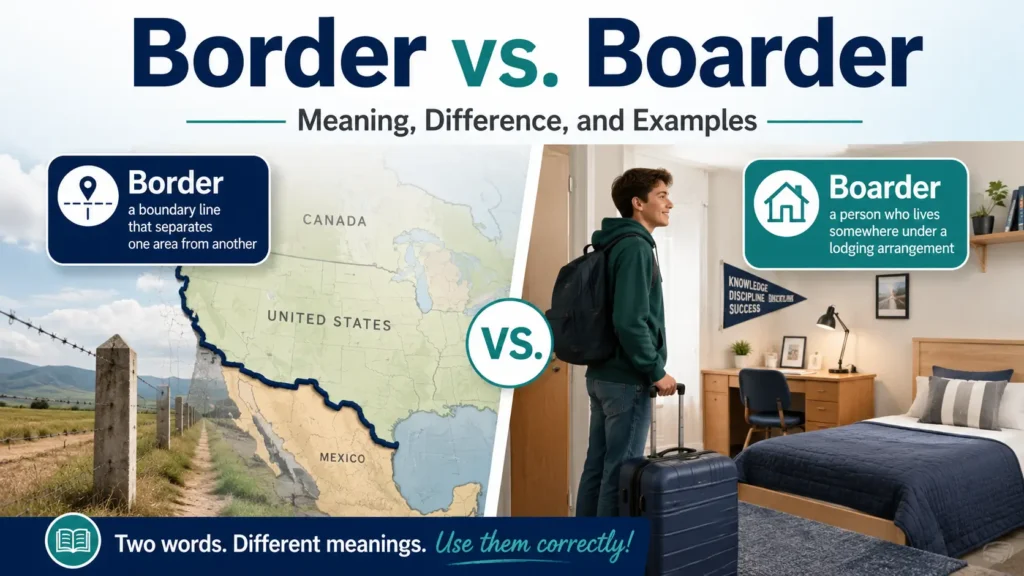
Understanding border vs. boarder is important because these words look similar and often sound alike, yet they have completely different uses. The border meaning relates to a boundary, dividing line, outer edge, or limit, such as the line between two countries or the frame around a picture.
The boarder meaning, however, refers to a person who lives somewhere under a lodging arrangement, often with meals included. Learning the difference between border and boarder helps prevent mistakes in schoolwork, emails, travel writing, and everyday communication. Clear border examples include national boundaries, property lines, and decorative frames, while useful boarder examples involve boarding-school students or people renting rooms.
Although they may sound like English homophones in some accents, context makes the correct choice clear. Remembering the phrase room and board also makes boarder easier to identify and use correctly. This simple distinction improves clarity, accuracy, and professional writing.
Quick Difference Between Border and Boarder
| Word | Meaning | Part of speech | Example |
| Border | A boundary, edge, or dividing line | Noun and verb | The river forms the border between the two countries. |
| Boarder | A person who pays for lodging | Noun | The school has 100 boarders. |
Use border when referring to a line, edge, or limit.
Use boarder when referring to a person who lives at a school, boarding house, or rented property.
Read this also: Infront or In Front: Correct Spelling, Meaning, and Examples
What Does Border Mean?
Examples:
- The two countries share a long border.
- They live near the state border.
- A fence marks the property border.
- The invitation has a decorative border.
- Flowers grow along the garden border.
A border may be official, such as the boundary between two countries, or decorative, such as a line around a photograph.
Border as a Verb
Border can also be used as a verb meaning “to be next to” or “to form an edge around something.”
Examples:
- Canada borders the United States.
- The farm borders a national park.
- Trees border both sides of the road.
- White flowers border the walkway.
In these examples, one place or object is located directly beside another.
Common Uses of Border
Country or State Border
A country border separates one nation from another, while a state or regional border separates smaller political areas.
Examples:
- Travelers waited at the border crossing.
- The river forms part of the state border.
- The town is located near the Canadian border.
Common expressions include:
- Border control
- Border crossing
- Border security
- Border region
- Border dispute
Property Border
A property border marks the legal or physical edge of someone’s land.
Examples:
- The wall stands along the property border.
- A surveyor measured the exact boundary.
- Their land borders a protected forest.
Page, Picture, or Design Border
A border can also be a line or decorative frame around a page, image, poster, or design.
Examples:
- Add a thin border around the photograph.
- The certificate has a gold border.
- The designer changed the button border.
Garden Border
A garden border is the edge of a flower bed, lawn, or path.
Examples:
- Small stones form a border around the garden.
- Tulips grow along the garden border.
- A brick border keeps the soil in place.
Border On
The phrase border on means to come close to having a particular quality.
Examples:
- His comment bordered on rudeness.
- The situation borders on being dangerous.
- Her response bordered on sarcasm.
What Does Boarder Mean?
A boarder is a person who lives somewhere under an arrangement that usually includes lodging and may also include meals.
The word comes from the expression room and board:
- Room means accommodation.
- Board means meals.
A boarder may be:
- A student living at a boarding school
- A person renting a room in a private home
- Someone living in a boarding house
- A lodger who receives accommodation and meals
The important point is that boarder refers to a person, not a boundary or edge.
Common Uses of Boarder
Boarder at a Boarding School
A student who lives at school during the academic term is called a boarder.
Examples:
- The school has both boarders and day students.
- Each boarder has a room in the dormitory.
- Boarders eat their meals in the dining hall.
- Weekend activities are organized for boarders.
A day student attends classes but returns home afterward.
Boarder in a Private Home
A boarder may also rent a room in another person’s home.
Examples:
- The family rented the spare room to a boarder.
- The boarder paid rent every month.
- Breakfast was included in the boarder’s agreement.
In modern English, words such as lodger, roomer, or tenant may also be used. However, these words do not always have exactly the same meaning.
A boarder commonly rents a room and may receive meals. A tenant usually rents a property under a tenancy agreement.
Boarder in a Boarding House
A boarding house is a property where people rent rooms and may receive meals.
Examples:
- The boarding house had six boarders.
- Each boarder had a private room.
- The boarders ate dinner together.
This use is less common in everyday conversation today, but it remains correct.
Border or Boarder: How to Choose
Ask one simple question:
Does the word describe a line or a person?
Use border for:
- Countries
- States and regions
- Maps
- Property
- Pages and pictures
- Gardens
- Edges and limits
Use boarder for:
- Boarding-school students
- People renting rooms
- Boarding-house residents
- People receiving room and board
Compare:
- The border between the countries follows the river.
- The boarder lives in the upstairs room.
The first sentence refers to a boundary. The second refers to a person.
Read this also: Laid Out vs Layed Out: Correct Spelling, Meaning, and Examples
Common Mistakes
Using Boarder for a Country Boundary
Incorrect:
They crossed the boarder at night.
Correct:
They crossed the border at night.
A country has a border, not a boarder.
Using Border for a Person
Incorrect:
The school has 200 borders.
Correct:
The school has 200 boarders.
Students who live at a boarding school are boarders.
Confusing Boarder With Tenant
A boarder and a tenant may both pay for accommodation, but the terms are not always interchangeable.
A boarder usually rents a room and may receive meals or other household services. A tenant normally rents a house, apartment, or other property under a rental agreement.
Easy Memory Tips
Border Means Boundary
Both border and boundary begin with the letter b.
Think:
A border shows where something begins or ends.
Boarder Contains Board
The word boarder contains board, as in room and board.
Think:
A boarder is a person who receives room and board.
Line or Person?
Use this quick test:
- A line or edge = border
- A person = boarder
Example Sentences With Border
- The river marks the border between the two regions.
- We crossed the border before sunset.
- A wooden fence surrounds the border of the property.
- The photograph looks better with a white border.
- Their farm borders a national park.
- Her remarks bordered on being offensive.
Example Sentences With Boarder
- The new boarder moved into the spare bedroom.
- Each boarder must follow the school’s dormitory rules.
- The family welcomed a boarder into their home.
- Boarders eat breakfast in the main dining hall.
- The boarding house provides meals for its boarders.
- The boarder pays monthly for the room.
Read this also: Rather or Whether: Meaning, Difference, and Correct Usage
Frequently Asked Questions
A border is a boundary, edge, or dividing line.
A boarder is a person who pays for lodging and may receive meals.
Use border for the line separating two countries, states, or regions.
Example: “The river forms the border between the two countries.”
A boarder is a student who lives at school during the academic term.
A student who returns home after classes is called a day student.
Yes, border is a noun for a boundary and a verb meaning “to lie next to.”
Example: “The farm borders a protected forest.”
Remember that border means boundary, while boarder relates to room and board.
Use border for a line or edge and boarder for a person.
Final Summary
The border vs. boarder rule becomes easy once you connect each word with its correct context. The border definition covers a boundary, edge, dividing line, or something that lies beside another place. A country border separates nations, while a property border marks the edge of land. In contrast, the boarder definition describes a person who receives lodging, such as a boarding-school student or someone renting a room in a private home. The phrase room and board is the most useful memory clue because it directly connects boarder with accommodation and meals. Before choosing either word, ask whether the sentence describes a line or a person. This quick check supports correct word choice, improves readability, and prevents an otherwise small spelling difference from changing the entire meaning of a sentence.
