
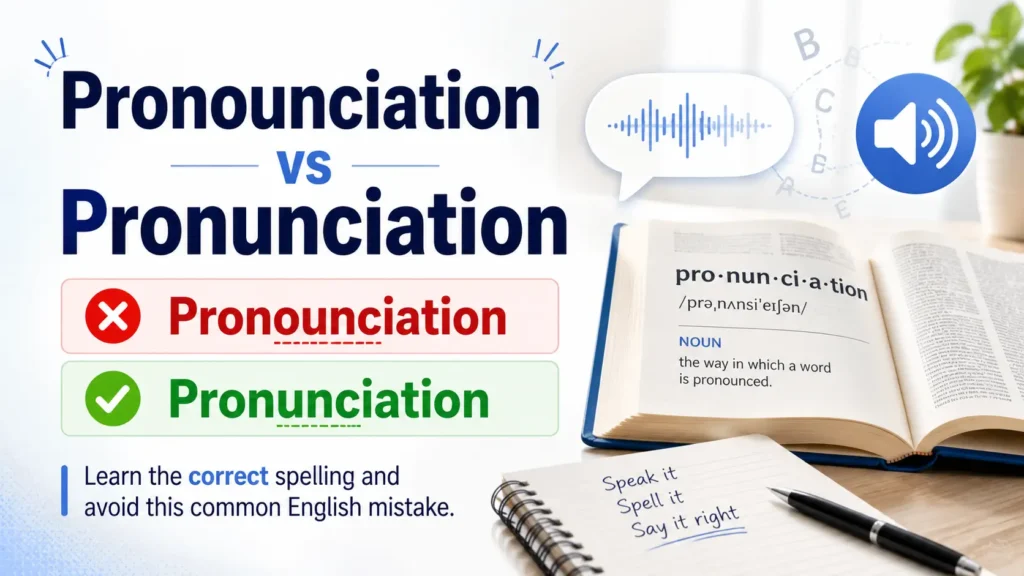
Pronounciation vs pronunciation is a common spelling confusion in English. The correct word is pronunciation, while pronounciation is a misspelling. The mistake happens because the verb pronounce contains “ou,” but the noun pronunciation does not. This small spelling change often confuses students, writers, professionals, and even native English speakers.
The correct spelling is pronunciation. Pronounciation is a common misspelling and is not recognized as a standard English word. Knowing the difference is important because using the correct spelling makes your writing more professional, improves your grammar, and helps you communicate with confidence.
In this guide, you’ll learn why pronunciation is correct, why so many people mistakenly write pronounciation, how to remember the spelling, and how to use the word correctly with simple examples and grammar tips.
Quick Answer: Pronounciation or Pronunciation?
The correct spelling is pronunciation.
Pronunciation means the way a person says a word, including its sounds, stress, and rhythm.
Pronounciation is an incorrect spelling. It usually appears because people connect the noun with pronounce, which contains an “o” after the “n.”
| Form | Status | Example |
| Pronunciation | ✅ Correct | Your pronunciation of the word is excellent. |
| Pronounciation | ❌ Incorrect | Your pronounciation of the word is excellent. |
The mistake usually doesn’t change what a sentence means, but it can make writing look less accurate or professional.
What Does Pronunciation Mean?
Pronunciation is a noun that describes how a word, phrase, or language is spoken.
It includes several important parts:
- Individual sounds in a word
- Stress placed on certain syllables
- Rhythm and flow of speech
- The way sounds connect during conversation
Two people can use the same word but pronounce it differently because they have different accents. The written spelling stays the same even when the spoken sound changes.
For example:
“Schedule” can have different pronunciations in American and British English.
Many American English speakers say:
SKED-jool
Many British English speakers say:
SHED-yool
Both are accepted pronunciations.
Pronunciation as a Part of Speech
The word pronunciation is a noun. It names the act, manner, or result of pronouncing something.
| Word | Part of Speech | Meaning | Example |
| Pronounce | Verb | To say a word or sound | Please pronounce this name correctly. |
| Pronunciation | Noun | The way a word is spoken | Her pronunciation is clear. |
| Pronounced | Adjective/verb form | Clearly noticeable or spoken | He has a pronounced accent. |
A common mistake is using pronounce where the sentence needs the noun pronunciation.
❌ Incorrect:
I need to improve my pronounce.
✅ Correct:
I need to improve my pronunciation.
The first sentence incorrectly uses a verb where a noun is required.
Pronounciation vs Pronunciation: What Is the Difference?
The difference between pronounciation and pronunciation is straightforward:
One is correct. The other is a spelling mistake.
| Word | Status | Meaning | Example |
| Pronunciation | Correct | The way a word is spoken | The teacher explained the pronunciation of the new word. |
| Pronounciation | Incorrect | Common misspelling | Pronounciation is not the standard spelling. |
Unlike many confusing English word pairs, these spellings don’t represent two different meanings.
There is no standard-English situation where pronounciation should replace pronunciation.
Why Do People Write Pronounciation Instead of Pronunciation?
The mistake makes sense when you look at the related verb.
The verb is:
Pronounce
Many learners naturally assume the noun should be:
Pronounce → Pronounciation
However, English word formation doesn’t follow that pattern here.
The correct change is:
Pronounce → Pronunciation
The extra “o” disappears.
The Influence of the Word Pronounce
Most of the confusion comes from the close relationship between pronounce and pronunciation.
Compare:
- I pronounce the word correctly.
- My pronunciation is correct.
Because the words are closely connected, writers may copy the spelling pattern of the verb when writing the noun.
English has many related words that change form:
| Verb | Noun |
| Decide | Decision |
| Describe | Description |
| Define | Definition |
| Pronounce | Pronunciation |
This change is part of normal English word formation.
Why Does Pronunciation Drop the “O”?
English words sometimes change when suffixes are added.
The ending -tion appears in many nouns formed from verbs. When pronounce becomes pronunciation, its spelling changes to form the standard noun.
Think of the word as:
Pro + nun + ci + a + tion
Not:
Pro + noun + ci + a + tion
That small spelling difference is easy to miss because pronounce and pronunciation are closely related in meaning.
How to Spell Pronunciation Correctly Every Time
Many learners remember how a word sounds but still struggle to spell it.
A few simple tricks can make pronunciation easier to remember.
Memory Trick: Remove the Extra “O”
Remember this sentence:
I pronounce words, but I check my pronunciation.
The verb has the extra “o.”
The noun doesn’t.
Pronounce → Pronunciation
Break the Word Into Parts
Instead of trying to memorize the whole word at once, divide it:
Pro-nun-ci-a-tion
Avoid thinking:
Pro-nounce-iation
That second pattern leads directly to the common misspelling.
How to Pronounce the Word Pronunciation
The spelling and sound of pronunciation can feel confusing because it doesn’t sound exactly like pronounce.
In American English, you can roughly represent it as:
pro-nun-see-AY-shun
The main stress falls near the “a” sound:
pro-nun-ci-A-tion
Breaking the word into smaller parts can also help:
pro | nun | ci | a | tion
Learning the sound alongside the spelling makes the correct form easier to remember.
Pronunciation vs Pronounce: Understanding the Difference
Although pronunciation and pronounce belong to the same word family, they perform different jobs in a sentence.
| Word | Type | Use |
| Pronounce | Verb | Describes the action of saying something |
| Pronunciation | Noun | Describes how something is said |
Pronounce Example
Can you pronounce my last name?
The sentence asks someone to perform an action.
Pronunciation Example
Your pronunciation of my last name is correct.
The sentence talks about how the name was spoken.
Correct and Incorrect Examples of Pronunciation Usage
Examples make the difference easier to remember.
Correct Examples
✅ The pronunciation of this medical term is difficult.
The sentence refers to the way the term is spoken.
✅ She improved her English pronunciation through daily practice.
Here, pronunciation is the noun describing speaking ability.
✅ The dictionary includes audio to help with pronunciation.
The sentence refers to the way words should sound when spoken.
Incorrect Examples
❌ I want to improve my English pronounciation.
✅ I want to improve my English pronunciation.
❌ His pronounce is very clear.
✅ His pronunciation is very clear.
❌ Can you pronunciation this word?
✅ Can you pronounce this word?
Common Mistakes Related to Pronunciation
Mistake 1: Adding an Extra “O”
The most common spelling error is:
❌ Pronounciation
instead of:
✅ Pronunciation
This usually happens because writers copy the spelling of pronounce.
Mistake 2: Confusing Pronunciation With Accent
People sometimes treat pronunciation and accent as if they mean the same thing.
They don’t.
Pronunciation refers to how speech sounds or words are produced.
Accent refers to a recognizable style of speech influenced by region, culture, or language background.
For example, someone can speak with a clear American, British, Pakistani, Indian, or regional accent while still using accurate pronunciation.
Having an accent doesn’t automatically mean your pronunciation is incorrect.
Mistake 3: Focusing Only on Spelling
Pronunciation isn’t only a spelling topic.
It also relates to spoken language.
A person may spell pronunciation perfectly but still need practice saying difficult words clearly.
Why Pronunciation Matters in American English
Clear pronunciation helps other people understand you more easily.
It can make a noticeable difference in school, work, interviews, travel, and everyday communication.
| Situation | Why Pronunciation Helps |
| School | Helps with presentations and reading aloud |
| Work | Improves meetings and professional communication |
| Interviews | Creates clearer conversations |
| Travel | Makes everyday interactions easier |
| Language learning | Builds confidence when speaking |
Clear pronunciation doesn’t mean removing your accent.
The real goal is understandable speech.
If listeners can follow what you’re saying without unnecessary difficulty, your pronunciation is doing its job.
How to Improve Your Pronunciation Skills
Improving pronunciation takes regular practice rather than memorizing one complicated rule.
Listen to Native Speakers
Pay attention to:
- Word stress
- Connected sounds
- Rhythm
- Natural speaking speed
- How sounds change in normal conversation
Listening trains your ear to recognize speech patterns.
Practice Difficult Words Slowly
Break longer words into smaller sections.
For example, instead of rushing through:
pronunciation
practice:
pro-nun-ci-a-tion
Once each part feels comfortable, gradually say the whole word at a natural speed.
Use Audio Dictionaries
Many dictionaries include recordings of words.
These can help you compare:
- Correct sounds
- Stress patterns
- American pronunciation
- British pronunciation
- Variations between accents
Record Yourself Speaking
Recording yourself can reveal pronunciation problems that are difficult to notice while you’re speaking.
Say a word or sentence aloud, record it, and compare your version with a trusted pronunciation model.
Small differences become much easier to hear this way.
Related Words That Often Cause Confusion
Pronunciation vs Enunciation
Pronunciation and enunciation are related, but they aren’t identical.
Pronunciation focuses on producing the sounds of a word correctly.
Enunciation focuses on saying words clearly enough for listeners to distinguish them.
For example:
A person may pronounce a word correctly but enunciate poorly if they speak too quietly or mumble.
Pronunciation vs Intonation
Intonation refers to changes in the pitch of your voice while speaking.
For example, the voice often rises when someone asks a yes-or-no question.
Pronunciation, by contrast, focuses primarily on how words and sounds are spoken.
Pronunciation vs Spelling
Spelling refers to written letters.
Pronunciation refers to spoken sounds.
English makes this distinction especially important because spelling and pronunciation don’t always match perfectly.
A word may have difficult spelling but relatively simple pronunciation.
Quick Practice: Choose the Correct Word
Choose pronunciation or pronounciation.
- Her English ______ improved after months of practice.
- The teacher corrected my ______ of the difficult word.
- Correct ______ is important for clear communication.
Answers
- Pronunciation
- Pronunciation
- Pronunciation
The answer is the same each time because pronounciation is not the correct standard spelling.
Conclusion
The correct spelling is pronunciation, while pronounciation is a common misspelling that should be avoided in standard English. The confusion happens because the verb pronounce contains an extra “o,” but the noun pronunciation does not. Although this mistake is widespread, remembering the correct spelling is simple once you understand the pattern.
Whether you’re a student, English learner, teacher, or professional, using pronunciation correctly will make your writing more accurate and polished. Keep this easy rule in mind: You pronounce words, but you improve your pronunciation. With regular practice and careful proofreading, you’ll avoid this common spelling mistake and communicate with greater confidence.
Frequently Asked Questions (FAQs)
Q1: Is pronounciation a correct English word?
No. Pronounciation is not a correct English word. It is a common misspelling. The correct spelling is pronunciation.
Q2: Which is correct: pronounciation or pronunciation?
Pronunciation is the correct spelling. It refers to the way a word is spoken. Pronounciation should not be used in formal or standard English.
Q3: Why do people spell pronunciation as pronounciation?
Many people mistakenly copy the spelling of the verb pronounce, which includes an extra “o.” However, when the word changes into the noun pronunciation, the extra “o” is dropped.
Q4: What does pronunciation mean?
Pronunciation is a noun that means the way a word, phrase, or language is spoken, including its sounds, stress, and rhythm.
Q5: Is pronunciation a noun or a verb?
Pronunciation is a noun. The related verb is pronounce.
Q6: How can I remember the correct spelling of pronunciation?
A simple memory trick is: You pronounce words, but you improve your pronunciation. Remember that the noun pronunciation does not contain the extra “o.”
Q7: Do American and British English spell pronunciation differently?
No. Both American English and British English use the same spelling: pronunciation. Only the way the word is spoken may vary slightly depending on the accent.
Q8: Is having good pronunciation the same as having no accent?
No. Having good pronunciation means your speech is clear and easy to understand. You can have a regional or foreign accent and still have excellent pronunciation.
Q9: How can I improve my English pronunciation?
You can improve your pronunciation by listening to native speakers, practicing difficult words aloud, using audio dictionaries, recording yourself, and speaking English regularly.
Q10: Why is correct pronunciation important?
Correct pronunciation helps people understand you more easily, improves communication, builds confidence, and creates a more professional impression in school, work, interviews, and everyday conversations.
Respond vs Response: Difference, Meaning, Grammar Rules, and Correct Usage
Persue or Pursue: Correct Spelling, Meaning, and Easy Examples
Shined vs Shone: Difference, Meaning, and Correct Usage
Smooth vs Smoothe: Correct Spelling, Meaning, and Easy Examples
