
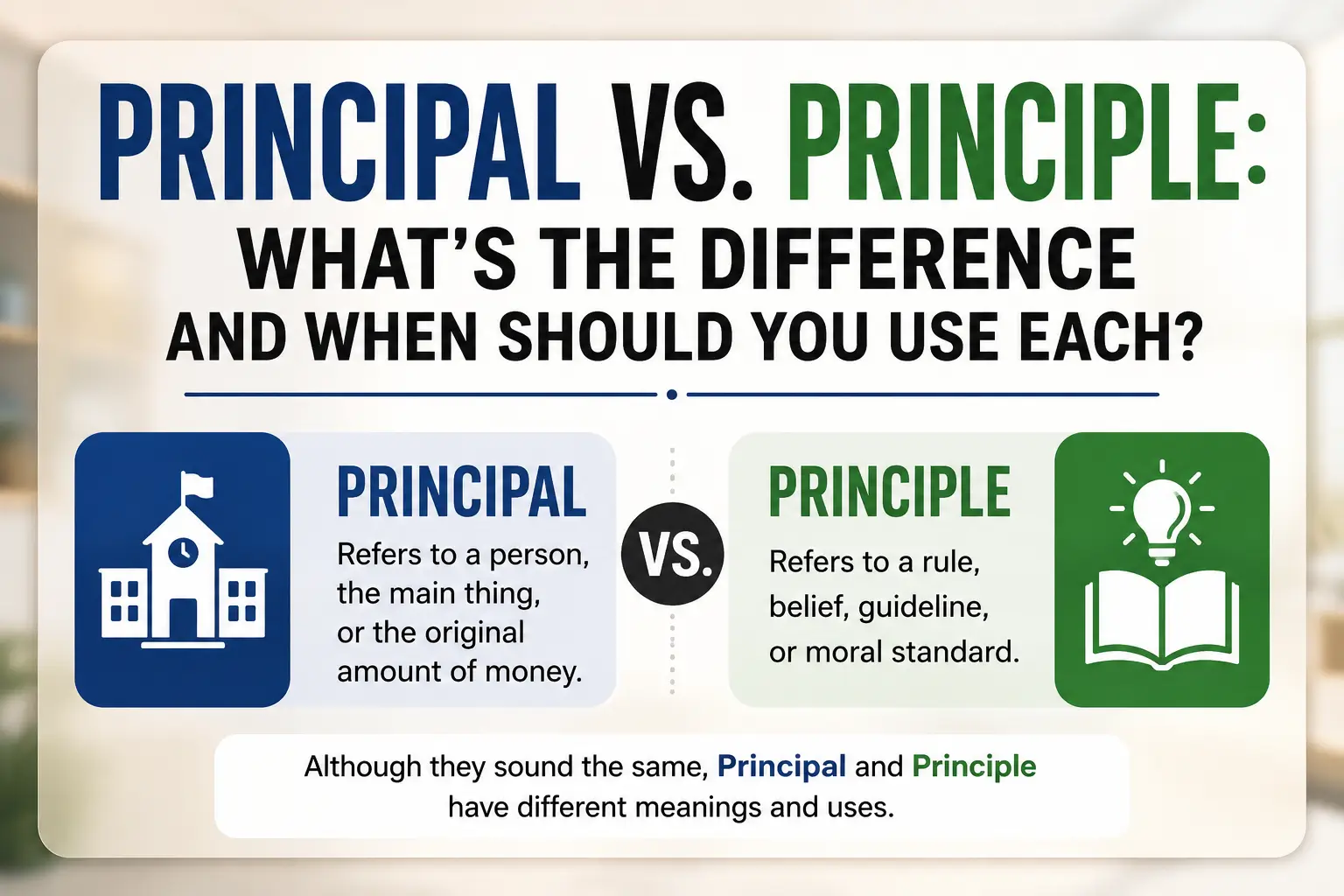
Principal vs. principle is one of the most searched commonly confused words in English grammar because both words sound the same but have very different meanings. If you’ve ever wondered which spelling is correct, you’re in the right place. This guide explains the difference between principal and principle, when to use each word, and how to avoid common mistakes in everyday writing.
Although principal and principle are homophones, they are not interchangeable. Principal can refer to a school leader, the main or most important thing, or the original amount of money in finance. Principle, however, means a rule, belief, guideline, or moral standard. Understanding the context is the easiest way to choose the correct word.
By the end of this guide, you’ll understand their meanings, grammar rules, real-life examples, memory tricks, and common mistakes. Whether you’re a student, writer, professional, or English learner, you’ll be able to use principal and principle correctly and write with greater confidence.
Quick Answer: Principal vs. Principle
The difference between principal and principle comes down to meaning, not pronunciation.
| Word | Meaning | Part of Speech | Example |
| Principal | The main person or thing; also a school leader or the original amount of money | Noun, Adjective | The principal welcomed new students. |
| Principle | A rule, belief, truth, or moral value | Noun | Honesty is an important principle. |
The easiest way to remember
- Principal = a person or something main.
- Principle = a rule or belief.
Quick examples
- ✅ The principal announced the school’s new policy.
- ✅ She always follows her principles.
- ✅ We paid off the loan’s principal.
- ❌ The school principle gave a speech.
- ❌ Honesty is an important principal.
What Does Principal Mean?
The word principal has more than one meaning. It can function as both a noun and an adjective, making it more flexible than principle.
Principal as a Noun
Most people first learn this meaning in school.
A principal is the head of a school, college, or educational institution. The principal oversees teachers, manages daily operations, enforces policies, and helps create a positive learning environment.
Examples
- The principal greeted students at the entrance.
- Our principal announced the graduation ceremony.
- Parents met with the principal to discuss the new rules.
Here, principal refers to a person with authority.
Besides education, principal can also refer to the main person involved in an activity.
Examples
- The company’s principal investor attended the meeting.
- She became the principal architect of the project.
- The principal witness testified in court.
In these examples, principal means the leading or most important person.
Principal in Finance
Another common meaning appears in banking, loans, and investments.
The principal is the original amount of money borrowed or invested before interest is added.
Example
If you borrow $20,000 for a car:
- Principal: $20,000
- Interest: Additional money charged by the lender
When you make loan payments, part of each payment reduces the principal, while another part pays interest.
Examples
- She paid an extra $500 toward the principal.
- The loan’s principal decreases every month.
- Investors try to protect their original principal.
This is one of the most common financial uses of the word.
Principal as an Adjective
As an adjective, principal means main, chief, or most important.
Examples
- Their principal concern is customer safety.
- The principal reason for the delay was bad weather.
- English is the principal language spoken in the office.
In these sentences, principal simply means primary or most significant.
Common Uses of Principal
You will often see principal in these situations:
- School principal
- Principal amount
- Principal balance
- Principal office
- Principal investigator
- Principal engineer
- Principal reason
- Principal objective
- Principal shareholder
- Principal source of income
Notice that every example refers to either the main person, the primary thing, or the original amount of money.
What Does Principle Mean?
Unlike principal, the word principle is always a noun.
A principle is a rule, belief, law, idea, or moral standard that guides actions or explains how something works.
People often talk about principles when discussing ethics, science, education, business, religion, or personal values.
Principle as a Moral Rule
Many people use principle when talking about right and wrong.
Examples
- Honesty is one of her strongest principles.
- They refused the offer because it violated their principles.
- Good leaders stay true to their principles.
Here, principle refers to moral beliefs.
Principle as a Basic Rule
A principle can also describe an accepted rule or fundamental idea.
Examples
- Gravity is a basic scientific principle.
- The course teaches the principles of economics.
- Every engineer should understand the principles of physics.
In these examples, principle means a foundational concept.
Principle in Everyday Life
You probably use principles every day, even if you don’t think about them.
Examples include:
- Respect others.
- Tell the truth.
- Arrive on time.
- Keep your promises.
- Treat everyone fairly.
These are personal or professional principles that guide behavior.
Common Uses of Principle
You’ll frequently encounter these expressions:
- Moral principle
- Guiding principle
- Basic principle
- Scientific principle
- Legal principle
- Religious principle
- Principle of fairness
- Principle of equality
- Principle of honesty
- Principle of supply and demand
Each phrase refers to a belief, rule, or fundamental truth.
Principal vs. Principle: Key Differences at a Glance
The easiest way to understand these confusing words is to compare them side by side.
| Feature | Principal | Principle |
| Part of Speech | Noun, Adjective | Noun only |
| Basic Meaning | Main person, primary thing, original loan amount | Rule, belief, moral value, law |
| Used for People? | Yes | No |
| Used in Finance? | Yes | No |
| Used in Ethics? | Rarely | Yes |
| Used in Science? | Sometimes as “main” | Frequently |
| Used in Schools? | Yes (school leader) | No |
| Example | The principal gave a speech. | Honesty is an important principle. |
When Should You Use Principal?
Use principal whenever you’re talking about someone or something that is first, chief, or most important.
It also applies when discussing finance or school administration.
Talking About Schools
This is probably the most familiar use.
Correct examples
- The principal congratulated the students.
- Our principal introduced the new teachers.
- Every student respects the principal.
Incorrect example
❌ The school principle welcomed everyone.
Why it’s wrong: A school leader is a principal, not a principle.
Talking About Business
Many companies use principal to describe leadership positions or important responsibilities.
Examples include:
- Principal consultant
- Principal engineer
- Principal partner
- Principal architect
Examples
- She was promoted to Principal Engineer.
- He serves as the company’s principal consultant.
- The principal shareholder owns 40% of the company.
Talking About Finance
Banks, lenders, accountants, and investors regularly use this word.
Examples
- Pay extra toward the principal to reduce interest.
- The principal remains unchanged unless you make payments.
- The investment protected the original principal.
Understanding this meaning is important because it affects loans, mortgages, and savings.
Using Principal as an Adjective
Whenever you mean main, chief, or primary, principal is usually the correct choice.
Examples
- The principal objective is customer satisfaction.
- Safety remains our principal concern.
- Their principal office is located in Chicago.
Notice that you could often replace principal with main without changing the meaning.
Key Takeaways So Far
- Principal refers to people, leadership, main importance, or original money.
- Principle refers to rules, beliefs, morals, and fundamental truths.
- Although they sound identical, their meanings are completely different.
- Looking at the context of the sentence is the easiest way to choose the correct word.
When Should You Use Principle?
Use principle when you’re talking about a rule, belief, value, law, or fundamental truth. Unlike principal, this word is always a noun. It never describes a person or acts as an adjective.
If you can replace principle with words like rule, belief, standard, or guideline, you’re probably using it correctly.
Talking About Rules and Ethics
Many people use principle when discussing morals or ethics. These principles guide decisions and behavior.
Examples
- She lives by the principle of honesty.
- Fairness is an important principle in every workplace.
- They refused to compromise their principles.
In each sentence, principle refers to a belief or moral standard.
Talking About Science
Scientists use principle to describe natural laws or established concepts.
Examples
- The principle of gravity explains why objects fall.
- Students learned the basic principles of chemistry.
- Newton’s principles changed modern physics.
Here, principle means a fundamental idea rather than a personal belief.
Talking About Personal Values
People often mention their principles when explaining why they make certain choices.
Examples
- My parents taught me strong principles.
- She never lies because it’s against her principles.
- Respect is one of his guiding principles.
These examples show how principles shape everyday decisions.
Principal vs. Principle in Real-Life Sentences
Looking at real examples makes the difference much easier to remember.
Correct Examples Using Principal
- The principal welcomed new students on the first day of school.
- Our principal concern is employee safety.
- She paid off the principal on her student loan.
- He’s the principal architect of the new building.
- The company’s principal office is in New York.
In every example, principal refers to a person, the main thing, or the original amount of money.
Correct Examples Using Principle
- Honesty is an important principle.
- The company operates on strong ethical principles.
- Students learned the basic principles of economics.
- Freedom of speech is a democratic principle.
- She acted according to her principles.
Each sentence uses principle to mean a rule, belief, or fundamental idea.
Incorrect Examples and Why They’re Wrong
Understanding mistakes is one of the fastest ways to learn.
| Incorrect Sentence | Correct Sentence | Why? |
| The school principle called my parents. | The school principal called my parents. | A school leader is a principal. |
| Honesty is my strongest principal. | Honesty is my strongest principle. | Honesty is a belief, not a person. |
| We paid extra toward the loan principle. | We paid extra toward the loan principal. | Finance uses principal. |
| Their principle office moved downtown. | Their principal office moved downtown. | It means main office. |
| She ignored her own principals. | She ignored her own principles. | Moral beliefs are principles. |
A simple question can help:
Are you talking about a person or something main? Use principal.
Are you talking about a rule or belief? Use principle.
Common Phrases and Expressions
Some expressions almost always use one specific word. Learning these common combinations can prevent mistakes.
Principal Amount
In finance, the principal amount is the original money borrowed or invested before interest.
Example
You borrow $15,000.
- Principal: $15,000
- Interest: Extra money charged by the lender
Sentence:
- I made an extra payment toward the principal amount.
Principal Balance
Banks often refer to the remaining unpaid loan as the principal balance.
Example
- Your monthly payment reduced the principal balance.
Principal Investigator
In universities and research projects, the principal investigator (PI) leads the study.
Example
- The principal investigator presented the research findings.
Principal Reason
This phrase means the main reason.
Examples
- Cost was the principal reason for the decision.
- Safety remains our principal concern.
Guiding Principles
A guiding principle is a belief that influences decisions.
Examples
- Integrity is one of our guiding principles.
- Transparency should be a guiding principle for every organization.
Moral Principles
These are beliefs about right and wrong.
Examples include:
- Honesty
- Respect
- Responsibility
- Kindness
- Fairness
Principles of Grammar
Grammar books often refer to the principles of grammar, meaning the basic rules of sentence structure and language.
Example:
- Learning the principles of grammar improves your writing.
Is It School Principal or School Principle?
The correct phrase is always:
✅ School principal
Never write:
❌ School principle
Why?
Because the word refers to the person who manages the school, not a rule or belief.
Correct Examples
- The school principal announced a new attendance policy.
- Students thanked the principal during graduation.
- The principal met with parents after school.
Is It Principal Amount or Principle Amount?
The correct term is:
✅ Principal amount
In banking and finance, principal means the original amount of money borrowed or invested.
Example
Suppose you borrow $50,000.
- Principal = $50,000
- Interest = Extra amount charged over time
Every loan has a principal, but no loan has a “principle amount.”
Is It Principle of or Principal of?
This is another common source of confusion.
Correct
- Principle of honesty
- Principle of fairness
- Principle of equality
- Principle of economics
- Principle of supply and demand
These phrases discuss ideas or beliefs.
Correct Use of Principal of
Use principal of only when referring to a person in charge.
Examples:
- Principal of Lincoln High School
- Principal of the academy
Notice how the meaning changes completely depending on the word you choose.
Principal vs. Principles vs. Principals
Plural forms often confuse learners just as much as the singular forms.
| Word | Meaning |
| Principal | One leader, one main thing, or one original loan amount |
| Principals | More than one leader or main person |
| Principle | One rule or belief |
| Principles | Multiple rules or beliefs |
Examples of Principals
- The conference welcomed several school principals.
- All the principals met with the superintendent.
Examples of Principles
- The company’s principles never change.
- Good principles build trust.
A helpful tip is to remember that principals are people, while principles are ideas.
Synonyms of Principal
The exact synonym depends on how the word is used.
When It Means “Main”
- Main
- Primary
- Chief
- Leading
- Major
- Primary
- Foremost
When It Means a Person
- Director
- Head
- Administrator
- Leader
- Supervisor
- Executive
Synonyms of Principle
These words are close in meaning, although each has its own nuance.
- Rule
- Belief
- Standard
- Value
- Doctrine
- Guideline
- Ideal
- Ethics
- Philosophy
- Conviction
Choose the synonym that best fits the context rather than replacing the word automatically.
Related Words
Understanding related words can strengthen your vocabulary.
| Word | Meaning |
| Principle | Rule or belief |
| Principal | Main person or thing |
| Principled | Guided by strong morals |
| Principally | Mainly or chiefly |
| Primary | First in importance |
| Ethics | Moral principles |
| Values | Personal beliefs |
| Doctrine | Set of beliefs |
Notice that principled comes from principle, not principal.
Example:
- She’s a highly principled leader.
Key Points to Remember
- Principal refers to people, leadership, importance, or finance.
- Principle refers to beliefs, rules, morals, and fundamental truths.
- Principal can be both a noun and an adjective.
- Principle is always a noun.
- In schools, banking, and business, you’ll usually encounter principal.
- In ethics, science, law, and personal values, you’ll almost always use principle.
Conclusion
Choosing between principal and principle becomes much easier once you understand what each word means. Principal usually refers to a person in charge, the main or most important thing, or the original amount of money in finance. Principle, on the other hand, always refers to a rule, belief, moral value, or fundamental truth. Although these words sound the same, they serve different purposes in English.
A simple way to remember them is to think about the context. If you’re talking about a school principal, a principal amount, or something primary, use principal. If you’re discussing ethics, laws, guidelines, or personal beliefs, use principle. Reading examples, practicing with real sentences, and learning a few memory tricks will help you avoid common grammar mistakes and use the correct word with confidence.
FAQs
Q1. What is the main difference between principal and principle?
The main difference is that principal refers to a person, the main thing, or the original amount of money, while principle refers to a rule, belief, law, or moral standard.
Q2. Is it school principal or school principle?
The correct term is school principal because a principal is the person who leads a school. Principle never refers to a person.
Q3. Is it principal amount or principle amount?
The correct phrase is principal amount. In finance, the principal is the original sum of money borrowed or invested before interest is added.
Q4. Can principal be both a noun and an adjective?
Yes. Principal can be a noun, such as a school principal, or an adjective meaning main, chief, or most important.
Q5. How can I easily remember the difference between principal and principle?
A popular memory trick is: “The principal is your pal.” Since a school principal is a person, remember that pal is inside principal. Use principle whenever you’re talking about a rule, belief, or moral value.