
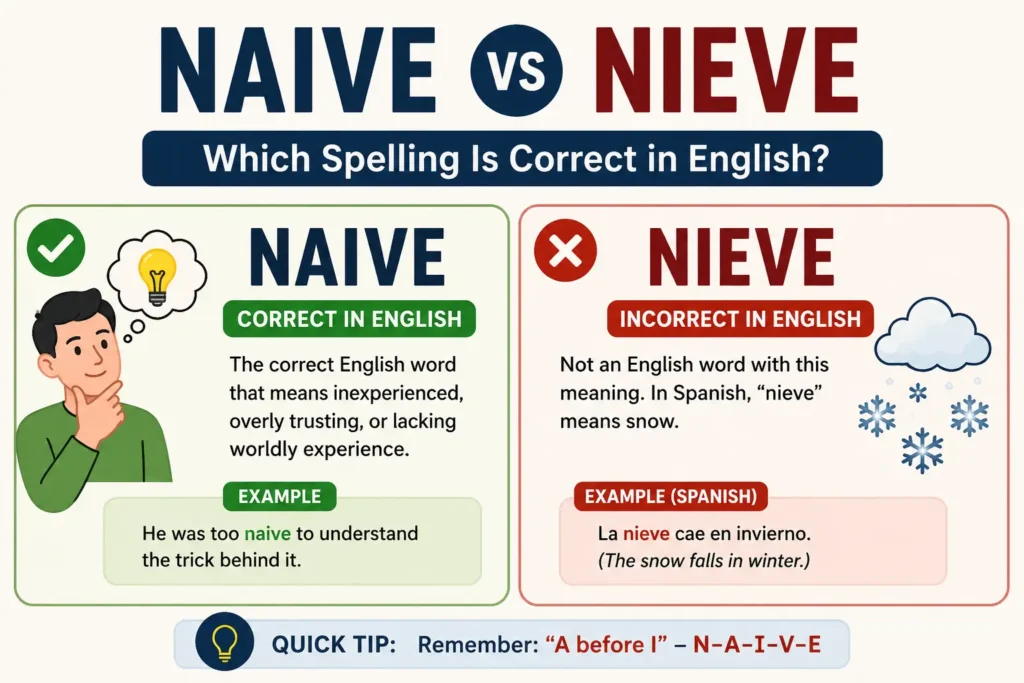
Naive vs nieve confuses many writers, but naive is the correct adjective in standard English for someone who lacks experience or trusts too easily. The word entered English through French, which explains its unusual spelling. Nieve is not the English form; in Spanish, it means snow.
Naive is pronounced “ny-EEV,” with both vowel sounds heard separately. Fast speech can make the two spellings seem alike, but sound does not decide the correct form. Use naive for a person, plan, belief, or assumption that shows limited experience: “a naive buyer” or “a naive plan.”
Correct spelling matters in emails, academic work, blog posts, and professional writing because mistakes can reduce clarity and credibility. A practical editing check is to picture naïve first: the a comes before the i. Remove the dots, but keep the letters in the same order. This memory trick helps students, writers, and English learners choose naive correctly every time.
Naive vs. Nieve: The Quick Answer
Use naive or naïve when describing someone or something that shows limited experience, unrealistic trust, or simple judgment.
Do not use nieve as a replacement for naive in English.
Quick rule: If you mean “inexperienced” or “too trusting,” write naive.
| Word | Correct in Standard US English? | Meaning | Example |
| naive | Yes | Inexperienced, overly trusting, or lacking practical judgment | She was naive about online scams. |
| naïve | Yes | The same as naive | It was naïve to expect no delays. |
| nieve | No, not for this meaning | “Snow” in Spanish; a fist in regional Scots | The Spanish word for snow is nieve. |
The words naive and nieve are not interchangeable. They have different spellings, meanings, and uses.
Read this also: LYT Meaning in Text: What Does LYT Mean?
What Does Naive Mean?
Naive is an adjective. An adjective describes a person, place, object, idea, or situation.
The word usually means that someone lacks experience or practical knowledge. It can also suggest that a person trusts others too easily.
For example:
- I was naive about how difficult the job would be.
- He was naive enough to believe the fake message.
- Their plan was based on a naive assumption.
In each sentence, naive points to limited experience, weak judgment, or an unrealistic expectation.
Naive Can Mean Inexperienced
The most common meaning of naive is “lacking experience.”
Someone may be naive because they haven’t faced a certain situation before. That doesn’t mean the person lacks intelligence.
Consider this sentence:
Maya was highly educated, but she was naive about office politics.
Maya may be intelligent and qualified. However, she lacks experience with workplace relationships and hidden motives.
Therefore, naive and unintelligent are not synonyms.
Naive Can Mean Too Trusting
The word can also describe someone who believes people too easily.
For example:
You’d be naive to send money to a stranger without checking the offer.
Here, naive suggests that the person is ignoring a clear risk. The issue isn’t only inexperience. It’s also excessive trust.
This meaning often appears when discussing:
- online scams
- dishonest sales tactics
- misleading advertisements
- false promises
- workplace manipulation
- financial fraud
- social media claims
Naive Can Describe an Idea or Assumption
People aren’t the only things that can be naive. You can also describe a plan, belief, argument, model, or expectation as naive.
Examples include:
- a naive assumption
- a naive business plan
- a naive view of human behavior
- a naive prediction
- a naive approach to security
For instance:
The budget was naive because it didn’t include repair costs.
The sentence criticizes the budget, not the person who created it. This wording is often more useful in professional or academic settings.
Naive Can Mean Simple or Unsophisticated
In some contexts, naive describes something simple, natural, or technically unsophisticated.
For example, naive art often uses simple forms, direct perspectives, and childlike detail. The term doesn’t necessarily insult the artist.
Likewise, a naive model in mathematics, computing, or research may use basic assumptions. Such a model can still be useful as a starting point.
Context determines whether the word sounds negative, neutral, or descriptive.
How Do You Pronounce Naive?
Naive is pronounced ny-EEV.
It has two syllables:
- ny
- EEV
The stress falls on the second syllable.
A simple pronunciation guide looks like this:
naive = ny-EEV
The word is not pronounced like nave, knave, or knife.
Why the Pronunciation Causes Confusion
The spelling looks unusual because the vowels a and i appear together. However, they belong to separate syllables.
Writers sometimes reverse the letters because the ie pattern looks more familiar in English. As a result, they write nieve.
That spelling may feel natural, but it’s wrong when the intended word is naive.
Pronunciation alone won’t always reveal the correct spelling. You need to remember the letter order:
n-a-i-v-e
Naive vs. Naïve: Are Both Spellings Correct?
Yes. Naive and naïve are both correct.
They have the same:
- meaning
- pronunciation
- grammatical function
- word history
The only difference is the pair of dots above the i in naïve.
| Spelling | Correct? | Pronunciation | Meaning |
| naive | Yes | ny-EEV | Inexperienced or overly trusting |
| naïve | Yes | ny-EEV | Inexperienced or overly trusting |
In everyday American English, naive is common because it’s easier to type. Many websites, emails, and digital documents leave out the special mark.
However, naïve remains fully correct.
What Are the Two Dots in Naïve?
The two dots are called a diaeresis.
A diaeresis tells the reader to pronounce two nearby vowels separately. In naïve, it shows that the a and i don’t form one blended sound.
Instead, the word has two clear vowel sounds:
na-ïve
The mark is not an umlaut in this context. Although the symbols look the same, they perform different jobs in different languages.
Which Spelling Should You Use?
For most US readers, naive is the simplest choice.
Use naïve when:
- your publication prefers traditional diacritical marks
- you want to show the original vowel separation
- your style guide requires it
- you’re writing in a context where accented forms are preserved
Whichever form you choose, remain consistent. Don’t switch between naive and naïve throughout the same document without a reason.
Is Nieve a Real Word?
Nieve is a real word, but it usually isn’t the English word you need.
In standard American English, nieve doesn’t mean inexperienced, innocent, or overly trusting. Therefore, you shouldn’t use it as a variant of naive.
Incorrect:
She was nieve about the contract.
Correct:
She was naive about the contract.
The first sentence contains a spelling error because the writer intends the English adjective naive.
Nieve in Spanish
In Spanish, nieve means snow.
For example:
La nieve cubrió las montañas.
This sentence means that snow covered the mountains.
In some Spanish-speaking regions, nieve may also refer to a frozen dessert. However, that meaning doesn’t make it an accepted spelling of naive in English.
Nieve in Scots
In regional Scots, nieve can mean a fist or closed hand.
That use is rare in modern American writing. Most US readers won’t recognize it without context.
Therefore, a sentence using the Scots meaning may need explanation:
He raised his nieve, meaning his clenched fist.
This regional definition is valid, but it has no connection to the adjective naive.
Why Do People Spell Naive as Nieve?
The spelling mistake is understandable. Still, that doesn’t make it correct.
Several factors cause confusion.
Writers Reverse the Vowels
The most obvious mistake is switching ai to ie.
Correct:
naive
Incorrect:
nieve
Many English words contain ie, so the incorrect form may look familiar. In contrast, the vowel sequence in naive looks unusual.
People Overuse the “I Before E” Rule
Many students learn the rhyme “i before e except after c.”
Unfortunately, that rhyme isn’t a reliable spelling rule. English has many exceptions, and it doesn’t explain words that entered English from other languages.
Because naive came into English through French, it doesn’t follow a simple native-English spelling pattern.
So, don’t change naive to nieve just because ie feels more familiar.
The Accent Mark Is Removed
Some writers first see the word as naïve. Later, they remember the pronunciation but not the correct letter order.
The correct process is simple:
naïve → naive
You remove the dots. You don’t rearrange the letters.
Autocorrect May Not Catch the Error
Spell-checking tools don’t understand every context.
A multilingual keyboard may recognize nieve as a valid Spanish word. Therefore, it may not mark the spelling as incorrect.
That’s why you should check meaning, not only spelling.
Ask yourself:
Am I talking about snow, a regional Scots fist, or a person’s lack of experience?
If you mean lack of experience, write naive.
How Naive Works in a Sentence
Because naive is an adjective, it usually modifies a noun or describes the subject of a sentence.
Several sentence patterns are especially common.
Naive Before a Noun
You can place naive directly before the noun it describes.
Pattern:
naive + noun
Examples:
- a naive employee
- a naive belief
- a naive question
- a naive plan
- a naive expectation
In this sentence, naive modifies assumption:
The report is based on a naive assumption.
Naive After a Linking Verb
A linking verb connects the subject to a description.
Common linking verbs include:
- be
- seem
- appear
- sound
- remain
Examples:
- The idea seems naive.
- Their expectations were naive.
- His response sounded naive.
- We remained naive about the danger.
In each case, naive describes the subject.
Naive About Something
The phrase naive about identifies the area in which someone lacks knowledge or experience.
Examples:
- She was naive about investing.
- They were naive about the legal risks.
- I was naive about how long the move would take.
- He’s naive about social media privacy.
This pattern is useful because it limits the criticism. It says the person is inexperienced in one area, not in every part of life.
Naive to Think, Believe, or Assume
Another common pattern is:
naive to + verb
Examples:
- It was naive to trust the caller.
- We were naive to expect an immediate answer.
- She was naive to assume the service was free.
- They were naive to believe the rumor.
The infinitive phrase explains the unrealistic belief or action.
Naive Enough To
The phrase naive enough to often highlights a mistake caused by excessive trust.
Example:
I was naive enough to share my password.
This construction can sound self-critical. However, it’s common in conversation because it admits a past mistake directly.
Is Naive an Insult?
Naive can sound insulting, but it isn’t always an insult.
Tone, context, and sentence structure all matter.
When Naive Sounds Harsh
Calling a person naive without explanation can sound dismissive.
For example:
You’re naive.
This sentence makes a broad judgment about the person. It doesn’t identify a specific idea, action, or area of inexperience.
A harsher example is:
Only a naive person would believe that.
The phrase suggests poor judgment and may embarrass the listener.
When Naive Is More Neutral
The word sounds less personal when it describes a specific situation.
For example:
I was naive about the hiring process.
The speaker admits limited experience in one area.
Likewise:
Our original forecast was naive.
This sentence criticizes the forecast rather than attacking the team.
Better Choices in Professional Feedback
In workplace or academic writing, direct labels can create unnecessary conflict.
Instead of saying:
Your plan is naive.
You could write:
The plan may underestimate the cost and legal risk.
Other professional alternatives include:
- inexperienced
- overly optimistic
- based on incomplete information
- unfamiliar with the process
- not fully aware of the risks
- too broad
- insufficiently supported
These phrases are often more precise. They explain the weakness instead of merely labeling it.
Naive vs. Innocent, Gullible, Ignorant, and Inexperienced
Several related words overlap with naive, but they don’t mean exactly the same thing.
| Word | Main Meaning | Usual Tone | Key Difference |
| naive | Lacking experience or practical judgment | Often negative | May suggest unrealistic trust |
| innocent | Free from guilt, harm, or worldly experience | Often positive or neutral | Doesn’t always suggest poor judgment |
| gullible | Easily tricked or deceived | Strongly negative | Focuses on believing false claims |
| ignorant | Lacking knowledge | Often harsh | Focuses on missing information |
| inexperienced | Having little experience | Neutral | Doesn’t imply foolishness |
| credulous | Too ready to believe | Formal and negative | Focuses on weak skepticism |
Naive vs. Gullible
A naive person lacks experience or practical judgment.
A gullible person is easily deceived.
The meanings overlap, but gullible is more specific and usually more negative.
He was naive about online investing.
This means he lacked experience.
He was gullible enough to believe a fake investment guarantee.
This means he accepted a false claim too easily.
Naive vs. Innocent
Innocent can mean free from guilt. It can also describe someone who lacks worldly experience.
However, the word often has a more positive tone than naive.
Her innocent question made everyone smile.
The question seems harmless or sincere.
Her naive question showed that she didn’t understand the process.
This version focuses on limited knowledge.
Naive vs. Ignorant
Ignorant means lacking knowledge about a subject.
Unlike naive, it doesn’t necessarily involve excessive trust.
He was ignorant of the new tax rule.
He didn’t know the rule.
He was naive to believe the rule didn’t apply to him.
He made an unrealistic assumption.
Also, ignorant often sounds harsher when it directly describes a person. Use it carefully.
Naive vs. Inexperienced
Inexperienced is usually the most neutral choice.
She’s inexperienced in contract negotiation.
This sentence simply states that she lacks practice.
She’s naive about contract negotiation.
This wording may suggest that she also underestimates the risks or trusts others too easily.
Correct Examples of Naive in Everyday English
The word appears in conversation, school, work, email, social media, and technical writing.
Everyday Conversation
I was naive enough to think the repair would cost only $50.
The speaker admits that the expectation was unrealistic.
He’s smart, but he’s naive about how people use personal information online.
The sentence separates intelligence from experience.
Maybe I’m naive, but I still believe they’ll apologize.
Here, the speaker recognizes that their hope may be unrealistic.
School and Academic Writing
The essay presents a naive view of economic inequality.
The adjective criticizes the argument’s lack of depth.
The researchers began with a naive model before adding more variables.
In this context, naive means basic or simplified. It doesn’t necessarily mean useless.
It would be naive to treat one survey as proof of a national trend.
The sentence warns against drawing a broad conclusion from weak evidence.
Work and Business
Our first sales estimate was too naive.
The estimate failed to account for real conditions.
The proposal relies on a naive assumption about customer loyalty.
This sentence identifies the exact weakness.
It would be naive to expect the negotiation to end in one meeting.
The writer warns against an unrealistic expectation.
Email and Professional Communication
In professional writing, use naive carefully. It can sound blunt.
Less effective:
Your timeline is naive.
More useful:
The timeline may be too optimistic because it doesn’t include testing delays.
However, the word can work when the tone is analytical:
Our initial estimate was naive because we lacked complete cost data.
The sentence takes responsibility and explains the problem.
Social Media and Texting
Maybe I’m naive, but I thought the “free trial” was actually free.
That opinion seems naive about how hiring works.
I was so naive when I first started freelancing.
These examples sound natural because people often use naive when reflecting on past mistakes.
Incorrect Uses of Nieve and Their Corrections
The following examples show how to correct the spelling.
| Incorrect | Correct | Explanation |
| She was nieve about the offer. | She was naive about the offer. | Use naive for limited experience. |
| That’s a nieve assumption. | That’s a naive assumption. | Nieve doesn’t have this meaning in English. |
| He seemed nieve at first. | He seemed naive at first. | The adjective after seemed is naive. |
| It was nieve of us to trust them. | It was naive of us to trust them. | The sentence pattern is correct, but the spelling isn’t. |
| Their nieve plan failed. | Their naive plan failed. | Naive correctly modifies plan. |
Common Mistakes With Naive
Spelling isn’t the only issue. Writers also misuse the word’s meaning and grammatical forms.
Treating Naive as a Synonym for Stupid
A naive person may be intelligent, educated, or skilled.
The word points to limited experience, unrealistic expectations, or excessive trust. It doesn’t prove low intelligence.
Incorrect idea:
She made a naive choice, so she must be stupid.
Better interpretation:
She may not have had enough information or experience.
Attacking the Person Instead of the Idea
Broad personal labels weaken professional communication.
Personal:
You’re naive.
Specific:
That assumption doesn’t account for the possibility of fraud.
The second version tells the reader what needs improvement.
Using the Wrong Word Form
Naive is an adjective.
Naively is an adverb.
Naivety or naïveté is a noun.
| Word | Part of Speech | Example |
| naive | Adjective | His naive belief caused a problem. |
| naively | Adverb | He naively trusted the message. |
| naivety | Noun | His naivety made him vulnerable. |
| naïveté | Noun | Her naïveté surprised the team. |
Incorrect:
She naive trusted the seller.
Correct:
She naively trusted the seller.
The sentence needs an adverb because the word modifies the verb trusted.
Pronouncing Naive as One Syllable
The word has two syllables.
Correct:
ny-EEV
Incorrect:
“nave”
Remember that the a and i represent separate vowel sounds.
Switching Spellings Without Consistency
Both naive and naïve are correct. However, random switching looks careless.
Choose one style for the document:
- naive, naively, naivety
- naïve, naïvely, naïveté
Some publications mix forms according to house style, but general writers should keep their choices consistent.
Common Collocations With Naive
A collocation is a group of words that commonly appear together.
Learning collocations helps your writing sound more natural.
Naive Plus a Noun
Common combinations include:
- naive assumption
- naive belief
- naive view
- naive approach
- naive expectation
- naive question
- naive interpretation
- naive model
- naive optimism
Examples:
The plan depends on a naive assumption about demand.
His naive optimism disappeared after the first delay.
Adverbs That Modify Naive
Common modifiers include:
- very naive
- slightly naive
- somewhat naive
- politically naive
- financially naive
- technically naive
- hopelessly naive
- deliberately naive
Examples:
The company was financially naive during its first year.
That conclusion seems somewhat naive.
Words such as slightly and somewhat soften the criticism.
A Real-Life Example: Naive Assumptions at Work
Imagine a small company preparing to launch an online store.
The team predicts that every website visitor will buy something. It also assumes that returns will be rare and customer support will require little time.
The forecast looks impressive. However, it ignores normal business realities.
The team’s assumptions are naive because they don’t include:
- visitors who leave without buying
- failed payments
- product returns
- shipping delays
- customer complaints
- advertising costs
- seasonal changes
- fraudulent orders
A manager could say:
The team is naive.
However, that statement attacks the people and offers little guidance.
A better response would be:
The forecast relies on naive assumptions about conversion rates, returns, and support costs.
This version identifies the problem. It also creates a path for improvement.
The lesson applies beyond business. Whenever possible, describe the assumption, plan, or expectation rather than labeling the entire person.
How to Remember the Correct Spelling of Naive
The easiest memory trick begins with naïve.
Picture the Dots Over the I
Visualize the word:
naïve
The dots sit over the i, which comes after the a.
Now remove the dots:
naive
The letter order stays the same.
Break the Word Into Parts
Spell it slowly:
na + ive
Or say each letter:
n-a-i-v-e
The key is to remember a-i, not i-e.
Use a Meaning Check
Before writing the word, ask:
Do I mean inexperienced or overly trusting?
If yes, choose:
- naive
- naïve
Do not choose nieve.
Connect Nieve With Snow
A second memory trick uses the Spanish meaning:
Nieve is snow. Naive is inexperienced.
This contrast helps bilingual readers keep the words separate.
A Simple Decision Guide
Use this quick process when you’re unsure.
- Do you mean inexperienced, overly trusting, or unrealistic? Write naive or naïve.
- Do you mean snow in Spanish? Write nieve.
- Do you mean a fist in regional Scots? Write nieve, but provide context.
- Are you writing for a general American audience? Prefer naive unless your style guide uses the diaeresis.
See must: Quantify vs Qualify: Meaning, Difference, and Correct Usage
Frequently Asked Questions
Q1: Is It Naive or Nieve?
Naive is the correct English spelling when you mean inexperienced, overly trusting, or lacking practical judgment. Nieve is incorrect for that meaning.
Q2: Are Naive and Naïve Both Correct?
Yes. Naive and naïve have the same meaning and pronunciation. The two dots in naïve show that the vowels are pronounced separately.
Q3: What Does Nieve Mean?
In Spanish, nieve means snow. It can also have a rare regional meaning in Scots, but it doesn’t mean inexperienced in standard English.
Q4: How Do You Pronounce Naive?
Naive is pronounced “ny-EEV.” It has two syllables, and the stress falls on the second syllable.
Q5: Is Naive a Negative Word?
It can sound negative because it often suggests weak judgment or too much trust. However, it may also describe limited experience in a neutral way, especially when referring to a plan, belief, or technical model.
Conclusion
The difference between naive vs nieve is clear once you consider the language and meaning. Use naive or naïve in standard English when describing a person, belief, plan, or assumption that shows limited experience or excessive trust.
Use nieve only in its separate language contexts, such as the Spanish word for snow. It isn’t the correct spelling of the English adjective.
To remember the correct spelling, picture naïve first. The a comes before the i. Then remove the dots without changing the letter order. This simple memory trick can help you avoid the error in emails, school assignments, blog posts, and professional writing.
