
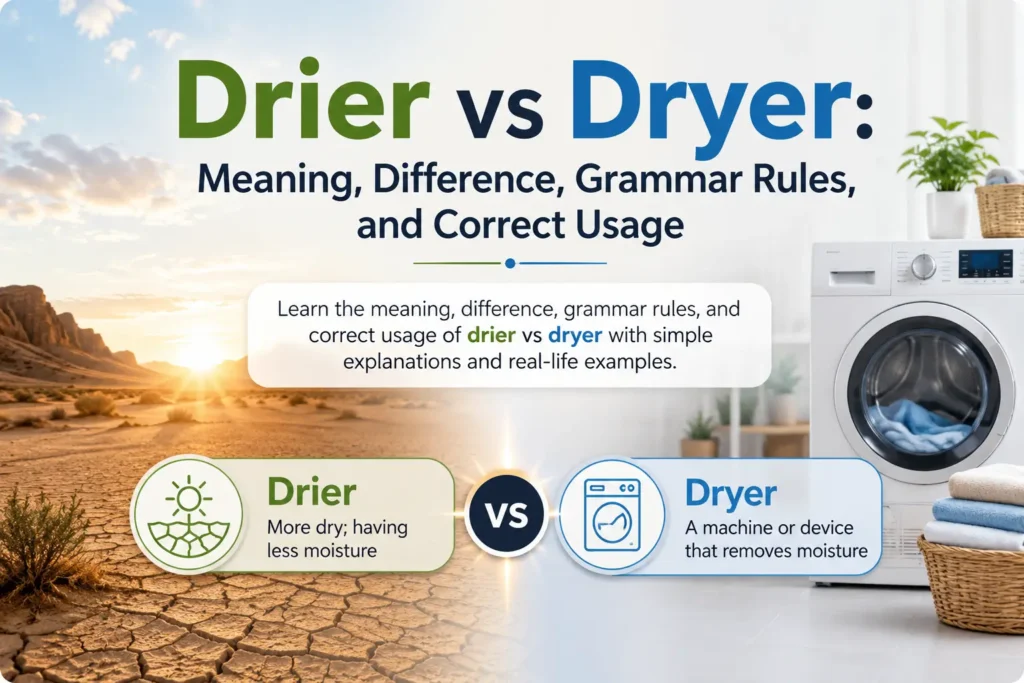
Many writers, students, bloggers, and non-native English speakers struggle to understand drier vs dryer because these English homophones sound alike and usually have the same pronunciation in spoken English. However, their meaning, difference, and usage depend on context. When I review writing and content, I often notice that people choose a word based only on sound instead of checking its grammar role and word choice. In written English, the small spelling difference between these words helps readers identify the correct meaning.
Both words are related to dryness, but they have different parts of speech and grammatical functions. Drier is a comparative adjective used for comparison, meaning something is more dry or has less moisture. Dryer is usually a noun that refers to a machine, device, or equipment that removes moisture. For example, “The desert is drier than the forest” compares conditions, while “The clothes dryer is broken” refers to a device.
Understanding the context, spelling, and grammar rules makes choosing the correct word easier. These similar words cannot be substituted for one another because they are not always interchangeable. A skilled listener may need context to determine the meaning in conversation, while readers can rely on spelling in articles, emails, social media posts, and technical descriptions. Learning these common mistakes, real-life examples, and correct usage helps people confidently explain and use drier vs dryer in everyday conversation, professional writing, and online content.
Quick Answer: Drier vs Dryer
The main difference between drier and dryer is their meaning and grammar role.
| Word | Meaning | Part of Speech | Example |
| Drier | More dry; having less moisture | Comparative adjective | This winter is drier than last year. |
| Dryer | A machine or device that removes moisture | Noun | The clothes dryer is running. |
The easiest rule is:
- Use drier when comparing dryness.
- Use dryer when referring to something that dries.
Think of it this way:
Drier describes a condition. Dryer names a thing.
What Does Drier Mean?
Drier is the comparative form of the adjective dry.
It means that something contains less water or moisture than something else.
The pattern is:
Dry → Drier → Driest
Examples:
- Arizona has a drier climate than Florida.
- My skin feels drier during winter.
- This towel is drier than the one on the bathroom floor.
- The soil is drier today than it was yesterday.
In each example, drier compares two levels of dryness.
Drier as a Comparative Adjective
A comparative adjective compares two people, places, things, or conditions.
Examples of comparative forms include:
- tall → taller
- fast → faster
- cold → colder
- dry → drier
When an adjective ends in consonant + y, English usually changes the y to i before adding -er.
| Base Word | Comparative Form |
| dry | drier |
| happy | happier |
| easy | easier |
| busy | busier |
So:
✅ The air is drier today.
Not:
❌ The air is dryer today.
In that sentence, you need the comparative adjective drier.
Where Is Drier Used in Real Life?
The word drier appears in many everyday situations where people compare moisture levels.
Drier in Weather and Climate
Weather reports often use drier to describe areas or periods with less rainfall or humidity.
Examples:
- The western region will experience drier conditions this week.
- The summer months are usually drier than spring.
- This year has been drier than the previous year.
- The desert is drier than the rainforest.
In each case, one climate or condition contains less moisture than another.
Drier in Skin and Hair Care
People also use drier when talking about changes in skin or hair moisture.
Examples:
- My hands become drier in cold weather.
- This product may make your hair feel drier.
- Your skin may become drier as you get older.
- My scalp feels drier during winter.
Here, drier describes a lower level of moisture.
Drier in Agriculture and Food
Farmers and food producers may use drier when discussing soil, crops, storage, and moisture levels.
Examples:
- The soil became drier after several weeks without rain.
- A drier environment can help prevent mold growth.
- The grains need to stay in a drier storage area.
- The field was much drier after several sunny days.
What Does Dryer Mean?
Dryer is usually a noun that refers to something that dries another object.
It comes from the word dry plus -er, an ending that can form nouns for people, tools, or things that perform an action.
Examples:
- dry + er = dryer
- wash + er = washer
- mix + er = mixer
- print + er = printer
A dryer is something that removes moisture.
Examples:
- The dryer stopped working.
- She bought a new dryer yesterday.
- The factory uses a large industrial dryer.
Common Types of Dryers
The word dryer can refer to several different devices.
Clothes Dryer
A clothes dryer is a household appliance that removes moisture from washed clothing.
Example:
I put my wet clothes in the dryer.
This is one of the most common uses of the word.
Hair Dryer
A hair dryer uses moving air, often warm air, to remove moisture from hair.
Examples:
- She used a hair dryer after washing her hair.
- My hair dryer stopped working this morning.
Hand Dryer
A hand dryer is a machine commonly found in public bathrooms.
Example:
The hand dryer is next to the sink.
Industrial Dryer
Factories and production facilities may use industrial dryers to remove moisture from materials.
Examples:
- The company uses an industrial dryer to process food products.
- The factory installed a high-temperature dryer.
- The plant uses a specialized dryer for raw materials.
Drier vs Dryer: Key Differences
The easiest way to separate drier and dryer is to look at what the word is doing in the sentence.
| Difference | Drier | Dryer |
| Meaning | More dry | Something that dries |
| Grammar role | Comparative adjective | Noun |
| Main purpose | Describes a condition | Names a machine or device |
| Used for comparison | Yes | No |
| Example | The climate is drier. | The dryer is broken. |
Ask yourself:
Am I describing something, or am I naming something?
If you are describing a lower moisture level, use:
Drier
If you are naming a machine or device that removes moisture, use:
Dryer
Grammar Rules Behind Drier and Dryer
The different spellings come from different grammar functions.
How Dry Becomes Drier
The adjective dry changes to drier because of a common English spelling rule.
When a word ends in:
consonant + y
the y usually changes to i before adding -er.
Examples:
- dry → drier
- noisy → noisier
- messy → messier
- happy → happier
Correct:
The climate is becoming drier.
Incorrect:
The climate is becoming dryer.
In this sentence, the word describes a condition, so drier is needed.
How Dry Becomes Dryer
The word dryer follows a different pattern.
The ending -er can create a noun meaning a person, object, or device that performs an action.
Examples:
- dryer = something that dries
- cleaner = something that cleans
- printer = something that prints
- washer = something that washes
So:
The dryer stopped working.
means:
The machine that dries stopped working.
Why Do People Confuse Drier and Dryer?
There are several reasons these words are often mixed up.
They Sound the Same
In many English accents, drier and dryer sound the same or very similar.
Because of this, pronunciation alone may not tell you which spelling is correct.
You need to look at the context.
They Look Almost Identical
The spelling difference is small:
- drier
- dryer
However, that small difference changes the grammar role and meaning.
Compare:
The air is drier.
This describes the air.
The air dryer is broken.
This refers to a machine.
Autocorrect Can Create Errors
Phones and writing tools may sometimes suggest the wrong word because both spellings are valid English words.
For example:
The weather is drier this year.
A tool may incorrectly suggest:
The weather is dryer this year.
Always check the meaning before accepting an autocorrect suggestion.
Common Mistakes With Drier vs Dryer
Understanding the most common errors makes the distinction easier to remember.
Mistake 1: Using Dryer as a Comparative Adjective
Incorrect:
❌ The desert is dryer than the forest.
Correct:
✅ The desert is drier than the forest.
Why?
The sentence compares two environments, so you need the comparative adjective drier.
Mistake 2: Using Drier for a Machine
Incorrect:
❌ My clothes drier is broken.
Correct:
✅ My clothes dryer is broken.
Why?
The sentence refers to an appliance, so dryer is the correct noun.
Mistake 3: Thinking Drier Is Not a Real Word
Some people assume drier is incorrect because the spelling looks unusual.
However, drier is a standard English word.
It is commonly used in:
- weather reports
- academic writing
- science
- everyday conversation
- professional writing
Example:
The region has become drier over the past decade.
Can Dryer Ever Be Used Before Another Noun?
Yes.
Although dryer is usually a noun, it can appear before another noun as part of a noun phrase.
Examples:
- dryer settings
- dryer technology
- dryer temperature
- dryer vent
- dryer cycle
In these phrases, dryer does not mean “more dry.”
It refers to something connected with a drying machine.
Example:
This dryer technology uses less energy.
Drier vs Dryer in American and British English
Both drier and dryer are used in American English.
Examples:
- The weather is getting drier.
- The clothes dryer needs repair.
- My skin feels drier during winter.
British English generally follows the same distinction:
- drier = more dry
- dryer = a device that dries
The main difference between the words is grammatical, not regional.
Easy Memory Tricks for Drier vs Dryer
These simple tests can help you choose the right spelling.
The Comparison Trick
Ask:
Am I comparing two levels of dryness?
If yes, use:
Drier
Examples:
- Today is drier than yesterday.
- This towel is drier than that one.
- My skin is drier this winter.
The Machine Trick
Ask:
Is it something that dries things?
If yes, use:
Dryer
Examples:
- The dryer finished the laundry.
- I bought a new hair dryer.
- The hand dryer is broken.
The Object Test
Try replacing the word with machine.
If the sentence still makes sense, dryer may be correct.
Example:
The clothes machine is broken.
This can logically refer to:
The clothes dryer is broken.
But:
The desert machine is hotter.
does not make sense.
So the correct sentence is:
The desert is drier.
Drier and Dryer Examples in Everyday Writing
Here are some practical examples showing the difference.
At Home
Drier:
The towels outside are drier now.
Meaning: The towels contain less moisture.
Dryer:
The towels are inside the dryer.
Meaning: The towels are inside a drying machine.
At Work
Drier:
The company moved equipment to a drier environment because humidity caused problems.
Dryer:
The factory installed a new industrial dryer.
In Social Media and Texting
Both words are common in casual writing.
Examples:
- My skin is so much drier this winter.
- I forgot my clothes in the dryer.
- My hair feels drier after swimming.
- The dryer is making a strange noise.
Related Words and Synonyms
The correct alternative depends on whether you mean drier or dryer.
Words Related to Drier
Possible alternatives include:
- less humid
- more arid
- less moist
- dehydrated
- parched
Examples:
The area is more arid.
The soil is less moist.
Words Related to Dryer
Related terms include:
- drying machine
- appliance
- blower
- dehydrator
- air dryer
Examples:
A food dehydrator removes moisture from fruit.
The air dryer removes water from compressed air.
Practice: Choose Drier or Dryer
Fill in the blanks:
- The climate is becoming ______ every year.
- My clothes are still inside the ______.
- This region is ______ than the nearby area.
- The hair ______ stopped working.
- My skin feels ______ during winter.
- The factory installed a new industrial ______.
Answers
- drier
- dryer
- drier
- dryer
- drier
- dryer
Remember:
Comparison = drier
Machine = dryer
- dryer than the forest.” ❌
Correct:
- “The desert is drier than the forest.” ✅
Conclusion: Understanding the Difference Between Drier vs Dryer
The difference between drier vs dryer becomes simple once you focus on meaning and grammar role. Use drier when you are comparing something and describing a lower level of moisture, such as “the weather is drier this year.” Use dryer when you are talking about a machine, device, or tool that removes moisture, such as a clothes dryer or hair dryer.
Although these words are homophones and have the same pronunciation in many forms of English, they are not interchangeable. Paying attention to context, spelling, and sentence structure will help you choose the correct word in writing and conversation. Whether you are creating content, writing emails, studying English, or communicating professionally, knowing this small spelling difference can prevent common grammar mistakes and make your writing clearer.
Frequently Asked Questions About Drier vs Dryer
Q1: What is the main difference between drier and dryer?
Drier means “more dry” and works as a comparative adjective. It describes a condition with less moisture. Dryer usually refers to a machine or device that removes moisture, such as a clothes dryer or hair dryer.
Example:
- “The air is drier today.”
- “The dryer is finished with the laundry.”
Q2: Is drier a correct English word?
Yes, drier is a correct English word. It is the comparative form of the adjective dry.
The word follows this pattern:
Dry → Drier → Driest
Example:
- “This area is drier than the coastal region.”
Q3: Is dryer only used for clothes machines?
No. While a clothes dryer is the most common example, the word can describe many devices that remove moisture.
Examples include:
- Hair dryer
- Hand dryer
- Food dryer
- Industrial dryer
- Air dryer
Q4: Are drier and dryer pronounced the same?
In most American English accents, drier and dryer are pronounced the same or almost the same. Because they sound alike, many people depend on context and spelling to choose the correct word.
Q5: Which is correct: drier weather or dryer weather?
The correct phrase is usually drier weather.
Example:
- “The region is expected to have drier weather next month.”
The word describes a change in moisture levels, so the comparative adjective drier is needed.
Q6: Can dryer mean more dry?
No, dryer does not normally mean “more dry.” The correct comparative form is drier.
Incorrect:
- “The desert is dryer than the forest.” ❌
Correct:
- “The desert is drier than the forest.” ✅
Q7: Why do people confuse drier and dryer?
People confuse these words because they:
- Sound the same when spoken
- Have almost identical spelling
- Come from the same base word, “dry”
- Have different meanings depending on context
The difference is only one letter, but that letter changes the grammar role and meaning.
Q8: What are the grammar roles of drier and dryer?
Drier is a comparative adjective.
Example:
- “My skin feels drier in winter.”
Dryer is usually a noun.
Example:
- “The dryer needs repair.”
Understanding the part of speech helps you select the correct word.
Q9: Can drier and dryer be used interchangeably?
No. They cannot normally replace each other because they have different meanings.
Example:
- “The towel is drier.” → The towel has less moisture.
- “The towel is in the dryer.” → The towel is inside a machine.
Changing the word changes the meaning of the sentence.
Q10: How can I easily remember the difference between drier and dryer?
Use this simple memory trick:
- Drier = describes dryness
- Dryer = describes a drying device
If you are comparing moisture levels, choose drier. If you are naming something that dries an object, choose dryer.
Allude vs Elude: What’s the Difference? Meaning, Examples, and Easy Ways to Remember
Desert vs. Dessert: What’s the Difference? Meaning, Pronunciation, Examples, and Memory Tips
Weather vs. Whether: What’s the Difference and How Do You Use Them Correctly?
