
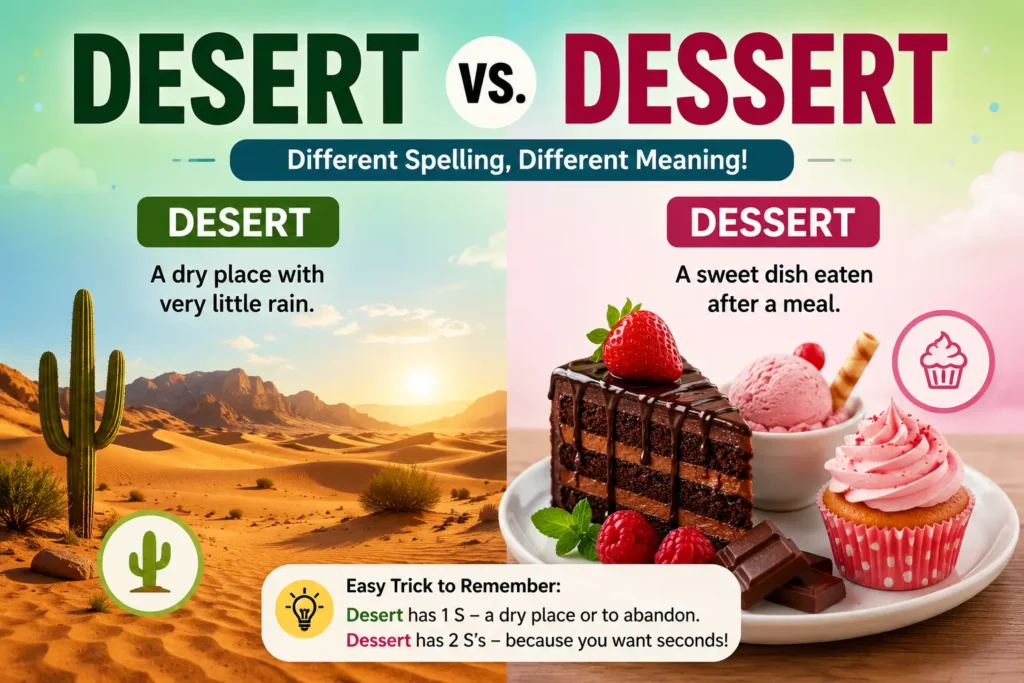
If you’re confused about desert vs. dessert, you’re not alone. These two words look almost identical, and in some uses, they sound exactly the same. However, their meanings are completely different.
Desert can mean a dry geographical region or, as a verb, to abandon someone or something. Dessert is a sweet food served after a meal. The noun desert is pronounced DEZ-ert, while dessert is pronounced dih-ZURT.
The easiest spelling trick is to remember that dessert has two S’s because you want seconds. Meanwhile, desert has only one S when you’re talking about a dry place.
This guide explains desert vs. dessert in detail, including their meanings, parts of speech, pronunciation, sentence examples, common mistakes, the phrase just deserts, and practical ways to remember which word to use.
Quick Answer: Desert vs. Dessert
The difference between desert and dessert depends on meaning:
- Desert = a dry region with little precipitation.
- Desert = to abandon or leave someone, something, or a responsibility.
- Dessert = a sweet food or course usually eaten at the end of a meal.
- Just deserts = the punishment or reward someone deserves.
| Word | Meaning | Part of Speech | Pronunciation | Example |
| desert | A dry geographical region | Noun | DEZ-ert | The Sahara is a vast desert. |
| desert | To abandon or leave | Verb | dih-ZURT | He wouldn’t desert his family. |
| dessert | A sweet food served after a meal | Noun | dih-ZURT | We had ice cream for dessert. |
| deserts | What someone deserves | Noun, usually in “just deserts” | dih-ZURTS | He finally got his just deserts. |
The simplest way to remember them
Desert with one S → a dry place or to abandon someone.
Dessert with two S’s → a sweet treat, and you want seconds.
What Does “Desert” Mean?
The word desert has two main meanings. It can be a noun referring to a dry region, or it can be a verb meaning to abandon someone or something.
These meanings are pronounced differently, so context matters when you hear the word.
Desert as a Noun: A Dry Region
As a noun, a desert is a region that receives very little precipitation. Although many people imagine endless sand and extreme heat, not every desert looks like that.
Some deserts are rocky, while others contain gravel, mountains, or even snow and ice. What makes a region a desert is primarily its lack of precipitation, not simply its temperature or appearance.
For example:
The desert can become surprisingly cold at night.
We watched the sunset over the desert.
Many plants have special adaptations that help them survive in the desert.
The noun desert is pronounced DEZ-ert, with the stress on the first syllable.
Some well-known deserts include:
- The Sahara Desert
- The Mojave Desert
- The Sonoran Desert
- The Gobi Desert
- The Atacama Desert
For American readers, the Mojave Desert and Sonoran Desert are especially familiar examples because they are located partly in the southwestern United States.
Desert as a Verb: To Abandon
Desert can also function as a verb. In this sense, it means to abandon, leave behind, or give up on someone or something.
For example:
She promised never to desert her family.
He refused to desert his friends during a crisis.
The soldier was accused of deserting his post.
This meaning is usually more serious or formal than simply saying leave.
Compare these sentences:
John left his friends at the restaurant.
John deserted his friends when they needed his help.
The first sentence simply says that John went away. The second suggests that John abandoned his friends, especially when they expected him to remain loyal or supportive.
The verb desert is pronounced dih-ZURT, with the stress on the second syllable.
Forms of the Verb “Desert”
The verb follows regular English verb patterns:
| Form | Example |
| desert | Don’t desert your responsibilities. |
| deserts | He never deserts his team. |
| deserted | The soldier deserted his post. |
| deserting | She was accused of deserting her duties. |
Therefore, be careful with the spelling. The past tense is deserted, not desserted.
What Does “Dessert” Mean?
Dessert is a noun that refers to a sweet food or course typically served at the end of a meal.
Common examples include:
- Cake
- Pie
- Ice cream
- Cookies
- Brownies
- Pudding
- Cheesecake
- Fruit tarts
- Pastries
For example:
We had chocolate cake for dessert.
Would you like dessert?
The restaurant has a long dessert menu.
The word dessert is pronounced dih-ZURT, with the stress on the second syllable.
Unlike the noun desert, which means a dry region, dessert has two S’s.
Is “Dessert” Countable or Uncountable?
The answer depends on how you’re using the word.
When you mean dessert as a general meal course, it often behaves like an uncountable noun:
We had dessert after dinner.
I don’t usually eat dessert.
However, when you’re talking about different types or individual servings, desserts can be plural:
The bakery sells several different desserts.
We ordered two desserts to share.
So, both forms can be correct:
- dessert = the sweet course in general
- desserts = individual sweet dishes or different varieties
Can “Dessert” Be a Verb?
In standard modern American English, dessert is normally used as a noun.
You wouldn’t normally say:
We desserted after dinner.
Instead, say:
We had dessert after dinner.
Or:
We ate dessert after dinner.
The natural expression is have dessert, not dessert as a verb.
Desert vs. Dessert: Key Differences
The most important differences involve meaning, pronunciation, spelling, and grammatical function.
| Feature | Desert | Dessert |
| Main meaning | Dry region | Sweet food |
| Other meaning | To abandon | None in standard everyday use |
| Part of speech | Noun or verb | Noun |
| Noun pronunciation | DEZ-ert | dih-ZURT |
| Verb pronunciation | dih-ZURT | Not normally used as a verb |
| Number of S’s | One | Two |
| Example | The desert is dry. | We ordered dessert. |
The key point is that desert and dessert aren’t interchangeable.
If you write:
We had cake for desert.
You’ve used the wrong word because you’re talking about food.
The correct sentence is:
We had cake for dessert.
Likewise, if you write:
The Sahara Dessert is enormous.
The spelling is incorrect because you’re referring to a dry region.
The correct sentence is:
The Sahara Desert is enormous.
How to Pronounce Desert and Dessert
Pronunciation is one reason these words cause so much confusion.
“Desert” Meaning a Dry Place
When desert is a noun meaning a dry region, pronounce it:
DEZ-ert
The first syllable receives the stress.
We drove across the DEZ-ert.
“Desert” Meaning to Abandon
When desert is a verb meaning to abandon, pronounce it:
dih-ZURT
The second syllable receives the stress.
He would never dih-ZURT his family.
“Dessert” Meaning a Sweet Food
Dessert is also pronounced:
dih-ZURT
For example:
We ordered dih-ZURT after dinner.
Therefore, these two words sound identical in some contexts:
- desert as a verb → dih-ZURT
- dessert as a noun → dih-ZURT
However, the noun desert is pronounced differently:
- desert as a dry region → DEZ-ert
This is why the surrounding words and context help listeners understand which meaning you intend.
How to Use Desert vs. Dessert Correctly
The easiest way to choose the right word is to identify what you’re talking about.
Use “Desert” for a Dry Region
Use desert when you’re talking about a geographical area with very little precipitation.
The desert is home to many unique animals.
We visited the Mojave Desert during our vacation.
The temperature in the desert can change dramatically between day and night.
Use “Desert” When Someone Abandons Something
Use desert as a verb when someone abandons a person, place, duty, or responsibility.
Don’t desert your friends when they need you.
He deserted his post.
She would never desert her responsibilities.
This usage often carries a stronger emotional or moral meaning than leave.
Use “Dessert” for Sweet Food
Use dessert when you’re referring to a sweet food or course after a meal.
I had pie for dessert.
What’s your favorite dessert?
The restaurant offers several homemade desserts.
We skipped dessert because we were already full.
Examples of Desert in Real Sentences
“Desert” as a Noun
The desert looked completely different after the rain.
Many animals are active at night in the desert.
We stopped to take pictures of the desert landscape.
The desert isn’t always covered with sand.
The family took a road trip through the desert.
In each sentence, desert refers to a dry geographical environment.
“Desert” as a Verb
He refused to desert his team.
She wouldn’t desert her children.
The soldiers were ordered not to desert their positions.
His friends didn’t desert him during the difficult period.
The captain was accused of deserting his post.
Here, the word means abandon or leave behind.
Examples of Dessert in Everyday American English
Dessert appears in many ordinary situations, from restaurants to family dinners.
At a Restaurant
Could we see the dessert menu?
I’ll have the cheesecake for dessert.
We ordered two desserts and shared them.
At Home
What’s for dessert?
Mom made brownies for dessert.
We usually have fruit for dessert.
At a Party
The dessert table was full of cookies and cupcakes.
Everyone loved the chocolate dessert.
In a School or Workplace Context
Students brought homemade desserts for the fundraiser.
The office provided coffee and dessert after the meeting.
The word works naturally in casual, professional, and formal contexts.
Common Mistakes With Desert and Dessert
Because these words are so similar, spelling errors are extremely common.
Mistake: Writing “Desert” for a Sweet Treat
Incorrect:
We had ice cream for desert.
Correct:
We had ice cream for dessert.
Why? The word for a sweet course is dessert, with two S’s.
Mistake: Writing “Dessert” for a Dry Region
Incorrect:
The Sahara Dessert is one of the world’s largest dry regions.
Correct:
The Sahara Desert is one of the world’s largest dry regions.
Why? A dry geographical region is a desert, with one S.
Mistake: Writing “Desserted” for “Deserted”
Incorrect:
He desserted his post.
Correct:
He deserted his post.
Why? The verb meaning to abandon is desert. Its past tense is deserted.
Mistake: Using “Dessert” as a Verb
Incorrect:
We desserted after dinner.
Correct:
We had dessert after dinner.
Why? In standard American English, dessert is normally a noun.
The Memory Trick: Dessert Has Two S’s
The most useful way to remember desert vs. dessert is:
Dessert has two S’s because you want seconds.
Think about your favorite dessert. If it’s delicious, you probably want another serving.
Dessert → two S’s → seconds
By contrast:
Desert → one S → dry place
This is only a spelling mnemonic, not an actual grammar rule. Still, it’s one of the easiest ways to avoid this common mistake.
A Three-Question Memory Test
When you’re unsure, ask:
Is it a dry place?
→ Use desert.
Does it mean to abandon someone or something?
→ Use desert.
Is it a sweet food after a meal?
→ Use dessert.
For most everyday writing, this test will give you the correct answer immediately.
What Does “Just Deserts” Mean?
The phrase just deserts is another source of confusion.
Just deserts means the punishment, reward, or outcome that someone deserves because of their actions.
For example:
The dishonest employee eventually got his just deserts.
After years of treating people badly, he finally received his just deserts.
The phrase is spelled deserts, not desserts.
Although just deserts sounds exactly like something related to sweet food, it has nothing to do with cake, pie, or ice cream.
It also doesn’t refer to a dry region.
Why Is It “Just Deserts”?
The word deserts in this expression comes from an older use of desert meaning what someone deserves.
Therefore:
- just deserts = what someone deserves
- desserts = sweet foods
- deserts = dry regions or, in another grammatical use, forms of the verb desert
The expression is somewhat formal and is often used when someone’s actions lead to a deserved consequence.
Desert vs. Dessert in American English
For US readers, there is no major American-versus-British spelling difference between these words. The standard spellings are desert and dessert in both varieties of English.
The meanings also remain essentially the same.
In American English:
We drove through the desert.
We had pie for dessert.
The main challenge isn’t regional spelling. It’s remembering which word matches which meaning.
Formal vs. Casual Usage
The noun dessert is neutral and common in almost every setting.
You can use it in:
- casual conversation
- restaurant conversations
- school writing
- professional writing
- academic contexts
- menus and recipes
The verb desert, however, can sound more serious or formal.
For example:
Casual:
He left his friends.
Stronger or more serious:
He deserted his friends.
The word desert suggests abandonment and often implies that leaving was wrong, disloyal, or irresponsible.
Related Words and Common Phrases
Learning related expressions can help you understand these words in context.
Words and Phrases Related to “Desert”
Common combinations include:
- desert climate
- desert landscape
- desert wildlife
- desert plant
- desert environment
- desert island
- desert heat
- food desert
A food desert, for example, is an area where people have limited access to affordable, nutritious food.
The phrase desert island refers to an uninhabited island. You may hear it in hypothetical questions:
If you were stranded on a desert island, what three things would you bring?
Words and Phrases Related to “Dessert”
Common combinations include:
- dessert menu
- dessert course
- dessert recipe
- dessert table
- dessert options
- dessert plate
- frozen dessert
- chocolate dessert
For example:
The restaurant has an impressive dessert menu.
She found an easy dessert recipe for the holiday party.
Desert vs. Dessert: Synonyms and Related Terms
Understanding synonyms can also clarify the meanings.
Synonyms for “Desert” as a Dry Region
Depending on context, related terms may include:
- arid region
- dryland
- wasteland
- barren region
These aren’t always exact synonyms. For example, an arid region is defined by dryness, while a desert is a specific type of environment.
Synonyms for “Desert” as a Verb
Depending on context:
- abandon
- leave
- forsake
- quit
- walk away from
However, these words aren’t always interchangeable.
Abandon is often the closest general synonym.
He abandoned the project.
He deserted his post.
The second sentence can carry a stronger sense of failing to fulfill a duty.
Synonyms for “Dessert”
Depending on the specific food, you might use:
- sweet
- sweet course
- treat
- confection
- pastry
Again, these aren’t perfect substitutes in every sentence. Dessert is the broadest everyday term for the sweet course served after a meal.
Quick Practice: Desert or Dessert?
Choose the correct word in each sentence.
- We had chocolate cake for ___.
- The family drove across the ___.
- He refused to ___ his friends.
- The restaurant offers several ___.
- The ___ can become very cold at night.
- The soldier was accused of ___ his post.
- What’s your favorite ___?
- The Sahara is a famous ___.
- She brought homemade ___ to the party.
- He finally got his just ___.
Answers
- dessert
- desert
- desert
- desserts
- desert
- deserting
- dessert
- desert
- desserts
- deserts
The best way to solve these questions is to focus on the meaning first. Don’t rely only on how the word sounds.
Conclusion: Desert vs. Dessert
The difference between desert vs. dessert is simple once you connect each word with its meaning. Desert can refer to a dry, barren region, such as the Sahara, or it can mean to abandon someone or something. Dessert means a sweet food served at the end of a meal, such as cake, pie, or ice cream. The easiest spelling trick is to remember that dessert has two S’s because you may want seconds. Also, remember that just deserts means what someone deserves and is spelled with one S. With these simple rules, you’ll be able to choose the correct word and avoid this common spelling mistake.
Frequently Asked Questions About Desert vs. Dessert
Q1. What is the difference between desert and dessert?
Desert can mean a dry region with little rainfall or to abandon someone or something. Dessert is a sweet food usually eaten after a meal.
Q2. Is it dessert or desert after dinner?
The correct word is dessert. For example, you might have ice cream, cake, or pie for dessert after dinner.
Q3. How can I remember the spelling of dessert?
Remember this simple trick: dessert has two S’s because you want seconds. The extra S can help you remember that you’re talking about a sweet treat.
Q4. Is the Sahara a desert or dessert?
The Sahara is a desert. It is a large, dry region in North Africa. The word has only one S.
Q5. How do you pronounce desert and dessert?
Desert, when it means a dry region, is pronounced DEZ-ert. Dessert is pronounced dih-ZURT. The verb desert, meaning to abandon, is also pronounced dih-ZURT.
Q6. Is dessert a noun or a verb?
Dessert is normally a noun in standard American English. You can say, “We had dessert after dinner.” You wouldn’t normally use dessert as a verb.
Q7. What does desert mean as a verb?
As a verb, desert means to abandon or leave someone or something, often when you have a responsibility or duty to remain. For example, “He deserted his post.”
Q8. Is “desserted” the correct spelling?
No, desserted isn’t the standard spelling when you mean “abandoned.” The correct word is deserted, which is the past tense of the verb desert.
Q9. What does “just deserts” mean?
Just deserts means the punishment, reward, or result that someone deserves because of their actions. The phrase is spelled deserts, with one S.
Q10. Can desert and dessert sound the same?
Yes. The verb desert, meaning to abandon, and dessert, meaning a sweet food, are pronounced the same: dih-ZURT. However, desert, when referring to a dry region, is pronounced DEZ-ert.
