
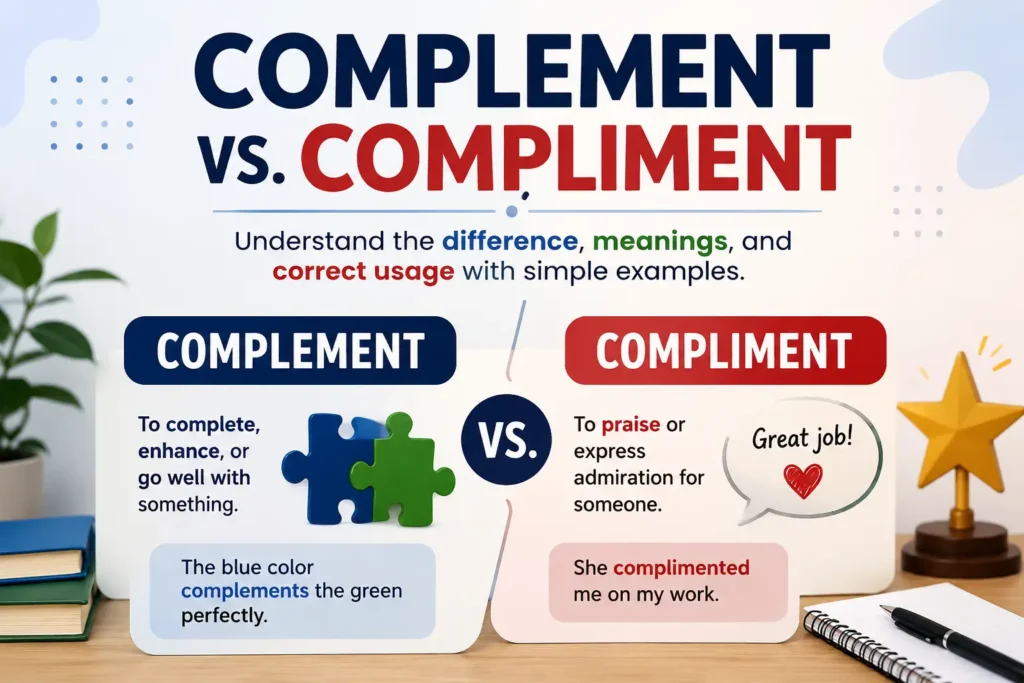
Complement vs compliment can be confusing because these two words sound alike but have different meanings. Complement means to complete, improve, or work well with something, while compliment means to praise someone or something. Knowing this simple difference helps you choose the correct spelling in everyday writing, emails, schoolwork, and professional communication.
For example, “The shoes complement your outfit” means the shoes look good with the outfit. However, “She complimented your outfit” means she praised it. The key is to ask what you mean: enhance or complete points to complement, while praise or admiration points to compliment.
The related words can cause confusion, too. Complementary describes things that work well together, while complimentary can mean free or expressing praise. These simple distinctions can help you avoid common grammar mistakes and make your English writing clearer.
Quick Answer: Complement vs Compliment
The easiest way to remember the difference is this:
- Complement = to complete, improve, match, or go well with something.
- Compliment = to praise or express admiration.
- Complementary = completing, matching, or working well together.
- Complimentary = free of charge or expressing praise.
Compare these examples:
The wine complements the meal.
The wine works well with the meal and enhances the overall experience.
The server complimented the chef.
The server praised the chef.
So, when you’re talking about praise, choose compliment. When you’re talking about something that completes or enhances something else, choose complement.
Read this also: Reckless or Wreckless: Which Spelling Is Correct?
Complement vs Compliment at a Glance
| Word | Part of Speech | Main Meaning | Example |
| complement | Noun | Something that completes or enhances another thing | The sauce is a perfect complement to the dish. |
| complement | Verb | To complete, improve, or go well with something | The colors complement each other. |
| compliment | Noun | An expression of praise or admiration | She gave me a nice compliment. |
| compliment | Verb | To praise someone or something | He complimented her presentation. |
| complementary | Adjective | Completing, matching, or working well together | The two skills are complementary. |
| complimentary | Adjective | Free or expressing praise | The hotel offers complimentary breakfast. |
The key is meaning, not pronunciation. Because complement and compliment sound alike, you need to choose the spelling based on what you mean.
What Does “Complement” Mean?
Complement refers to something that completes, improves, balances, or works well with another thing.
It can be a noun or a verb.
The central idea is connection: one thing adds something useful to another.
Complement as a Noun
As a noun, a complement is something that completes or enhances another thing.
For example:
- The salad was a refreshing complement to the heavy meal.
- Her experience is a valuable complement to the team’s technical skills.
- The wooden table is a beautiful complement to the room.
- The sauce makes an excellent complement to the grilled chicken.
In each sentence, the complement adds something that makes the whole combination better or more complete.
The word can also refer to a full or complete set or number of people or things.
For example:
The ship sailed with a full complement of crew members.
Here, complement means the complete number of people needed for the ship.
That meaning is less common in everyday conversation, but you’ll encounter it in formal, technical, military, business, or organizational contexts.
Complement as a Verb
As a verb, complement means to complete, enhance, or work well with something else.
For example:
- The blue curtains complement the gray walls.
- Her leadership skills complement his technical expertise.
- The lemon flavor complements the fish.
- That jacket complements your outfit.
Notice an important point: complement doesn’t mean “say something nice.”
In “The jacket complements your outfit,” the jacket isn’t praising your outfit. Instead, the jacket looks good with it or enhances it.
Common Uses of “Complement”
You’ll often see complement used with:
- Colors
- Clothing
- Food and drinks
- Interior design
- Personal qualities
- Professional skills
- Team members
- Products or services
- Musical or artistic elements
For example:
Her communication skills complement his analytical abilities.
This means the two skills work well together. Neither person is necessarily praising the other.
What Does “Compliment” Mean?
Compliment means praise, admiration, or a polite expression of approval.
Like complement, it can function as both a noun and a verb.
However, the meaning is completely different.
Compliment as a Noun
As a noun, a compliment is something you say or write to praise someone or something.
For example:
- She gave me a compliment about my presentation.
- His teacher paid him a compliment after the speech.
- That was a nice compliment.
- I appreciated your compliment about my writing.
- The designer received several compliments on the new website.
A compliment can focus on almost anything positive:
- Appearance
- Clothing
- Personality
- Skills
- Work
- Performance
- Achievement
- Creativity
- Behavior
For example:
“You explained that difficult topic really clearly.”
That’s a compliment because it expresses approval of someone’s ability.
Compliment as a Verb
As a verb, compliment means to praise someone or something.
For example:
- She complimented me on my new haircut.
- The manager complimented the team on its performance.
- He complimented her presentation.
- Several customers complimented the restaurant’s service.
A particularly common structure is:
compliment + someone + on + something
For example:
My supervisor complimented me on my report.
Another common structure is:
compliment + someone/something
The customer complimented the employee.
The important distinction is simple: compliment involves praise.
Complement vs Compliment: The Key Difference in Real Sentences
The easiest way to understand these words is to compare sentences that look almost identical.
| Sentence | Meaning |
| The necklace complements her dress. | The necklace goes well with the dress. |
| She complimented her dress. | She praised the dress. |
| The two flavors complement each other. | The flavors work well together. |
| The chef complimented the waiter. | The chef praised the waiter. |
| His skills complement mine. | His skills work well with mine. |
| He complimented me on my skills. | He praised my skills. |
Here’s another useful pair:
The painting complements the room.
The painting fits the room’s design and improves the overall appearance.
The visitor complimented the painting.
The visitor expressed admiration for the painting.
The subject matter can be similar, but the action is different. One word describes how things work together. The other describes praise.
Complementary vs Complimentary: The Other Common Confusion
The confusion doesn’t stop with complement vs. compliment. Their adjective forms create another common spelling problem.
What Does “Complementary” Mean?
Complementary means completing, matching, or working well with something else.
For example:
- The colors are complementary.
- Their personalities are complementary.
- The two software tools provide complementary features.
- The side dish has a complementary flavor.
If two things fit together well, complementary is usually the word you want.
A useful connection is:
complement → complementary
Both relate to the idea of completing or enhancing something.
What Does “Complimentary” Mean?
Complimentary has two main meanings.
First, it can mean given free of charge.
For example:
- The hotel provides complimentary breakfast.
- Guests receive complimentary Wi-Fi.
- The airline offered complimentary drinks.
- We received complimentary tickets to the event.
Second, complimentary can mean expressing praise.
For example:
- The review was highly complimentary.
- She made complimentary remarks about his work.
Context tells you which meaning applies.
Is It “Complimentary” or “Complementary” for Free Things?
When something is provided free of charge, use complimentary.
Correct:
The hotel offers complimentary breakfast.
Incorrect for that meaning:
The hotel offers complementary breakfast.
Complementary means things work together. Complimentary can mean something is free.
This distinction matters in restaurants, hotels, travel, retail, and business communication.
Common Expressions With Complement and Compliment
Some phrases make the distinction easier because they strongly favor one spelling.
“Pay Someone a Compliment”
To pay someone a compliment means to praise that person.
For example:
My professor paid me a compliment after my presentation.
You could also simply say:
My professor complimented me on my presentation.
Both communicate praise.
“With Compliments”
With compliments is a formal expression used to indicate that something is being given or sent as a courtesy.
You may see wording such as:
With compliments of the management.
This expression uses compliments, not complements, because it relates to courtesy or goodwill.
“A Full Complement”
A full complement means a complete number or set.
For example:
The hospital hired a full complement of nurses for the new department.
Here, complement has nothing to do with praise. It refers to the complete number needed.
“Complement Each Other”
When two or more things work well together, they complement each other.
For example:
- The red and black colors complement each other.
- Their skills complement each other.
- The spicy sauce and sweet dessert complement each other.
This is one of the most useful everyday expressions containing complement.
Complement vs Compliment in American English
In American English, complement and compliment are generally pronounced alike.
That makes them homophones: words that sound the same but have different meanings and spellings.
For example, you might hear:
“The colors complement each other.”
and
“She complimented the colors.”
The pronunciation won’t reliably tell you which spelling to use. You need to consider the meaning.
Everyday Conversation
Both words appear naturally in everyday American English.
You might say:
That scarf really complements your coat.
Or:
I love your scarf. That’s a great compliment.
The first sentence describes a relationship between two things. The second describes praise.
Professional Communication
The distinction is also important at work.
Compare:
Her project-management skills complement his technical knowledge.
This describes how two skills work together.
Now compare:
The director complimented her project-management skills.
This means the director praised those skills.
Using the wrong spelling can make professional writing look careless, even when the intended meaning is obvious from context.
Academic Writing
Academic writing may use complement in discussions of systems, relationships, language, science, economics, or research.
For example:
The two approaches complement each other.
Meanwhile, compliment is appropriate when discussing praise:
The reviewer complimented the researchers on the clarity of their explanation.
The same spelling distinction applies in formal writing as in conversation.
Common Mistakes With Complement and Compliment
These words are easy to mix up because the difference is only one letter.
Mistake 1: Using “Compliment” for Something That Matches
Incorrect:
The shoes compliment the dress.
Correct:
The shoes complement the dress.
Why? The shoes go well with the dress. They aren’t praising it.
Mistake 2: Using “Complement” for Praise
Incorrect:
My manager complemented me on my work.
Correct:
My manager complimented me on my work.
Why? The manager praised the work.
Mistake 3: Confusing “Complementary” and “Complimentary”
Incorrect:
The hotel provides complementary breakfast.
If you mean breakfast is free, use:
Correct:
The hotel provides complimentary breakfast.
Mistake 4: Thinking Similar Spelling Means Similar Meaning
Although the words are related historically, modern English uses them for different ideas.
Don’t choose the spelling based on how similar the words look. Instead, identify the meaning first.
Ask yourself:
Is this about praise?
Use compliment.
Is this about completing, matching, or enhancing?
Use complement.
How to Remember Complement vs Compliment
A simple memory trick can save you from most mistakes.
Remember “Complete” for Complement
The word complement contains “comple”, which can remind you of complete.
Think:
Complement = complete or enhance
If something completes another thing or works well with it, choose complement.
For example:
The curtains complement the furniture.
Remember “I” for Compliment
Compliment contains an i.
You can use the I as a memory clue:
Compliment = I like something about you.
This isn’t a grammar rule. It’s simply a quick spelling trick.
For example:
I complimented her on her presentation.
Use the Two-Question Test
When you’re unsure, ask:
- Am I talking about praise?
→ compliment - Am I talking about completing, matching, or enhancing?
→ complement
Try it:
The curtains ______ the room.
The curtains enhance the room.
Answer: complement
The guest ______ the host on the beautiful room.
The guest praised the host.
Answer: complimented
Synonyms for Complement and Compliment
Synonyms can help you understand the difference, although they aren’t always interchangeable in every sentence.
Synonyms for “Complement”
Depending on context, complement can mean:
- Enhance
- Complete
- Improve
- Match
- Accompany
- Balance
- Round out
- Go well with
For example:
The fresh herbs complement the soup.
You could describe the relationship as the herbs enhancing or improving the soup’s flavor.
Synonyms for “Compliment”
Depending on context, compliment can mean:
- Praise
- Admire
- Commend
- Applaud
- Flatter
- Congratulate
However, these words aren’t perfect substitutes in every sentence.
For example, congratulate usually refers to recognizing an achievement, while compliment can praise almost any positive quality.
Compare:
She complimented him on his jacket.
with:
She congratulated him on winning the competition.
The first expresses admiration. The second recognizes an achievement.
Real-Life Examples: Which Word Should You Use?
Understanding the distinction becomes easier when you see how it works in everyday situations.
At a Restaurant
The spicy sauce complements the grilled chicken.
The sauce and chicken work well together.
The customer complimented the chef.
The customer praised the chef.
At Work
Her design skills complement his programming experience.
Their abilities work well together.
The manager complimented her design work.
The manager praised her work.
At School
The examples complement the teacher’s explanation.
The examples help complete or strengthen the explanation.
The teacher complimented the student on her clear writing.
The teacher praised the student.
While Shopping
This belt complements your shoes.
The belt matches or enhances the shoes.
The salesperson complimented your choice.
The salesperson praised your choice.
In Social Media
A comment such as:
“You look amazing!”
is a compliment.
If someone writes:
“That jacket really complements the color of your shoes.”
they’re describing how two things work together.
Read this also: Mine as Well or Mind as Well
A Closer Look at “Complement Each Other”
The phrase complement each other deserves special attention because it’s often confused with compliment each other.
When two things complement each other, they work well together.
For example:
Their different personalities complement each other.
This doesn’t mean they praise each other. It means their differences create a good balance.
Similarly:
The two colors complement each other.
The colors look good together.
By contrast:
The two friends compliment each other.
This could mean the friends praise each other, although that usage is much less common than complimented each other in a specific context.
Therefore, if you mean “work well together,” use complement.
Practice: Choose Complement or Compliment
Try filling in each blank before checking the answers.
- The blue tie ______ his gray suit.
- Sarah ______ me on my presentation.
- The restaurant offers ______ drinks to hotel guests.
- Their different skills ______ each other.
- The customer paid the employee a ______.
- The manager ______ the team on its excellent work.
- The herbs ______ the flavor of the soup.
- The two colors are ______.
Answer Key
- complements — The tie enhances or works well with the suit.
- complimented — Sarah praised the speaker.
- complimentary — The drinks are free.
- complement — The skills work well together.
- compliment — A compliment is an expression of praise.
- complimented — The manager praised the team.
- complement — The herbs enhance the flavor.
- complementary — The colors work well together.
Quick Reference: Complement, Compliment, Complementary, and Complimentary
| Word | Meaning | Example |
| Complement | Complete, improve, match, or enhance | The shoes complement the dress. |
| Compliment | Praise or admiration | She gave me a compliment. |
| Complementary | Completing or working well together | The colors are complementary. |
| Complimentary | Free or expressing praise | The hotel offers complimentary breakfast. |
A useful way to group them is:
Complement family:
complete → enhance → match → work together
Compliment family:
praise → admiration → approval
Frequently Asked Questions About Complement vs Compliment
Q1. What is the difference between complement and compliment?
Complement means to complete, improve, or match something. Compliment means to praise or show admiration. For example, “The colors complement each other” means they work well together, while “She complimented the colors” means she praised them.
Q2. Is complement or compliment the word for praise?
Compliment is the word for praise. You can give someone a compliment, or you can compliment someone on their work, appearance, or achievement.
Q3. Is complement or compliment the word for matching?
Complement is correct when you mean that something matches, enhances, or works well with another thing. For example, “The blue curtains complement the gray walls.”
Q4. Are complement and compliment pronounced the same?
Yes. In standard American English, complement and compliment are generally pronounced the same. They are homophones, so you must use their meaning to choose the correct spelling.
Q5. What is an easy way to remember complement vs. compliment?
Connect complement with complete. Both relate to completing or enhancing something. For compliment, think about saying something nice to someone or giving praise.
Q6. What does complementary mean?
Complementary means completing, matching, or working well with something else. For example, “The two colors are complementary” means they work well together.
Q7. What does complimentary mean?
Complimentary has two common meanings. It can mean free of charge, as in “The hotel offers complimentary breakfast.” It can also mean expressing praise, as in “The review was complimentary.”
Q8. Is it complimentary breakfast or complementary breakfast?
Use complimentary breakfast when you mean breakfast is provided free of charge. Use complementary when describing things that complete or work well together.
Q9. Can complement and compliment be used as verbs?
Yes. Complement as a verb means to enhance, complete, or match something. Compliment as a verb means to praise someone or something. For example, “The colors complement the room” versus “She complimented the designer.”
Q10. Why do people confuse complement and compliment?
People often confuse them because they look very similar and are pronounced the same. However, their meanings are different. Remember: complement = complete or enhance, while compliment = praise.
Conclusion
Understanding complement vs. compliment becomes much easier when you focus on meaning instead of sound. Use complement when something completes, enhances, matches, or works well with another thing. Use compliment when someone praises or expresses admiration.
The same idea applies to complementary and complimentary. Complementary describes things that work well together, while complimentary can mean free or praising. When you’re unsure, remember the simple rule: complement connects with “complete,” while compliment connects with praise.
With this distinction in mind, you’ll be better prepared to use these commonly confused English words correctly in conversations, emails, school assignments, and professional writing.
