
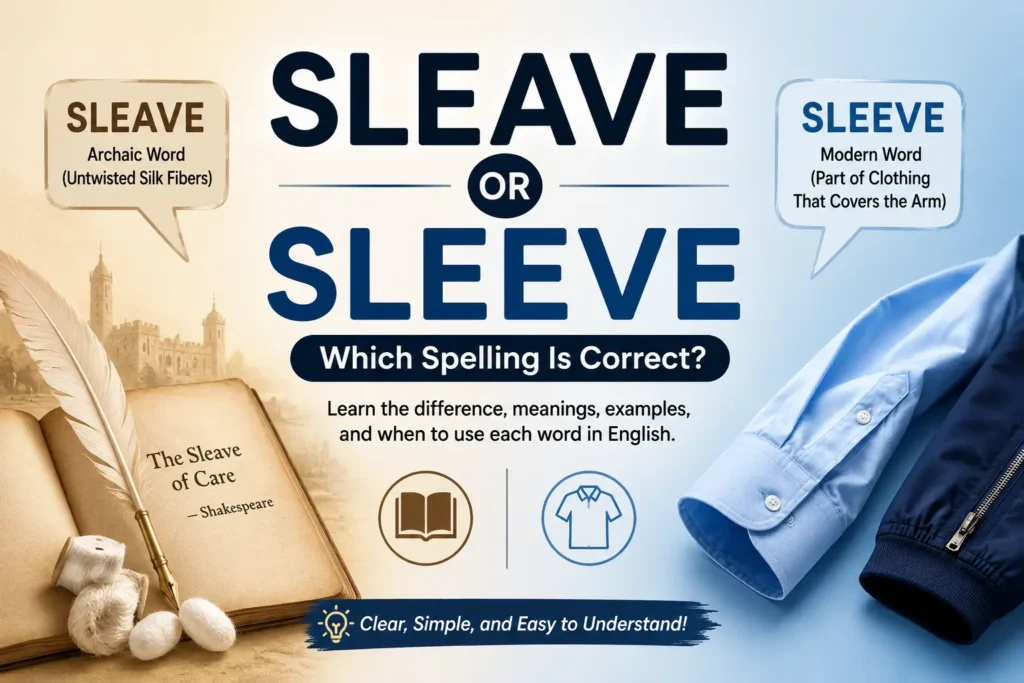
Sleave or sleeve can be confusing because both are real English words, but they don’t have the same meaning. If you’re talking about the part of a shirt, jacket, or dress that covers the arm, the correct spelling is sleeve. Sleave is a rare historical textile term linked to silk fibers and older English.
For modern American English, this distinction is easy to remember: use sleeve for clothing, fashion, sleeve tattoos, and common expressions such as “up your sleeve.” You may see sleave in classic literature, historical texts, or specialized discussions of old textile vocabulary.
Understanding this difference can help you avoid a common spelling mistake, especially because sleave may be accepted by some spell-checkers. The key is to focus on meaning and context, not just pronunciation. If you mean a garment part, sleeve is the word you want.
Sleave or Sleeve: Quick Answer
The simplest rule is:
Use “sleeve” for the part of a garment that covers the arm. Use “sleave” only when referring to its rare historical textile meaning.
| Word | Main meaning | Modern everyday use | Example |
| sleeve | Part of a garment covering the arm; also a covering or component | Very common | “My shirt sleeve is too long.” |
| sleave | Historical textile term, especially loose or untwisted silk thread | Very rare | “The old text refers to sleave silk.” |
Therefore, these are correct:
- The sleeve of my jacket is torn.
- Roll up your sleeves.
- She bought a long-sleeve shirt.
- He has a sleeve tattoo.
These are not correct when you mean the garment part:
- The sleave of my jacket is torn.
- Roll up your sleaves.
- She bought a sleave shirt.
- He has a sleave tattoo.
The key point is that sleave and sleeve aren’t interchangeable spellings.
Read this also: Lended vs Lent: Meaning, Grammar Rules, and Correct Usage
What Does “Sleeve” Mean?
Sleeve: Definition and Part of Speech
Sleeve is primarily a noun. In clothing, it means the part of a garment that covers some or all of the arm.
For example:
The sleeve on my left arm is ripped.
Here, sleeve names a physical part of the shirt.
The plural form is sleeves:
These sleeves are too short.
The word can also describe a covering or tube that fits around another object. Because of this broader meaning, you’ll find sleeve in clothing, technology, engineering, sports, music, and other areas.
Sleeve in Clothing
In everyday American English, sleeve is the standard word for the arm-covering part of a garment.
You can have sleeves on:
- shirts
- T-shirts
- blouses
- dresses
- sweaters
- jackets
- coats
- uniforms
- hoodies
- formalwear
For example:
The sleeves on this sweater are too long.
She rolled up her shirt sleeves before starting work.
This dress has short sleeves.
The word remains sleeve regardless of the type of garment.
Common Sleeve Types and Lengths
Clothing descriptions often combine sleeve with another word to describe length or design.
Common terms include:
- long sleeve — a sleeve that extends toward the wrist
- short sleeve — a sleeve that ends above the elbow or around the upper arm
- three-quarter sleeve — a sleeve that extends partway down the forearm
- bell sleeve — a sleeve that widens toward the bottom
- puff sleeve — a sleeve with a fuller, gathered shape
- raglan sleeve — a sleeve extending in one piece toward the neckline
- sleeveless — having no sleeves
For example:
I prefer short-sleeve shirts in the summer.
Notice that the spelling doesn’t change to sleave in any of these expressions.
Sleeve Has More Than One Modern Meaning
Although clothing is the meaning most people think of first, sleeve has several other established uses.
A Sleeve as a Protective Covering
A sleeve can be something that covers or protects another object.
For example:
- a laptop sleeve
- a document sleeve
- a card sleeve
- a protective sleeve
- a cable sleeve
Consider this sentence:
Put the tablet in its protective sleeve before packing it.
Here, sleeve doesn’t refer to clothing. It describes something that surrounds and protects an object.
The basic idea is still similar: a sleeve covers something.
Record and Album Sleeve
The word sleeve is also used for a cover that holds a record or similar media.
For example:
The album came in a colorful cardboard sleeve.
This meaning is especially associated with physical music formats and publishing.
Mechanical and Technical Sleeve
In technical contexts, a sleeve can be a cylindrical or tubular part that surrounds another component.
For example:
The metal sleeve protects the inner part of the assembly.
This use is common in engineering and manufacturing terminology. It has the same broad concept of a covering or surrounding component.
Sleeve as a Verb
Sleeve can also function as a verb, although this use is less common than the noun.
Depending on context, it can mean to provide something with a sleeve or covering.
The noun remains by far the more familiar form in everyday English.
What Does “Sleave” Mean?
Sleave Is a Real English Word
Here’s where the comparison becomes interesting: sleave isn’t simply a made-up spelling mistake.
It is a genuine English word, but it has a specialized and historical meaning.
That distinction matters because someone might see sleave in a dictionary and assume:
“Then sleave must be another spelling of sleeve.”
It isn’t.
The two words have different meanings and different histories.
The Historical Textile Meaning of Sleave
Historically, sleave referred to silk thread in a loose, untwisted, or unfinished form.
The word belongs to older textile vocabulary. In historical textile production, the condition of thread mattered because silk could be prepared, twisted, wound, and woven in different ways.
Modern readers rarely need the word sleave. However, it can appear when reading older English texts, historical writing, or discussions of traditional textile terminology.
For example, a historical passage might use sleave to describe silk thread rather than a part of clothing.
Sleave in Older Literature
Readers sometimes encounter sleave in discussions of Shakespeare and other older English literature.
One well-known example appears in Shakespeare’s Macbeth, where the phrase “sleave of care” occurs.
This is important because literary examples can make a rare word appear more common than it really is.
A word appearing in Shakespeare doesn’t mean it’s normal modern vocabulary. English has changed considerably over time, and many words found in older literature are now rare, specialized, or obsolete.
So, when you encounter sleave in an old text, look at the historical context before assuming it’s a spelling mistake.
Is Sleave Used in Modern English?
Sleave is extremely uncommon in ordinary modern English.
Most people don’t use it when discussing clothing, fashion, sewing, or everyday textiles.
For modern writing, sleave is generally relevant only when you’re discussing:
- historical textiles
- older English vocabulary
- literary language
- historical documents
- specialized textile terminology
In contrast, sleeve is an ordinary modern word that appears frequently in everyday communication.
Sleave vs. Sleeve: The Key Difference
The biggest difference is meaning, not simply spelling.
| Point | Sleeve | Sleave |
| Standard modern clothing word | Yes | No |
| Refers to a shirt’s arm covering | Yes | No |
| Common in US English | Yes | No |
| Common in everyday conversation | Yes | No |
| Historical textile meaning | No | Yes |
| Associated with silk thread | No | Yes |
| Appears in older literature | Yes | Yes |
| Can be used in modern technical contexts | Yes | Rarely |
| Interchangeable with the other word | No | No |
Meaning
Sleeve has several modern meanings, but its most familiar meaning is the part of clothing that covers the arm.
Sleave, by contrast, has a specialized historical meaning connected with textile thread, particularly silk.
Therefore:
shirt + arm covering = sleeve
but
historical textile thread = sleave
Modern Usage
The difference in frequency is enormous.
You might see or hear sleeve every day:
I need to shorten the sleeves on this shirt.
You could go years without encountering sleave outside a historical or specialized context.
That doesn’t make sleave “wrong.” It simply makes it rare and context-specific.
Context Matters
Context can quickly tell you which word is intended.
Compare:
The tailor shortened the sleeve.
This clearly concerns clothing.
Now consider:
The historian discussed the use of sleave in silk production.
The textile context signals the historical meaning.
Sleeve or Sleave for Shirts, Jackets, and Dresses?
When discussing modern clothing, the answer is always sleeve.
For a Shirt
Correct:
My shirt sleeve is too long.
The sleeves on this shirt are loose.
Incorrect:
My shirt sleave is too long.
The incorrect version uses the historical word sleave where the modern clothing noun sleeve is required.
For a Jacket
Correct:
The jacket sleeve is torn.
You can also say:
One sleeve of my jacket is torn.
Again, sleave isn’t an alternative spelling here.
For a Dress
Correct:
This dress has long sleeves.
Or:
She chose a sleeveless dress.
The same spelling applies whether the garment is casual or formal.
For a Sleeve Tattoo
A sleeve tattoo is a tattoo that covers a substantial part of the arm, often resembling the coverage of a garment sleeve.
Correct:
He has a full-sleeve tattoo.
She’s planning a sleeve tattoo.
Not:
He has a full-sleave tattoo.
The word is sleeve because the expression is based on the modern clothing term.
How to Pronounce “Sleeve” and “Sleave”
Pronunciation can contribute to spelling confusion, especially for English learners.
Sleeve Pronunciation
Sleeve is pronounced with one syllable and has the long e vowel sound:
sleeve → /sliːv/
The final sound is a voiced v.
For example:
sleeve
leave
believe
These words share a similar long e sound.
Sleave Pronunciation
The pronunciation of the historical word sleave may vary depending on the historical period and dictionary tradition. In modern references, it can be pronounced similarly to sleeve.
That similarity is one reason spelling can be confusing.
However, pronunciation doesn’t make the words interchangeable.
When you’re writing about a shirt or jacket, choose the spelling based on meaning:
sleeve, not sleave.
American English: Is “Sleeve” Different in British English?
No major US-versus-UK spelling difference exists here.
Both American and British English use:
sleeve
for the garment part.
So this isn’t like color/colour, favorite/favourite, or center/centre.
American English
US English:
The sleeves on my shirt are too long.
British English
British English:
The sleeves on my shirt are too long.
The spelling is the same.
Therefore, sleave is not the British English spelling of sleeve.
That’s an important point because learners sometimes assume that an unfamiliar spelling must be a British variant. In this case, it isn’t.
Common Mistakes With Sleeve and Sleave
“My Shirt Sleave Is Too Long”
Incorrect:
My shirt sleave is too long.
Correct:
My shirt sleeve is too long.
The mistake changes sleeve, the ordinary clothing word, into sleave, a rare historical textile term.
“Roll Up Your Sleaves”
Incorrect:
Roll up your sleaves.
Correct:
Roll up your sleeves.
The plural of sleeve is sleeves.
It isn’t sleaves.
“She Bought a Sleave Shirt”
Incorrect when referring to a garment:
She bought a sleave shirt.
A natural correction is:
She bought a long-sleeve shirt.
You can also say:
She bought a shirt with long sleeves.
The first version is especially common in clothing descriptions.
“The Jacket Sleave Is Torn”
Incorrect:
The jacket sleave is torn.
Correct:
The jacket sleeve is torn.
“He Has a Sleave Tattoo”
Incorrect:
He has a sleave tattoo.
Correct:
He has a sleeve tattoo.
The phrase is based on the clothing sense of sleeve.
Assuming Sleave Is an Alternative Spelling
This is the most important mistake to avoid.
Sleave isn’t an alternative spelling of sleeve in modern English.
Instead, the two words have distinct meanings.
Common Grammar Forms of “Sleeve”
Understanding the related forms can make the spelling easier to remember.
Singular and Plural
Singular:
sleeve
Plural:
sleeves
Examples:
The sleeve is dirty.
The sleeves are dirty.
Notice that the plural adds -s without changing the spelling of the base word.
Long-Sleeve and Short-Sleeve
When sleeve forms part of a compound modifier before a noun, you’ll commonly see a hyphen:
a long-sleeve shirt
a short-sleeve T-shirt
However, when the phrase is used differently, you may see:
The shirt has long sleeves.
The distinction comes from grammar and sentence structure, not from the spelling of sleeve itself.
Sleeve and Sleeveless
Sleeveless means “without sleeves.”
For example:
She wore a sleeveless dress to the party.
The word sleeveless is built from sleeve + -less, meaning “without.”
This gives you another useful spelling connection:
sleeve → sleeveless
not:
sleave → sleaveless
A Simple Memory Trick for Sleeve
One useful way to remember the spelling is to connect sleeve with leave.
Both contain:
leeve
So think:
sleeve = s + leave
This isn’t an explanation of the word’s historical origin. It’s simply a spelling trick.
Another useful association is:
Arm → sleeve → “ee”
When you’re talking about the part of a shirt that covers the arm, think sleeve with double e.
Think “Arm = Sleeve”
If you see a shirt, jacket, or dress and you’re naming the part that covers the arm, ask:
“Is this the garment’s arm covering?”
If yes, write:
sleeve
That simple question prevents most mistakes.
Read this also: Pronounciation vs Pronunciation: Correct Spelling, Meaning, Difference, and Common Mistakes
Sleeve in Real-Life American English
The word sleeve appears in many ordinary situations.
Everyday Conversation
Can you roll up your sleeves?
I got paint on my sleeve.
This shirt has loose sleeves.
These are natural examples of everyday American English.
School and Academic Writing
Students may use sleeve when describing clothing:
The costume has wide sleeves that extend to the wrists.
Meanwhile, sleave may appear in a literature class if students are analyzing an older text.
For example:
The unusual word “sleave” reflects older textile vocabulary.
In that sentence, sleave is being discussed as a historical term rather than used as a modern clothing word.
Professional Communication
In workplace writing, the standard spelling matters because clarity matters.
For example:
Please wear a long-sleeve shirt under the protective jacket.
Using sleave could make the message look like a spelling error or distract the reader.
Texting and Social Media
Casual writing doesn’t change the standard spelling:
Love the sleeves on that jacket!
Thinking about getting a sleeve tattoo.
Even in informal communication, sleeve remains the correct modern spelling.
Practice: Sleeve or Sleave?
Choose the correct word in each sentence.
- The tailor shortened the ______ of my coat.
- Roll up your ______ before washing the car.
- She bought a short-______ shirt.
- The historian discussed ______ silk.
- He spilled coffee on his shirt ______.
- The old text uses the word ______ in a textile context.
Answers
- sleeve
- sleeves
- sleeve
- sleave
- sleeve
- sleave
The first three and fifth examples involve modern clothing, so sleeve is correct.
The fourth and sixth examples involve the historical textile meaning, so sleave is appropriate.
Related Words and Expressions
Several common expressions use sleeve in ways that have nothing to do with literal clothing.
“Up Your Sleeve”
If someone has something up their sleeve, they have a secret idea, plan, trick, or advantage.
For example:
The team has a few surprises up its sleeve.
The phrase is usually figurative.
“Wear Your Heart on Your Sleeve”
To wear your heart on your sleeve means to show your feelings openly rather than hiding them.
For example:
She wears her heart on her sleeve and always tells people how she feels.
“Roll Up Your Sleeves”
To roll up your sleeves literally means to push your sleeves higher on your arms.
Figuratively, it can mean preparing to work hard:
We have a lot to finish, so let’s roll up our sleeves.
“Sleeveless”
Sleeveless describes clothing that doesn’t have sleeves.
Example:
He wore a sleeveless shirt during the workout.
These expressions reinforce the fact that sleeve is the standard modern word.
Synonyms and Related Terms
There isn’t a perfect synonym for sleeve in every context.
For clothing, related terms include:
- arm covering
- garment sleeve
- cuff — the end portion of a sleeve, not the entire sleeve
- armhole — the opening where the sleeve connects to the garment
- sleeveless — without sleeves
It’s important not to treat these terms as exact substitutes.
For example, a cuff isn’t another word for a sleeve. It’s usually the finished part at the end of a sleeve.
Likewise, an armhole is the opening or area where the arm and sleeve connect.
What Writers Should Remember About Sleave vs. Sleeve
If you’re writing for a modern American audience, the distinction is simple.
Use sleeve when you mean:
- the arm covering of a shirt
- the arm covering of a jacket
- the arm covering of a dress
- a protective covering
- a mechanical sleeve
- a sleeve tattoo
- a record or album sleeve
- a figurative expression such as “up your sleeve”
Use sleave only when the context specifically calls for its rare historical textile meaning.
A Quick Decision Rule
Ask yourself:
Am I talking about a shirt, jacket, dress, tattoo, cover, or modern component?
If yes, sleeve is almost certainly the word you need.
Am I discussing historical textile terminology or older English?
If yes, sleave may be appropriate.
Frequently Asked Questions
Q1: Is “sleave” a real English word?
Yes. Sleave is a real English word, but it is rare in modern English. It traditionally refers to loose or untwisted silk thread and is most likely to appear in historical or literary contexts.
Q2: Which is correct for a shirt: “sleave” or “sleeve”?
Sleeve is correct. The part of a shirt that covers the arm is called a sleeve.
The sleeve of my shirt is too long.
Q3: Is “sleave” another spelling of “sleeve”?
No. Sleave isn’t simply an alternative spelling of sleeve. The two words have different meanings, although their similar spelling and pronunciation can cause confusion.
Q4: Why do people confuse “sleave” and “sleeve”?
The words look and sound similar, so it’s easy to mix them up. Also, sleave is a legitimate dictionary word, which means a spell-checker may not always flag it as an error.
Q5: What does “sleave” mean?
Historically, sleave referred to untwisted or loosely prepared silk fibers or thread. Today, the word is uncommon and is mainly found in historical, literary, or specialized textile contexts.
Q6: What does “sleeve” mean?
A sleeve is the part of a garment that covers some or all of the arm. The word can also describe other types of coverings or components, such as a protective sleeve or mechanical sleeve.
Q7: Is “sleave” used in modern American English?
It is very rare in modern American English. For ordinary writing, especially when discussing clothing, sleeve is the appropriate word.
Q8: Is “sleave” used in Shakespeare?
Yes. Sleave appears in Shakespeare’s Macbeth. Its appearance in older literature reflects its historical use and doesn’t make it a modern replacement for sleeve.
Q9: Is “sleeve” spelled differently in British and American English?
No. Both American English and British English use sleeve for the garment part. Sleave isn’t the British spelling of sleeve.
Q10: How can I remember whether to use “sleave” or “sleeve”?
Use this simple rule: if you’re talking about clothing or an arm covering, use “sleeve.” Think shirt → arm → sleeve. Reserve sleave for its rare historical textile meaning.
Conclusion
The difference between sleave or sleeve comes down to meaning and modern usage. Sleeve is the correct and standard spelling when you mean the part of a shirt, jacket, dress, or other garment that covers the arm. It is also used in phrases such as sleeve tattoo, long-sleeve shirt, and “up your sleeve.”
Sleave is a legitimate English word, but it is rare and historical. It is mainly connected with untwisted silk fibers and may appear in older literature, historical texts, or discussions of traditional textiles. It isn’t an alternative spelling of sleeve.
For everyday American English, remember the simple rule: arm covering = sleeve. Choosing the correct spelling will make your writing clearer and help you avoid confusion caused by similar-looking or similar-sounding words.
