
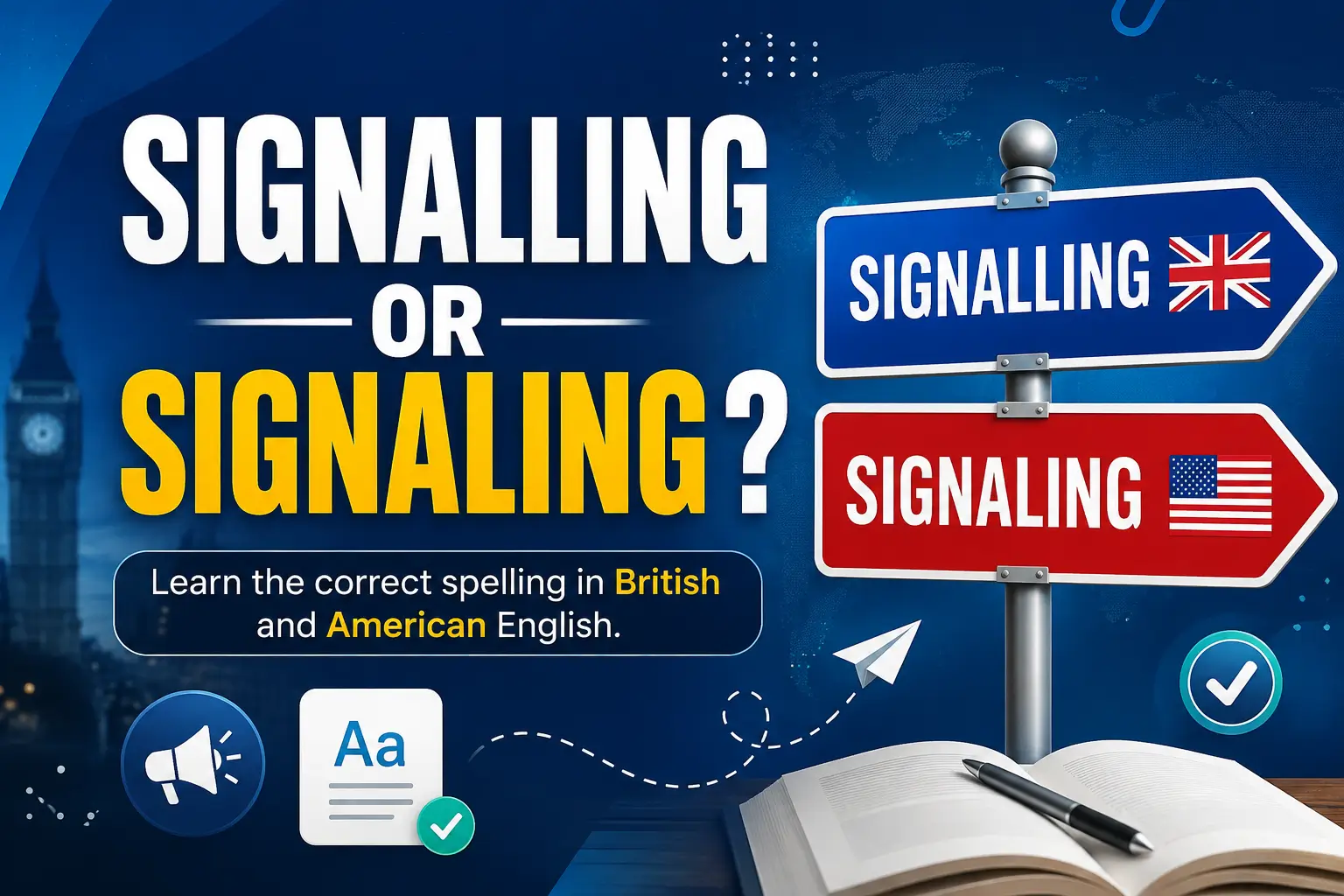
Signalling or signaling is a spelling difference between British and American English. Signalling is the standard British English form, while signaling is the standard American English form. Both words have the same meaning, pronunciation, and grammatical function. If you’re writing for a US audience, choose signaling. For a UK audience, use signalling.
The difference is easy to remember once you understand the spelling pattern. British English often doubles the final l in forms such as signalling and signalled, while American English usually keeps one l, giving signaling and signaled.
This distinction matters when you’re writing an article, school assignment, email, or professional document. Using the preferred American spelling or British spelling for your target audience keeps your writing clear and consistent.
Signaling vs. Signalling: Quick Answer
Signaling and signalling are two regional spellings of the same word.
- Signaling = American English
- Signalling = British English
- Signaled = American English past tense
- Signalled = British English past tense
- Both forms mean the same thing.
- Both are pronounced the same way.
- Neither spelling is universally “more correct.”
For example:
American English: The driver was signaling before making a left turn.
British English: The driver was signalling before making a left turn.
The meaning doesn’t change. Only the spelling convention changes.
| Feature | American English | British English |
| Base verb | signal | signal |
| Present participle | signaling | signalling |
| Gerund | signaling | signalling |
| Past tense | signaled | signalled |
| Past participle | signaled | signalled |
| Meaning | Same | Same |
| Pronunciation | Same | Same |
| Best choice for US readers | Signaling | — |
| Best choice for UK readers | — | Signalling |
Major dictionaries recognize this regional distinction. For example, Oxford lists signaling as the US form and signalling as the British form, while Cambridge likewise identifies the double-l form as British and the single-l form as the usual US spelling.
What Does Signaling or Signalling Mean?
The word comes from the verb signal. To signal means to communicate information, give a warning or instruction, or indicate that something is happening or is likely to happen.
A signal can be a:
- movement
- sound
- light
- gesture
- action
- electronic transmission
- physical sign
- change in behavior
For example:
The officer signaled the driver to stop.
Here, the officer used an action to communicate an instruction.
The word can also describe something less direct:
The company’s decision signaled a change in strategy.
In this sentence, the decision didn’t literally make a hand movement. Instead, it indicated something about the company’s future plans.
Oxford describes signal as an action that communicates a message or instruction and also as something that indicates that an event or change exists or is likely to happen.
Signal as a Verb
Signal can be used as both a transitive and intransitive verb.
A transitive verb takes an object:
The referee signaled a foul.
Here, foul is what the referee signaled.
It can also be used without a direct object:
The referee signaled.
The context tells you what the signal meant.
Common structures include:
- signal to someone
- signal for something
- signal someone to do something
- signal that something happened
- signal something
Examples:
She signaled to her friend.
He signaled for help.
The teacher signaled the students to begin.
The announcement signaled that the meeting was over.
The decision signaled a change in policy.
These structures are useful because they show that signal doesn’t have just one fixed sentence pattern.
Read this also: Invision vs Envision: Which Word Is Correct? Meaning, Differences, and Usage Guide
Signaling and Signalling as Verb Forms
Signaling and signalling are the -ing forms of signal.
They can appear in continuous verb forms:
She is signaling to the driver.
They were signaling for help.
In British English:
She is signalling to the driver.
They were signalling for help.
The -ing form can also work as a gerund, which means the verb form functions like a noun:
Signaling clearly can prevent accidents.
Here, signaling clearly is the subject of the sentence.
In British English, the equivalent is:
Signalling clearly can prevent accidents.
Why Are There Two Spellings?
The difference comes from regional spelling conventions.
English developed different spelling preferences in Britain and the United States. One noticeable difference involves verbs ending in -l.
British English commonly doubles the final l before endings such as -ing and -ed:
- signal → signalling
- signal → signalled
- travel → travelling
- travel → travelled
- cancel → cancelling
- cancel → cancelled
American English commonly uses a single l in these forms:
- signal → signaling
- signal → signaled
- travel → traveling
- travel → traveled
- cancel → canceling
- cancel → canceled
Cambridge specifically identifies signal as a verb that takes -ll- in British English and usually -l- in US English.
The American English Pattern
For American English, the standard forms are:
signal → signaling → signaled
For example:
The driver was signaling before turning.
The announcement signaled the beginning of the ceremony.
The warning signs are signaling a potential problem.
This is the spelling to choose when you’re writing specifically for readers in the United States.
The British English Pattern
British English normally uses:
signal → signalling → signalled
For example:
The driver was signalling before turning.
The announcement signalled the beginning of the ceremony.
The warning signs are signalling a potential problem.
The extra l doesn’t create a different word. It’s simply part of the British spelling convention.
Signaling or Signalling in American English
If your content is written in American English, choose signaling.
This applies to:
- US blog posts
- American school assignments
- US business writing
- American news writing
- US academic material
- professional emails
- websites targeting US readers
- American SEO content
For example:
The company’s latest announcement is signaling a major change.
That’s the natural spelling for an American audience.
The same rule applies to the past tense:
The company’s announcement signaled a major change.
Using signalled isn’t likely to prevent an American reader from understanding the sentence. However, it introduces a British spelling into otherwise American English.
For polished professional content, consistency is better.
Signalling or Signaling in British English
British English normally uses signalling.
For example:
The driver was signalling before turning.
The announcement signalled a major change.
This spelling is common in British writing, including everyday, professional, academic, and technical contexts.
The British form also appears in specialized fields such as railway signalling and biological cell signalling.
Do Signaling and Signalling Have Different Meanings?
No.
There is no difference in basic meaning between signaling and signalling.
Compare:
The flashing light was signaling danger.
The flashing light was signalling danger.
The two sentences communicate exactly the same idea.
The difference is regional spelling, not vocabulary.
This is important because learners sometimes assume that the extra l must create a different meaning. It doesn’t.
Think of it like these familiar pairs:
- color / colour
- center / centre
- traveling / travelling
- canceled / cancelled
- signaling / signalling
The regional spelling changes, but the underlying word remains the same.
How to Use Signaling or Signalling in a Sentence
The word is useful in many situations because a signal can be direct or indirect.
Everyday Communication
Maria was signaling to me from across the room.
The signal is a physical action.
His expression was signaling that something was wrong.
Here, the signal is indirect. His expression gives information without words.
She kept signaling for the waiter.
The person is using a gesture to communicate a request.
Driving and Road Safety
Driving provides one of the clearest everyday examples.
The driver was signaling before making a left turn.
In American English, the device used to indicate a turn is commonly called a turn signal. Cambridge specifically identifies turn signal as the US term, with indicator used in British English. (Cambridge Dictionary)
You might also see:
Always use your turn signal before changing lanes.
In British English, the spelling would be:
The driver was signalling before making a left turn.
Notice that the spelling of the verb changes, while the basic action remains the same.
Business and Professional Communication
In business writing, signal often means indicate.
The company’s hiring plans are signaling confidence in the market.
This doesn’t mean the company is physically making a signal. Its actions provide information about its plans or expectations.
Similarly:
The CEO’s announcement signaled a shift in strategy.
Here, signaled means indicated.
This use is common in journalism, economics, business analysis, and professional communication.
Science and Technology
The word also has a technical meaning.
A signal can be information carried through an electrical, optical, radio, or other communication system.
For example:
The device is signaling when the connection is lost.
In scientific writing, signaling can also describe communication within biological systems:
The researchers studied how cells respond to external signals.
The British spelling is signalling.
Signaling and Signalling in Different Contexts
The word appears across many fields. However, the underlying idea remains similar: information is being communicated or indicated.
Traffic Signaling
Traffic signaling involves signals that help control the movement of vehicles and pedestrians.
Examples include:
- traffic lights
- turn signals
- hand signals
- warning signals
- railroad crossing signals
In American English:
The city is upgrading its traffic signaling system.
In British English:
The city is upgrading its traffic signalling system.
Railway Signalling
Railway signalling is especially common as a British-English term.
Rail systems use signals and related control systems to communicate information about train movements and routes.
For example:
The railway signalling system was temporarily closed for maintenance.
In US English, railway signaling or railroad signaling may be used depending on the context and terminology of the organization.
Cell Signaling
In biology and medicine, cell signaling refers to the ways cells communicate with one another and respond to signals.
For example:
Researchers are studying how cell signaling affects tissue development.
The same concept in British English is commonly written:
Researchers are studying how cell signalling affects tissue development.
This is a good example of why spelling consistency matters in scientific writing.
Telecommunications and Digital Systems
In communications technology, signaling can refer to information exchanged to establish, control, or manage communication.
For example:
The system uses digital signaling to coordinate network operations.
The technical meaning depends on the field, but the basic concept remains communication through signals.
Social and Behavioral Contexts
Signaling can also describe actions that communicate intentions or attitudes.
For example:
Her decision to attend the meeting was signaling support for the proposal.
A social media post can also signal a person’s position without stating it directly:
The company’s public statement was signaling that changes were coming.
This use is common in everyday commentary, business writing, and social discussions.
Signaling and Signalling: Related Word Forms
Understanding the whole word family makes the spelling easier to remember.
| Form | American English | British English |
| Base verb | signal | signal |
| Third-person singular | signals | signals |
| Present participle | signaling | signalling |
| Past tense | signaled | signalled |
| Past participle | signaled | signalled |
Notice something important: signals doesn’t change between the two varieties.
The regional difference appears when the word takes -ing or -ed.
Signal
Signal can be a noun or a verb.
As a noun:
The light gave us a signal to proceed.
As a verb:
She signaled us to wait.
Signaled vs. Signalled
Both are past-tense forms of signal.
American English:
The referee signaled the end of the game.
British English:
The referee signalled the end of the game.
Signaling vs. Signalling
Both are present participles and gerunds.
American:
The referee is signaling the players.
British:
The referee is signalling the players.
Common Collocations With Signaling and Signalling
A collocation is a group of words that commonly appear together.
Learning common combinations can make your writing sound more natural.
Common examples include:
- signaling a change
- signaling intent
- signaling approval
- signaling danger
- signaling a warning
- signaling a shift
- signaling support
- signaling readiness
- traffic signaling
- digital signaling
- cell signaling
- railway signalling
For example:
The policy change is signaling a shift in the company’s priorities.
The phrase signaling a shift is particularly useful in business and analytical writing.
Signaling vs. Signalling Examples Side by Side
The easiest way to see the difference is to compare equivalent sentences.
| American English | British English |
| She is signaling for help. | She is signalling for help. |
| He was signaling to the driver. | He was signalling to the driver. |
| The change signaled a new direction. | The change signalled a new direction. |
| The company is signaling confidence. | The company is signalling confidence. |
| The officer signaled the car to stop. | The officer signalled the car to stop. |
The meaning stays the same in every pair.
Only the spelling changes.
American English Examples
The driver was signaling before changing lanes.
The announcement signaled a major policy change.
Her response was signaling that she disagreed.
The warning light is signaling a system problem.
British English Examples
The driver was signalling before changing lanes.
The announcement signalled a major policy change.
Her response was signalling that she disagreed.
The warning light is signalling a system problem.
Signal vs. Sign: Are They the Same?
Signal and sign overlap in meaning, but they aren’t always interchangeable.
A sign can be a visible mark, notice, indication, or clue.
The sign says, “No Parking.”
A signal often involves communication or an indication intended to convey information.
The driver gave a signal before turning.
A signal can also be an event or action that indicates something:
Falling sales are a signal that the company needs to change.
There are cases where the words overlap:
The dark clouds were a sign of rain.
The dark clouds were a signal that rain was coming.
However, sign is the more natural word in some contexts, especially for physical notices.
Signal vs. Symbol vs. Gesture
These words are related, but each has its own focus.
| Word | Basic idea | Example |
| Signal | Communicates information or an instruction | The officer gave a signal to stop. |
| Sign | Shows information, meaning, or evidence | The stop sign was easy to see. |
| Symbol | Represents an idea, object, or concept | A heart is a symbol of love. |
| Gesture | A physical movement used to communicate | She made a gesture for him to come closer. |
A gesture can be a signal, but not every signal is a gesture.
For example, a flashing light is a signal, but it isn’t a human gesture.
Common Mistakes to Avoid
Mistake 1: Thinking One Spelling Is Wrong
Incorrect assumption:
“Signalling is misspelled.”
That’s not true.
Signalling is a standard British English spelling.
Likewise, signaling is a standard American English spelling.
Mistake 2: Mixing Regional Spellings
A document can become inconsistent when it uses both styles without a reason.
For example:
The company is signaling a change that was previously signalled by management.
The sentence isn’t grammatically impossible, but the spelling is inconsistent if the writer is trying to follow one regional style.
For American English, use:
The company is signaling a change that was previously signaled by management.
For British English:
The company is signalling a change that was previously signalled by management.
Mistake 3: Assuming the Extra L Changes Pronunciation
It doesn’t.
Signaling and signalling are generally pronounced the same way.
The extra l is a spelling difference.
Mistake 4: Using the Wrong Past Tense
Don’t forget that the regional distinction applies to the past tense too.
American:
She signaled the driver.
British:
She signalled the driver.
If you’re writing American English, switching from signaling to signalled creates an unnecessary style inconsistency.
Mistake 5: Confusing Signal With Sign
Not every sign is a signal, and not every signal is a sign.
For example:
The stop sign was clearly visible.
But:
The officer gave a signal to stop.
Choosing the right word depends on what you’re describing.
Read this also: Totalling vs Totaling: Which Spelling Is Correct in American and British English?
Is Signaling or Signalling More Correct?
Neither one is universally more correct.
The correct choice depends on which variety of English you’re using.
If you’re writing American English, signaling is the appropriate spelling.
If you’re writing British English, signalling is the appropriate spelling.
The important point is consistency.
A US publication generally shouldn’t switch to British spelling without a specific reason. Similarly, a UK publication normally follows British spelling throughout its content.
A Simple Rule for US Writers
If your readers are primarily American, remember:
US = signaling, signaled
If your readers are primarily British:
UK = signalling, signalled
That’s enough to solve most spelling questions about this word.
Practical Writing Tips for American English
If you’re creating content for a US audience, these habits will help you maintain consistent spelling.
1. Choose American English Before You Start
Decide whether your document uses US or UK English.
For a US audience, choose signaling.
2. Watch Related Words
The same regional pattern appears in other words:
- traveling / travelling
- canceled / cancelled
- labeling / labelling
- modeled / modelled
- signaling / signalling
However, don’t assume every word ending in l follows exactly the same pattern. English spelling has exceptions and special cases.
3. Check the Whole Document
If you’ve chosen American English, look for both:
- signaling
- signalling
Then keep the appropriate version.
The same applies to signaled/signalled.
4. Follow Your Publication’s Style Guide
Academic journals, newspapers, companies, and publishers may have specific style requirements.
When a style guide gives a clear instruction, follow it even if your personal preference differs.
5. Don’t Change Quoted Material
If you’re writing American English and quoting a British source, preserve the original spelling when the quotation is meant to remain exact.
For example, a British source might use signalling. That doesn’t mean you need to change your surrounding American English to British English.
Memory Tricks for Remembering the Difference
You don’t need to memorize a complicated spelling rule.
Try these simple reminders.
Memory Trick 1: Think “US = One L”
For this word:
US → signaling
UK → signalling
The US form has one l. The British form has two.
Memory Trick 2: Remember the Past Tense Too
The same pattern continues:
US: signaled
UK: signalled
If you remember one pair, you can usually remember the other.
Memory Trick 3: Match the Rest of Your Writing
If you write:
The company is signaling a change.
You’re probably using American English.
Then related forms should normally follow that style:
The company signaled the change yesterday.
Consistency is more useful than trying to memorize isolated spellings.
Frequently Asked Questions
Q1:Is signaling or signalling correct?
Both are correct. Signaling is the standard American English spelling, while signalling is the standard British English spelling.
Q2: Is signaling American or British English?
Signaling is the standard American English form. British English generally uses signalling.
Q3: Is signalling British English?
Yes. Signalling is the conventional British English spelling of the -ing form of signal.
Q4: Do signaling and signalling have different meanings?
No. They have the same meaning and grammatical role. The difference is simply a regional spelling convention.
Q5: Why does British English use signalling?
British English commonly doubles the final l in certain verb forms before endings such as -ing and -ed. Therefore, signal becomes signalling and signalled.
Q6: Why does American English use signaling?
American English generally keeps one l in these forms. As a result, the standard forms are signaling and signaled.
Q7: Are signaling and signalling pronounced differently?
Generally, no. The two spellings have the same pronunciation. The extra l in signalling is a spelling difference rather than a pronunciation difference.
Q8: What is the past tense of signal?
The American English past tense is signaled. The British English form is signalled.
Q9: Should I use signaling in an American English article?
Yes. If your article follows American English, use signaling. This is especially appropriate for US-focused websites, schoolwork, business writing, and professional content.
Q10: Can I use signaling and signalling in the same article?
You can, but normally you shouldn’t switch between them without a reason. Choose the spelling that matches your target variety of English and use it consistently throughout the article.
Conclusion
Signalling or signaling does not represent two different words. Both forms describe the act of giving information, showing an intention, or indicating that something is happening. The main difference is regional spelling.
For American English, use signaling and signaled. For British English, use signalling and signalled. The pronunciation and basic meaning remain the same.
When writing for a specific audience, consistency is the key. If your readers are mainly in the United States, signaling is the better choice. If you’re following British English, choose signalling instead. This simple rule will help you avoid unnecessary spelling mistakes while keeping your writing natural and accurate.