
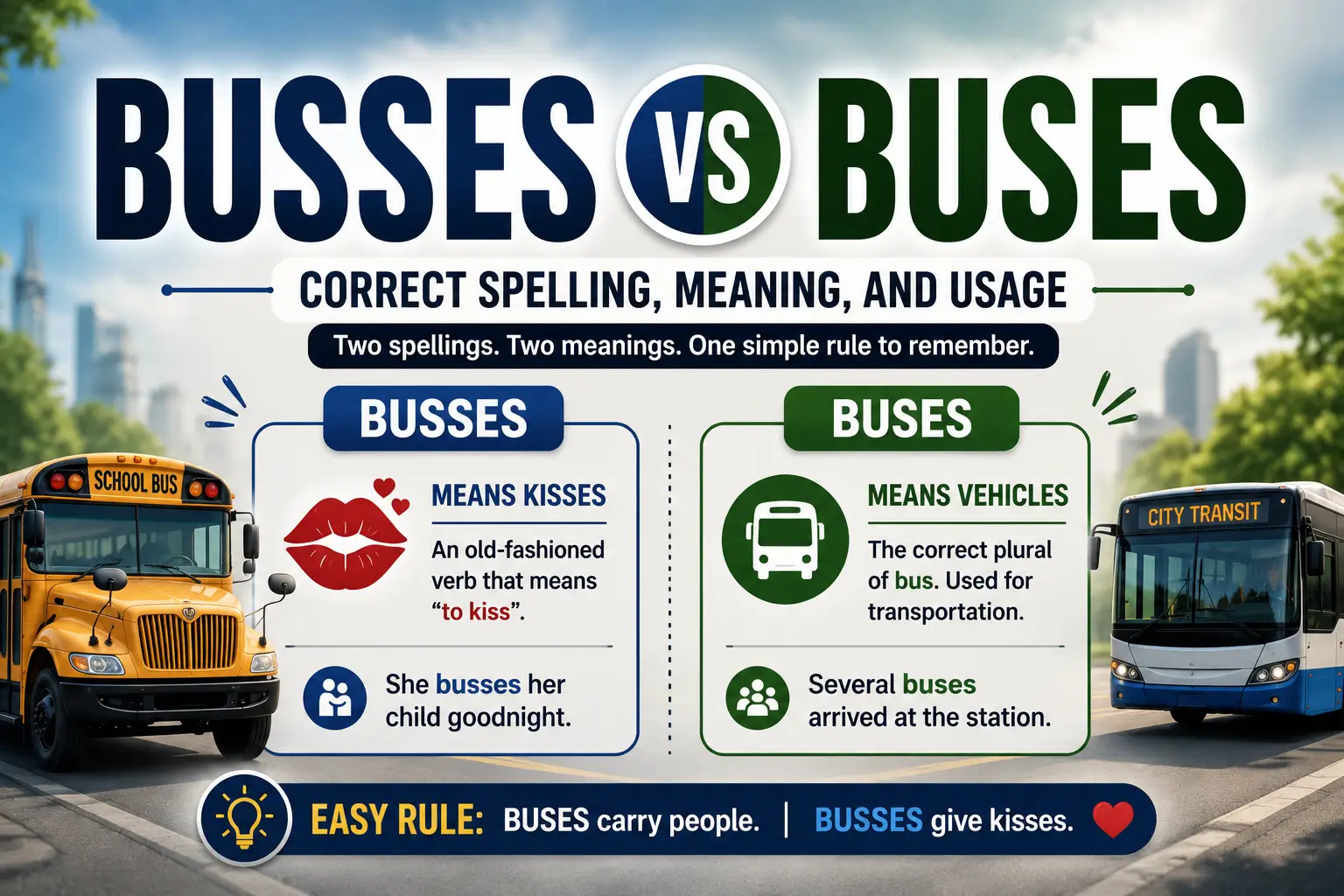
The busses vs buses difference is simple: buses is the correct plural of bus, while busses usually means kisses in older usage.
In standard English and modern English, English speakers use the standard plural form buses for multiple vehicles that transport people. Common usage contexts include public transport, private transport, public transit, school transportation, and organized tours. These vehicles follow normal grammar rules and usage rules.
Busses has distinct meanings and important differences. It is rarely accepted as the plural of bus and appears more in informal use, literary use, historical contexts, or poetic contexts. In professional writing, academic writing, academic papers, workplace communication, and digital content, writers who are misusing terms may confuse readers and undermine credibility. This grammar lesson helps define both words, prevent common mistakes, noticeable mistakes, and awkward errors, and gives clear actionable decision rules: use buses for transportation and busses for kisses. This supports correct usage and clearer practical examples.
Quick Answer: Busses or Buses?
Use buses as the standard plural of bus.
Three buses arrived at the station.
Use buses as the third-person singular form of the verb bus.
The school buses students across town.
Use busses when the verb buss means “kisses.”
She busses her child on the cheek.
The easiest rule is simple:
- Buses usually relates to transportation, table clearing, or computer systems.
- Busses usually means kisses.
Busses vs. Buses at a Glance
| Form | Part of Speech | Main Meaning | Modern Usage | Example |
| Buses | Plural noun | More than one bus | Standard | The city bought new buses. |
| Buses | Verb | Transports by bus or clears tables | Standard | He buses tables after school. |
| Busses | Verb | Kisses | Correct but uncommon | She busses the baby goodnight. |
| Busses | Plural noun | More than one bus | Rare or dated variant | Older texts may use busses. |
For most modern writing, buses is the correct choice.
Read this also: Blankie vs Blanky: Which Spelling Is Correct in English?
What Does Buses Mean?
Buses can be either a plural noun or a verb. Its meaning depends on how it works in the sentence.
Buses as the Standard Plural of Bus
The most common meaning of buses is “more than one bus.”
The school purchased six new buses.
Several buses stop near the courthouse.
Airport buses run every twenty minutes.
This spelling is standard in current American English. It appears in schools, transportation systems, news reports, government documents, and everyday writing.
Buses as a Transportation Verb
Buses can also be the third-person singular form of the verb bus. In transportation contexts, it means to carry people by bus.
The district buses students from rural areas.
The company buses workers to the construction site.
The hotel buses guests to the airport.
Here, the subject is singular, such as district, company, or hotel. Therefore, the verb takes the form buses.
Buses as a Restaurant Verb
In restaurant English, to bus a table means to remove used plates, glasses, and utensils.
Marcus buses tables during the dinner shift.
She clears and buses each table before the next guests arrive.
This use is common in the United States. However, many workplaces also use phrases such as clear tables or reset tables.
Buses in Computing
In technology, a bus is a system that carries data between parts of a computer.
Modern computers may use several data buses.
The processor communicates with memory through internal buses.
Although the meaning is technical, the plural remains buses.
What Does Busses Mean?
Busses is a real word, but it is not usually the best plural spelling for bus in modern American English.
Busses as a Rare Plural Variant
Some older dictionaries and publications have accepted busses as an alternative plural of bus. However, it now looks unusual to many readers.
Less common:
The town added three new busses.
Preferred:
The town added three new buses.
The first sentence may not be strictly impossible, but the second is clearer and more current.
Busses as a Form of Buss
The verb buss means to kiss. Its third-person singular form is busses.
He busses his grandmother on the cheek.
She busses the child before bedtime.
This verb sounds old-fashioned, playful, or literary. Most American speakers would simply use kisses.
Why Busses Can Confuse Readers
When readers see busses, they may think of kissing rather than transportation.
For example:
The driver busses the children.
This sentence is confusing. Does the driver transport the children or kiss them?
For transportation, write:
The driver buses the children.
For kissing, write:
The driver busses the child on the forehead.
Clear spelling prevents an unintended meaning.
The Main Difference Between Busses and Buses
The main difference involves modern spelling, grammar, and meaning.
Buses Is the Standard Transportation Spelling
Use buses when you mean:
- more than one bus
- transports people by bus
- clears restaurant tables
- computer data systems
Examples:
The city operates electric buses.
The district buses students each morning.
Ava buses tables on weekends.
Several internal buses connect the computer components.
Busses Usually Relates to Kissing
Use busses when the verb means “kisses.”
He busses her lightly on the cheek.
Because this verb is uncommon, many readers may find it dated. Still, it is grammatically correct.
Standard Form vs. Rare Variant
The safest modern rule is:
Use buses for transportation and technical meanings.
Use busses only for the verb buss, meaning “to kiss.”
This rule works in school, business, academic, technical, and professional writing.
Why the Standard Plural Is Buses
The plural buses follows the common English pattern for words ending in s.
The Basic Plural Rule
Many nouns ending in s, x, z, ch, or sh form the plural by adding -es.
Examples:
- class → classes
- box → boxes
- church → churches
- dish → dishes
- bus → buses
Therefore, bus becomes buses.
Why the Final S Is Not Usually Doubled
Writers sometimes assume the final s must be doubled because the word is short. However, modern standard spelling does not require that doubling.
Correct:
bus → buses
Not preferred:
bus → busses
The spelling buses is now dominant because it is simpler and widely accepted.
Historical Variation
The form busses appeared more often in older English. Over time, buses became the usual spelling.
That change also helped separate the plural of bus from the verb buss, meaning “to kiss.”
Pronunciation of Buses and Busses
Both words are generally pronounced the same way in American English.
How to Pronounce Buses
Buses usually has two syllables:
BUS-iz
The first syllable is stressed.
How to Pronounce Busses
Busses is also pronounced:
BUS-iz
Because the pronunciation is the same, you must use context to choose the spelling.
Why Sound Does Not Solve the Problem
Consider these sentences:
The city bought new buses.
She busses the baby goodnight.
The key difference is not pronunciation. Instead, the meaning tells you which spelling belongs.
Buses as a Noun in Real-Life English
The noun buses appears in many everyday settings.
Public Transit Buses
Public transportation systems use buses to carry passengers along fixed routes.
The downtown buses stop every fifteen minutes.
Many commuters use city buses instead of driving.
School Buses
School districts use buses to transport students.
Yellow school buses lined up outside the building.
The district inspected all its buses before the school year began.
Shuttle and Charter Buses
Hotels, airports, companies, and tour groups often use shuttle or charter buses.
The airport buses run between the terminals.
Two charter buses carried the team to the tournament.
Computer Buses
In computing, buses transfer information between hardware components.
Data buses move information between memory and the processor.
This technical meaning is standard in computer science and engineering.
Buses as a Verb
The verb bus has more than one accepted meaning.
To Transport by Bus
The school buses students from nearby towns.
The company buses employees to the factory.
In these sentences, buses means “transports by bus.”
To Clear Tables
Jordan buses tables at a busy restaurant.
The server buses the table after the guests leave.
This meaning is especially common in American restaurant work.
How Context Separates the Meanings
Compare:
The district buses students.
The employee buses tables.
The spelling is the same, but the object changes the meaning. Students are transported. Tables are cleared.
Busses as a Verb Meaning Kisses
The verb buss is less common today, but it still appears in dictionaries and literary writing.
Meaning of Buss
To buss someone means to kiss that person, often lightly.
He gave her a quick buss on the cheek.
As a verb:
He busses her on the cheek.
Verb Forms of Buss
The common forms are:
- present: buss
- third-person singular: busses
- past tense: bussed
- present participle: bussing
Examples:
She busses the child goodnight.
He bussed her on the forehead.
They were bussing each other in the doorway.
Tone and Modern Usage
The verb may sound:
- old-fashioned
- playful
- literary
- humorous
- regional
In normal conversation, kiss is usually clearer.
Modern:
She kisses her daughter goodnight.
Old-fashioned:
She busses her daughter goodnight.
Busses vs. Buses in American English
Modern American usage strongly favors buses as the plural.
School and Education
Students should normally write:
The school owns twelve buses.
Teachers and editors are likely to mark busses as unusual or less preferred.
Public Transportation
Transit agencies, schedules, and public notices use buses.
All buses will follow a revised route.
Restaurant Work
The correct present-tense form is usually:
He buses tables.
However, spelling variation appears more often in the related forms bused, bussed, busing, and bussing.
Professional Writing
Use buses in:
- reports
- contracts
- transportation plans
- safety manuals
- schedules
- policies
- emails
This spelling is the clearest and least distracting.
Technical Writing
Use buses for computer systems.
The design includes multiple address buses.
Creative Writing
A writer may use busses when the intended meaning is “kisses.”
The sailor busses his wife before leaving.
That sentence has a literary or dated tone.
Buses, Bus’s, and Buses’
Writers also confuse plural and possessive forms.
| Form | Grammar Role | Meaning | Example |
| Buses | Plural | More than one bus | The buses are late. |
| Bus’s | Singular possessive | Something belonging to one bus | The bus’s engine is loud. |
| Buses’ | Plural possessive | Something belonging to several buses | The buses’ routes changed. |
Buses: Simple Plural
The buses arrived on time.
No apostrophe is needed because the word is only plural.
Bus’s: Singular Possessive
The bus’s door would not close.
The door belongs to one bus.
Buses’: Plural Possessive
The buses’ schedules were updated.
The schedules belong to multiple buses.
Apostrophes Do Not Make Regular Plurals
Incorrect:
The city bought five bus’s.
Correct:
The city bought five buses.
An apostrophe usually shows possession, not a regular plural.
Bus, Buses, Bused, Bussed, Busing, and Bussing
The verb forms of bus can cause extra confusion.
| Form | Common Use | Example |
| Bus | Base form | They bus students daily. |
| Buses | Third-person singular | The district buses students. |
| Bused | Past tense, common transportation spelling | Students were bused downtown. |
| Bussed | Accepted variant; also past of buss | He bussed the table or kissed her. |
| Busing | Common transportation form | The school began busing students. |
| Bussing | Common in restaurant use; also kissing | She is bussing tables. |
Bused or Bussed?
Both forms appear. However, bused often makes the transportation meaning clearer.
The children were bused to another school.
The spelling bussed may also appear, especially in restaurant contexts.
He bussed the tables quickly.
Because usage varies, consistency matters.
Busing or Bussing?
Busing is common when the meaning involves transportation.
The district started busing students.
Bussing often appears in restaurant contexts.
She is bussing tables tonight.
Still, dictionaries may accept both spellings for the verb bus. Follow your chosen style and stay consistent.
Bussing as Kissing
When the verb is buss, meaning to kiss, the form is bussing.
The couple was bussing under the doorway.
Context remains essential.
Read this also: Indecisive vs. Undecisive: Which Word Is Correct?
Common Mistakes With Busses and Buses
Several errors appear often in everyday writing.
Using Busses as the Normal Plural
Less preferred:
The company owns ten busses.
Preferred:
The company owns ten buses.
Use buses in current standard writing.
Assuming Busses Is Always Wrong
Busses is correct when it means “kisses.”
She busses him on the cheek.
It may also appear as an older plural variant, though that use is uncommon.
Confusing Buses With Busses
Incorrect for transportation:
The district busses students every morning.
Preferred:
The district buses students every morning.
The preferred spelling keeps the transportation meaning clear.
Adding an Apostrophe
Incorrect:
Three bus’s arrived late.
Correct:
Three buses arrived late.
The sentence needs a plural, not a possessive.
Using the Wrong Possessive Form
Incorrect:
The buses engine failed.
Correct:
The bus’s engine failed.
For one bus, use bus’s.
For several buses:
The buses’ engines were inspected.
Correct and Incorrect Examples
| Incorrect or Less Preferred | Correct or Preferred | Reason |
| The city bought new busses. | The city bought new buses. | Buses is the standard plural. |
| Three bus’s arrived. | Three buses arrived. | Apostrophes do not form regular plurals. |
| The buses tire was flat. | The bus’s tire was flat. | The tire belongs to one bus. |
| The bus’s routes changed. | The buses’ routes changed. | The routes belong to several buses. |
| The school busses students. | The school buses students. | Buses is the preferred transportation verb. |
| She buses him on the cheek. | She busses him on the cheek. | Busses is the form of buss, meaning kisses. |
| The processor uses several data busses. | The processor uses several data buses. | Technical writing prefers buses. |
Simple Rules for Choosing Buses or Busses
Use these rules when you are unsure:
- Use buses for more than one bus.
- Use buses when a school, company, or organization transports people.
- Use buses when someone clears restaurant tables.
- Use buses for computer data systems.
- Use busses when you mean “kisses.”
- Use bus’s for something belonging to one bus.
- Use buses’ for something belonging to several buses.
- Prefer buses in modern American writing.
Memory Tricks
A few simple tricks can prevent spelling errors.
The One-S Rule
The standard plural keeps one s before the ending:
bus + es = buses
The Kiss Connection
Remember:
buss = kiss
busses = kisses
The double s connects with the uncommon kissing verb.
The Vehicle Test
Replace the word with vehicles.
Several buses arrived.
Several vehicles arrived.
If the meaning still works, use buses.
The Possession Test
Ask whether something belongs to the bus.
The bus’s door
The door belongs to one bus, so use an apostrophe.
Synonyms and Related Words
Words Related to Buses
Depending on context, related terms include:
- coaches
- shuttles
- minibuses
- motorcoaches
- transit vehicles
- school buses
- charter buses
A coach often refers to a larger bus used for long-distance travel. A shuttle usually travels back and forth between fixed locations.
Words Related to the Verb Bus
For transportation, possible alternatives include:
- transport
- carry
- shuttle
- move
For restaurant work, alternatives include:
- clear
- reset
- remove dishes
- clean tables
Words Related to Buss
Related words include:
- kiss
- peck
- smooch
A peck is usually a quick, light kiss. Smooch is more informal and playful.
Real-Life Usage Examples
School Transportation
The district owns forty buses.
It buses students from several neighborhoods.
Both uses take the spelling buses.
Public Transit
Electric buses now serve the downtown route.
The word is a plural noun.
Restaurant Work
Luis buses tables after the lunch rush.
The word is a verb meaning “clears.”
Computer Hardware
The motherboard includes several communication buses.
The technical plural is buses.
Literary Kissing
The grandfather busses the child on both cheeks.
Here, busses means “kisses.”
Quick Practice: Choose Buses, Busses, Bus’s, or Buses’
Fill in each blank with the correct form.
- The city ordered twelve new ______.
- The school ______ students from nearby towns.
- The ______ engine needs repair.
- The ______ routes were changed.
- She ______ her baby on the forehead.
- He ______ tables during the evening shift.
- Several data ______ connect the computer parts.
- The airport ______ run every half hour.
- The ______ driver opened the door.
- The two ______ schedules were posted online.
Answers
- buses — The sentence refers to more than one bus.
- buses — The verb means transports by bus.
- bus’s — The engine belongs to one bus.
- buses’ — The routes belong to several buses.
- busses — The verb means kisses.
- buses — The verb means clears tables.
- buses — This is the standard technical plural.
- buses — The sentence refers to several vehicles.
- bus’s — The driver is connected to one bus.
- buses’ — The schedules belong to two buses.
Frequently Asked Questions About Busses vs. Buses
Q1: Is buses or busses the correct plural of bus?
Buses is the standard plural of bus in modern American English.
Two buses arrived at the station.
Although busses has appeared as a variant spelling, it is uncommon and may look outdated.
Q2: Is busses a real word?
Yes, busses is a real word. It is most often the third-person singular form of buss, an old-fashioned verb meaning “to kiss.”
She busses the child on the cheek.
However, most speakers now use kisses instead.
Q3: Why is the plural of bus spelled buses?
Words ending in s often form the plural by adding -es. Therefore, bus becomes buses.
Similar examples include:
- class → classes
- gas → gases
- bus → buses
The final s does not need to be doubled.
Q4: Can busses mean more than one bus?
Some dictionaries recognize busses as a rare variant plural of bus. However, buses is the preferred form in schools, newspapers, business documents, and professional writing.
Preferred: The city purchased new buses.
Q5: What does busses mean?
Busses usually means “kisses” when it comes from the verb buss.
He busses his grandmother on the forehead.
This usage sounds literary, humorous, or old-fashioned in modern English.
Q6: Is it buses or busses in American English?
Use buses when writing about transportation, school vehicles, public transit, restaurant table clearing, or computer systems.
Use busses only when you mean “kisses” or when you intentionally use an older spelling.
Q7: Is it correct to write “the school busses students”?
The preferred modern spelling is:
The school buses students.
Here, buses is a verb meaning “transports by bus.” Writing busses may confuse readers because it can suggest kissing.
Q8: Is it buses tables or busses tables?
In standard modern usage, write:
He buses tables at a restaurant.
The verb means that he removes used dishes and prepares the tables for new customers. However, bussing tables is also widely seen when the -ing form is used.
Q9: What is the difference between buses, bus’s, and buses’?
Buses is the plural form.
The buses are late.
Bus’s is the singular possessive form.
The bus’s door is open.
Buses’ is the plural possessive form.
The buses’ routes have changed.
Q10: What is the easiest way to remember busses vs. buses?
Use this simple memory rule:
- Buses carry people.
- Busses give kisses.
For almost every modern transportation sentence, buses is the correct spelling.
Conclusion
The difference between busses vs. buses depends on spelling, meaning, and modern usage. Buses is the correct and preferred plural of bus in American English. It also works as a verb when someone transports people or clears restaurant tables.
Use buses for public transit, school transportation, private travel, tours, and computer systems. By contrast, busses usually comes from the old-fashioned verb buss, which means “to kiss.”
The safest rule is easy to remember: buses are vehicles, while busses are kisses. Following this rule will improve clarity, prevent spelling mistakes, and make your academic, professional, and everyday writing easier to understand