
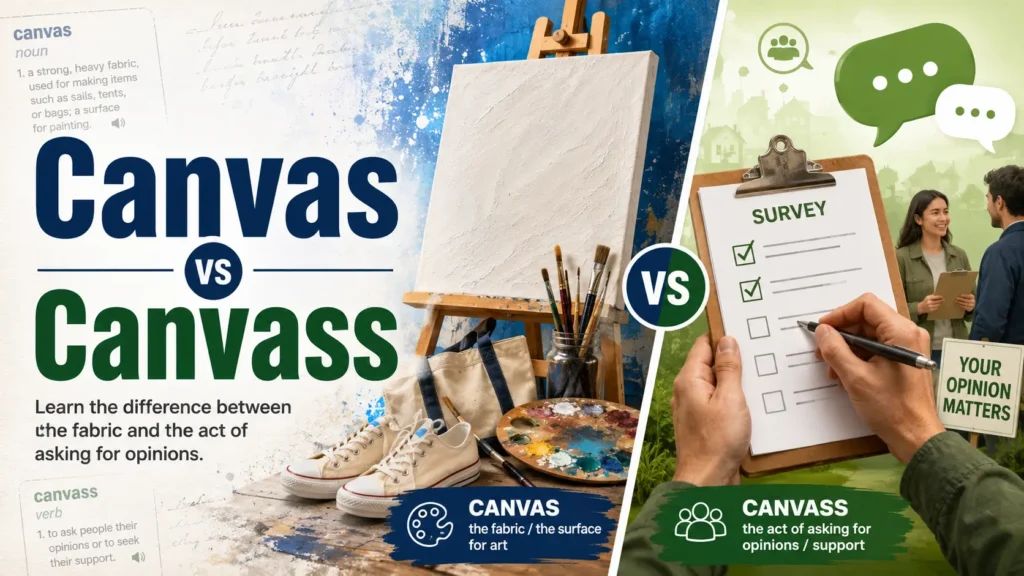
Canvas vs Canvass is a common spelling and vocabulary confusion because both words look similar and sound similar, yet their meanings and uses are completely different. Canvas usually refers to a strong fabric or material used for paintings, bags, shoes, and other products. For example, an artist may paint on a canvas, while a company may manufacture durable canvas shoes. In contrast, canvass means to survey opinion, solicit votes, or collect information and support from people.
The key difference is simple: canvas usually describes a physical thing, while canvass describes an action involving people. During elections, volunteers canvass voters to learn their views or encourage support. Businesses may survey customers, while researchers may gather community opinions. Although both spellings are correct English words, the extra s changes meaning, so choosing the right one matters.
In everyday writing, including emails, news writing, and school work, mixing up these terms can hurt grammar, communication, and writing accuracy. A useful grammar rule is to connect canvas with creation and materials, while linking canvass with conversations, opinions, and support. Understanding this correct usage strengthens your vocabulary, practical usage, and confidence in English.
Quick Answer: Canvas vs Canvass
Here is the easiest way to understand the difference:
| Word | Meaning | Example |
| Canvas | Strong fabric or a painting surface | “The artist painted on a large canvas.” |
| Canvass | Ask people for opinions, votes, or support | “The volunteers canvassed the neighborhood.” |
Simple Rule
Use canvas when talking about:
- art
- fabric
- bags
- shoes
- tents
- physical materials
Use canvass when talking about:
- asking questions
- collecting opinions
- elections
- surveys
- gathering support
- fundraising
Canvas vs Canvass: Understanding the Difference
The main difference between canvas and canvass comes down to meaning and purpose.
Although both words have similar spelling and pronunciation, they belong to completely different contexts.
Canvas usually describes something physical.
For example:
- A painter uses a canvas.
- A company makes canvas shoes.
- A tent may use canvas fabric.
Canvass, on the other hand, involves communication or information gathering.
For example:
- Political workers canvass voters.
- Researchers canvass public opinion.
- Charities may organize a fundraising canvass.
These words are not interchangeable. Replacing one with the other can completely change your sentence.
What Does Canvas Mean?
Canvas is mainly a noun, although it can sometimes function as a verb.
Its most common meaning is a strong and durable fabric. Manufacturers often make canvas from cotton, linen, or synthetic fibers.
Because the material is tough and long-lasting, people use it in art, fashion, travel products, outdoor equipment, and manufacturing.
Canvas as a Painting Surface
In art, a canvas is the surface on which an artist creates a painting.
Painters commonly stretch canvas over a wooden frame before applying oil or acrylic paint.
Examples:
- “The painter created a beautiful landscape on canvas.”
- “She bought a blank canvas for her art class.”
- “The museum displayed several paintings on canvas.”
Common phrases include:
- blank canvas
- canvas painting
- oil on canvas
The phrase blank canvas can also work figuratively.
“Starting a new project feels like working on a blank canvas.”
Here, a blank canvas represents a fresh beginning or an opportunity to create something new.
Canvas as a Fabric Material
Outside the art world, canvas refers to a strong fabric used for many practical products.
Common examples include:
- backpacks
- shoes
- tents
- jackets
- furniture covers
- tarps
- tool bags
Example sentences:
- “He bought a canvas backpack for traveling.”
- “These canvas shoes are comfortable and lightweight.”
- “The tent is made from waterproof canvas.”
This meaning appears frequently in American English, especially in fashion and product descriptions.
Canvas as a Verb
Although less common, canvas can also function as a verb.
In this sense, it means covering something with canvas material.
Example:
“Workers canvased the boat to protect it from harsh weather.”
Most people, however, encounter canvas as a noun when discussing artwork or physical materials.
What Does Canvass Mean?
Canvass means to ask people for information, opinions, votes, or support.
Unlike canvas, which often describes a physical object, canvass usually involves communication with people.
You will commonly see the term in politics, research, surveys, business, and fundraising.
Canvass as a Verb
As a verb, canvass means to approach people and ask questions, request support, or collect information.
It commonly appears in:
- elections
- political campaigns
- surveys
- market research
- community studies
- fundraising
Examples:
- “Campaign workers canvassed voters before election day.”
- “The company canvassed customers to understand their needs.”
- “Researchers canvassed residents about public transportation.”
In each case, someone actively gathers information or support from other people.
Canvass as a Noun
Canvass can also function as a noun.
As a noun, it refers to an organized effort to collect opinions, votes, information, or support.
Examples:
- “The election canvass showed strong support for the candidate.”
- “The charity organized a door-to-door canvass.”
Here, canvass describes the activity itself.
Canvas vs Canvass Comparison Table
The following table makes the distinction easier to remember.
| Feature | Canvas | Canvass |
| Spelling | One final “s” | Two final “s” letters |
| Pronunciation | KAN-vuhs | KAN-vuhs |
| Main meaning | Fabric or painting surface | Asking people for opinions or support |
| Part of speech | Noun and verb | Noun and verb |
| Common fields | Art, fashion, manufacturing | Politics, surveys, fundraising |
| Example | “She painted on canvas.” | “They canvassed voters.” |
The words may sound the same, but their spelling tells you which meaning applies.
Canvas vs Canvass in American English
Both words appear regularly in American English, although they occur in very different situations.
Common Uses of Canvas
Americans often use canvas when discussing art, fashion, products, and design.
Art
“The artist stretched the canvas before painting.”
Fashion
“Canvas sneakers are popular during summer.”
Products
“This canvas bag is designed for daily use.”
Design
“The designer started with a blank canvas.”
Common Uses of Canvass
Americans typically use canvass when discussing elections, research, public opinion, or business feedback.
Elections
“Volunteers are canvassing neighborhoods to encourage voting.”
Research
“The organization canvassed public opinion before making changes.”
Business
“The company canvassed customers for feedback.”
Common Mistakes With Canvas and Canvass
Because the two words sound alike, writers frequently choose the wrong spelling.
Knowing the context usually solves the problem.
Mistake: Using Canvas for Elections
Incorrect:
❌ “The campaign team canvas the neighborhood.”
Correct:
✅ “The campaign team canvassed the neighborhood.”
The campaign team is asking people for support or opinions. Therefore, canvass is the correct word.
Mistake: Using Canvass for Art
Incorrect:
❌ “The painting was created on canvass.”
Correct:
✅ “The painting was created on canvas.”
A painting surface is canvas, not canvass.
Mistake: Using Canvass for Fabric
Incorrect:
❌ “The company used a canvass bag.”
Correct:
✅ “The company used a canvas bag.”
The sentence describes a physical fabric material, so canvas is correct.
Real-Life Examples of Canvas vs Canvass
Real-world examples make the difference much easier to remember.
Canvas Examples
| Sentence | Meaning |
| “She bought a large canvas for her painting.” | Painting surface |
| “The store sells canvas backpacks.” | Fabric material |
| “The artist worked on a blank canvas.” | Creative surface |
Canvass Examples
| Sentence | Meaning |
| “Workers canvassed voters before the election.” | Asked for votes |
| “The company canvassed customers for feedback.” | Collected opinions |
| “The charity started a fundraising canvass.” | Organized support effort |
Easy Memory Tricks for Canvas vs Canvass
You don’t need to memorize complicated grammar rules.
Two simple associations can prevent most mistakes.
Think: Canvas = Creation
Artists create something on a canvas.
Remember:
Canvas → Create
Examples:
- canvas painting
- canvas artwork
- canvas bag
- blank canvas
When you’re talking about a physical material or something connected with creation, canvas is probably correct.
Think: Canvass = Communication
When you canvass, you communicate with people.
Examples include:
- asking voters
- conducting surveys
- requesting support
- collecting opinions
- gathering feedback
A useful memory sentence is:
You paint on canvas, but you talk during a canvass.
Synonyms and Related Words
The best alternative depends on how each word is being used.
Synonyms for Canvas
When canvas means fabric, related words include:
- cloth
- material
- textile
- fabric
When it means a painting surface, related expressions include:
- painting surface
- artwork surface
- art board
These terms may not work perfectly in every sentence, so always consider the context.
Synonyms for Canvass
When canvass means asking for opinions, related words include:
- survey
- poll
- question
- interview
When it means seeking support, related words include:
- campaign
- solicit
- request
- appeal
Again, these are related terms rather than perfect replacements in every situation.
Grammar Tips for Using Canvas and Canvass Correctly
When you’re unsure which spelling to use, examine what the sentence is actually describing.
Pay Attention to Context
Ask yourself:
Is the sentence about a physical thing or about communicating with people?
Use this shortcut:
- Physical thing or material → canvas
- People, opinions, votes, or support → canvass
Example:
“The organization collected feedback from residents.”
Because the sentence involves people’s opinions, you could write:
“The organization canvassed residents.”
Check the Part of Speech
Both canvas and canvass can function as nouns and verbs.
Canvas as a noun:
“The canvas is ready for painting.”
Canvas as a verb:
“Workers canvased the structure.”
Canvass as a noun:
“The election canvass ended yesterday.”
Canvass as a verb:
“They canvassed local voters.”
Knowing the part of speech helps, but the sentence’s meaning remains the most important clue.
Why the Extra “S” Matters
The spelling difference may seem tiny, but that final “s” changes the meaning.
Compare:
Canvas → material, fabric, or painting surface
Canvass → asking people for information or support
Because both words sound almost identical when spoken, context becomes especially important in writing.
A misspelling can make an otherwise clear sentence confusing.
For example:
❌ “They bought a canvass tent.”
The sentence refers to material, so it should be:
✅ “They bought a canvas tent.”
Likewise:
❌ “The volunteers canvas voters every weekend.”
If they are approaching voters for support or opinions, write:
✅ “The volunteers canvass voters every weekend.”
Conclusion: Canvas vs Canvass
Understanding the difference between canvas vs canvass becomes easy when you connect each word with its purpose. Canvas refers to a material, such as fabric used for paintings, bags, shoes, and other durable products. Canvass, on the other hand, refers to an action involving people, such as asking for opinions, collecting information, or seeking votes and support.
Although both words have similar spelling and pronunciation, they are not interchangeable. Remember this simple rule: if you are talking about something you can touch or create on, use canvas. If you are talking about asking people questions or gathering opinions, use canvass. Using the correct word helps improve your grammar, writing accuracy, and overall English communication.
FAQs About Canvas vs Canvass
Q1: What is the main difference between canvas and canvass?
The main difference is their meaning. Canvas is a type of fabric or a surface used for painting, while canvass means to ask people for opinions, votes, information, or support.
Q2: Is canvas a noun or a verb?
Canvas is mainly used as a noun. It refers to a fabric or painting surface. However, it can also be used as a verb meaning to cover something with canvas material, although this usage is uncommon.
Example:
- “The artist painted on a canvas.”
- “Workers canvased the boat.”
Q3: Is canvass a noun or a verb?
Canvass can be both a noun and a verb. As a verb, it means to ask people for opinions or support. As a noun, it refers to an organized effort to collect information or gain support.
Examples:
- “Volunteers canvassed voters.”
- “The campaign organized a voter canvass.”
Q4: Are canvas and canvass pronounced the same?
Yes. In most American English conversations, canvas and canvass have the same pronunciation: KAN-vuhs. The difference appears in their spelling and meaning, not their sound.
Q5: Can I use canvas when talking about elections?
No. When discussing elections, voting, or political campaigns, the correct word is canvass.
Correct:
- “The campaign workers canvassed voters.”
Incorrect:
- “The campaign workers canvased voters.”
Q6: What does canvas mean in art?
In art, canvas is a strong fabric surface used by painters to create artwork. Many artists use canvas for oil paintings, acrylic paintings, and other forms of visual art.
Example:
- “The painter created a portrait on a large canvas.”
Q7: What does canvass mean in politics?
In politics, canvass means contacting people to ask for their opinions, encourage voting, or gain support for a candidate or cause.
Example:
- “Volunteers canvassed neighborhoods before election day.”
Q8: Why do people confuse canvas and canvass?
People confuse these words because they look almost identical and sound the same when spoken. The extra “s” in canvass changes the meaning, which makes spelling important.
Q9: Are canvas and canvass interchangeable words?
No. They cannot replace each other because they have different meanings.
Example:
Incorrect:
- “She painted on a canvass.”
Correct:
- “She painted on a canvas.”
Incorrect:
- “They canvas voters before the election.”
Correct:
- “They canvass voters before the election.”
Q10: How can I remember the difference between canvas and canvass?
Use this simple memory trick:
- Canvas = Create → You create art on a canvas.
- Canvass = Communicate → You communicate with people to collect opinions.
If it involves a painting, fabric, or product, choose canvas. If it involves asking people questions, choose canvass.
Tying vs Tieing: Which Spelling Is Correct?
