
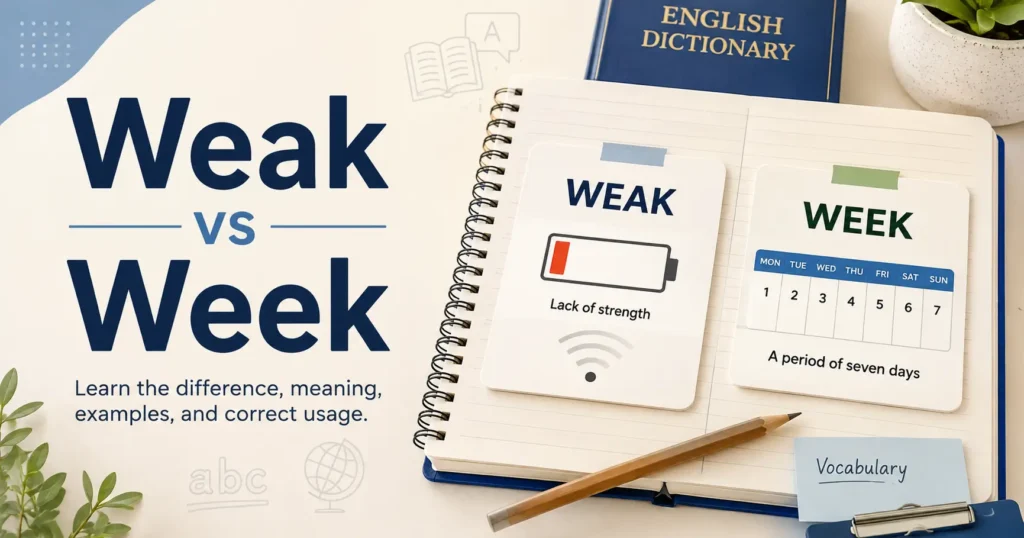
Confused about weak vs week? Learn the simple difference between these words, their meanings, and how to use them correctly in daily English.
Many English learners struggle with weak vs week because both words sound the same, but they have different meanings. Weak describes a lack of strength, power, or ability, while week refers to a period of seven days.
This guide explains the difference with clear examples, grammar tips, and practical usage. By understanding the meaning and context of each word, you can avoid common spelling mistakes and choose the correct word confidently in everyday writing and conversations. It also helps students, professionals, and writers improve their vocabulary by learning how these confusing homophones work in real situations. They also build confidence when writing professional messages and completing academic tasks with fewer errors in grammar and everyday English use.
Quick Answer: What Is the Difference Between Weak and Week?
Weak and week are homophones. That means they have the same pronunciation but different spellings and meanings.
| Word | Meaning | Part of Speech | Example |
| Weak | Not strong, powerful, or effective | Adjective | The signal is weak. |
| Week | A period of seven days | Noun | I will visit you next week. |
Here’s the easiest rule to remember:
- If you’re talking about strength, ability, or power, use weak.
- If you’re talking about time or seven days, use week.
Quick memory trick: Weak = strength. Week = time.
Weak vs Week: Key Differences at a Glance
The easiest way to separate these two words is to look at what each one describes.
| Feature | Weak | Week |
| Meaning | Lacking strength or power | Seven days |
| Word type | Adjective | Noun |
| Used for | People, objects, signals, ideas, arguments | Periods of time |
| Example | She feels weak today. | She will return next week. |
| Opposite | Strong | No direct opposite |
The key difference is simple: weak describes a condition, while week describes time.
For example:
- The athlete is weak after the injury.
Here, weak describes the athlete’s physical condition. - The athlete will return in a week.
Here, week tells us how much time will pass.
Why Do People Confuse Weak and Week?
People often confuse weak and week because they sound identical when spoken.
Both are pronounced:
/wiːk/
Pronunciation gives you no clue about which spelling to choose. You have to understand the sentence’s meaning.
Consider this example:
“I have been feeling ___ for a ___.”
The first blank describes a physical condition. The second refers to time.
The correct sentence is:
“I have been feeling weak for a week.”
The words sound the same, yet their meanings change the spelling.
This same problem appears with other English homophones, such as:
- there / their / they’re
- to / too / two
- right / write
- see / sea
The sound may stay the same. The meaning doesn’t.
What Does Weak Mean?
Weak is an adjective. It describes a person, object, idea, signal, argument, or other thing that lacks strength, quality, power, or effectiveness.
You can use weak to describe:
- Physical strength
- Emotional condition
- Arguments and ideas
- Signals and connections
- Products and performance
- Flavors and concentrations
Its exact meaning depends on the context.
Weak Meaning in Physical Situations
When weak describes a person, it usually means that person doesn’t have normal physical strength.
Examples:
- After being sick for several days, he felt weak.
- The injured player was too weak to continue the game.
- My legs feel weak after the workout.
In these sentences, weak describes reduced physical ability.
Someone may temporarily feel weak because of:
- Illness
- Injury
- Lack of sleep
- Exhaustion
- Poor nutrition
Weak Meaning for Objects and Things
Weak can also describe objects or systems that don’t have enough strength or power.
Examples:
- My phone has a weak battery.
- The Wi-Fi signal is weak in this room.
- This material is too weak for construction.
Here, the word doesn’t describe a person. It describes low strength, poor performance, or limited power.
Weak Meaning for Ideas and Arguments
The word weak can also mean unconvincing or ineffective.
Examples:
- The lawyer presented a weak argument.
- His explanation was weak and lacked evidence.
- The company has a weak strategy.
A weak argument isn’t physically weak. It simply isn’t strong enough to convince someone.
Common Synonyms and Antonyms of Weak
The best synonym for weak depends on the situation.
Synonyms of Weak
| Context | Synonyms |
| Physical strength | Frail, tired, feeble |
| Ability | Limited, powerless, ineffective |
| Argument | Unconvincing, poor, unsupported |
| Signal | Low, unstable |
Antonyms of Weak
| Weak Meaning | Opposite |
| Physical weakness | Strong |
| Poor argument | Convincing |
| Low power | Powerful |
| Ineffective | Effective |
Examples:
- Weak signal → Strong signal
- Weak argument → Strong argument
- Weak person → Strong person
What Does Week Mean?
Week is a noun that refers to a period of seven consecutive days.
The starting day of a week can vary depending on calendars, cultures, workplaces, or personal schedules. However, a week always represents seven days.
Examples:
- I will finish the project next week.
- She works five days a week.
- We stayed there for two weeks.
The singular and plural forms are straightforward:
- One week
- Two weeks
- Several weeks
Unlike weak, the word week doesn’t describe strength, quality, or condition. It describes time.
Common Uses of Week in American English
The word week appears in many everyday English expressions.
Next Week
Meaning: The following week or upcoming seven-day period.
Example:
- I have a doctor’s appointment next week.
Last Week
Meaning: The previous week.
Example:
- We completed the report last week.
Once a Week
Meaning: One time during every seven-day period.
Example:
- I go to the gym once a week.
Workweek
Meaning: The days during which someone normally works.
Example:
- My workweek usually runs from Monday to Friday.
Weekend
Meaning: Saturday and Sunday for many people in the United States.
Example:
- We are going hiking this weekend.
Weak vs Week Grammar Differences
Grammar makes the difference between weak and week much easier to understand.
The two words don’t simply have different meanings. They also perform different jobs in a sentence.
How Weak Functions in a Sentence
Weak is an adjective.
An adjective describes a noun or gives more information about a person, object, place, idea, or condition.
Examples:
- A weak person
- A weak signal
- A weak excuse
- A weak argument
Sentence examples:
- The bridge looks weak.
- She gave a weak explanation.
In both sentences, weak describes something.
How Week Functions in a Sentence
Week is a noun.
A noun names a person, place, thing, or idea. In this case, week names a period of time.
Examples:
- One week
- Three weeks
- Next week
- Every week
Sentence examples:
- The course lasts six weeks.
- I will call you next week.
If the word represents a period of seven days, week is the correct choice.
Weak vs Week Examples in Everyday English
Real-life examples make the distinction easier to remember.
| Sentence | Correct Word | Why? |
| My internet connection is very ___. | Weak | It describes signal strength. |
| I will finish the task in one ___. | Week | It describes seven days. |
| The player looked ___ after the injury. | Weak | It describes physical condition. |
| We have a meeting next ___. | Week | It describes time. |
| His excuse was ___. | Weak | It describes quality. |
The simplest approach is to ask what the sentence is talking about.
Strength or quality? Choose weak.
Time? Choose week.
Weak vs Week Sentence Pairs
Seeing the wrong and correct versions together can make the difference stick.
Example: Feeling Weak
❌ I felt week after running.
✅ I felt weak after running.
Why? Running affected your strength, not time.
Example: One Week
❌ The project will finish in one weak.
✅ The project will finish in one week.
Why? The sentence refers to a seven-day period.
Example: A Weak Voice
❌ She has a week voice.
✅ She has a weak voice.
Why? The sentence describes the strength of her voice.
Example: Waiting for a Week
❌ I have been waiting for a weak.
✅ I have been waiting for a week.
Why? Waiting refers to a length of time.
Common Mistakes With Weak and Week
Because these words sound identical, spelling mistakes are easy to make. Understanding the meaning behind the sentence is the best defense.
Using Week When You Mean Weak
Incorrect:
The team has a week defense.
Correct:
The team has a weak defense.
Why? Defense describes performance or quality, not time.
Using Weak When You Mean Week
Incorrect:
I will complete the course in two weak.
Correct:
I will complete the course in two weeks.
Why? The sentence describes duration.
Trusting Pronunciation Alone
Listening won’t help you distinguish these words because both have the same pronunciation.
Instead, ask:
“What does this sentence mean?”
If it relates to:
- Strength → weak
- Time → week
Depending Only on Spell Check
Spell-check tools may not always catch this mistake because weak and week are both correctly spelled English words.
For example:
I will finish it next weak.
The spelling of weak is technically correct, but its meaning doesn’t fit the sentence.
The real problem is word choice, not spelling.
Easy Memory Tricks for Weak vs Week
You don’t need a complicated grammar rule to remember the difference. A few simple tricks can help.
Think About Strength
Remember:
Weak = lacking strength or power
Examples:
- Weak muscles
- Weak battery
- Weak argument
If something could be described as strong, the opposite word is probably weak.
Think About Time
Remember:
Week = seven days
Examples:
- One week
- Next week
- Every week
- Weekly schedule
If you’re talking about a calendar, schedule, deadline, or period of seven days, choose week.
Use the Question Trick
Ask yourself:
“Am I talking about strength or time?”
If the answer is strength:
→ Weak
If the answer is time:
→ Week
This quick question solves most weak vs week mistakes.
Related Words: Weekly, Weakness, and Weaken
Looking at related words can also make the distinction easier.
Words Related to Weak
Weakness
Meaning: A lack of strength or ability.
Example:
- His biggest weakness is poor time management.
Weaken
Meaning: To make something less strong.
Example:
- The storm weakened the structure.
Words Related to Week
Weekly
Meaning: Happening every week.
Example:
- We have a weekly meeting.
Weekday
Meaning: A day from Monday through Friday in common usage.
Example:
- I work on weekdays.
Weekend
Meaning: Saturday and Sunday in common American usage.
Example:
- We relax on the weekend.
Practice: Choose Weak or Week
Test your understanding by filling in each blank with weak or week.
- I will submit the assignment next ______.
- The battery is too ______ to last all day.
- She felt ______ after the long trip.
- We meet once a ______.
- The company has a ______ marketing strategy.
Answers
- Week
- Weak
- Weak
- Week
- Weak
If you got all five correct, you’ve understood the core difference.
Conclusion: Remember the Difference Between Weak and Week
The difference between weak vs week becomes easy when you focus on the meaning behind the word. Weak describes something that lacks strength, power, ability, or effectiveness, while week refers to a period of seven days. Although these two words sound exactly the same, their spelling and usage are completely different.
A simple trick is to ask yourself what you are talking about. If the sentence is about physical power, a poor result, a low signal, or a lack of ability, use weak. If the sentence is about a schedule, deadline, or a period of time, use week. With regular practice and attention to context, you can easily avoid this common English mistake and use both words correctly in your writing and conversations.
Frequently Asked Questions About Weak vs Week
Q1: What is the difference between weak and week?
Weak means lacking strength, power, or effectiveness, while week means a period of seven days. They sound the same but have different meanings and spellings.
Q2: Are weak and week homophones?
Yes, weak and week are homophones because they have the same pronunciation but different meanings and spellings.
Q3: Is weak an adjective or a noun?
Weak is an adjective because it describes a person, object, idea, or situation. For example, “The signal is weak” describes the strength of the signal.
Q4: Is week a noun or an adjective?
Week is a noun because it refers to a period of time. For example, “I will complete the project in one week.”
Q5: How can I remember the difference between weak and week?
Remember that weak relates to strength, while week relates to time. If you can replace the word with “strong,” use weak. If you can replace it with “seven days,” use week.
Q6: Can weak describe a person?
Yes, weak can describe a person when they lack physical strength or ability. For example, “She felt weak after being sick.”
Q7: Can week describe strength or ability?
No, week cannot describe strength or ability. It only refers to a period of time.
Q8: What is the correct phrase: too weak to or too week to?
The correct phrase is “too weak to” when talking about a lack of ability or strength. For example, “He was too weak to lift the box.”
Q9: Why do people confuse weak and week?
People confuse these words because they have the same pronunciation. Since the sound is identical, writers must use the meaning and context of the sentence to choose the correct spelling.
Q10: What are some examples of weak and week in sentences?
Examples:
- Weak: The battery is too weak to power the device.
- Week: I will finish the assignment next week.
The first sentence talks about power, while the second sentence talks about time.
Seam vs Seem: Meaning, Difference, Examples, and Easy Rules
Entwined vs Intertwined: Meaning, Difference, and Examples
Sell vs Sale: The Ultimate Guide to the Difference
Afterward or Afterwards: Meaning, Difference, and Easy Usage Rules
