
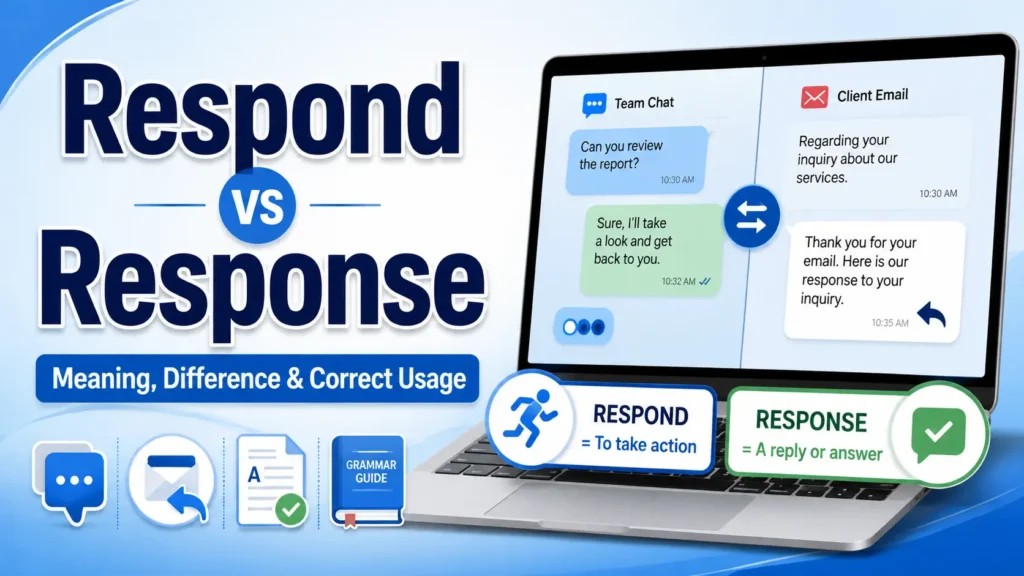
Respond vs response becomes easy to understand once you know their grammar roles. Respond is a verb that means to answer, reply, or react. Response is a noun that means an answer, reaction, or result. Although these words look similar, they work differently in English. Knowing this difference improves writing, speaking, emails, and professional communication while making your usage clearer and more accurate.
Many learners experience confusion because both words come from the same Latin root and often appear together in everyday conversation, news report, and workplace messages. For example, “Please respond to my email” describes an action, while “Thank you for your response” refers to the reply itself. A common mistake is writing “Please response to this message” because response cannot replace the verb respond. Understanding this simple grammar rule helps improve writing clarity, avoid errors, and build confidence in professional and casual communication.
The easiest way to remember the difference is: respond = action, response = answer or reaction. When someone needs to react or provide information, they respond. When you receive or discuss the result, you talk about the response. This pattern works across different situations, including customer service, academic writing, workplace emails, and daily conversations.
Quick Answer: Respond vs Response
The easiest way to remember the difference is:
| Word | Meaning | Grammar Role | Example |
| Respond | To answer, reply, or react | Verb (action word) | Please respond to this message. |
| Response | An answer, reply, or reaction | Noun (thing or result) | Thank you for your response. |
A simple trick:
You respond. You give a response.
If you are talking about doing something, use respond. If you are talking about the answer itself, use response.
What Does Respond Mean?
Respond is a verb that means to answer, reply, react, or take action after receiving something.
Because respond is a verb, it describes something someone does. It usually connects to a question, message, request, situation, or event.
Common Meanings of Respond
- To reply verbally or in writing
- To react to a situation
- To take action after something happens
- To show a reaction or behavior
Examples of Respond in Sentences
Replying to communication
She didn’t respond to my text message.
Here, respond means “reply.”
Reacting to a situation
The company quickly responded to customer complaints.
Here, the company took action after receiving complaints.
Answering a question
Students must respond to all questions before submitting the exam.
The students are performing an action: answering.
How Respond Works in a Sentence
The word respond often appears with the preposition to.
Common Structure
Respond + to + person, question, message, or situation
Examples:
- I will respond to your email tomorrow.
- The doctor responded to the emergency quickly.
- She never responded to my invitation.
However, respond does not always need “to.”
For example:
He responded politely.
The sentence is complete because the focus is on how he reacted.
What Does Response Mean?
Response is a noun that means an answer, reaction, reply, or result caused by something.
Unlike respond, which describes the action, response describes the thing that comes after the action.
Common Meanings of Response
- An answer to a question
- A reply to communication
- A reaction to an event
- A result caused by a situation
Examples of Response in Sentences
Reply or answer
I am waiting for your response.
The speaker is waiting for the answer, not the action of answering.
Reaction
His response to the news was surprising.
The sentence describes his reaction.
Official action
The emergency response arrived within minutes.
Here, response means the action taken after an emergency.
How Response Works in a Sentence
Because response is a noun, it usually appears with words that describe possession, quantity, or actions connected to nouns.
Common patterns include:
A Response to + Something
Examples:
- We received a response to our request.
- Her response to the question was correct.
Give a Response
Examples:
- Please give a detailed response.
- The manager gave a quick response.
Receive a Response
Examples:
- I haven’t received a response yet.
- They finally received a response from the company.
Respond vs Response: Key Differences Explained
Although these words share the same origin and meaning, their grammar roles are different.
| Difference | Respond | Response |
| Part of speech | Verb | Noun |
| Describes | An action | A result or thing |
| Main question answered | What did someone do? | What did someone give or receive? |
| Example | She will respond soon. | She sent a response. |
| Similar words | Reply, answer, react | Reply, answer, reaction |
A useful comparison:
The customer responded to the complaint.
The customer’s response was helpful.
The first sentence focuses on the action. The second focuses on the result.
The Grammar Rule: Action vs Result
The most important rule for respond vs response is:
Use respond when someone performs the action. Use response when you describe the answer or reaction.
Think about these questions:
Are You Describing an Action?
Use respond.
Example:
Please respond before Friday.
The person must do something.
Are You Describing an Answer or Reaction?
Use response.
Example:
We are waiting for your response.
The answer itself is the focus.
Respond vs Response Examples: Correct and Incorrect Usage
Using Respond Correctly
✅ Correct:
Please respond to this email as soon as possible.
Why?
Because the person needs to take an action.
❌ Incorrect:
Please response to this email as soon as possible.
Why?
Because response is not a verb. It cannot describe an action.
Using Response Correctly
✅ Correct:
Thank you for your quick response.
Why?
The sentence talks about the reply that was received.
❌ Incorrect:
Thank you for your quick respond.
Why?
Respond cannot be used as a noun in this sentence.
Common Mistakes With Respond and Response
Many English learners confuse these words because they look almost identical. However, small grammar differences completely change how they work.
Mistake 1: Using Response as a Verb
Incorrect:
I will response to your message tomorrow.
Correct:
I will respond to your message tomorrow.
Why?
“Will” requires a verb. Therefore, respond is correct.
Mistake 2: Using Respond as a Noun
Incorrect:
I am waiting for your respond.
Correct:
I am waiting for your response.
Why?
The sentence needs a noun because it refers to the answer being expected.
Mistake 3: Saying “Quick Respond” Instead of “Quick Response”
Incorrect:
Thank you for your quick respond.
Correct:
Thank you for your quick response.
Why?
“Quick” describes a noun here. The noun is response.
However:
Please respond quickly.
is correct because “quickly” describes the verb.
Mistake 4: Using “Respond Back”
Many people say:
Please respond back to me.
This phrase is common in casual speech, but it is often unnecessary.
The word respond already means “answer back.”
Better:
Please respond to me.
or:
Please reply to me.
In informal conversations, “respond back” may appear, but professional writing usually avoids it.
Respond to vs Response to: Understanding the Difference
The words often appear with to, which creates confusion.
Respond to
This is a verb phrase.
Examples:
- She responded to the question.
- He responded to my request.
- The company responded to criticism.
The subject performs the action.
Response to
This is a noun phrase.
Examples:
- His response to the question was correct.
- The response to the announcement was positive.
- We received a response to our complaint.
The phrase describes the answer or reaction.
Can Respond and Response Be Used Together?
Yes. In fact, they often appear in the same sentence because one describes the action and the other describes the result.
Examples:
The manager responded quickly, and his response solved the problem.
Explanation:
- Responded = the action the manager took.
- Response = the solution or answer produced.
Another example:
She responded to the customer, and her response was professional.
Both words are correct because they have different jobs.
Respond vs Response in Different Contexts
Everyday Conversation
In normal conversations, people usually use respond when talking about replies.
Examples:
- Why didn’t you respond?
- She responded with a smile.
- He never responded to my question.
They use response when discussing the reply itself.
Examples:
- Your response surprised me.
- I liked your response.
- That was an interesting response.
Emails and Professional Writing
Professional communication often uses both words.
Examples:
Respond:
Please respond by the end of the day.
Response:
We appreciate your quick response.
Business writing usually prefers response when discussing customer feedback, decisions, or official replies.
Academic Writing
Students often use response in essays and assignments.
Examples:
- Write a response to the article.
- Your response should explain your opinion.
However:
- Students should respond to the discussion question.
Both words are correct depending on the sentence structure.
Social Media and Texting
Online communication commonly uses respond.
Examples:
- She didn’t respond to my comment.
- Why didn’t you respond?
The noun response appears when discussing reactions.
Examples:
- The post received thousands of responses.
- His response went viral.
Related Words: Respond, Response, Responsive, Responding
These words are connected but have different meanings.
| Word | Meaning | Example |
| Respond | To answer or react | She responded politely. |
| Response | An answer or reaction | His response was honest. |
| Responding | The act of answering | Responding quickly helps communication. |
| Responsive | Reacting quickly or positively | The company is responsive to customers. |
Synonyms for Respond and Response
Synonyms for Respond
Depending on the situation, you can use:
- Reply
- Answer
- React
- Acknowledge
- Address
- Comment
Example:
She responded to my email.
Similar:
She replied to my email.
Synonyms for Response
Depending on the meaning, you can use:
- Reply
- Answer
- Reaction
- Feedback
- Statement
- Explanation
Example:
His response was helpful.
Similar:
His answer was helpful.
Memory Trick to Remember Respond vs Response
Use this simple pattern:
Respond = Do
Response = Thing
Examples:
- I respond to a message.
- I send a response to a message.
Another trick:
If you can replace the word with reply, check the sentence:
- “Please reply.” → Use respond
- “I received a reply.” → Use response
Conclusion: Choosing Between Respond and Response Correctly
Understanding respond vs response becomes simple when you remember one key difference: respond is an action, while response is the answer, reply, or reaction that comes from that action. You respond to a question, message, or situation, but you give, receive, or write a response.
Using the correct word helps your English sound clearer and more professional. Whether you are writing an email, answering a question, creating content, or having a conversation, knowing when to use respond and response prevents common grammar mistakes and improves your communication skills.
FAQs About Respond vs Response
Q1: What is the main difference between respond and response?
The main difference is their grammar role. Respond is a verb that describes an action, such as answering or reacting. Response is a noun that describes the answer, reply, or reaction itself.
Example:
- Please respond to my message.
- I received your response.
Q2: Is respond a verb or a noun?
Respond is a verb. It shows an action performed by a person, group, or organization.
Examples:
- She will respond later.
- The company responded to customer feedback.
Q3: Is response a verb or a noun?
Response is a noun. It refers to the answer, reaction, or result after someone responds.
Examples:
- His response was helpful.
- We are waiting for a response from the team.
Q4: Which is correct: “Please respond” or “Please response”?
The correct phrase is “Please respond.”
The word please is followed by a verb when you are asking someone to take action. Since response is a noun, it cannot be used in this sentence.
Correct:
✅ Please respond to my email.
Incorrect:
❌ Please response to my email.
Q5: Is “Thank you for your quick respond” correct?
No, the correct phrase is:
✅ Thank you for your quick response.
The word quick describes a noun in this sentence, so response is needed. If you want to use respond, you would say:
✅ Thank you for responding quickly.
Q6: Can respond and response be used in the same sentence?
Yes, both words can appear in the same sentence because they have different meanings.
Example:
She responded quickly, and her response solved the problem.
Here, responded describes the action, while response describes the result.
Q7: Can response be plural?
Yes, response can become plural because it is a countable noun.
Examples:
- The survey received hundreds of responses.
- We received many positive responses from customers.
Q8: Is “respond back” grammatically correct?
“Respond back” is commonly used in casual speech, but it is often unnecessary because respond already means to answer or reply.
Better choices:
- Please respond to my message.
- Please reply to my message.
However, people may still use “respond back” in informal conversations.
Q9: What is the difference between “respond to” and “response to”?
Respond to is a verb phrase that describes an action.
Example:
She responded to the question.
Response to is a noun phrase that describes an answer or reaction.
Example:
Her response to the question was correct.
The difference depends on whether you are talking about the action or the result.
Q10: How can I easily remember the difference between respond and response?
Use this simple memory trick:
Respond = Do
Response = Thing
You respond to something because you perform an action. A response is the answer, reply, or reaction you receive afterward.
Example:
- I will respond to the email.
- I will send a response to the email.
Momma vs Mama: Meaning, Difference, Correct Usage, and Spelling Guide
Invision vs Envision: Which Word Is Correct? Meaning, Differences, and Usage Guide
Seal vs Seel: Difference, Meaning, and Correct Usage in English
