
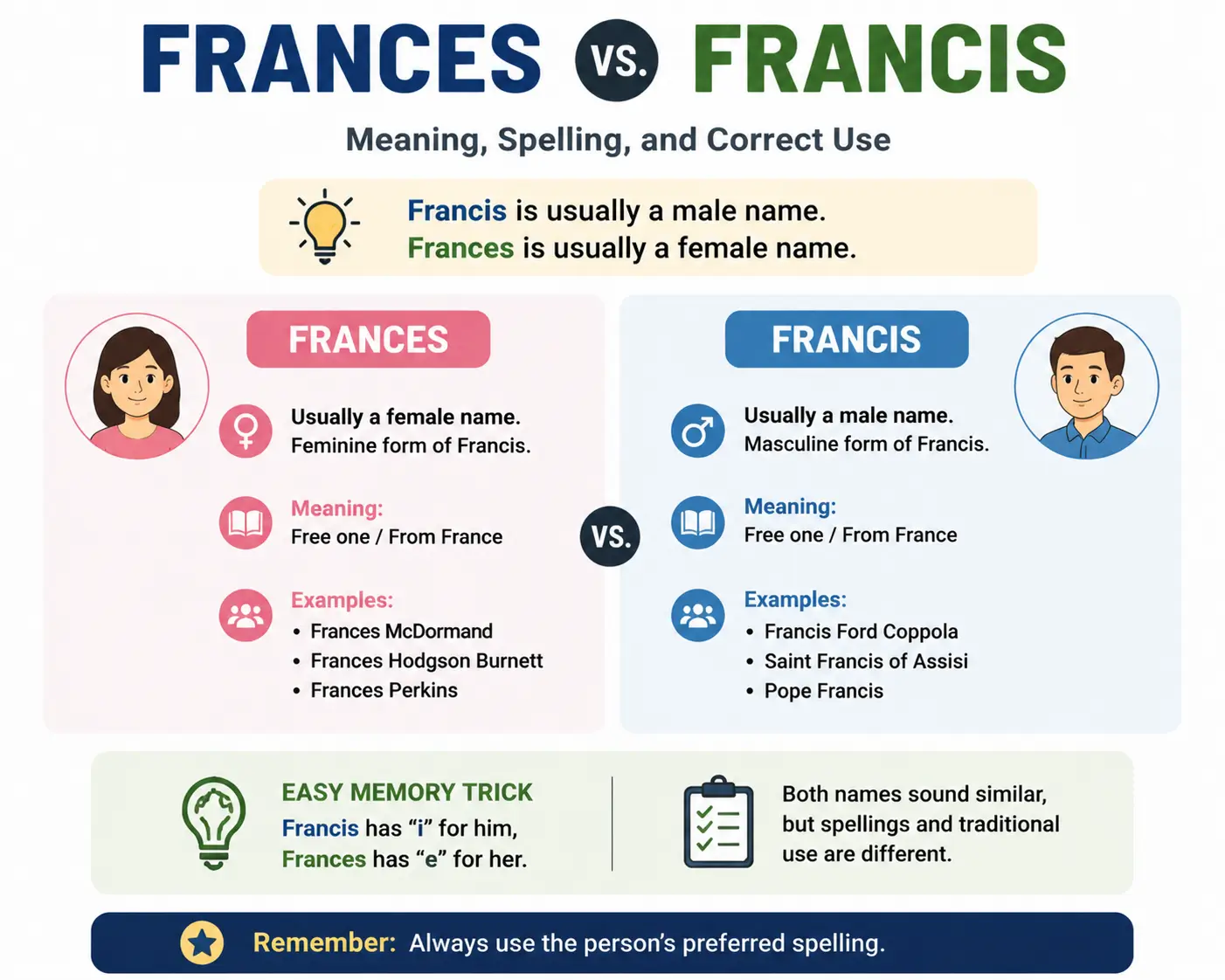
Frances vs Francis can create big confusion because these two names look almost the same and often have the same sound in speech. In my experience with editing English names, this is one of those small details people miss in emails, school work, official documents, and normal everyday writing. The basic spelling rule is clear: Francis is a usually male name, while Frances is a usually female name. So, Francis is commonly treated as a male name, masculine name, and given name, while Frances is commonly treated as a female name, feminine name, and personal name.
Still, the gender usage is not always fixed because different people may use these proper names for either gender. That is why you should not choose the proper word only by sound. The spoken form may cause pronunciation confusion, but the written form shows the real name spelling. The small spelling change between Frances and Francis creates a clear name difference, even though their similarities, lexical similarity, and semantic relationship make them easy to mix up. If a reader feels confused, the reader confusion usually comes from the spelling variation, word choice, and unclear contextual meaning.
A good guide or language guide should explain the origin, name meaning, meaning difference, usage difference, proper usage, correct usage, grammar usage, and usage rule in a simple way. For SEO, this topic has strong search intent, user intent, learning intent, and informational intent because people search the search query francis or frances to find the right spelling, correct spelling, correct form, and avoid the incorrect form. As a comparison keyword, exact match keyword, and related keyword, this name comparison also works well with NLP related terms, topic relevance, content context, name entity, entity pair, and naming convention. The easiest easy tricks to remember it with confidence are simple: Francis has “i” for him, and Frances has “e” for her.
Quick Answer: Francis or Frances?
Francis is usually the masculine spelling. Frances is usually the feminine spelling.
That is the easiest rule to remember.
| Name | Traditional Use | Meaning | Common Sound | Example |
| Francis | Male name | Linked to French or Frankish origin | FRAN-sis | Francis Ford Coppola |
| Frances | Female name | Feminine form of Francis | FRAN-sis | Frances McDormand |
Both names often sound the same when spoken. Because of that, you should not guess the spelling by ear.
A simple memory trick helps:
Francis with “i” is usually for him. Frances with “e” is usually for her.
This rule works well in standard English. However, personal spelling always comes first. If someone spells their name differently, use their spelling.
What Does Francis Mean?
Francis is a classic male given name with old European roots. It comes from the Late Latin name Franciscus. That name connects with the Franks and France.
In simple words, Francis is often linked with meanings like Frenchman, Frankish, or someone connected to France.
The name became well known because of religious, historical, and cultural figures. One of the most famous examples is Saint Francis of Assisi. His name helped Francis spread across Europe and later into English-speaking countries.
Francis has a calm and traditional sound. It does not feel trendy or modern in a flashy way. Instead, it feels steady, mature, and historic.
You may see Francis used as:
- A first name
- A middle name
- A surname
- A religious name
- A papal name
- A character name
- A family name passed down through generations
Because of its long history, Francis often appears in books, church records, family trees, films, and official documents.
Read this also: Entwined vs Intertwined: Meaning, Difference, and Examples
Francis as a Traditionally Male Name
Francis has usually been used for boys and men in English. It became common in many Christian, Catholic, Irish, British, European, and American families.
The name feels soft in sound but strong in history. It does not have the hard edge of names like Mark or Grant. Still, it carries respect because people connect it with saints, thinkers, artists, and public figures.
Famous male examples include:
- Saint Francis of Assisi, a major Christian saint
- Francis Bacon, an English philosopher and statesman
- Francis Drake, an English explorer
- Francis Ford Coppola, an American film director
- Pope Francis, the first pope to choose the name Francis
These examples show why Francis often feels religious, intellectual, creative, and historic.
Today, some parents choose Francis because it sounds vintage. Others choose it to honor a family member. It also works well as a middle name.
Examples include:
| Full Name Style | Example |
| First name | Francis James |
| Middle name | Henry Francis |
| Religious name | Brother Francis |
| Family name | Thomas Francis Miller |
Francis may not be the loudest name in the room. Still, it has staying power.
What Does Frances Mean?
Frances is the feminine English form of Francis. It shares the same root, but the spelling marks it as the female version in traditional English use.
Frances has a graceful and literary feel. It sounds classic without sounding too fancy. It also has a quiet strength, which makes it different from softer names like Lily, Daisy, or Bella.
Many people know Frances through writers, actors, reformers, and historical women. The name has been used for centuries, especially in English-speaking countries.
Famous female examples include:
- Frances Hodgson Burnett, author of The Secret Garden
- Frances McDormand, award-winning actor
- Frances Perkins, the first woman in a U.S. presidential cabinet
- Frances Xavier Cabrini, a Catholic saint
- Frances Bean Cobain, visual artist
These examples give Frances a smart and serious image. It feels creative, thoughtful, and independent.
Frances as a Traditionally Female Name
Frances is usually used for girls and women. It is the standard feminine spelling in English.
The name has appeared in family records, novels, school registers, religious history, and modern public life. It has never felt like a short-lived trend. Instead, Frances has the kind of old-school charm that keeps returning.
Frances also offers several nicknames, such as:
- Fran
- Frannie
- Frankie
- Francie
- Fanny
Some of these nicknames sound vintage. Others feel modern and friendly. For example, Frankie can sound playful and fresh, while Fran feels simple and classic.
That flexibility gives Frances more range than many people expect.
Main Difference Between Francis and Frances
The main difference is traditional gender use.
Francis is the male form. Frances is the female form.
| Feature | Francis | Frances |
| Traditional gender | Male | Female |
| Root | Late Latin Franciscus | Feminine form of Francis |
| Common sound | FRAN-sis | FRAN-sis |
| Key spelling | Has i | Has e |
| Common nicknames | Frank, Frankie, Fran | Fran, Frannie, Frankie |
| Tone | Historic, religious, classic | Literary, graceful, classic |
| Main mistake | Used for women by accident | Used for men by accident |
The spellings are close, so mistakes happen often. However, the difference is not random. English uses Francis mainly for men and Frances mainly for women.
Still, this is a naming tradition, not a law. Some people may use a spelling that does not follow the usual pattern. In that case, the person’s preferred spelling wins.
Do Francis and Frances Sound the Same?
Yes, they often sound the same.
Most English speakers pronounce both names as FRAN-sis. The first syllable gets the stress. The second syllable stays short and light.
That is why people confuse them.
You may hear a slight difference in some accents, but it is not reliable. One person may say Frances with a softer ending. Another may pronounce Francis the same way. In everyday speech, your ear usually cannot tell the difference.
That means you should never rely only on pronunciation when writing the name.
Instead, check:
- Email signatures
- Official documents
- Social media profiles
- School records
- Company bios
- Published articles
- The person directly
A quick check saves embarrassment later.
Read this also: Sell vs Sale: The Ultimate Guide to the Difference
Why the Spelling Difference Matters
Name spelling matters because names carry identity. When you spell a name correctly, you show respect. When you spell it wrong, even by one letter, it can look careless.
This matters even more in formal writing.
A mistake in a text message may be easy to fix. A mistake on a certificate, contract, article, or medical form can create real problems.
For example:
| Situation | Why Correct Spelling Matters |
| It affects first impressions | |
| Certificate | It may need reprinting |
| Legal form | It can cause record issues |
| School record | It may affect official files |
| News article | It can damage credibility |
| Social media post | It can spread the wrong spelling |
| Invitation | It may feel personal or rude |
A name is not just a word. It belongs to someone.
So, when in doubt, ask.
How to Use Francis in a Sentence
Use Francis when you refer to a man, boy, or person whose name is spelled that way.
Examples:
- Francis joined the meeting early.
- I sent the report to Francis yesterday.
- Francis asked a helpful question.
- The article mentioned Francis as the project lead.
- Francis signed the document before lunch.
These sentences are simple because the name works like any other proper noun. The only challenge is choosing the right spelling.
Francis in Formal Writing
Formal writing needs extra care. If you misspell a name in a formal document, the error stands out quickly.
Better examples include:
- Francis Carter will speak at the event.
- The committee thanked Francis Miller for his service.
- Francis Johnson received the leadership award.
- The biography explores the work of Francis Bacon.
Formal writing rewards precision. Guessing is lazy. Checking is professional.
Francis in Emails
Email mistakes are common because people write quickly. However, the greeting is the first thing the reader sees.
Correct examples:
- Hi Francis, thanks for your quick reply.
- Dear Francis, your appointment has been confirmed.
- Hello Francis, I attached the revised file.
- Thanks, Francis. I appreciate your help.
If the person uses Frank or Frankie, follow their preference. Do not force the full name unless the situation requires it.
How to Use Frances in a Sentence
Use Frances when you refer to a woman, girl, or person whose name is spelled that way.
Examples:
- Frances joined the call after lunch.
- I emailed Frances about the schedule.
- Frances wrote a clear and helpful reply.
- The award went to Frances for her research.
- Frances signed the guest book.
Again, the grammar is easy. The spelling is the important part.
Frances in Formal Writing
Frances appears often in formal writing, especially in education, literature, public records, and professional profiles.
Correct examples include:
- Frances Taylor has been appointed department chair.
- The school honored Frances Williams for academic excellence.
- Frances Hodgson Burnett wrote The Secret Garden.
- The program lists Frances Miller as the keynote speaker.
Before publishing or printing, check the spelling against a reliable source.
Frances in Emails
A correct email greeting feels small, but it builds trust.
Good examples:
- Hi Frances, thank you for sending the notes.
- Dear Frances, your form has been approved.
- Hello Frances, could you review this file?
- Thanks again, Frances. Your feedback helped.
Here is the simple rule: copy the name from the person’s email signature whenever possible.
That one habit prevents many mistakes.
Common Mistakes With Francis and Frances
People usually make mistakes with these names for one reason: they guess.
That is the whole problem.
The names sound alike, look alike, and share the same root. So, it is easy to choose the wrong spelling without noticing.
Guessing the Spelling by Sound
This is the most common mistake.
If someone says “Francis” or “Frances” aloud, you may not know which spelling they use. Both can sound like FRAN-sis.
Wrong approach:
- “It sounded like Francis, so I wrote Francis.”
- “I thought Frances was just another spelling.”
- “I used the version I see more often.”
Better approach:
- Check the email signature.
- Check the official record.
- Ask the person politely.
- Use the spelling they provide.
You can say:
“Could you please confirm how you spell your first name?”
That question is not awkward. It is respectful.
Mixing the Gender Association
Another common mistake is mixing the traditional gender use.
For example:
Incorrect:
- Francis McDormand is an award-winning actor.
Correct:
- Frances McDormand is an award-winning actor.
Another example:
Incorrect:
- Saint Frances of Assisi is a famous Christian saint.
Correct:
- Saint Francis of Assisi is a famous Christian saint.
This mistake is easy to fix, but it can look bad if published.
Ignoring the Person’s Preferred Spelling
Traditional rules help, but people come first.
Some people may use a spelling that does not follow the common pattern. A family may pass down Francis as a middle name for a daughter. Another person may choose a spelling for personal reasons.
In those cases, do not “correct” the name.
Use the spelling the person uses.
That rule is stronger than any chart.
Misspelling Names in Official Documents
Official documents need exact spelling. A one-letter mistake can create extra work later.
This includes:
- Passports
- Certificates
- Bank forms
- Medical records
- Legal papers
- School records
- Employment contracts
- Event badges
Before printing or submitting anything official, compare the name with the source document.
It sounds boring. It also saves time, money, and stress.
When Should You Use Francis?
Use Francis when the person’s name uses the i spelling.
In standard English, Francis is the masculine form. So, you will usually use it for men and boys.
Use Francis for:
- A male given name
- A person who spells their name Francis
- Religious male figures
- Historical male figures
- Family names with that spelling
- Official records that show Francis
Examples:
- Pope Francis
- Saint Francis of Assisi
- Francis Bacon
- Francis Ford Coppola
- Francis Drake
Do not change Francis to Frances because the name sounds soft. Sound does not decide spelling. The person’s actual name does.
When Should You Use Frances?

Use Frances when the person’s name uses the e spelling.
In standard English, Frances is the feminine form. So, you will usually use it for women and girls.
Use Frances for:
- A female given name
- A person who spells their name Frances
- Historical women with that name
- Literary figures
- Official records that show Frances
- Email signatures that use Frances
Examples:
- Frances McDormand
- Frances Hodgson Burnett
- Frances Perkins
- Frances Xavier Cabrini
- Frances Bean Cobain
Do not change Frances to Francis just because Francis looks more familiar. That is not editing. That is an error.
Exceptions You Should Know
Most of the time, the rule is clear. Francis is male. Frances is female.
However, names do not always follow neat boxes.
Family Traditions
Families often pass names down through generations. A child may receive a name to honor a grandparent, aunt, uncle, saint, or family friend.
Because of that, a family may choose a spelling that feels meaningful, even if it does not match the usual gender pattern.
For example, Francis may appear as a middle name for a girl if it honors her grandfather. Frances may appear in a family line because it belonged to a respected relative.
Family names follow memory, not always grammar.
Personal Preference
Some people simply prefer a certain spelling.
That is enough.
Names can reflect taste, identity, heritage, faith, or personal history. You do not need to argue with a person’s name. You only need to write it correctly.
Read this also: Shined vs Shone: Difference, Meaning, and Correct Usage
Gender Identity
Names may also connect with gender identity. A person may choose a spelling that fits who they are. They may keep an old spelling or use a new one.
In this case, respect matters more than tradition.
Do not say, “But Francis is for men” or “Frances is for women.” That may describe common usage, but it does not override a person’s chosen name.
Cultural Differences
Related forms of Francis and Frances appear in many languages.
| Language | Male Form | Female Form |
| French | François | Françoise |
| Italian | Francesco | Francesca |
| Spanish | Francisco | Francisca |
| German | Franz | Franziska |
| Polish | Franciszek | Franciszka |
| Portuguese | Francisco | Francisca |
These names are related, but they are not always interchangeable.
For example, Francesca is not the same as Frances in every context. Francisco is not just a longer version of Francis. Each form belongs to its own language and culture.
Nicknames for Francis and Frances
Nicknames can make the spelling even more confusing because some nicknames work for both names.
| Nickname | Commonly Linked To | Style |
| Fran | Frances or Francis | Simple and classic |
| Frankie | Frances or Francis | Friendly and modern |
| Frank | Francis | Traditional and masculine |
| Frannie | Frances | Warm and vintage |
| Francie | Frances | Soft and literary |
| Fanny | Frances | Old-fashioned |
A nickname does not always reveal the full name.
For example, a person named Frances may use Frankie. A person named Francis may also use Frankie. So, the nickname alone cannot confirm the spelling.
If you need the full legal or formal name, ask.
Francis or Frances in Real-Life Writing
These names show up in many types of writing. Each setting needs a slightly different level of care.
Emails
Emails create quick impressions. If you misspell the person’s name in the greeting, your message starts badly.
Incorrect:
- Hi Francis, thanks for your help.
Correct, if the person is named Frances:
- Hi Frances, thanks for your help.
A name mistake in the first line feels careless. The rest of the message may be great, but the damage is already done.
School Records
Schools must check names carefully. A spelling mistake can affect certificates, report cards, ID cards, and official student files.
Before printing, schools should check:
- Admission forms
- Birth certificates
- Student databases
- Parent-submitted records
- Previous school documents
A simple review can prevent a messy correction later.
Office Documents
Workplaces also need accurate spelling. Names appear on contracts, email accounts, payroll records, badges, and meeting notes.
A wrong spelling may seem small, but it can cause confusion. It may also make the employee feel overlooked.
Good HR writing starts with correct names.
News Articles
Writers, bloggers, and editors should verify every name before publishing.
Check:
- Official bios
- Verified profiles
- Publisher pages
- Film credits
- University pages
- Government records
- Company websites
Do not trust random copied text. One wrong spelling can spread across many sites.
Social Media
Social media moves fast, but speed does not excuse sloppy spelling.
Before posting about someone named Francis or Frances, check their profile. Then copy the spelling exactly.
This matters for tags, captions, graphics, and image text.
A public mistake can travel quickly.
Easy Examples of Correct Use
Here are simple examples that show the difference clearly.
| Correct Sentence | Why It Works |
| Francis sent the file before noon. | Francis is used as a male name. |
| Frances joined the women’s panel. | Frances is used as a female name. |
| Pope Francis spoke about service. | Correct papal name. |
| Frances McDormand won major acting awards. | Correct spelling of her name. |
| Saint Francis of Assisi is widely known. | Correct spelling for the saint. |
| Frances Hodgson Burnett wrote a famous children’s novel. | Correct spelling of the author’s name. |
More examples:
- Francis prefers to go by Frank.
- Frances prefers to go by Fran.
- I asked Francis to call the client.
- I sent Frances the final schedule.
- The form lists Francis as the account holder.
- The invitation names Frances as the guest speaker.
These examples show the basic pattern. Francis usually points to a male name. Frances usually points to a female name.
Incorrect Examples and Fixes
Mistakes become easier to understand when you see the correction.
| Incorrect | Correct | Reason |
| Francis McDormand acted in the film. | Frances McDormand acted in the film. | Her name is Frances. |
| Saint Frances of Assisi founded the Franciscan order. | Saint Francis of Assisi founded the Franciscan order. | The saint’s name is Francis. |
| I emailed Francis, but her reply bounced. | I emailed Frances, but her reply bounced. | The context suggests Frances. |
| Frances Ford Coppola directed the movie. | Francis Ford Coppola directed the movie. | His name is Francis. |
| The certificate says Francis, but her records say Frances. | The certificate should say Frances. | Official records control spelling. |
The fix is simple: check the source before writing the name.
Grammar Notes for Francis and Frances
These names can raise small grammar questions because both end with an s sound.
Possessive Form
In modern writing, many style guides accept ’s after singular names ending in s.
Examples:
- Frances’s book
- Frances’s email
- Francis’s office
- Francis’s appointment
Some styles use only an apostrophe:
- Frances’ book
- Francis’ office
Both styles appear in real writing. However, Frances’s and Francis’s are clearer for most readers.
Pick one style and stay consistent.
Capitalization
Always capitalize Francis and Frances when they are names.
Correct:
- Francis signed the letter.
- Frances joined the call.
Incorrect:
- francis signed the letter.
- frances joined the call.
Names are proper nouns. They need capital letters.
Plural Form
If you refer to more than one person named Francis, write Francises.
Example:
- There are two Francises in the family.
If you refer to more than one person named Frances, the plural can look awkward. In most cases, rewrite the sentence for clarity.
Awkward:
- The two Franceses joined the group.
Better:
- Two people named Frances joined the group.
Clear writing often beats strict grammar gymnastics.
Simple Memory Tricks
You do not need to memorize a long rule. Use one of these tricks.
The Letter Trick
Francis has i. Think: i for him.
Frances has e. Think: e for her.
This trick is not perfect, but it helps.
The Saint Francis Trick
Many people know Saint Francis or Pope Francis. Both use the male spelling.
So, when you see the i spelling, connect it with those well-known male figures.
The Literary Frances Trick
Frances often appears in literary and artistic contexts. Think of Frances Hodgson Burnett or Frances McDormand.
That can help you remember Frances as the female form.
Mini Case Study: The Email Mistake
A hiring manager speaks with a candidate named Frances Lee on the phone. Later, the manager writes:
Hi Francis, thank you for your time today.
The message sounds polite, but the name is wrong.
That small error sends a quiet message: “I did not check.”
Now compare it with:
Hi Frances, thank you for your time today.
The second version feels more careful. It shows attention to detail.
This matters in business. A correct name builds trust before the actual message begins.
Read this also: Smooth vs Smoothe: Correct Spelling, Meaning, and Easy Examples
Mini Case Study: The Certificate Mistake
A school prints a certificate for a student named Francis Miller. The certificate says:
Presented to Frances Miller
That mistake creates extra work. The school may need to reprint the certificate, update records, and explain the issue to the student.
The fix is easy but often ignored.
Before printing, compare the name with:
- The admission form
- The official database
- The student ID record
- The birth certificate
- The final approval sheet
A five-second check can prevent a five-day headache.
Quick Practice: Choose Francis or Frances
Choose the correct name.
| Sentence | Correct Answer |
| ___ McDormand is an award-winning actor. | Frances |
| Saint ___ of Assisi is a famous Christian saint. | Francis |
| ___ Perkins served in a U.S. presidential cabinet. | Frances |
| Pope ___ chose his papal name in honor of Saint Francis. | Francis |
| ___ Hodgson Burnett wrote The Secret Garden. | Frances |
| ___ Ford Coppola directed several major films. | Francis |
If you got these right, you understand the standard rule.
Now here is the real-world rule:
When the name belongs to a real person, confirm the spelling before you write it.
That rule beats every shortcut.
FAQs About Francis and Frances
Francis is traditionally the male spelling. Frances is traditionally the female spelling. Both names share the same root, but English uses different spellings to separate them.
Frances is traditionally a female name. It is the feminine English form of Francis.
Francis is traditionally a male name. It has a long history in religious, European, and English-speaking cultures.
Yes, many English speakers pronounce both names as FRAN-sis. Because they sound so similar, you should check the spelling before writing the name.
Yes, it can happen through family tradition or personal choice. However, Francis is usually the male spelling in standard English.
It is uncommon, but names can vary by family, culture, and personal identity. If a boy or man uses Frances, write it that way.
Use this simple trick: Francis with “i” is usually him. Frances with “e” is usually her.
No major difference exists in standard use. Both British and American English usually treat Francis as male and Frances as female.
People confuse them because they sound almost the same, look very similar, and come from the same name family.
Yes. If you are unsure, ask. It is better to confirm once than write the wrong name in an email, record, article, or document.
Conclusion
Frances vs Francis can confuse readers because these two names look almost the same and often have the same sound in speech. The simple spelling rule is clear: Francis is usually a male name, while Frances is usually a female name.
However, gender usage is not always fixed. Some different people may use these proper names for either gender, so you should not choose the proper word only by sound. The spoken form can cause pronunciation confusion, but the written form shows the real name spelling.
A useful guide should explain the origin, name meaning, usage difference, correct usage, and grammar usage in a simple way. For SEO, this topic has strong search intent, user intent, and learning intent because people search francis or frances to find the right spelling with confidence.
2 thoughts on “Frances vs Francis: Meaning, Spelling, and Correct Use”