
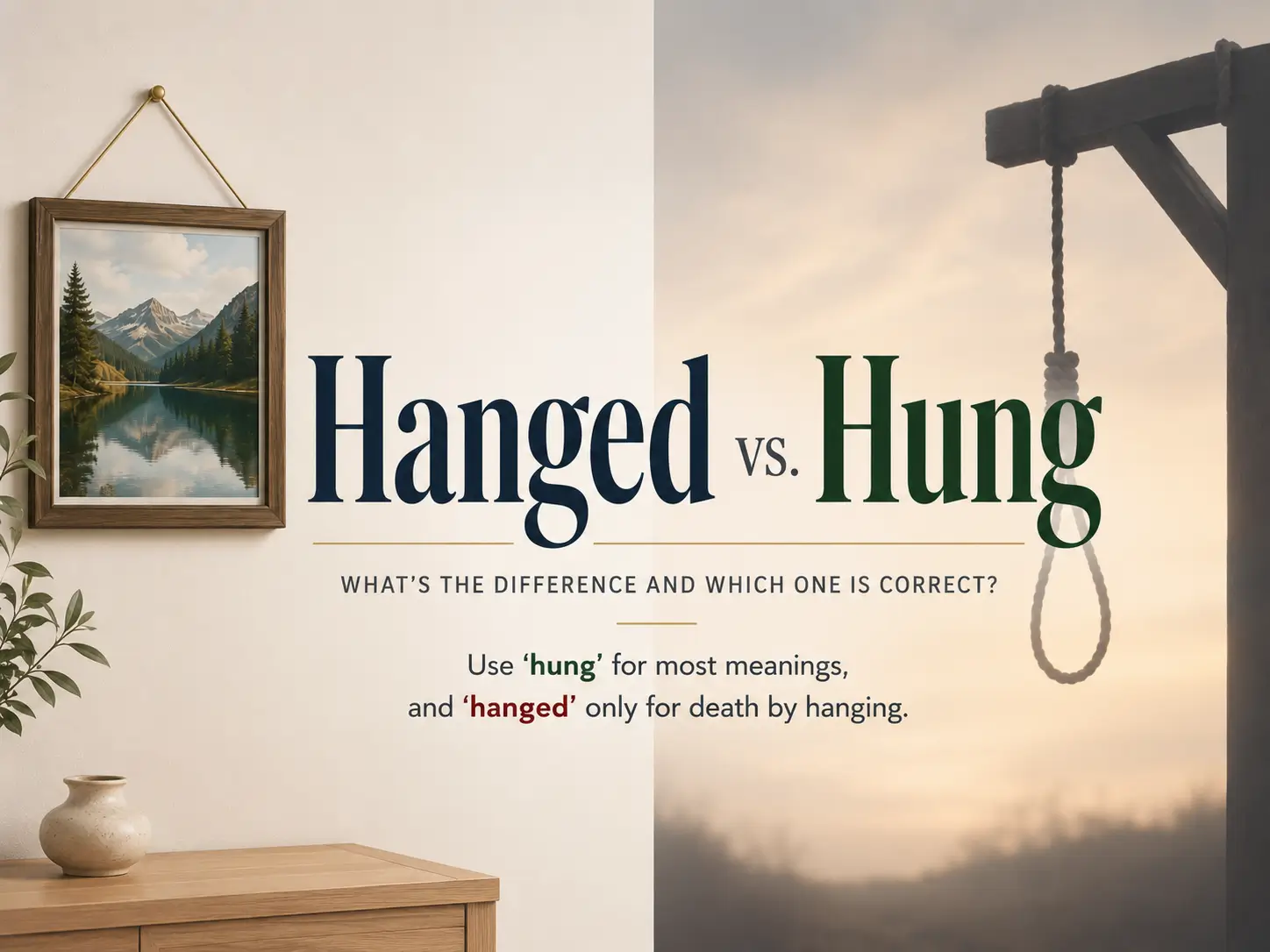
Hanged vs. hung describes two different past forms of the verb hang. Use hung when something is suspended, displayed, attached, or left in place. However, use hanged when a person is killed through death by hanging.
For example, you hung a picture on the wall, but a prisoner was hanged. The correct choice depends on the action’s meaning, not simply on whether the sentence refers to a person or an object.
Understanding the past tense of hang helps you write more clearly at school, at work, and in everyday messages. It also prevents serious misunderstandings because hung and hanged can describe very different events.
Quick Answer: Should You Use Hanged or Hung?
Use hung as the past tense and past participle of hang in almost every ordinary meaning.
Use hanged when hang means to kill a person by suspending them by the neck.
| Meaning | Correct word | Example |
| To suspend an object | Hung | She hung the keys by the door. |
| To display something | Hung | We hung the poster in the classroom. |
| To suspend a person without killing them | Hung | The performer was hung from a harness. |
| To end a phone call | Hung | He hung up without saying goodbye. |
| To spend time socially | Hung | We hung out after work. |
| To describe a jury that cannot agree | Hung | The trial ended with a hung jury. |
| To kill a person by hanging | Hanged | The condemned prisoner was hanged. |
A useful memory rule is:
Use hanged for death and hung for the rest.
That shortcut works in most cases. Still, you must focus on the sentence’s meaning rather than whether the subject is a person or an object.
What Do Hanged and Hung Mean?
Both hanged and hung come from the verb hang. However, English uses two different past-tense forms because the verb has several meanings.
What does hung mean?
Hung is the usual simple past tense and past participle of hang.
It can mean:
- Suspended from a higher point
- Attached to a wall or hook
- Displayed for people to see
- Delayed or frozen
- Unable to reach an agreement
- Remained in a place or position
- Spent time socially
Examples:
- Leo hung his jacket on the chair.
- Colorful lights hung above the patio.
- The computer hung during the update.
- The jury was hung.
- We hung out at the coffee shop.
In each case, nobody was executed. Therefore, hung is correct.
What does hanged mean?
Hanged is the simple past tense and past participle of hang when the verb means to kill someone by hanging.
Examples:
- The convicted criminal was hanged.
- Historical records state that the outlaw was hanged in 1881.
- Under the former law, people convicted of piracy could be hanged.
You’ll see hanged most often in legal, historical, academic, and news writing.
Because the word refers to death, writers should use it carefully. In sensitive contexts, a clearer phrase such as died by hanging may be more suitable.
Hanged vs. Hung Comparison Table
The following table shows the key differences between the two forms.
| Feature | Hanged | Hung |
| Base verb | Hang | Hang |
| Part of speech | Verb | Verb |
| Grammar form | Simple past and past participle | Simple past and past participle |
| Main meaning | Killed by hanging | Suspended, attached, displayed, delayed, or unable to agree |
| Common subjects | A person who dies by hanging | People, objects, signs, clothes, pictures, juries, computers |
| Common contexts | Executions, historical accounts, legal writing | Daily conversation, work, school, technology, decorating |
| Example | The prisoner was hanged. | The picture was hung. |
| Pronunciation | /hæŋd/ | /hʌŋ/ |
The most important difference is meaning. The identity of the subject doesn’t decide which word you need.
What Is the Past Tense of Hang?
The verb hang has two possible past-tense forms: hung and hanged.
Forms of hang in ordinary meanings
When hang means to suspend, attach, display, remain, or delay, it follows this pattern:
| Verb form | Word |
| Base form | hang |
| Third-person singular | hangs |
| Present participle | hanging |
| Simple past | hung |
| Past participle | hung |
Examples:
- I hang my coat near the door.
- She hangs her coat near the door.
- He is hanging a picture.
- They hung the decorations yesterday.
- We have hung the new curtains.
In ordinary uses, hang is an irregular verb. It doesn’t form its past tense by simply adding -ed.
Forms of hang when it means execution
When hang means to kill by hanging, it follows this pattern:
| Verb form | Word |
| Base form | hang |
| Third-person singular | hangs |
| Present participle | hanging |
| Simple past | hanged |
| Past participle | hanged |
Examples:
- The law allowed the state to hang convicted pirates.
- The government hanged the prisoner.
- Several prisoners had been hanged before the law changed.
In this narrow meaning, the past tense follows a regular -ed pattern.
Why Does Hang Have Two Past-Tense Forms?
English often keeps older forms for specialized meanings. That is what happened with hanged.
Over time, hung became the normal past tense of hang for most meanings. However, hanged remained common in legal and official language related to execution.
As a result, modern English uses:
- Hang–hung–hung for ordinary meanings
- Hang–hanged–hanged for death by hanging
This difference may feel unusual, but English has other words whose forms or meanings change according to context.
The distinction also adds precision. Consider these sentences:
- The man was hung from a cable.
- The man was hanged from a wooden platform.
The first sentence suggests physical suspension, perhaps during a stunt or rescue. The second states or strongly suggests death by hanging.
One changed vowel can completely change the meaning.
When to Use Hung
Use hung for nearly every meaning of hang that doesn’t involve killing a person by hanging.
Use hung for objects that are suspended
When an object is supported from above, use hung.
- Dana hung the towels outside to dry.
- The lamp hung above the kitchen table.
- We hung the bird feeder from a branch.
- Holiday lights were hung across the porch.
The objects are suspended or attached. Therefore, hanged would be incorrect.
Use hung for pictures, signs, and decorations
Objects displayed on walls, doors, ceilings, or other surfaces are hung.
- The gallery hung the painting near the entrance.
- Students hung posters around the classroom.
- A welcome sign was hung above the front desk.
- They hung balloons from the ceiling.
Incorrect:
- The gallery hanged the painting.
Correct:
- The gallery hung the painting.
A painting can show a person, but it remains an object. Its subject matter doesn’t affect the verb.
Use hung for clothing and personal items
Clothing, bags, keys, and similar items are also hung.
- I hung my coat in the closet.
- She hung her purse on the back of the chair.
- He hung his keys beside the door.
- The uniforms were hung in neat rows.
This usage appears often in everyday American English.
Use hung when a living person is suspended
A common memory trick says, “People are hanged, but things are hung.” However, that rule is incomplete.
People are hung when they are physically suspended but not killed by hanging.
- The stunt actor was hung from a safety cable.
- The patient’s injured leg was hung in a sling.
- The climber hung from the ledge.
- The child hung upside down from the monkey bars.
The correct word depends on the result and intended meaning.
If a person is merely suspended, use hung. If the person is killed by hanging, use hanged.
Use hung in phrasal verbs
A phrasal verb combines a verb with another word, usually an adverb or preposition. The combination creates a new meaning.
Common phrasal verbs with hang use hung in the past tense.
| Phrasal verb | Meaning | Example |
| Hang up | End a phone call or place something on a hook | She hung up before I finished. |
| Hang out | Spend time socially | We hung out after class. |
| Hang around | Stay nearby without a clear purpose | He hung around after the meeting. |
| Hang on | Wait or continue holding | She hung on until help arrived. |
| Hang back | Remain behind | I hung back to speak with the teacher. |
| Hang over | Remain as a worry or influence | Doubt hung over the project. |
Never write hanged up, hanged out, or hanged around.
Incorrect:
- He hanged up the phone.
- We hanged out after work.
Correct:
- He hung up the phone.
- We hung out after work.
Use hung for a jury that cannot agree
A hung jury is a jury that cannot reach the agreement required for a verdict.
- The judge declared a mistrial because the jury was hung.
- After two days of discussion, the panel remained hung.
This expression has nothing to do with physical suspension. Therefore, only hung is correct.
You would never write hanged jury.
Use hung for computers and software
In technology, hung can describe a computer, program, or process that has stopped responding.
- My laptop hung during the presentation.
- The application hung while saving the file.
- The system had hung before the update finished.
In casual US English, people may also say that a computer froze or locked up.
Use hung in figurative expressions
The verb hang often describes something that seems to remain in the air, atmosphere, or mind.
- An awkward silence hung over the room.
- Smoke hung in the evening air.
- A difficult decision hung over the team.
- The smell of coffee hung in the kitchen.
These sentences use hung because the meaning is figurative rather than execution-related.
When to Use Hanged
Use hanged only when a person dies or is put to death by hanging.
Use hanged for a formal execution
The clearest use of hanged appears in descriptions of legal or state-ordered executions.
- The prisoner was hanged at dawn.
- The court sentenced the convicted pirate to be hanged.
- The government hanged several rebels after the uprising.
This wording often appears in historical documents, legal discussions, biographies, and academic writing.
Use hanged in historical accounts
Writers use hanged when discussing people who were executed in the past.
- Several people accused of witchcraft were hanged.
- The outlaw was captured, tried, and hanged.
- According to the account, the spy had been hanged before the war ended.
Historical writing should still follow the modern distinction unless a direct quotation uses a different form.
Use hanged when the method caused death
The word hanged can describe death by hanging even outside a formal execution.
However, this subject requires care. When method details aren’t necessary, a writer may choose less graphic wording.
Depending on the context, you might write:
- The report states that the person died by hanging.
- The character dies by hanging near the end of the novel.
- Historical records indicate that he was hanged.
In news, healthcare, workplace, or educational writing, clarity and sensitivity matter as much as grammatical correctness.
The Rule Depends on Meaning, Not the Subject
Many grammar tips oversimplify the difference by saying:
“People are hanged. Objects are hung.”
Although easy to remember, that statement isn’t fully accurate.
A person can be hung if they are suspended without being killed. Meanwhile, a representation of a person can be hung because it is an object.
Compare these examples:
| Sentence | Correct word | Reason |
| The prisoner was hanged. | Hanged | The sentence describes execution. |
| The performer was hung from wires. | Hung | The performer was suspended safely. |
| A portrait of the judge was hung in court. | Hung | A portrait is an object. |
| An effigy was hung in the town square. | Hung | An effigy is a representation, not a living person. |
| The climber hung from the rope. | Hung | The climber remained suspended. |
Therefore, ask what hang means in the sentence. Don’t choose a word only by looking at the noun.
Hanged vs. Hung in Active and Passive Voice
The distinction remains the same in both active and passive sentences.
Active voice
In active voice, the subject performs the action.
- The curator hung the painting.
- The workers hung the lights.
- The authorities hanged the convicted criminal.
Passive voice
In passive voice, the subject receives the action.
- The painting was hung by the curator.
- The lights were hung by the workers.
- The convicted criminal was hanged by the authorities.
Changing the sentence’s voice doesn’t change the correct verb form.
Meaning still controls the choice.
Using Hanged and Hung in Different Tenses
Writers often understand the simple past but become unsure when using perfect tenses or helping verbs.
Simple past
Use the simple past for a completed action.
- We hung the curtains yesterday.
- The prisoner was hanged in 1902.
Present perfect
The present perfect uses has or have plus a past participle.
- We have hung the new sign.
- The museum has hung three new paintings.
- Several prisoners have been hanged under the law.
Incorrect:
- We have hang the sign.
Correct:
- We have hung the sign.
Past perfect
The past perfect uses had plus a past participle.
- She had hung the coat before dinner.
- They had hung the decorations by noon.
- The government had hanged the prisoner before the appeal arrived.
Future forms
After will, use the base form hang.
- We will hang the banner tomorrow.
- The court ruled that the prisoner would hang.
The word hanged appears only after the action becomes past or when grammar requires a past participle.
- The banner will have been hung by Friday.
- The prisoner would have been hanged under the earlier law.
Modal verbs
After can, could, may, might, must, or should, use hang.
- You should hang the picture lower.
- The sign might hang above the doorway.
- Under the old sentence, the defendant could hang.
However, use a past participle after have:
- You should have hung the picture lower.
- The prisoner might have been hanged.
Real-Life Examples of Hanged and Hung
The difference becomes easier when you see the words in familiar situations.
At home
- I hung the family calendar beside the refrigerator.
- We hung wet clothes in the laundry room.
- A plant hung from the ceiling near the window.
At school
- The teacher hung student artwork in the hallway.
- An uncomfortable silence hung over the classroom.
- Students hung out near the library after class.
At work
- The manager hung the schedule in the break room.
- The video call hung when the connection failed.
- Concerns about the budget hung over the meeting.
In texting and conversation
- “Sorry, I didn’t mean to hang up.”
- “We hung out downtown last night.”
- “I hung around for another ten minutes.”
In historical or legal writing
- The court ordered that the prisoner be hanged.
- The official was convicted of treason and hanged.
- Under that era’s law, piracy could result in being hanged.
Mini Case Studies: Choosing the Right Word
These short editing examples show how meaning changes the answer.
Museum exhibit
Draft sentence:
The museum hanged a portrait of the governor near the entrance.
Corrected sentence:
The museum hung a portrait of the governor near the entrance.
Although the portrait shows a person, the museum displayed an object. Therefore, hung is correct.
Stage performance
Draft sentence:
During the show, the actor was hanged above the audience.
Corrected sentence:
During the show, the actor was hung above the audience in a safety harness.
The actor was suspended for a performance. The added phrase also removes any disturbing ambiguity.
Historical report
Draft sentence:
The convicted spy was hung in 1943.
Corrected sentence:
The convicted spy was hanged in 1943.
The sentence describes an execution. Therefore, standard edited English uses hanged.
Software support email
Draft sentence:
My computer hanged while I was uploading the file.
Corrected sentence:
My computer hung while I was uploading the file.
In computing, hung means that the device or program stopped responding.
Common Hanged vs. Hung Mistakes
Several errors appear regularly in school assignments, workplace emails, social posts, and news writing.
Writing hanged for an object
Incorrect:
- The photo was hanged above the desk.
Correct:
- The photo was hung above the desk.
A photo is displayed, so hung is the correct form.
Writing hung for an execution
Incorrect in standard edited English:
- The prisoner was hung at dawn.
Preferred:
- The prisoner was hanged at dawn.
The sentence describes death by hanging.
Using hanged in a phrasal verb
Incorrect:
- She hanged up the phone.
- We hanged out all weekend.
Correct:
- She hung up the phone.
- We hung out all weekend.
Phrasal verbs use hung.
Using the base verb after have
Incorrect:
- They have hang the decorations.
Correct:
- They have hung the decorations.
The helping verb have requires the past participle hung.
Adding an extra ending
Incorrect:
- The sign was hunged outside.
- The prisoner was hangged.
Correct:
- The sign was hung outside.
- The prisoner was hanged.
The word hunged isn’t a standard English form. Also, hang doesn’t double the final g before adding -ed.
Relying too heavily on “people versus things”
Incorrect reasoning:
- He is a person, so he must have been hanged from the rescue helicopter.
Correct:
- He was hung from the rescue helicopter in a safety harness.
The person remained alive. Therefore, hung describes the suspension.
Tricky Situations and Ambiguous Sentences
Some sentences require more than a simple rule.
“He was hung from a tree”
This sentence usually means that someone suspended him from a tree. However, it may sound incomplete or disturbing because readers may assume death.
Add context when possible:
- The stunt performer was hung from a tree in a safety harness.
- The rescue dummy was hung from a tree for the training exercise.
“He was hanged from a tree”
This sentence means that he was killed by hanging. The form hanged makes the result clear.
“The body was hung” or “the body was hanged”?
Context matters.
If a body was suspended after death, hung may describe the physical placement. If a person died through the act of hanging, hanged describes the death.
Because either sentence can sound unclear, professional writers should often rewrite it.
For example:
- The body was found suspended from a beam.
- The report concluded that the person died by hanging.
Clear wording is better than forcing readers to interpret an ambiguous verb.
“Found hanging”
In a sentence such as “The person was found hanging,” the word hanging is a present participle.
You don’t need to choose between hanged and hung because neither past form appears.
Still, consider whether the method is necessary to include. In sensitive writing, provide only relevant details.
“Death by hanging”
Here, hanging functions as a noun.
- The official report listed the cause as hanging.
- The novel ends with the character’s death by hanging.
Again, the hanged-or-hung choice doesn’t apply.
Formal, Informal, and Professional Usage
The standard rule stays consistent, but tone and context can affect your wording.
Formal and academic writing
Use the traditional distinction:
- Hanged for execution or death by hanging
- Hung for every other common meaning
Historical and legal writing should be especially precise because the wrong form may change the meaning.
Professional writing
In business writing, you’ll usually need hung.
- The notice was hung near the elevator.
- The software hung during testing.
- Several decisions hung over the project.
If the topic involves death, use neutral and sensitive language. Depending on the document, died by hanging may provide greater clarity than was hanged.
Informal speech
In casual conversation, some speakers use hung for nearly every meaning. You may hear someone say, “He was hung,” even when discussing an execution.
However, edited American English generally preserves hanged for death by hanging.
Using the standard distinction makes your writing clearer and more credible.
American and British English Usage
Standard American English and British English generally follow the same rule.
Both varieties normally use:
- Hung for objects, suspension, figurative meanings, and phrasal verbs
- Hanged for execution or death by hanging
Therefore, this isn’t a major US-versus-UK spelling difference like color/colour or center/centre.
Real usage can vary, especially in older texts, dialects, and informal speech. Still, the standard distinction remains the safest choice in modern edited English.
Pronunciation of Hanged and Hung
The two words don’t sound alike.
| Word | Pronunciation | Rhymes approximately with |
| Hanged | /hæŋd/ | banged |
| Hung | /hʌŋ/ | young |
In hanged, the final -ed sounds like d, not as a separate syllable.
Say:
- hanged as one syllable
- hung as one syllable
The spelling and vowel sound both change.
Synonyms for Hanged and Hung
No synonym works in every sentence. Choose one that matches the intended meaning.
Synonyms for hung meaning suspended
Possible alternatives include:
- Suspended
- Draped
- Attached
- Fastened
- Mounted
- Displayed
- Dangling
- Slung
Examples:
- The banner was hung across the street.
- The banner was suspended across the street.
- The painting was hung in the lobby.
- The painting was displayed in the lobby.
Synonyms for hung meaning delayed or frozen
Possible alternatives include:
- Froze
- Stalled
- Stopped responding
- Locked up
- Became unresponsive
Example:
- The program hung during installation.
- The program froze during installation.
Alternatives to hanged
Because hanged has a specific and serious meaning, exact synonyms are limited.
Depending on context, writers may use:
- Executed by hanging
- Put to death by hanging
- Died by hanging
These phrases aren’t always interchangeable. For example, executed by hanging describes a formal punishment, while died by hanging doesn’t identify who caused the death.
Related Words and Expressions
Understanding related terms can prevent other mistakes.
Hanging
Hanging can work as a verb form, adjective, or noun.
- They are hanging the lights.
- A hanging plant blocked the window.
- The law allowed death by hanging.
Hangman
A hangman is a person whose role is to carry out an execution by hanging, especially in historical contexts.
The word is spelled hangman, not hungman.
Hangout
A hangout is an informal place where people often spend time.
- The diner became our favorite hangout.
As a verb, write two words:
- We hang out there.
- We hung out there yesterday.
Hang-up
A hang-up can mean a personal worry, emotional difficulty, or source of embarrassment.
- He has a hang-up about public speaking.
The phrase can also relate to ending a phone call:
- The sudden hang-up surprised me.
Hung jury
A hung jury cannot reach the required decision.
The expression is always hung jury, never hanged jury.
Hang in there
Hang in there means to continue despite difficulty.
- Hang in there. You’re almost finished.
Its past form may appear as:
- She hung in there through a difficult semester.
Grammar Tips for Choosing the Correct Form
A few quick checks can help you choose confidently.
Ask whether the sentence describes death
If a person died because of hanging, use hanged.
- The prisoner was hanged.
If not, use hung.
- The prisoner’s portrait was hung.
Look for a phrasal verb
Expressions such as hang up, hang out, and hang around always use hung in the past.
- We hung out.
- She hung up.
- They hung around.
Check for a helping verb
After has, have, or had, use the past participle.
- Has hung
- Have hung
- Had hung
- Has been hanged
- Had been hanged
Rewrite unclear sentences
Grammar isn’t only about being technically correct. It’s also about being understood.
Instead of:
- He was hung from the helicopter.
Write:
- A safety harness suspended him below the helicopter.
The revised sentence removes any possible confusion.
Easy Memory Tricks
The most useful memory trick is:
Hanged for death; hung for the rest.
You can also remember:
Pictures are hung. Prisoners were hanged.
However, treat the second trick as a starting point, not a complete rule. A stunt performer can be hung from wires, and a portrait of a prisoner can be hung in a museum.
A more accurate decision process is:
- Find the verb hang.
- Identify what the sentence means.
- Ask whether a person died by hanging.
- Use hanged if the answer is yes.
- Use hung in other cases.
- Rewrite the sentence if the meaning remains unclear.
Practice: Choose Hanged or Hung
Choose the correct word for each sentence.
- We ___ the family photos in the hallway.
- The jury remained ___ after two days of discussion.
- The convicted pirate was ___ at the port.
- She ___ up before I could answer.
- The stunt performer was ___ above the stage.
- They had ___ the banner before the guests arrived.
- A heavy silence ___ over the conference room.
- Under the former law, convicted spies could be ___.
- The application ___ while loading the report.
- We ___ out at the park after school.
Answers
- Hung — The photos were displayed.
- Hung — The jury couldn’t agree.
- Hanged — The sentence describes an execution.
- Hung — Hung up is the past form of hang up.
- Hung — The performer was suspended, not executed.
- Hung — The present perfect or past perfect requires the participle hung.
- Hung — The sentence uses a figurative meaning.
- Hanged — The sentence refers to execution.
- Hung — In computing, it means the application stopped responding.
- Hung — Hung out means spent time socially.
Frequently Asked Questions
Q1: What is the main difference between hanged and hung?
Use hanged when a person dies by hanging. Use hung for almost every other meaning of hang, including displaying, attaching, or suspending something.
Examples:
- We hung the curtains yesterday.
- The prisoner was hanged after the trial.
Q2: Is it hanged or hung for a picture?
A picture is always hung, not hanged.
Correct:
- She hung the picture above the couch.
- The photograph was hung in the hallway.
A picture is being displayed or attached to a surface. Therefore, hung is the correct past tense of hang.
Q3: Is it “he was hanged” or “he was hung”?
Both can be correct, but they have different meanings.
- He was hanged means he died by hanging.
- He was hung means he was suspended, perhaps from a rope or safety harness.
Because the second sentence may sound unclear, add enough detail to show what happened.
Q4: Is hung the past tense of hang?
Yes. Hung is the usual simple past tense and past participle of hang.
- Present: I hang my coat by the door.
- Past: I hung my coat by the door.
- Present perfect: I have hung my coat by the door.
However, use hanged when the verb refers to an execution or death by hanging.
Q5: Is hanged grammatically correct?
Yes. Hanged is a correct word, but it has a narrow meaning.
It is the past tense and past participle of hang when someone is killed by hanging.
- The convicted criminal was hanged.
- Several prisoners had been hanged under the old law.
Q6: Is it hung up or hanged up?
The correct phrase is hung up.
- She hung up the phone.
- He hung up his jacket.
- We got hung up in traffic.
Hanged up is not correct in standard American English.
Q7: Is a person always hanged instead of hung?
No. A person can be hung when they are suspended but not killed.
- The stunt performer was hung from a safety harness.
- The climber hung from the rope.
Use hanged only when the hanging causes death.
Q8: Is a jury hanged or hung?
A jury is hung when its members cannot reach the agreement required for a verdict.
Correct:
- The judge declared a mistrial because of a hung jury.
The phrase hanged jury is incorrect.
Q9: Can hung be used for an execution?
You may hear hung used informally, but hanged is the standard form for an execution in edited English.
Preferred:
- The prisoner was hanged.
Using hanged makes the meaning clear and follows accepted grammar rules.
Q10: What is an easy way to remember hanged vs. hung?
Use this memory trick:
Hanged for death; hung for the rest.
This rule covers most situations. Pictures, clothes, decorations, phone calls, computers, and juries use hung. A person who dies by hanging is hanged.
Conclusion
The difference between hanged vs. hung depends on meaning. Use hung as the normal past tense of hang when something is displayed, attached, suspended, delayed, or unable to reach a decision.
Use hanged only when referring to an execution or death by hanging. Therefore, a picture is hung, a phone call is hung up, and a jury may be hung. In contrast, a person who was killed by hanging was hanged.
Remember the simplest rule: hanged for death; hung for the rest. When a sentence could be misunderstood, add more context or rewrite it for clarity.