
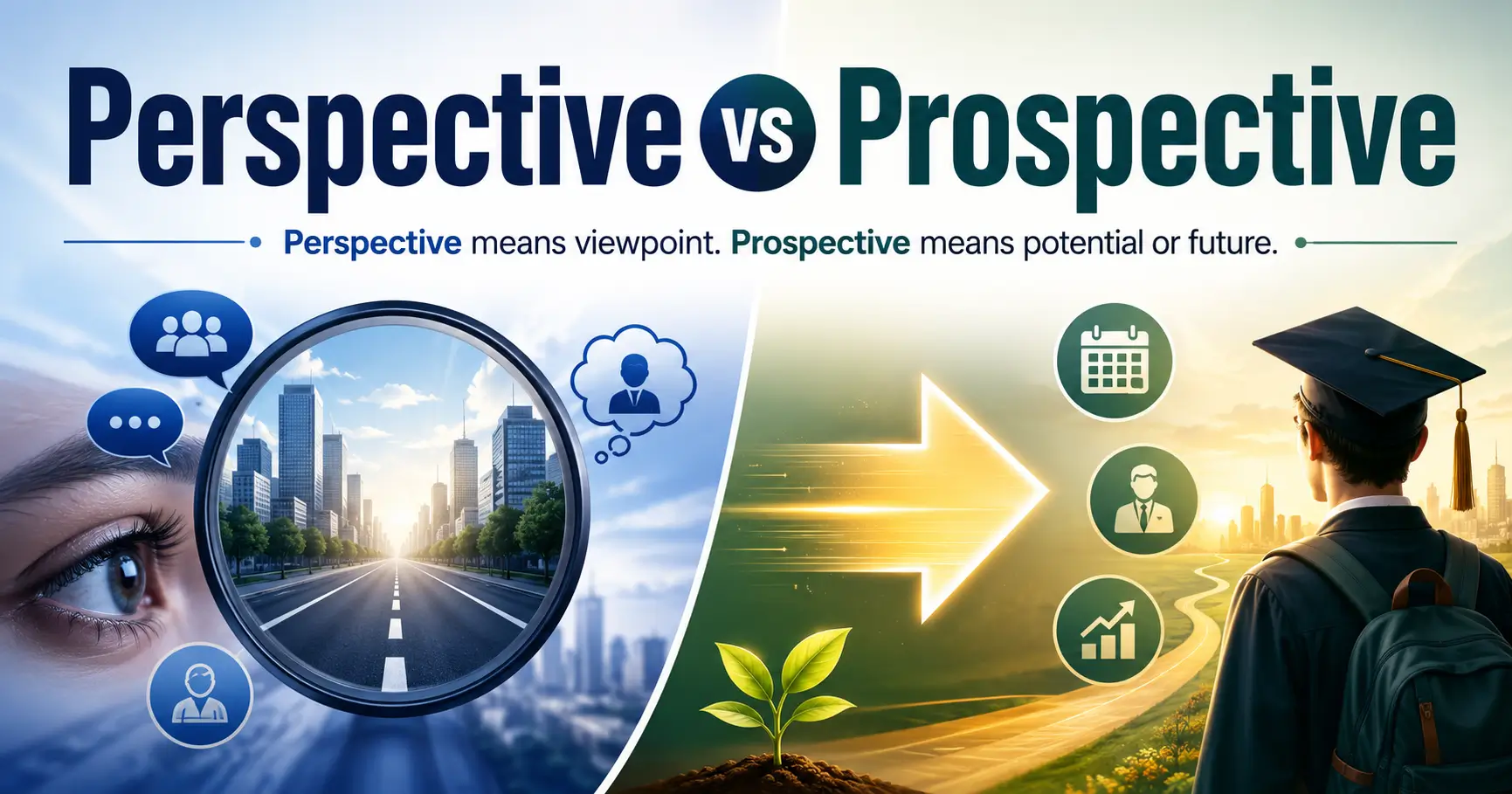
Perspective vs prospective explains the difference between a viewpoint and something connected with the future. Perspective is usually a noun that means a way of seeing, understanding, or judging something. Prospective is usually an adjective that describes a person, event, or result that may exist or happen later.
For example, from my perspective means “from my point of view.” In contrast, a prospective student is someone who may become a student. Although these commonly confused words look and sound similar, they have different meanings and sentence roles.
Understanding the distinction helps you avoid mistakes in schoolwork, emails, business writing, research, and everyday conversation. A simple test can guide you: use perspective when you mean viewpoint, outlook, or visual depth. Use prospective when you mean potential, expected, or future.
Quick Answer: Perspective vs. Prospective
Use perspective when you mean a viewpoint, outlook, or way of seeing something.
Use prospective when you mean potential, expected, or likely to happen in the future.
| Word | Part of Speech | Main Meaning | Example |
| Perspective | Noun | A viewpoint or way of understanding something | Try to see the issue from her perspective. |
| Prospective | Adjective | Expected or likely to happen or become something | The college welcomed prospective students. |
Quick rule: If you can replace the word with viewpoint, use perspective. If you can replace it with potential or future, use prospective.
Consider these two sentences:
- From an employee’s perspective, the new policy is confusing.
- The company interviewed several prospective employees.
In the first sentence, perspective means “point of view.” In the second, prospective describes people who may become employees.
Why Perspective and Prospective Are Easy to Confuse
These words cause problems because they share most of the same letters. They also sound similar when spoken quickly.
However, their meanings and grammatical roles are different.
Similar Spelling
The spelling difference appears near the beginning:
- perspective
- prospective
That small change matters. Perspective relates to how something is viewed. Prospective points toward a possible future situation.
Writers sometimes type one word when they mean the other. Spell-checking software may not catch the mistake because both words are spelled correctly.
Similar Pronunciation
In American English, the words are commonly pronounced like this:
- Perspective: per-SPEK-tiv
- Prospective: pruh-SPEK-tiv or pro-SPEK-tiv
The first syllables can sound unclear in fast speech. Therefore, it helps to focus on meaning rather than sound.
Different Grammar Roles
The clearest grammatical difference is their part of speech.
Perspective is usually a noun. A noun names a person, place, thing, or idea.
- Her perspective changed.
- We considered several perspectives.
- The painting shows accurate perspective.
Prospective is an adjective. An adjective describes a noun.
- a prospective buyer
- a prospective student
- a prospective employer
- prospective growth
Because prospective is an adjective, it usually appears directly before the noun it modifies.
What Does Perspective Mean?
Perspective usually means a particular way of seeing, understanding, or thinking about something.
It can also refer to a sense of relative importance or to a method of showing depth in visual art.
Perspective as a Point of View
The most common meaning of perspective is “point of view.”
A person’s perspective develops from their experience, knowledge, role, culture, and personal beliefs. Two people can experience the same event but understand it differently.
- From my perspective, the project is moving too slowly.
- The article presents the issue from a historical perspective.
- Listening to customers gave the team a different perspective.
- You should consider the problem from your manager’s perspective.
In each example, perspective refers to a way of understanding the situation.
The phrase from my perspective is similar to:
- in my view
- from my point of view
- as I see it
- in my opinion
However, these phrases aren’t always identical in tone. From my perspective often sounds thoughtful and professional. In my opinion can sound more direct.
Perspective as a Sense of Importance
Perspective can also mean the ability to judge a situation according to its true size or importance.
For example:
- One bad grade won’t ruin your future, so keep it in perspective.
- The experience helped her put her career problems into perspective.
- Talking to the doctor gave us some much-needed perspective.
- A short break may help you regain perspective.
Here, perspective helps someone see the larger picture.
The phrase put something in perspective means to compare a situation with other facts so you can judge it more fairly.
Suppose you make a small mistake during a presentation. You may feel embarrassed at first. However, putting the mistake in perspective means recognizing that one minor error probably won’t damage your career.
Perspective in Art and Design
In art, photography, and design, perspective describes the way depth and distance appear on a flat surface.
Artists use perspective to make objects look closer, farther away, larger, or smaller.
- The artist used one-point perspective to draw the hallway.
- The chair looks too large because the perspective is incorrect.
- Photography students studied how camera angles affect perspective.
- The road becomes narrower in the distance because of linear perspective.
This artistic meaning is different from “opinion,” but both meanings involve a way of seeing.
Common Expressions With Perspective
Several phrases regularly use perspective:
| Expression | Meaning | Example |
| From my perspective | From my point of view | From my perspective, the meeting was productive. |
| From the perspective of | As viewed by a particular person or group | The policy makes sense from the company’s perspective. |
| Put it in perspective | Judge it within a larger context | Compare the cost with your yearly income to put it in perspective. |
| Keep things in perspective | Avoid treating a problem as more serious than it is | It was a difficult day, but try to keep things in perspective. |
| Gain perspective | Develop a clearer or broader understanding | Time away from work helped her gain perspective. |
| A fresh perspective | A new way of viewing something | A new editor can offer a fresh perspective. |
| Broaden your perspective | Become open to more viewpoints | Reading international news can broaden your perspective. |
What Does Prospective Mean?
Prospective means expected, possible, or likely to happen in the future.
It usually describes someone who may enter a role or something that may occur later.
Prospective Meaning Potential or Likely
You’ll often see prospective before words that describe a role.
- prospective student
- prospective employee
- prospective buyer
- prospective client
- prospective tenant
- prospective parent
A prospective student isn’t enrolled yet. However, that person may enroll later.
Likewise, a prospective buyer hasn’t completed a purchase. The person is considering whether to buy.
Consider these examples:
- The university invited prospective students to tour the campus.
- A prospective buyer asked whether the roof had been replaced.
- The recruiter spoke with three prospective employees.
- We sent a proposal to a prospective client.
- The landlord checked the references of each prospective tenant.
In every sentence, the person may take on the stated role in the future.
Prospective Meaning Future or Expected
Prospective can also describe a future event, effect, benefit, or condition.
- The board discussed the project’s prospective benefits.
- Investors studied the company’s prospective growth.
- The policy applies to prospective changes, not past decisions.
- Researchers considered the treatment’s prospective effects.
In these cases, prospective means “expected in the future” or “forward-looking.”
However, it doesn’t mean that the future result is guaranteed. A prospective benefit is an expected or possible benefit.
Common Words Used With Prospective
Certain nouns often follow prospective in American English.
| Context | Common Phrases |
| Education | prospective student, prospective applicant |
| Employment | prospective employee, prospective employer, prospective hire |
| Business | prospective client, prospective customer, prospective investor |
| Real estate | prospective buyer, prospective tenant, prospective homeowner |
| Family | prospective parent, prospective spouse |
| Research | prospective study, prospective trial, prospective analysis |
| Law and policy | prospective application, prospective effect, prospective rule |
Prospective in Research
In medical, scientific, and social research, a prospective study follows people or events forward in time.
Researchers first identify participants or conditions. Then, they collect information about future outcomes.
For example, researchers might enroll adults who don’t have heart disease. Next, they may track their diet and health for ten years. That design is prospective because the researchers observe outcomes after the study begins.
Common research phrases include:
- prospective study
- prospective cohort study
- prospective clinical trial
- prospective data collection
- prospective analysis
In contrast, a retrospective study looks backward. It examines events or records that already exist.
| Research Type | Direction | Basic Method |
| Prospective | Forward | Researchers follow participants toward future outcomes. |
| Retrospective | Backward | Researchers review past records or completed events. |
Therefore, prospective randomized trial is correct. Perspective randomized trial is not.
Prospective in Legal and Policy Writing
In legal writing, prospective may describe a law, rule, or decision that applies to future conduct.
- The court gave the ruling prospective effect.
- The new policy will apply prospectively beginning next year.
- The change won’t affect cases decided before the effective date.
The adverb prospectively means “with future effect” or “from this point forward.”
Key Differences Between Perspective and Prospective
The main difference involves both meaning and grammar.
| Feature | Perspective | Prospective |
| Usual part of speech | Noun | Adjective |
| Main meaning | Viewpoint or way of seeing | Potential, future, or expected |
| Can refer to an opinion? | Yes | No |
| Can describe a possible future person? | No | Yes |
| Common phrase | from my perspective | prospective customer |
| Helpful replacement | viewpoint | potential |
| Opposite or contrast | another perspective | retrospective |
Perspective Names an Idea
Because perspective is a noun, it can act as a sentence’s subject or object.
- Her perspective surprised me.
- We need a different perspective.
- Several perspectives were discussed.
It can also follow possessive words:
- my perspective
- your perspective
- the customer’s perspective
- their perspectives
Prospective Describes a Noun
Because prospective is an adjective, it tells you more about a person, thing, event, or outcome.
- prospective applicant
- prospective sale
- prospective employer
- prospective improvement
It usually can’t replace the noun itself.
- Awkward: We interviewed six prospectives.
- Better: We interviewed six prospective candidates.
- Better: We interviewed six applicants.
In standard modern American English, prospective works mainly as an adjective. Use a clear noun such as candidate, applicant, buyer, or customer.
Perspective vs. Prospective Examples in Real Life
The difference becomes easier to remember when you see both words in realistic settings.
School and College
- The teacher asked students to explain the story from the narrator’s perspective.
- The admissions office emailed prospective students about financial aid.
- Studying abroad changed Elena’s perspective on education.
- The campus tour included prospective applicants and their families.
A student can have a perspective. A prospective student may become a student later.
Work and Hiring
- From the employee’s perspective, flexible hours improve morale.
- The hiring manager contacted several prospective candidates.
- The consultant offered a fresh perspective on the company’s sales problem.
- A prospective employer may review your public social media posts.
Notice that perspective names a viewpoint. Meanwhile, prospective modifies a person or organization connected with a possible future role.
Business and Sales
- From the customer’s perspective, the checkout process takes too long.
- The sales team followed up with ten prospective customers.
- The report examines the issue from a financial perspective.
- A prospective investor requested updated revenue figures.
A customer’s perspective explains how the customer sees a situation. A prospective customer hasn’t purchased yet.
Real Estate
- From the seller’s perspective, the offer was too low.
- Three prospective buyers attended the open house.
- The agent explained the neighborhood from a parent’s perspective.
- Each prospective tenant completed an application.
The phrases prospective buyer and prospective tenant are especially common in real estate.
Email and Professional Communication
Both words often appear in workplace messages.
Correct use of perspective:
From our team’s perspective, the revised deadline gives us enough time to test the product.
Correct use of prospective:
Please send the pricing guide to all prospective clients by Friday.
In formal writing, choosing the wrong word can distract the reader. It may also weaken your credibility.
Mini Case Studies
A College Admissions Email
A university employee writes:
- Incorrect: We’re excited to welcome perspective students to our open house.
- Correct: We’re excited to welcome prospective students to our open house.
The visitors may become students later. Therefore, prospective is correct.
A Project Review
A manager writes:
- Incorrect: From my prospective, the project needs a clearer timeline.
- Correct: From my perspective, the project needs a clearer timeline.
The manager is expressing a viewpoint. Therefore, the sentence needs perspective.
A Medical Research Summary
A researcher writes:
- Incorrect: We conducted a perspective study of 500 adults.
- Correct: We conducted a prospective study of 500 adults.
The study followed participants forward in time. Therefore, prospective is the correct research term.
Common Perspective vs. Prospective Mistakes
Most errors happen in a few repeated phrases.
“From My Prospective” Is Incorrect
- Incorrect: From my prospective, remote work saves time.
- Correct: From my perspective, remote work saves time.
You’re describing your viewpoint, not a future possibility.
The same rule applies to:
- from your perspective
- from her perspective
- from a legal perspective
- from the customer’s perspective
- from the perspective of the employer
“Perspective Student” Is Usually Incorrect
- Incorrect: The college sent brochures to perspective students.
- Correct: The college sent brochures to prospective students.
The students may enroll in the future. Therefore, they’re prospective students.
A student perspective, however, is correct when you mean a student’s viewpoint.
- The report includes a student perspective on campus safety.
This contrast shows why word order and context matter.
“Perspective Buyer” Is Incorrect
- Incorrect: A perspective buyer requested a home inspection.
- Correct: A prospective buyer requested a home inspection.
A prospective buyer may buy something later.
However, a buyer’s perspective means the buyer’s point of view.
- From the buyer’s perspective, the repair costs are too high.
“A New Prospective” Is Incorrect
- Incorrect: The conversation gave me a new prospective.
- Correct: The conversation gave me a new perspective.
The sentence needs a noun meaning “way of seeing.”
“From the Prospective of” Is Incorrect
- Incorrect: From the prospective of the customer, the fee is unreasonable.
- Correct: From the perspective of the customer, the fee is unreasonable.
The fixed expression is from the perspective of.
“Perspective Study” and “Prospective Study”
Use prospective study when research moves forward from a starting point.
A perspective study could theoretically mean a study about viewpoints or artistic perspective. However, it doesn’t replace the established scientific term.
Grammar Tips for Using Perspective Correctly
Use Perspective as a Countable Noun
When perspective means a viewpoint, it can be singular or plural.
- She offered a useful perspective.
- The panel represented several perspectives.
- We need more diverse perspectives.
Use a before the singular form when appropriate:
- a different perspective
- a broader perspective
- a professional perspective
Use the Right Preposition
Common patterns include:
- from my perspective
- from a legal perspective
- from the perspective of a teacher
- a perspective on education
- a perspective about the issue
Perspective on is usually more natural when naming the topic.
- She shared her perspective on the policy.
From the perspective of identifies the person or group whose viewpoint matters.
- The change looks different from the perspective of hourly workers.
Add a Comma After an Introductory Phrase
When a sentence begins with from my perspective, a comma usually improves readability.
- From my perspective, the deadline is reasonable.
- From a financial perspective, the plan carries too much risk.
The comma separates the introductory phrase from the main statement.
Grammar Tips for Using Prospective Correctly
Place Prospective Before a Noun
Prospective usually comes before the noun it describes.
- prospective client
- prospective employee
- prospective change
- prospective benefit
It can also appear after a linking verb in rare or highly formal constructions. However, this pattern often sounds unnatural.
- Awkward: The benefits are prospective.
- Clearer: The benefits are expected in the future.
- Clearer: The proposal has prospective benefits.
Don’t Use Prospective as a General Synonym for Positive
Prospective doesn’t mean “promising” in every context.
- Unclear: She has a prospective career.
- Better: She has a promising career.
- Better: She is considering several prospective career paths.
Use prospective when the meaning clearly involves a possible future role, event, or result.
Synonyms for Perspective and Prospective
Synonyms can help you test your word choice. However, no synonym works in every sentence.
Perspective Synonyms
Depending on context, synonyms for perspective include:
- viewpoint
- point of view
- outlook
- position
- angle
- approach
- frame of reference
- sense of proportion
- interpretation
Examples:
- From my viewpoint, the plan is fair.
- She offered a different angle on the problem.
- Travel changed his outlook.
In artistic contexts, possible related terms include:
- depth
- proportion
- spatial representation
- viewpoint
Prospective Synonyms
Depending on context, synonyms for prospective include:
- potential
- future
- possible
- expected
- likely
- intended
- would-be
- forthcoming
Examples:
- a potential customer
- a future employee
- an expected benefit
- a would-be buyer
Be careful with forthcoming. It often describes something scheduled or about to appear, such as a forthcoming book. It doesn’t always replace prospective.
Related Words That Aren’t Interchangeable
Several related words overlap with perspective or prospective, but their meanings differ.
Perspective vs. Perception
Perception refers to the way you notice, recognize, or interpret something.
Perspective refers to the broader viewpoint from which you understand it.
- Her perception was that the room felt tense.
- Her professional perspective helped her explain why the team was tense.
Perception may involve an immediate impression. Perspective often reflects experience, context, or a larger way of thinking.
Prospective vs. Potential
Both words can describe future possibilities.
However, prospective often identifies someone expected to enter a specific role.
- prospective student
- prospective buyer
- prospective employer
Potential has a wider meaning. It can refer to possibility, ability, capacity, or future success.
- a potential problem
- potential energy
- an employee with great potential
- a potential buyer
In many situations, prospective buyer and potential buyer are both correct. Still, prospective often sounds more specific and formal.
Prospective vs. Prospect
A prospect is a noun. It can mean a possibility, opportunity, or person who may become a customer.
- The prospect of moving is exciting.
- She is a strong job prospect.
- The salesperson contacted several prospects.
Prospective is an adjective:
- a prospective customer
- a prospective employee
- a prospective opportunity
Compare:
- The company contacted a sales prospect.
- The company contacted a prospective customer.
Prospective vs. Retrospective
Prospective looks forward. Retrospective looks backward.
- A prospective study tracks future outcomes.
- A retrospective study reviews past records.
- A prospective policy applies to future actions.
- A retrospective review examines completed events.
Perspective vs. Opinion
An opinion is a belief or judgment. A perspective is the broader position or viewpoint that shapes that judgment.
- My opinion is that the policy should change.
- My perspective comes from working in public education.
An opinion may be one specific conclusion. A perspective is often the lens behind that conclusion.
Easy Ways to Remember the Difference
Use the Viewpoint Test
Replace the word with viewpoint.
- From my viewpoint, the plan is risky.
- From my perspective, the plan is risky.
Because the replacement works, perspective is correct.
Use the Potential Test
Replace the word with potential.
- We met a potential buyer.
- We met a prospective buyer.
Because the replacement works, prospective is correct.
Remember “Perspective = Point of View”
Both perspective and point of view begin with a p sound.
You can remember:
Perspective gives you a point of view.
Connect Prospective With Prospect
A prospect is a future possibility. Therefore, prospective usually points toward the future.
- prospect → future possibility
- prospective → possible or expected in the future
Practice: Perspective or Prospective?
Choose the correct word for each sentence.
- The company invited several ______ employees to tour the office.
- From my ______, the price is too high.
- The artist struggled with depth and ______.
- A ______ buyer requested more information about the house.
- Talking to a mentor gave her a new ______.
- Researchers began a ______ study of sleep habits.
- The report explains the issue from a legal ______.
- Each ______ student received an admissions packet.
- Try to keep one negative comment in ______.
- The sales manager called three ______ clients.
Answers
- Prospective — The people may become employees.
- Perspective — The sentence refers to a viewpoint.
- Perspective — The word refers to visual depth in art.
- Prospective — The person may become a buyer.
- Perspective — The conversation changed her way of thinking.
- Prospective — The study follows outcomes forward in time.
- Perspective — The phrase means a legal point of view.
- Prospective — The person may enroll later.
- Perspective — The phrase means judging the comment within a larger context.
- Prospective — The clients may do business with the company later.
Frequently Asked Questions
Q1: What Is the Main Difference Between Perspective and Prospective?
Perspective means a viewpoint or way of understanding something. Prospective describes someone or something that may exist, happen, or take on a role in the future.
- From her perspective, the rule is unfair.
- The school welcomed prospective students.
Q2: Is It “From My Perspective” or “From My Prospective”?
From my perspective is correct because the phrase refers to your point of view.
- Correct: From my perspective, the plan needs more detail.
- Incorrect: From my prospective, the plan needs more detail.
Q3: Is It “Prospective Student” or “Perspective Student”?
Prospective student is correct. It means someone who may enroll in a school or college later.
A student perspective, however, means a student’s viewpoint.
- The college invited prospective students.
- The survey presents a student perspective on campus life.
Q4: Is It “Prospective Buyer” or “Perspective Buyer”?
Use prospective buyer for someone who may buy a product, home, or service.
Use buyer’s perspective when referring to the buyer’s point of view.
- A prospective buyer visited the house.
- From the buyer’s perspective, the price was too high.
Q5: Can Perspective Mean an Opinion?
Yes. Perspective can mean an opinion, viewpoint, or way of interpreting a subject.
However, a perspective is often broader than a single opinion. It may develop from a person’s role, knowledge, culture, or past experiences.
Q6: Can Prospective Be Used as a Noun?
In standard American English, prospective is mainly an adjective. It normally describes a noun.
- prospective employee
- prospective customer
- prospective applicant
Instead of using prospective alone, use a clear noun such as candidate, buyer, client, or applicant.
Q7: How Do You Pronounce Perspective and Prospective?
In American English, perspective is commonly pronounced “per-SPEK-tiv.”
Prospective is commonly pronounced “pruh-SPEK-tiv” or “pro-SPEK-tiv.” Because their first syllables may sound similar in fast speech, writers often confuse their spellings.
Q8: What Is the Difference Between Perspective and Perception?
Perception is how you notice or interpret something. Perspective is the broader viewpoint from which you understand it.
- Her perception was that the meeting felt tense.
- Her professional perspective helped her understand the conflict.
Q9: What Is the Difference Between Prospective and Potential?
Both words can describe a future possibility. However, prospective often refers to someone expected to enter a specific role.
- prospective customer
- prospective employee
- prospective student
Potential has a wider meaning. It can refer to ability, capacity, risk, or possibility.
- potential problem
- potential growth
- an athlete with great potential
Q10: Is It a Prospective Study or a Perspective Study?
Use prospective study when researchers follow people, events, or outcomes forward in time.
A perspective study would normally examine viewpoints or visual perspective. Therefore, scientific and medical writers usually need prospective study.
Conclusion
The difference between perspective vs prospective depends on meaning and grammar. Perspective is usually a noun meaning a viewpoint, outlook, sense of importance, or method of showing depth. Prospective is an adjective meaning potential, expected, or connected with the future.
Use the replacement test when you’re unsure. If viewpoint fits, choose perspective. If potential or future fits, choose prospective. For example, a person may explain an issue from their perspective, while a company may contact a prospective customer.