
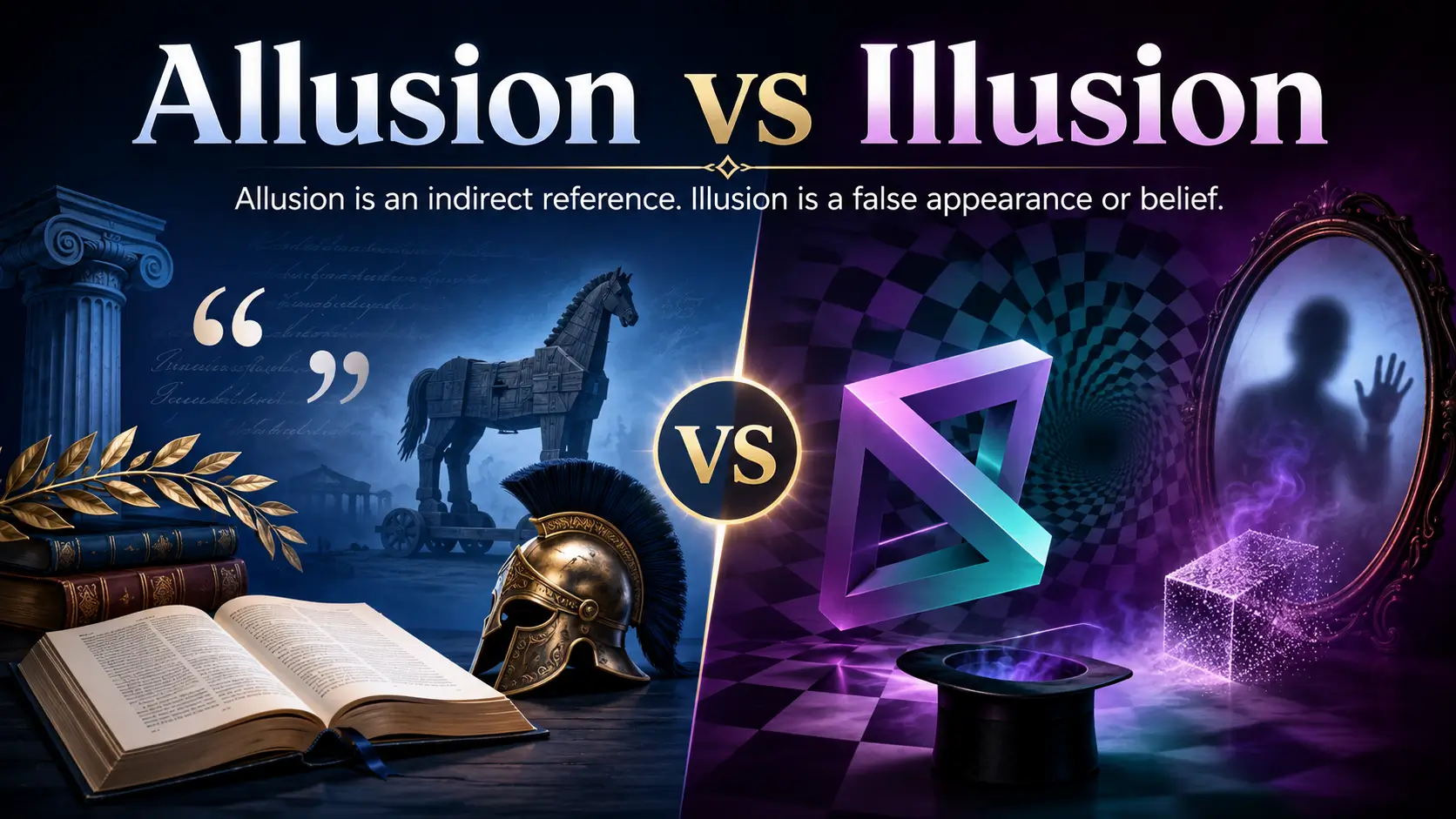
Allusion vs. illusion explains the difference between an indirect reference and a false appearance or belief. An allusion points to a familiar person, story, event, or idea. In contrast, an illusion makes something seem real or true when it isn’t. Understanding this difference helps you choose the correct word in schoolwork, professional writing, emails, and everyday conversation.
The words look similar and have nearly the same ending. However, they serve very different purposes. Writers often use an allusion as a literary device to add meaning without giving a full explanation. For example, calling someone’s weakness an “Achilles’ heel” is an allusion to Greek mythology.
An illusion, meanwhile, may affect your senses, judgment, or beliefs. A mirror can create a visual illusion of extra space, while misleading information can create a false impression. This guide explains both meanings, common sentence patterns, related words, pronunciation, mistakes, and practical ways to remember which term you need.
Quick Answer: Allusion vs. Illusion
Use allusion when you mean an indirect reference.
Use illusion when you mean something that appears real or true but isn’t.
An allusion points to something. An illusion misleads the senses or mind.
Consider these two sentences:
- The movie includes an allusion to Greek mythology.
- The special effects create the illusion of flight.
The first sentence describes a reference. The second describes a false appearance.
Allusion vs. Illusion at a Glance
| Word | Meaning | Part of speech | Common use | Example |
| Allusion | An indirect reference | Noun | Literature, speeches, movies, advertising, conversation | The title is an allusion to a famous poem. |
| Illusion | A false appearance, impression, or belief | Noun | Vision, magic, design, expectations, mistaken beliefs | The lighting creates the illusion of depth. |
Both words are countable nouns. Therefore, they can appear in singular or plural form:
- an allusion
- several allusions
- an illusion
- several illusions
Although they share the ending -lusion, they don’t share the same meaning.
What Does “Allusion” Mean?
An allusion is a brief or indirect reference to something the audience may recognize.
The reference may point to:
- A historical event
- A famous person
- A book or poem
- A religious story
- A myth or legend
- A movie or television show
- A song
- A political slogan
- A cultural event
- A familiar character
An allusion usually works without a full explanation. Instead, the writer or speaker expects the audience to understand the connection.
For example:
The new employee quickly became the office’s Sherlock Holmes.
This sentence alludes to Sherlock Holmes, the fictional detective known for solving mysteries. The speaker doesn’t explain the entire story. However, readers who know the character understand that the employee is observant or good at solving problems.
How an Allusion Works
An allusion adds meaning by connecting one idea to another.
The process often works like this:
- A writer mentions a familiar name, phrase, object, or event.
- The audience recognizes the original source.
- That source adds extra meaning to the sentence.
- The writer communicates an idea without a long explanation.
For instance:
Finishing the project became her personal Mount Everest.
The sentence doesn’t mean she climbed the actual mountain. Instead, Mount Everest represents a difficult challenge.
This allusion works because many readers associate the mountain with danger, effort, and achievement.
Examples of Allusion in Sentences
Here are several examples from everyday American English:
- His comment about a “Trojan horse” was an allusion to Greek mythology.
- The campaign slogan contains an allusion to a famous movie.
- Calling the weakness his “Achilles’ heel” was an allusion to the Greek hero Achilles.
- The novel’s forbidden garden is an allusion to the Garden of Eden.
- Her “Big Brother” remark was an allusion to George Orwell’s 1984.
- The coach’s David-and-Goliath comparison was an allusion to the biblical story.
- The phrase “opening Pandora’s box” is an allusion to Greek mythology.
In each case, the speaker refers to a familiar story, person, or idea without fully explaining it.
Allusion as a Literary Device
Writers often use allusion as a literary device. A literary device is a technique that helps a writer create meaning or produce an effect.
An allusion can:
- Add emotional depth
- Develop a theme
- Reveal a character’s personality
- Create humor
- Make criticism more subtle
- Connect a modern situation to history
- Help readers understand a complex idea
- Create a shared cultural connection
Suppose a novel describes a wealthy character as “Midas.” Readers familiar with the myth of King Midas may connect the character with wealth, greed, or the danger of wanting too much.
That single reference can communicate several ideas at once.
However, an allusion only works when the audience recognizes it. If readers don’t know the original source, they may miss the intended meaning.
Allusion vs. Direct Reference
An allusion is usually indirect or brief. A direct reference clearly identifies and explains its source.
Compare these examples:
Direct reference:
The speaker compared the small company’s struggle to the biblical story of David defeating Goliath.
Allusion:
The small company faced a David-and-Goliath battle.
The second sentence doesn’t explain the story. Instead, it assumes the reader understands that David represents the weaker opponent and Goliath represents the stronger one.
Not every mention is an allusion. A full summary, formal citation, or detailed explanation is usually a direct reference.
What Does “Illusion” Mean?
An illusion is something that seems real, true, or accurate but isn’t.
An illusion may affect:
- Sight
- Sound
- Touch
- Memory
- Expectations
- Beliefs
- Judgment
- A sense of space or movement
Some illusions are visual. Others exist only as mistaken ideas or impressions.
For example:
The wall-sized mirror creates the illusion of more space.
The room isn’t actually larger. However, the reflection makes it appear larger.
An illusion can also involve a belief:
He was under the illusion that the event was free.
In this sentence, no visual trick is involved. Instead, he believes something that isn’t true.
Visual and Physical Illusions
A visual illusion occurs when your eyes and brain interpret an image in a misleading way.
Examples include:
- A mirror that makes a room appear larger
- A drawing that seems three-dimensional
- A road that appears wet because of heat
- A stage trick that makes an object disappear
- A pattern that seems to move even though it is still
Consider this sentence:
The painted window creates the illusion of an outdoor view.
The window isn’t real. However, the painting creates a convincing appearance.
Magicians also create illusions. They use lighting, mirrors, movement, timing, and distraction to make the audience perceive something that didn’t happen as it appeared to happen.
Figurative Illusions
An illusion doesn’t have to involve sight. It can also describe a misleading belief or impression.
For example:
- A busy schedule can create the illusion of productivity.
- Social media may create an illusion of effortless success.
- The early profit gave investors the illusion of long-term stability.
- A friendly conversation created the illusion that the conflict was over.
- The simple interface gives users the illusion of complete control.
In these examples, people form an inaccurate impression.
The word illusion often suggests a gap between appearance and reality.
Common Phrases With “Illusion”
Several expressions commonly include the word illusion.
| Phrase | Meaning | Example |
| Create the illusion of | Make something appear to exist | Light colors create the illusion of space. |
| Give the illusion of | Produce a misleading appearance | The design gives the illusion of movement. |
| Maintain the illusion of | Continue making something seem true | The company tried to maintain the illusion of stability. |
| Shatter an illusion | Destroy a false belief | The final report shattered the illusion of progress. |
| Be under the illusion that | Believe something that isn’t true | She was under the illusion that the deadline had changed. |
| Optical illusion | A visual image that the brain interprets in a misleading way | The image is a well-known optical illusion. |
| Illusion of control | A belief that you control more than you actually do | The settings may give users an illusion of control. |
The phrase under the illusion that is especially common in both conversation and formal writing.
It often sounds mildly critical:
They were under the illusion that no one had noticed the error.
The sentence suggests their belief was clearly mistaken.
The Key Difference Between Allusion and Illusion
The main difference is simple:
- An allusion is a reference.
- An illusion is a false appearance or impression.
Ask yourself this question:
Does the sentence involve a reference, or does it involve something misleading?
If it involves an indirect reference, choose allusion.
If something only appears real or true, choose illusion.
Compare these examples:
- The painting contains an allusion to Greek mythology.
- The painting creates the illusion of movement.
The first painting refers to something. The second produces a misleading visual effect.
The words cannot switch places because their meanings don’t overlap.
Allusion and Illusion in the Same Sentence
Using both words together can make the difference easier to see.
- The magician’s costume included an allusion to Houdini, while the mirrors created an illusion of disappearance.
- The novel makes an allusion to the American Dream but questions whether that dream is an illusion.
- The commercial uses an allusion to Cinderella to create the illusion that one product can transform your life.
- His “Trojan horse” comment was an allusion, but his belief that nobody noticed the plan was an illusion.
- The mural contains an allusion to the moon landing and creates the illusion of a three-dimensional surface.
In every example, allusion describes a reference. Meanwhile, illusion describes a false perception or belief.
Common Mistakes With Allusion and Illusion
Because the two words sound similar, writers often choose the wrong one.
Using “Illusion” for a Cultural or Literary Reference
Incorrect:
The poem contains an illusion to Greek mythology.
Correct:
The poem contains an allusion to Greek mythology.
The poem refers to mythology. It doesn’t create a false appearance.
Using “Allusion” for a Visual Effect
Incorrect:
The mirror creates the allusion of a larger room.
Correct:
The mirror creates the illusion of a larger room.
The room appears larger than it is. Therefore, illusion is correct.
Treating Every Reference as an Allusion
Not every reference is an allusion.
A direct quotation with a source isn’t automatically an allusion. Likewise, a detailed explanation of a historical event is usually a direct reference.
An allusion normally depends on recognition.
For example:
He finally met his Waterloo.
This sentence alludes to Napoleon’s defeat at Waterloo. It uses the event as a symbol of a final or crushing defeat.
By contrast:
Napoleon was defeated at the Battle of Waterloo in 1815.
This is a direct historical statement, not an allusion.
Using the Wrong Preposition
The standard pattern is an allusion to, not an allusion about.
Correct:
- The song includes an allusion to a famous poem.
- Her joke was an allusion to an earlier conversation.
- The title may be an allusion to a historical event.
Similarly, the verb allude normally takes to:
- The speaker alluded to the budget problem.
- The email alludes to an earlier disagreement.
Confusing “Allusion” With “Allude”
Allusion is a noun. Allude is a verb.
Compare:
- The article contains an allusion to the scandal.
- The article alludes to the scandal.
Both sentences express a similar idea. However, the words have different grammatical roles.
Using “Illusion” When “Delusion” Is More Accurate
An illusion may be a false appearance or a mistaken impression.
A delusion is a firmly held false belief, often despite strong evidence to the contrary. The word also has a specific medical meaning, so it requires care.
Compare:
- The fog created the illusion of a figure in the road.
- He was under the delusion that he could never make a mistake.
The first example involves misleading perception. The second describes a deeply held false belief.
In casual conversation, delusion can sound harsh or insulting. Therefore, avoid using it carelessly when discussing another person’s mental state.
Allusion, Illusion, Delusion, and Elusion
Several similar-looking words come from different roots and have different meanings.
| Word | Meaning | Example |
| Allusion | An indirect reference | The speech includes an allusion to Abraham Lincoln. |
| Illusion | A false appearance, perception, or impression | The glass wall creates the illusion of an open space. |
| Delusion | A strongly held false belief | He was under the delusion that the rules didn’t apply to him. |
| Elusion | The act of avoiding, escaping, or remaining difficult to catch | The suspect’s continued elusion frustrated investigators. |
Allusion and Allude
Allude means to refer to something indirectly.
- She alluded to a disagreement.
- The book alludes to several ancient myths.
- His comment may allude to an earlier scandal.
An allusion is the reference itself:
- Her statement contained an allusion to the disagreement.
- The book contains several mythological allusions.
Illusion and Illusory
Illusory is the adjective related to illusion. It means seeming real or possible but not actually real.
Compare:
- The plan offered an illusion of security.
- The security offered by the plan was illusory.
Additional examples:
- Their early success proved illusory.
- The discount created an illusory sense of savings.
- The apparent agreement was illusory.
Elusion, Elude, and Elusive
Elusion is a valid noun, but it is less common in everyday English.
The related verb elude and adjective elusive appear more often.
Elude can mean to escape, avoid capture, or remain difficult to understand.
- The suspect eluded police.
- The correct answer continues to elude me.
- Sleep eluded her all night.
Elusive means difficult to find, catch, achieve, or understand.
- The animal is rare and elusive.
- A lasting solution remains elusive.
- The cause of the error was elusive.
Do not confuse elusive with illusory.
- Elusive means difficult to find or achieve.
- Illusory means not real, although it appears real.
Pronunciation and Spelling
Allusion and illusion sound similar, especially in fast conversation.
How to Pronounce “Allusion”
Allusion is pronounced:
uh-LOO-zhun
The stress falls on the second syllable.
Its pronunciation can be represented as:
/əˈluːʒən/
The first syllable has a relaxed “uh” sound.
How to Pronounce “Illusion”
Illusion is pronounced:
ih-LOO-zhun
The stress also falls on the second syllable.
Its pronunciation can be represented as:
/ɪˈluːʒən/
The first syllable sounds like the vowel in sit.
In everyday American speech, the difference may be subtle. Therefore, context often matters more than pronunciation.
Spelling Pattern
Notice the beginning of each word:
- all-usion
- ill-usion
Both end in -lusion, which explains much of the confusion.
However, spelling alone may not help you remember the meanings. A meaning-based memory trick is more reliable.
Grammar and Sentence Patterns
Both allusion and illusion are nouns. However, they commonly appear in different sentence patterns.
Singular and Plural Forms
The plural of allusion is allusions.
- The essay contains an allusion.
- The essay contains several allusions.
The plural of illusion is illusions.
- The mirror creates an illusion.
- The magician performs several illusions.
Neither word changes its spelling in an unusual way. Simply add -s.
Using “An,” Not “A”
Both words begin with a vowel sound. Therefore, use an before the singular form.
Correct:
- an allusion
- an illusion
Incorrect:
- a allusion
- a illusion
The choice between a and an depends on sound, not only spelling.
Common Prepositions
Use allusion to when naming the thing being referenced.
- an allusion to Shakespeare
- an allusion to the Civil War
- an allusion to a television show
- an allusion to Greek mythology
Use illusion of when describing the appearance being created.
- the illusion of movement
- the illusion of safety
- the illusion of choice
- the illusion of space
Use under the illusion that before a full statement.
- She was under the illusion that the office was closed.
- They were under the illusion that the service was free.
- I was under the illusion that we had already paid.
These patterns are useful because they often reveal which word belongs in the sentence.
Synonyms and Related Words
Allusion and illusion don’t have exact synonyms that work in every context. Still, several related words can help explain their meanings.
Synonyms for “Allusion”
Possible synonyms include:
- Reference
- Hint
- Mention
- Suggestion
- Indirect reference
- Implication
- Echo
However, these words aren’t always interchangeable.
For example, an implication is an idea suggested without being directly stated. An allusion, by contrast, usually points to a recognizable person, text, event, or cultural source.
Likewise, a mention may be direct. An allusion is often indirect.
Synonyms for “Illusion”
Possible synonyms include:
- False impression
- Misconception
- Deception
- Appearance
- Mirage
- Fantasy
- Misperception
Again, context matters.
A mirage is a specific visual effect, often associated with heat and distant objects. A misconception is an incorrect belief. An illusion can refer to either a sensory effect or a false impression.
How to Remember Allusion vs. Illusion
A strong memory trick connects each word with its meaning.
Use the First Letter
Think:
- Allusion = A reference
- Illusion = something I incorrectly see or believe
This method is simple and works in most situations.
Use the “Reference or Appearance?” Test
Ask:
- Is the sentence referring indirectly to something?
- Or does something only appear to be real?
Choose allusion for a reference.
Choose illusion for an appearance or false belief.
Use the Verb Test
If you can replace the idea with allude to, use allusion.
The speech alludes to Shakespeare.
Therefore:
The speech contains an allusion to Shakespeare.
If you can replace the idea with seems to be, use illusion.
The room seems to be larger than it is.
Therefore:
The mirror creates the illusion of a larger room.
Use a Short Memory Sentence
An allusion refers; an illusion deceives.
This sentence isn’t a complete dictionary definition. However, it captures the basic difference.
Real-Life Examples in American English
Both words appear in school, work, media, and casual conversation.
In School and Academic Writing
Students often use allusion when analyzing books, speeches, movies, or poems.
- The author’s description of the storm may be an allusion to Noah’s flood.
- The character’s name is an allusion to Roman mythology.
- The final scene contains an allusion to an earlier chapter.
In academic writing, explain the source and purpose of the allusion. Don’t only identify it.
A stronger analysis looks like this:
The reference to Icarus is an allusion to the Greek myth of a young man who flew too close to the sun. It emphasizes the character’s dangerous ambition.
Students may use illusion when discussing perception, appearance, or mistaken beliefs.
- The narrator lives under the illusion that wealth will solve every problem.
- The stage design creates the illusion of an endless hallway.
- The character’s confidence is an illusion that hides deep fear.
In the Workplace
In professional writing, illusion often describes misleading business results or appearances.
- A temporary increase in sales created the illusion of long-term growth.
- The dashboard gives managers the illusion of complete visibility.
- A full calendar can create the illusion of productivity.
- The open office creates the illusion of constant collaboration.
Because the word suggests that an impression is inaccurate, use it carefully. It can sound critical.
Allusion may appear in marketing, branding, presentations, and workplace conversation.
- The logo contains an allusion to the company’s original product.
- The campaign makes an allusion to a popular sports slogan.
- Her presentation included an allusion to David and Goliath.
In Texting and Social Media
In casual writing, people often use allusion to discuss memes, jokes, movies, and pop culture.
- Was that an allusion to Star Wars?
- I didn’t understand the allusion in that meme.
- His caption is an allusion to an old song.
The word illusion often appears in posts about appearance, filters, success, or lifestyle.
- That camera angle creates the illusion of more space.
- The filter gives the illusion of brighter lighting.
- Social media can create the illusion that everyone else is doing better.
In Advertising and Design
Advertisers often use allusions to connect products with familiar stories or ideas.
For example, an ad may use:
- A glass slipper as an allusion to Cinderella
- A lightning bolt as an allusion to speed
- A heroic pose as an allusion to superhero movies
- A phrase that echoes a famous slogan
Designers create illusions through color, light, spacing, and perspective.
For example:
- Vertical lines can create the illusion of height.
- Mirrors can create the illusion of additional space.
- Shadows can create the illusion of depth.
- Animation can create the illusion of continuous movement.
A Practical Usage Scenario
Imagine a theater review that includes this sentence:
The director uses an allusion to Alice in Wonderland, while shifting walls create the illusion that the stage is shrinking.
The word allusion is correct because the production refers to a known story.
The word illusion is correct because the walls make the stage appear smaller, even though its actual size doesn’t change.
Now consider an incorrect version:
The director uses an illusion to Alice in Wonderland, while shifting walls create the allusion that the stage is shrinking.
The words are reversed. A story reference is not an illusion, and a visual effect is not an allusion.
This context-based test is more useful than memorizing spelling alone.
Practice: Choose “Allusion” or “Illusion”
Complete each sentence with allusion or illusion.
- The mirror creates the ______ of a second doorway.
- The phrase “forbidden fruit” is an ______ to a biblical story.
- She was under the ______ that the deadline had changed.
- The character’s name may be an ______ to Greek mythology.
- The lighting produced the ______ of falling snow.
- His “Big Brother” comment was an ______ to George Orwell’s novel.
- The app gives users the ______ of complete privacy.
- The mural contains several historical ______.
- The song’s title is an ______ to a famous poem.
- The magician created the ______ that the card had disappeared.
Answer Key
- Illusion: The mirror produces a false appearance.
- Allusion: “Forbidden fruit” refers indirectly to a biblical story.
- Illusion: She believes something that isn’t true.
- Allusion: The name points to mythology.
- Illusion: The lighting creates a visual effect.
- Allusion: The comment refers to 1984.
- Illusion: The privacy may appear more complete than it is.
- Allusions: The mural contains multiple references.
- Allusion: The title refers indirectly to a poem.
- Illusion: The audience sees an effect that isn’t what it appears to be.
SEO Title: Allusion vs. Illusion: Meaning, Differences, and Examples
Meta Description: Learn the difference between allusion and illusion with simple definitions, clear examples, grammar tips, and memory tricks for correct usage.
Slug: allusion-vs-illusion
Tags: allusion vs illusion, allusion meaning, illusion meaning, commonly confused words, English grammar, word usage, grammar examples.
Frequently Asked Questions
Q1. What is the main difference between allusion and illusion?
An allusion is an indirect reference to something familiar. An illusion is a misleading appearance, perception, or belief.
For example:
- The novel contains an allusion to Greek mythology.
- The mirror creates the illusion of a larger room.
The first sentence involves a reference. The second involves a false appearance.
Q2. What is an example of an allusion?
The phrase “That decision opened Pandora’s box” is an allusion to Greek mythology.
The speaker doesn’t explain the full story of Pandora. Instead, the phrase indirectly refers to it and suggests that one action caused many unexpected problems.
Q3. What is an example of an illusion?
A large mirror can create the illusion that a small room has more space.
The room’s actual size doesn’t change. However, the reflection produces a misleading visual impression.
Q4. Is an allusion always indirect?
An allusion is generally indirect or brief. It depends on the reader or listener recognizing the source.
A detailed explanation, full summary, or clearly identified quotation is usually a direct reference rather than an allusion. However, a quotation may work as an allusion when its source isn’t fully explained.
Q5. Is an illusion always something you see?
No. An illusion may be visual, but it can also involve sound, judgment, expectations, or beliefs.
For example, the phrase illusion of control describes the mistaken belief that someone controls more than they actually do. No visual effect is involved.
Q6. What does “under the illusion” mean?
To be under the illusion that something is true means to believe it even though it is false or inaccurate.
For example:
We were under the illusion that the tickets included parking.
This sentence means the speakers mistakenly believed parking was included.
Q7. What is the difference between allusion and allude?
Allusion is a noun, while allude is a verb.
- The speech contains an allusion to a famous court case.
- The speech alludes to a famous court case.
Use allude to, not allude about or allude something.
Q8. What is the difference between illusion and delusion?
An illusion is a false appearance, perception, or impression. A delusion is a firmly held false belief, often maintained despite evidence.
The word delusion also has a specific clinical meaning. Therefore, it should be used carefully when discussing a person’s mental health.
Q9. Are allusion and illusion pronounced the same way?
The words sound similar, but their first syllables differ slightly in careful American pronunciation.
- Allusion: uh-LOO-zhun
- Illusion: ih-LOO-zhun
Because the difference can be hard to hear in fast speech, context usually reveals which word the speaker means.
Q10. How can you remember allusion vs. illusion?
Use this simple memory trick:
An allusion refers; an illusion deceives.
You can also connect the first letters with their meanings:
- Allusion = A reference
- Illusion = something I incorrectly see or believe
When you’re unsure, ask whether the sentence describes a reference or a false impression.
Conclusion
The difference in allusion vs. illusion becomes clear when you focus on meaning instead of spelling. An allusion is an indirect reference to a person, event, story, text, or cultural idea. An illusion is something that appears real or true but isn’t.
Use allusion when a writer or speaker points to another source. Use illusion when an image, belief, or situation creates a misleading impression. For example, a speech may contain an allusion to history, while incomplete data may create the illusion of success.
Remember the central rule: an allusion is a reference, while an illusion is a false appearance or belief. That quick test will help you choose the correct word in academic writing, workplace communication, social media, and everyday American English.
1 thought on “Allusion vs. Illusion: Meaning, Differences, and Examples”