
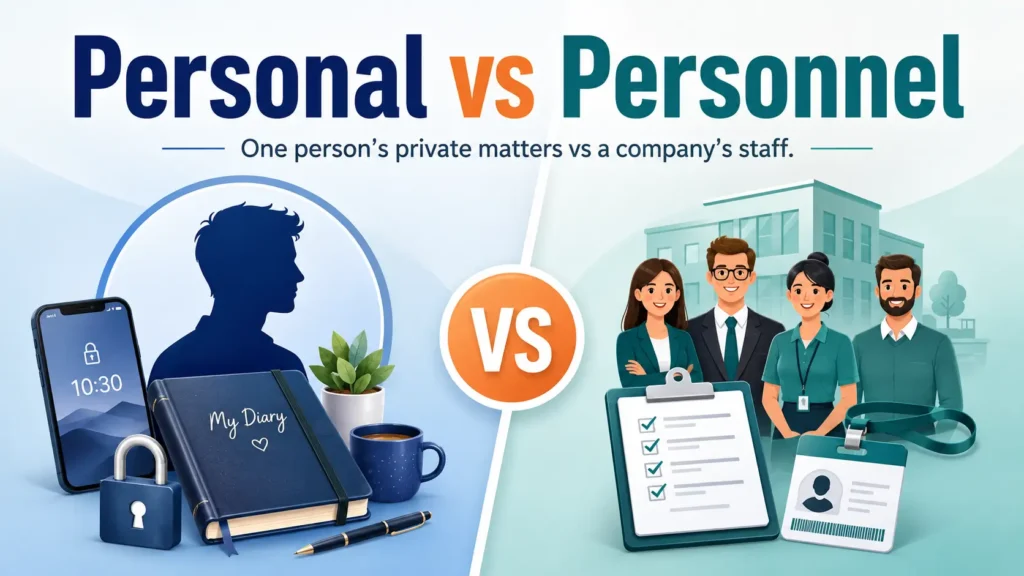
Personal vs Personnel can be confusing because the two words look and sound similar but have very different meanings. Personal is usually an adjective that describes something related to one person, their private life, belongings, opinions, goals, or interests. Personnel, on the other hand, is a noun that refers to employees, staff, or people who work for a company, institution, or organization.
The easiest way to remember the difference is simple: personal relates to an individual, while personnel refers to people at work. For example, you have personal information, personal belongings, and personal goals, but a company has personnel, including employees and staff.
Understanding Personal vs Personnel becomes easier when you look at the context. Ask whether you’re talking about something private or individual, or about workers in an organization. This simple distinction can help you choose the correct word in everyday, academic, and professional writing.
Quick Answer: Personal vs. Personnel
The simplest distinction is:
- Personal = related to a particular person or their private life.
- Personnel = employees, staff, or workers in an organization.
| Word | Part of Speech | Basic Meaning | Example |
| Personal | Usually an adjective | Related to an individual or their private life | That’s my personal opinion. |
| Personnel | Noun | Employees or staff of an organization | All personnel must attend the meeting. |
The easiest way to remember
Personal is about a person.
Personnel is about people working for an organization.
Consider these two sentences:
Please don’t share your personal information.
Only authorized personnel may enter this area.
In the first sentence, personal describes information connected to an individual. In the second, personnel refers to people who have permission to enter.
Therefore, the words aren’t interchangeable.
What Does Personal Mean?
Personal is most commonly an adjective. It describes something that belongs to, affects, or relates to a particular person.
The word can also describe something connected to someone’s private life, feelings, experiences, choices, or opinions.
For example:
This is my personal opinion.
The opinion belongs to the speaker. It isn’t necessarily an official statement from a company, organization, or group.
Another example is:
Please keep your personal belongings with you.
Here, personal describes belongings that belong to an individual.
Common meanings of personal
Depending on the context, personal can mean:
- Belonging to a particular person
- Related to an individual’s private life
- Connected to someone’s feelings or experiences
- Expressing an individual’s opinion
- Intended for an individual’s private use
- Involving a person’s own responsibility or choice
Because of these meanings, personal appears in many everyday phrases.
Common phrases with personal
- Personal information
- Personal opinion
- Personal experience
- Personal life
- Personal belongings
- Personal space
- Personal preference
- Personal responsibility
- Personal goals
- Personal account
- Personal email
- Personal phone
- Personal choice
For example, your personal email is an account you use for your own messages rather than an email account provided by your employer.
Likewise, your personal goals are goals you set for yourself. They may be different from your professional or academic goals.
Examples of Personal in Sentences
Here are several examples of personal in everyday American English.
I don’t want to discuss my personal life at work.
Why it’s correct: The sentence refers to the speaker’s private life.
That’s a personal decision, so you need to make it yourself.
Why it’s correct: The decision belongs to or affects an individual.
She shared her personal experience with online learning.
Why it’s correct: The experience happened directly to her.
Please remove all personal items from the desk.
Why it’s correct: The items belong to an individual.
He gave me his personal phone number.
Why it’s correct: The phone number is connected to his private contact information.
Everyone has their own personal preferences.
Why it’s correct: The preferences belong to individual people.
Personal in professional communication
The word personal is also common in workplace English.
For example:
I need to take a personal day tomorrow.
This usually means the employee needs time away from work for a private matter.
You might also write:
I’m using my personal email for this conversation.
Or:
Please don’t use your personal phone during the meeting.
In each case, personal describes something connected to an individual rather than the organization.
What Does Personnel Mean?
Personnel is a noun that refers to the people who work for an organization, company, institution, or group.
Depending on the context, it can mean:
- Employees
- Staff
- Workers
- Members of an organization with specific duties
For example:
All company personnel must complete the training.
Here, personnel means the employees or staff of the company.
The word often appears in formal or official language. You may see it in workplace policies, government documents, military writing, security notices, and organizational communication.
Common phrases with personnel
- Company personnel
- Military personnel
- Medical personnel
- Emergency personnel
- School personnel
- Hospital personnel
- Authorized personnel
- Security personnel
- Personnel department
For example:
Emergency personnel arrived at the scene.
The sentence refers to trained workers responding to an emergency.
Similarly:
Only authorized personnel may enter.
The sentence refers to people who have permission to enter.
Examples of Personnel in Sentences
Here are common examples of personnel used correctly.
All personnel must wear identification badges.
Why it’s correct: The sentence refers to employees or staff members.
The hospital has highly trained medical personnel.
Why it’s correct: The word refers to people who work in the medical setting.
Military personnel were deployed to the region.
Why it’s correct: The term refers to members of the military.
Only authorized personnel can access this room.
Why it’s correct: The sentence refers to people who have official permission.
The company is hiring additional personnel.
Why it’s correct: The company wants to add more employees or staff.
School personnel contacted the student’s parents.
Why it’s correct: The phrase refers to people who work for the school.
Notice that personnel always points toward people in an organizational or professional setting. The exact workers can change depending on the context.
Personal vs. Personnel: Key Differences
The most important difference between personal and personnel is what each word refers to.
Personal describes something connected to an individual.
Personnel refers to people who work for an organization.
| Feature | Personal | Personnel |
| Part of speech | Usually adjective | Noun |
| Meaning | Related to an individual | Employees or staff |
| Main focus | A person or private matters | Workers in an organization |
| Common context | Opinions, belongings, information, experiences | Workplaces, institutions, military, security |
| Example | Personal information | Company personnel |
| Typical tone | Everyday and professional | Often formal or official |
Another important difference is grammatical.
Personal usually modifies a noun:
personal information
personal experience
personal choice
personal belongings
By contrast, personnel is itself a noun:
The personnel arrived.
All personnel must register.
The company needs more personnel.
Therefore, if you need a word to describe something connected to one person, personal is usually the right choice. If you need a noun for employees or staff, personnel is the better choice.
How to Use Personal and Personnel Correctly
A simple question can help you choose between these two words.
Ask yourself:
Am I talking about something related to an individual, or am I talking about people who work for an organization?
If you’re describing something connected to an individual, use personal.
If you’re referring to employees or staff, use personnel.
Use personal for individual matters
Choose personal for:
- Personal information
- Personal opinions
- Personal experiences
- Personal belongings
- Personal choices
- Personal goals
- Personal preferences
For example:
My personal preference is to work in the morning.
The preference belongs to the speaker.
Use personnel for employees and staff
Choose personnel for:
- Company personnel
- Hospital personnel
- Military personnel
- Emergency personnel
- Security personnel
- Authorized personnel
For example:
Hospital personnel must follow strict safety procedures.
The word refers to people working at the hospital.
Personal vs. Personnel Pronunciation
Pronunciation is another reason these words can be confusing.
In American English, personal is commonly pronounced approximately like:
PUR-suh-nuhl
The word has three syllables, with the main stress near the beginning.
Personnel is commonly pronounced approximately like:
pur-suh-NEL
The final syllable receives the main stress.
The difference in stress can help you recognize the words when speaking. However, because they sound similar, context is still important.
For example, if someone says:
“The company needs more personnel.”
The context makes it clear that they’re talking about employees.
If someone says:
“That’s my personal opinion.”
The context shows that personal describes an individual’s opinion.
Is Personnel Singular or Plural?
The grammar of personnel deserves special attention.
When personnel means employees or staff, it generally refers to a group of people. In American English, it is commonly treated as a plural noun in sentences where the members of the group are acting individually.
For example:
The personnel are preparing for the inspection.
All personnel have completed the training.
However, personnel isn’t normally used as a singular count noun for one employee.
You wouldn’t usually say:
We hired a new personnel.
Instead, say:
We hired a new employee.
Or:
We hired a new staff member.
You can also say:
We hired a new worker.
The distinction is important because personnel refers to a group, while employee identifies one person.
Compare these examples
The personnel are attending the meeting.
This refers to a group of employees or staff.
An employee is attending the meeting.
This refers to one individual.
Two employees are attending the meeting.
This refers to two individual workers.
Therefore, if you need to identify a specific person, use employee, worker, or staff member rather than personnel.
Personal vs. Personnel vs. Staff
Personnel and staff can have similar meanings. However, they aren’t always used in the same way or with the same tone.
Staff is very common in everyday American English.
For example:
The hotel staff were friendly.
This sounds natural and conversational.
Personnel often sounds more formal or official.
Hotel personnel must follow safety procedures.
The second sentence sounds more like a workplace rule or policy.
A practical comparison
| Word | Typical meaning | Tone | Example |
| Staff | Employees or workers | Common, everyday | The restaurant staff were helpful. |
| Personnel | Employees or organizational workers | More formal or official | Authorized personnel only. |
| Employee | One person who works for an employer | Neutral | Each employee receives training. |
| Worker | A person who works | General | The workers finished the project. |
In casual conversation, staff may sound more natural. Meanwhile, personnel is especially common in formal policies, security language, military contexts, and official documents.
Personal vs. Personnel in Real-Life American English
The difference becomes much clearer when you see the words in familiar situations.
At work
Please keep your personal phone in your desk.
Here, personal means a phone belonging to you rather than a company-issued device.
Only authorized personnel can access the server room.
Here, personnel refers to employees or other authorized workers.
At school
Students should keep their personal belongings with them.
The belongings belong to individual students.
School personnel will contact the parents.
The personnel are people who work for the school.
In a hospital
Patients should protect their personal information.
The information relates to individual patients.
Medical personnel are available around the clock.
The personnel are healthcare workers or other staff.
In an email
Please don’t include sensitive personal information in the public form.
The information is private or connected to an individual.
All personnel should complete the form by Friday.
The message is directed toward employees or staff.
In a security notice
Personal belongings must be stored in the designated area.
The sentence refers to items owned by individuals.
Only authorized personnel may enter this area.
The sentence refers to people with permission to enter.
Common Mistakes With Personal and Personnel
Because these words look so similar, they are often mixed up in writing.
Mistake: Using Personal to Mean Employees
Incorrect:
All company personal must attend the meeting.
Correct:
All company personnel must attend the meeting.
The intended meaning is employees or staff. Therefore, personnel is the correct word.
Mistake: Using Personnel for Private Information
Incorrect:
Please protect your personnel information.
Correct:
Please protect your personal information.
The sentence refers to information about an individual. Therefore, personal is correct.
Mistake: Saying “A Personnel”
Incorrect:
The manager hired a new personnel.
Correct:
The manager hired a new employee.
Correct:
The manager hired a new staff member.
When you mean one worker, use a singular count noun such as employee or staff member.
Mistake: Confusing Personal Items With Personnel
Incorrect:
Please remove your personnel items from the desk.
Correct:
Please remove your personal items from the desk.
The sentence refers to belongings, not employees. Therefore, personal is correct.
Mistake: Writing “Authorized Personal”
Incorrect:
Authorized personal only.
Correct:
Authorized personnel only.
This is a common error on signs and in workplace communication.
The correct phrase is authorized personnel because it refers to people who have permission to enter or access something.
Personal vs. Personnel: A Useful Memory Trick
The easiest memory trick is to connect personal with person.
Personal → Person
Personal means related to a particular person.
Think:
Personal = person-related
Examples:
- Personal information
- Personal opinion
- Personal belongings
- Personal experience
Personnel → People at work
Personnel refers to employees or staff.
Think:
Personnel = people working for an organization
Examples:
- Company personnel
- Military personnel
- Medical personnel
- Authorized personnel
One sentence to remember both
The company protects employees’ personal information, and its personnel must follow privacy rules.
Here, personal describes information. Personnel refers to employees.
That single distinction can help you avoid most mistakes.
Personal vs. Personnel vs. Person
These three words are related but have different grammatical functions.
| Word | Meaning | Example |
| Person | One individual human being | That person is my neighbor. |
| Personal | Related to an individual | That’s my personal opinion. |
| Personnel | Employees or staff as a group | Company personnel attended the event. |
Think of the relationship this way:
A person is an individual.
Something personal relates to that individual.
Personnel refers to people working for an organization.
For example:
One person gave a personal opinion during the meeting, while the company’s personnel listened.
Each word has a different role in the sentence.
Synonyms and Related Words
Understanding related words can make the distinction even clearer.
Synonyms for Personal
Depending on the context, words similar to personal include:
- Private
- Individual
- Own
- Private-use
- Subjective
- Individualized
However, these words aren’t always exact replacements.
For example, personal information and private information can overlap, but they don’t always mean exactly the same thing in every context.
Likewise, personal opinion and subjective opinion can be similar, but personal opinion is much more common in everyday English.
Synonyms for Personnel
Depending on the context, alternatives for personnel include:
- Staff
- Employees
- Workers
- Team members
- Workforce
- Members of staff
Again, context matters.
Staff may refer to a group of employees in a particular workplace. Workforce can refer more broadly to all workers in a company, industry, or region.
Personnel is often the best choice when discussing employees in formal or organizational language.
Personal vs. Personnel Practice Quiz
Choose personal or personnel to complete each sentence.
1. Please don’t share your _____ information online.
Answer: personal
The information relates to an individual.
2. Only authorized _____ can enter the restricted area.
Answer: personnel
The sentence refers to authorized people or workers.
3. That’s my _____ opinion.
Answer: personal
The opinion belongs to the speaker.
4. Hospital _____ must follow safety procedures.
Answer: personnel
The sentence refers to hospital employees or staff.
5. Please take your _____ belongings with you.
Answer: personal
The belongings belong to individual people.
6. All _____ must complete the training.
Answer: personnel
The sentence refers to employees or staff.
7. She shared her _____ experience during the presentation.
Answer: personal
The experience belongs to the person who had it.
8. Emergency _____ arrived at the scene.
Answer: personnel
The phrase refers to trained workers responding to an emergency.
9. He uses his _____ email for family messages.
Answer: personal
The email account is for his private use.
10. The company hired additional _____ for the new project.
Answer: personnel
The company hired more employees or staff.
Here is a concise conclusion followed by 10 FAQs that reinforce the main difference between personal and personnel.
Conclusion: Personal vs. Personnel
Understanding personal vs. personnel becomes much easier when you focus on the meaning of each word. Personal usually describes something related to an individual, private life, opinions, experiences, or belongings. Personnel, however, is a noun that refers to employees, staff, or people who work for a company, business, institution, or organization.
A simple memory trick can help: personal has one n and connects with one individual, while personnel has two n’s and refers to a group of employees or staff. So, you have personal information, personal goals, and personal belongings, but you also have company personnel, medical personnel, and authorized personnel. When choosing between these commonly confused words, always consider whether you’re describing something connected to a person or referring to people who work for an organization.
Frequently Asked Questions About Personal vs. Personnel
Q1. What is the difference between personal and personnel?
Personal is usually an adjective that describes something related to an individual or their private life. Personnel is a noun that refers to employees, staff, or workers associated with an organization.
Q2. Is personnel the plural of person?
No. Personnel isn’t simply the plural form of person. It refers to people who work for or are associated with an organization, such as company employees or military members.
Q3. Can personnel refer to one person?
Generally, personnel refers to a group of employees or staff. If you’re talking about one person, use employee, worker, or staff member instead.
Q4. Is “a personnel” correct?
Usually, no. When personnel means employees or staff, it isn’t normally used as a singular count noun. Instead, say an employee or a staff member.
Q5. Is it personal information or personnel information?
Personal information is the standard phrase when referring to information about an individual. Personnel information can be used in some workplace contexts, but it doesn’t usually mean the same thing as personal information.
Q6. What does personal mean in a sentence?
Personal usually means related to a particular person, their private life, opinions, experiences, or belongings. For example, “She shared her personal experience” means the experience happened directly to her.
Q7. What does personnel mean in a sentence?
Personnel means employees, staff, or workers associated with an organization. For example, “All company personnel must attend the meeting” means all employees or staff members must attend.
Q8. Is it “authorized personal” or “authorized personnel”?
The correct phrase is authorized personnel when you mean people who have permission to enter or access a place. Personal means related to an individual, so it doesn’t have the intended meaning in this phrase.
Q9. How can I remember the difference between personal and personnel?
Remember that personal has one n and relates to an individual. Personnel has two n’s and refers to employees or staff. Think personal = person and personnel = people at work.
Q10. What is the difference between personal, person, and personnel?
A person is one individual. Personal describes something related to that individual, such as a personal opinion or personal belongings. Personnel refers to employees, staff, or workers as a group.
Segway or Segue: Meaning, Difference, Examples, and Easy Usage Guide
Too Many or To Many: Correct Usage, Grammar Rules, and Examples
