
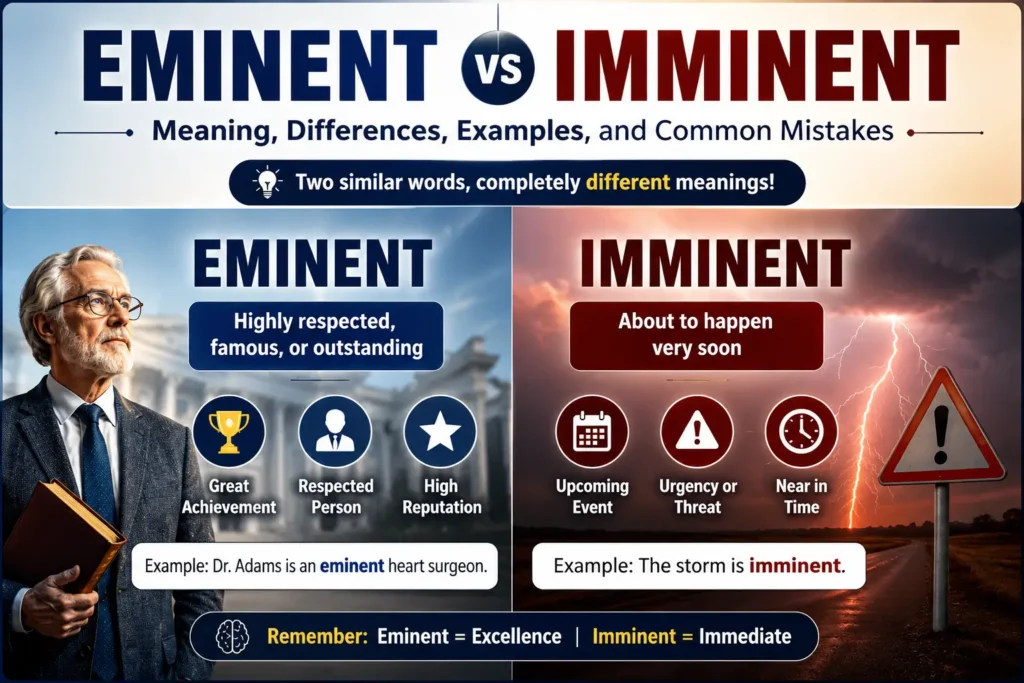
The difference between eminent vs imminent often creates confusion because these words have similar pronunciation, sound alike, and look similar. However, their meanings are completely different. The key difference is that eminent describes a famous, distinguished, and highly respected person or thing, while imminent describes something that is about to happen or will happen very soon. This small spelling change can alter the intended meaning of a sentence, especially when writing in the English language.
Many people interchange these terms because both are homophones, but they have distant meanings and are not spelled the same. An eminent scientist is a respected expert in a field who has achieved a high level of recognition through their work. An imminent storm means a storm is approaching and may happen soon. Understanding their applications, definitions, and correct use helps differentiate them and prevents using the wrong word. A useful way to remember this is that eminent connects with importance, skill, and respect, while imminent connects with arrival, upcoming events, and urgency.
Quick Answer: What Is the Difference Between Eminent and Imminent?
The main difference between eminent and imminent is their meaning and usage:
| Word | Meaning | Used For | Example |
| Eminent | Famous, respected, or excellent | People, achievements, positions | Dr. Adams is an eminent heart surgeon. |
| Imminent | About to happen very soon | Events, situations, changes | The company announced an imminent price increase. |
A simple way to remember:
- Eminent = Excellent or Elevated reputation
- Imminent = Immediate future
Although they share similar letters, they describe completely different ideas.
Why Eminent and Imminent Are Commonly Confused
The confusion happens because both words come from Latin roots and have similar spelling patterns.
Many English learners and native speakers mix them up because:
- They differ by only one letter.
- They have similar pronunciation.
- They are both adjectives.
- They often appear in formal writing.
However, their meanings are not interchangeable.
Consider these sentences:
❌ The earthquake warning is eminent.
✅ The earthquake warning is imminent.
The first sentence suggests the earthquake warning is respected or famous, which does not make sense. The second sentence correctly means the earthquake may happen soon.
Another example:
❌ She is an imminent professor.
✅ She is an eminent professor.
A professor cannot be “about to happen.” Instead, the person can be highly respected or recognized in their field.
Meaning of Eminent: Highly Respected or Outstanding
Definition and Part of Speech of Eminent
Eminent is an adjective used to describe someone or something that has a high level of importance, reputation, or achievement.
It often refers to people who are recognized because of their skills, knowledge, success, or influence.
Common meanings include:
- Famous
- Distinguished
- Respected
- Outstanding
- Notable
For example:
An eminent scientist contributed to groundbreaking medical research.
This means the scientist is respected and recognized because of their work.
How Eminent Describes People, Achievements, and Positions
The word eminent most commonly describes people.
You will often see it used with:
- Scientists
- Doctors
- Professors
- Lawyers
- Writers
- Artists
- Leaders
- Researchers
Examples:
- An eminent author published several award-winning novels.
- An eminent professor gave a lecture at the university.
- An eminent lawyer handled the important case.
It can also describe achievements, careers, or positions connected to respected individuals.
Examples:
- His eminent career influenced modern technology.
- The university honored her for her eminent contributions.
However, using eminent for ordinary objects is uncommon.
Common Contexts Where Eminent Is Used
Academic Writing
In academic settings, eminent often describes experts with significant knowledge.
Example:
The conference invited several eminent researchers from around the world.
Professional Communication
Businesses may use eminent when discussing respected professionals.
Example:
The company hired an eminent consultant to guide the project.
News and Public Recognition
News articles often use this word for well-known figures.
Example:
The award celebrates the work of an eminent filmmaker.
Examples of Eminent in Sentences
| Sentence | Explanation |
| She is an eminent historian. | She is respected in the field of history. |
| The hospital hired an eminent surgeon. | The surgeon is highly recognized. |
| He became an eminent figure in technology. | He became an important and respected person. |
| The university invited an eminent speaker. | The speaker is famous or distinguished. |
Meaning of Imminent: About to Happen Soon
Definition and Part of Speech of Imminent
Imminent is an adjective that describes something expected to happen very soon.
It suggests that an event is close in time and may happen at any moment.
Common meanings include:
- Near
- Approaching
- About to occur
- Ready to happen
Examples:
The company warned employees about an imminent system shutdown.
This means the shutdown is expected soon.
How Imminent Shows Urgency or Near Future Events
Unlike eminent, which focuses on reputation, imminent focuses on timing.
It is often used for situations involving:
- Danger
- Changes
- Decisions
- Events
- Deadlines
- Weather conditions
Common phrases include:
- Imminent danger
- Imminent threat
- Imminent arrival
- Imminent change
- Imminent decision
Examples:
The firefighters acted quickly because the building collapse was imminent.
The word creates a feeling of urgency because something is expected soon.
Examples of Imminent in Sentences
| Sentence | Explanation |
| A storm is imminent. | The storm will likely happen soon. |
| The deadline is imminent. | The deadline is approaching quickly. |
| The company announced an imminent update. | The update will happen soon. |
| Signs of an imminent problem appeared. | The problem may occur soon. |
Eminent vs Imminent: Key Differences Explained
Understanding the difference becomes easier when you focus on the question each word answers.
- Eminent asks: “Who or what is respected?”
- Imminent asks: “What is happening soon?”
Meaning Comparison: Reputation vs Nearness
| Feature | Eminent | Imminent |
| Main idea | Importance or reputation | Near future timing |
| Focus | Quality or status | Time or urgency |
| Usually describes | People | Events or situations |
| Feeling | Respect and recognition | Warning or expectation |
Examples:
- Eminent scientist → A respected scientist.
- Imminent discovery → A discovery expected soon.
Usage Comparison in American English
In American English, eminent usually appears in formal or professional contexts.
You might see it in:
- Academic articles
- News reports
- Professional profiles
Meanwhile, imminent appears more often in everyday situations.
Examples:
- “A storm is imminent.”
- “The launch date is imminent.”
- “There is imminent danger.”
How to Use Eminent Correctly in a Sentence
The usual structure is:
Eminent + noun
Examples:
- Eminent scientist
- Eminent leader
- Eminent writer
You can also use it with phrases describing achievements.
Examples:
She received recognition for her eminent contributions to medicine.
The university honored an eminent professor.
Incorrect Uses of Eminent
❌ The accident is eminent.
✅ The accident is imminent.
An accident cannot have a reputation. It can only happen soon.
❌ An imminent author wrote the book.
✅ An eminent author wrote the book.
An author can be respected, not “about to happen.”
How to Use Imminent Correctly in a Sentence
The common structure is:
Imminent + event or situation
Examples:
- Imminent danger
- Imminent arrival
- Imminent change
- Imminent attack
Examples:
The passengers prepared for the train’s imminent arrival.
Officials warned residents about imminent flooding.
Incorrect Uses of Imminent
❌ She is an imminent doctor.
✅ She is an eminent doctor.
Doctors are respected, not “about to happen.”
❌ He is an imminent expert.
✅ He is an eminent expert.
An expert can be famous or respected.
Common Mistakes With Eminent and Imminent
Mistake 1: Using Eminent for Future Events
Incorrect:
The meeting is eminent.
Correct:
The meeting is imminent.
A meeting does not have fame or importance. It is simply approaching.
Mistake 2: Using Imminent for Famous People
Incorrect:
She is an imminent author.
Correct:
She is an eminent author.
The author has a strong reputation.
Mistake 3: Misspelling Eminent as “Emminent”
A common spelling mistake is adding an extra “m.”
Incorrect:
❌ Emminent scientist
Correct:
✅ Eminent scientist
The correct spelling has only one “m.”
Mistake 4: Confusing Imminent With Immanent
Although imminent and immanent look similar, they have different meanings.
| Word | Meaning | Example |
| Eminent | Famous or respected | An eminent doctor |
| Imminent | About to happen | An imminent storm |
| Immanent | Existing within something | A belief about immanent qualities |
Immanent is mainly used in philosophy and religious discussions, so it appears less often in everyday English.
Pronunciation Guide: Eminent vs Imminent
Both words are pronounced similarly.
How to Pronounce Eminent
Eminent: /ˈem.ɪ.nənt/
The first syllable sounds like “em.”
Example:
EM-uh-nent
How to Pronounce Imminent
Imminent: /ˈɪm.ɪ.nənt/
The first syllable sounds like “im.”
Example:
IM-uh-nent
Why Their Pronunciation Causes Confusion
The middle and ending sounds are almost identical:
- Eminent
- Imminent
The main difference is the first vowel sound:
- Eminent
- Imminent
Because they sound close, checking the meaning before choosing the spelling is important.
Synonyms and Related Words
Synonyms for Eminent
Depending on the situation, you can use:
- Distinguished
- Famous
- Notable
- Respected
- Celebrated
- Renowned
- Outstanding
Example:
She is a renowned scientist.
This has a similar meaning to eminent scientist.
Synonyms for Imminent
Possible alternatives include:
- Approaching
- Near
- Upcoming
- Expected
- Immediate
- Pending
Example:
The deadline is approaching.
This has a similar meaning to:
The deadline is imminent.
Real-Life American English Examples
Examples in School and Academic Writing
The university invited an eminent professor to speak about climate science.
The professor is respected.
Students prepared for an imminent exam deadline.
The deadline is coming soon.
Examples in Workplace Communication
The company hired an eminent consultant for the project.
The consultant has a strong reputation.
Employees received notice of an imminent software update.
The update will happen soon.
Examples in Everyday Conversation
A famous chef visited the restaurant. She is an eminent figure in the food industry.
Bring an umbrella. Heavy rain is imminent.
Quick Memory Tricks to Remember Eminent vs Imminent
Remember Eminent With “Excellent”
Both begin with E:
Eminent = Excellent reputation
Think:
An eminent person is excellent in their field.
Remember Imminent With “Immediate”
Both relate to something happening soon:
Imminent = Immediate future
Think:
If something is imminent, it is coming right away.
Practice Exercises: Choose Eminent or Imminent
Fill in the blanks:
- The hurricane warning says dangerous weather is ______.
- She is an ______ scientist known worldwide.
- The company announced an ______ leadership change.
- The university honored an ______ researcher.
Answers
- Imminent — The weather is expected soon.
- Eminent — The scientist is respected.
- Imminent — The change will happen soon.
- Eminent — The researcher is highly recognized.
Conclusion: Choosing Between Eminent vs Imminent Correctly
Understanding the difference between eminent vs imminent becomes much easier when you focus on their meanings. Eminent refers to someone or something that is respected, famous, or outstanding, while imminent describes something that is expected to happen soon. Although these words share similar spelling and pronunciation, they serve completely different purposes in English.
Remember this simple trick: eminent is connected with excellence and recognition, while imminent is connected with immediate events. Whether you are writing an email, academic paper, professional document, or everyday message, choosing the correct word helps your writing stay clear and accurate.
FAQs About Eminent vs Imminent
Q1: What is the main difference between eminent and imminent?
The main difference is their meaning. Eminent means famous, respected, or distinguished, while imminent means something is about to happen soon.
For example:
- An eminent doctor is a highly respected doctor.
- An imminent storm is a storm that is expected soon.
Q2: Is eminent used for people or things?
Eminent is most commonly used for people who are recognized for their achievements, knowledge, or skills. It can also describe important contributions, careers, or positions.
Examples:
- She is an eminent researcher in medicine.
- His eminent achievements changed the industry.
Q3: Can imminent describe positive events?
Yes. Although imminent is often used with warnings or negative situations, it can describe any event that is expected to happen soon.
Examples:
- The baby’s arrival is imminent.
- The product launch is imminent.
- The celebration is imminent.
Q4: Is “eminent danger” correct?
No. The correct phrase is imminent danger.
Imminent danger means a dangerous situation is likely to happen soon.
Example:
The hikers were warned about imminent danger during the storm.
Q5: Is “imminent expert” the correct phrase?
No. The correct phrase is eminent expert.
An expert can be famous, respected, or highly skilled, so eminent is the correct word.
Example:
The conference invited an eminent expert in artificial intelligence.
Q6: Why do people confuse eminent and imminent?
People confuse these words because they look and sound very similar. They are also both adjectives and come from similar Latin roots.
However, their meanings are different:
- Eminent = respected or famous
- Imminent = about to happen
Q7: How do you remember the difference between eminent and imminent?
A simple memory trick can help:
- Eminent = Excellent reputation
- Imminent = Immediate future
If you are talking about someone’s success or importance, use eminent. If you are talking about something coming soon, use imminent.
Q8: Is “emminent” the correct spelling?
No. Emminent is a common spelling mistake.
The correct spelling is:
✅ Eminent
❌ Emminent
Remember that eminent has only one “m,” while imminent has two “m’s.”
Q9: What is the difference between imminent and immanent?
Although imminent and immanent look similar, they have different meanings.
- Imminent means something will happen soon.
- Immanent means something exists within or is naturally part of something.
Example:
- The storm is imminent.
- Philosophers discuss immanent qualities of nature.
Q10: Can eminent describe objects?
Usually, eminent describes people, but it can sometimes describe achievements, qualities, or contributions connected to important people.
Examples:
- An eminent scientist
- Eminent contributions to education
It is not normally used for ordinary objects or everyday items.
