
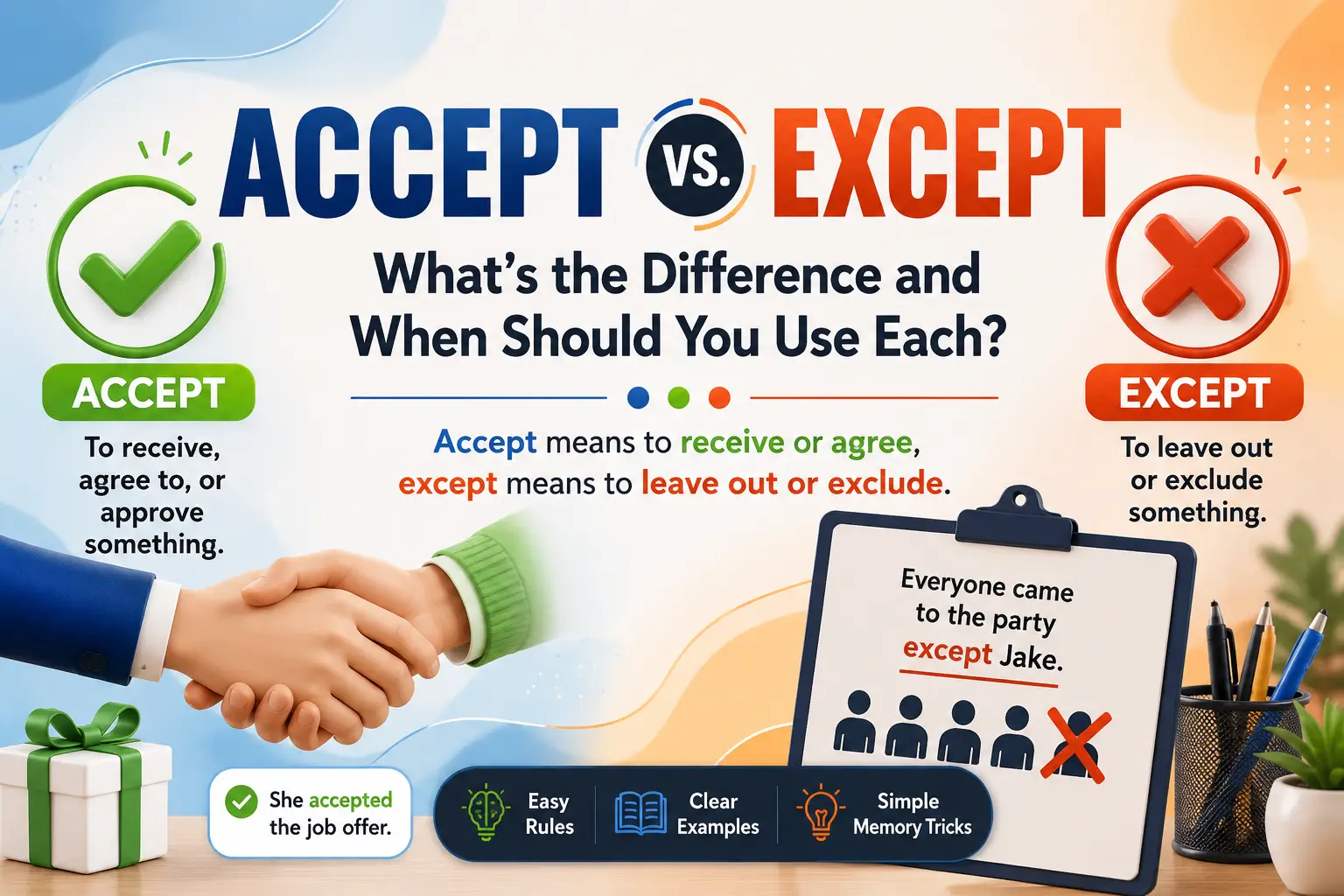
Accept vs. except is one of the most common grammar questions because these two words sound similar but have completely different meanings. If you’ve ever wondered whether you should write accept or except, you’re in the right place. The simple answer is that accept means to receive or agree, while except means to leave out or exclude. Learning this difference will help you avoid common writing mistakes and communicate more clearly in school, work, emails, and everyday conversations.
Although accept and except are often confused, remembering their meanings is easier than you might think. In this guide, you’ll learn the difference between accept and except, their definitions, grammar rules, parts of speech, American English usage, common mistakes, and practical examples. You’ll also discover simple memory tricks that make choosing the correct word much easier.
Quick Answer
Here’s the simplest way to remember accept vs. except:
| Word | Meaning | Part of Speech | Example |
| Accept | To receive, agree to, or approve something | Verb | She accepted the job offer. |
| Except | To leave out or exclude | Usually a preposition or conjunction | Everyone came except Jake. |
Simple memory trick:
- Accept = Receive
- Except = Exclude
If you’re talking about getting or agreeing to something, use accept.
If you’re talking about leaving something out, use except.
Why People Confuse Accept and Except
The confusion between accept and except isn’t surprising. They share several similarities.
First, they sound very similar in everyday American English. When people speak quickly, the difference can be difficult to hear.
Second, both words have almost the same spelling. Only one letter changes, making typing mistakes very common.
Finally, many English learners memorize pronunciation before meaning. As a result, they may choose the wrong word while writing.
Here’s a quick comparison.
| Similarity | Why It Causes Confusion |
| Similar pronunciation | Hard to distinguish when spoken |
| Nearly identical spelling | Easy typing error |
| Frequently used words | Writers often confuse them in everyday sentences |
| Common in school and work | Mistakes appear in essays, emails, and reports |
Fortunately, once you understand each word’s purpose, choosing the correct one becomes much easier.
What Does Accept Mean?
Accept is always a verb. It describes an action.
Definition of Accept
The word accept means to:
- Receive something willingly
- Agree to an offer or invitation
- Approve or believe something
- Take responsibility
- Recognize a fact or situation
Pronunciation
Accept
Pronounced as:
ak-SEPT
Part of Speech
- Verb
Unlike except, accept is not used as a preposition.
Common Ways “Accept” Is Used
The verb accept appears in many everyday situations.
Receiving Something
You accept something that is offered to you.
Examples:
- I accepted the scholarship.
- She accepted the package.
- They accepted the award.
Each sentence shows someone receiving something willingly.
Agreeing to Something
You can also accept an invitation, proposal, or request.
Examples:
- He accepted our invitation.
- The company accepted her application.
- They accepted the new contract.
In each case, someone agrees rather than refuses.
Believing or Admitting Something
Sometimes accept means recognizing that something is true.
Examples:
- She finally accepted the truth.
- He accepted that he had made a mistake.
- We must accept change.
This meaning often appears in conversations, self-improvement, and professional writing.
Taking Responsibility
People also use accept when discussing accountability.
Examples:
- The manager accepted responsibility for the mistake.
- She accepted the consequences of her decision.
- Good leaders accept criticism professionally.
Everyday Examples of Accept
Here are examples from daily American English.
At School
- I accepted the teacher’s advice.
- The university accepted my application.
At Work
- She accepted the promotion.
- Our client accepted the proposal.
In Emails
- Please accept my apology.
- I gladly accept your invitation.
On Social Media
- He accepted my friend request.
In Daily Conversation
- Thanks! I happily accept your help.
Common Expressions with Accept
You’ll often hear these phrases in American English.
| Expression | Meaning |
| Accept responsibility | Admit accountability |
| Accept an invitation | Agree to attend |
| Accept an offer | Agree to receive something |
| Accept payment | Receive money |
| Accept defeat | Admit that you lost |
| Accept advice | Listen to and follow guidance |
| Accept criticism | Receive feedback positively |
These expressions are common in both formal and informal communication.
Formal and Informal Usage of Accept
The word accept works well in every type of writing.
| Context | Example |
| Formal | We accept your proposal. |
| Business | The company accepted the contract. |
| Academic | Researchers accepted the findings. |
| Casual | I accepted his apology. |
| Conversation | Sure, I’ll accept that. |
Because it’s a standard English verb, you can confidently use it in nearly every situation.
Correct vs. Incorrect Examples with Accept
✅ Correct
- She accepted the gift.
Why?
Because she received the gift.
❌ Incorrect
- She excepted the gift.
Why?
Except means excluding, not receiving.
✅ Correct
- The bank accepts credit cards.
Why?
The bank receives credit cards as payment.
❌ Incorrect
- The bank excepts credit cards.
Why?
This changes the meaning completely and is grammatically incorrect.
Quick Tip
Whenever you can replace the word with receive, agree, or approve, the correct choice is almost always accept.
What Does Except Mean?
Unlike accept, except usually functions as a preposition or conjunction. Its main purpose is to show that something or someone is not included.
Definition of Except
The word except means:
- Leaving someone or something out
- Not including
- Other than
- With the exception of
It tells readers that one item does not belong to the rest of the group.
Pronunciation
Except
Pronounced as:
ik-SEPT
Although it sounds similar to accept, the meanings are completely different.
Parts of Speech
Most often, except is used as:
- Preposition
- Conjunction
It can also be used as a verb, although that use is uncommon in modern English and mostly appears in legal or formal writing.
Common Uses of Except
Excluding Someone or Something
This is the most common use.
Examples:
- Everyone arrived except Emma.
- All the stores were open except one.
- Everyone passed except me.
The excluded person or thing is clearly identified.
Showing an Exception
Sometimes except introduces the only exception.
Examples:
- Everything was perfect except the weather.
- The report is complete except for one page.
- Nothing changed except the date.
Connecting Clauses
As a conjunction, except joins ideas.
Examples:
- I’d go with you except I’m working today.
- He would help except he isn’t available.
This use is less common but still correct.
Everyday Examples of Except
At School
- Everyone submitted the assignment except Noah.
At Work
- All departments approved the plan except finance.
During Shopping
- Everything was on sale except electronics.
Family Conversations
- Everyone wanted pizza except Dad.
Text Messages
- I’m free every day except Friday.
Common Expressions with Except
| Expression | Meaning |
| Except for | Leaving one thing out |
| All except | Every item except one |
| Everyone except | Every person except one |
| Nothing except | Only one thing |
| Anywhere except | Every place but one |
These phrases are common in spoken and written American English.
Correct vs. Incorrect Examples with Except
✅ Correct
- Everyone came except Sarah.
Why?
Sarah is the only person who did not come.
❌ Incorrect
- Everyone came accept Sarah.
Why?
Accept means receive or agree, which makes no sense in this sentence.
✅ Correct
- The museum is open every day except Monday.
Why?
Monday is excluded from the schedule.
❌ Incorrect
- The museum is open every day accept Monday.
Why?
The sentence requires a word showing exclusion.
Quick Tip
If you can replace the word with excluding, other than, or apart from, the correct word is usually except.
Accept vs. Except: Side-by-Side Comparison
| Feature | Accept | Except |
| Meaning | Receive or agree | Leave out or exclude |
| Part of Speech | Verb | Preposition, conjunction, rarely verb |
| Action or Relationship | Action | Exclusion |
| Easy Memory Trick | Accept = Receive | Except = Exclude |
| Can Replace With | Receive, agree, approve | Excluding, other than |
| Example | I accepted the invitation. | Everyone came except John. |
| Common Contexts | School, work, business, daily life | Lists, exceptions, schedules, rules |
When Should You Use Accept?
The easiest way to choose accept is to ask yourself one question:
“Is someone receiving, agreeing to, approving, or admitting something?”
If the answer is yes, use accept.
Because accept is a verb, it always describes an action.
Accept for Receiving Something
One of the most common meanings of accept is to receive something willingly.
Examples:
- She accepted the award with a smile.
- The hospital accepts new patients.
- I accepted the birthday gift.
- The store accepts debit cards.
In each example, someone receives something voluntarily.
Accept for Agreement or Approval
You also use accept when someone agrees to an offer, invitation, proposal, or decision.
Examples:
- He accepted the job offer immediately.
- They accepted our invitation to dinner.
- The committee accepted the proposal.
- The customer accepted the new pricing.
This meaning appears frequently in business, education, and everyday conversations.
Accept for Responsibility or Facts
Sometimes people don’t receive an object. Instead, they accept a fact, mistake, or responsibility.
Examples:
- She accepted responsibility for the error.
- It’s important to accept constructive criticism.
- He finally accepted that he needed help.
- We must accept that change is part of life.
In these cases, accept means recognizing or admitting something as true.
Accept in Formal and Professional Writing
The word accept is common in professional communication.
Examples:
Business
- We are pleased to accept your proposal.
- The company accepted the revised contract.
Education
- The university accepted her application.
- Students must accept the school’s policies.
Customer Service
- We accept returns within 30 days.
- This location accepts cash and credit cards.
Because accept is neutral and standard, it works well in both formal and informal writing.
When Should You Use Except?
Use except whenever you want to exclude someone or something.
Ask yourself this question:
“Am I leaving someone or something out?”
If the answer is yes, the correct word is usually except.
Except to Exclude Someone or Something
This is by far the most common use.
Examples:
- Everyone passed the exam except Daniel.
- All the lights were off except one.
- Every restaurant was full except the café.
- Everyone enjoyed the movie except my brother.
The person or thing after except does not belong to the larger group.
Except After Words Like “All,” “Every,” and “Everyone”
You’ll often see except following words that refer to an entire group.
Common words include:
- All
- Every
- Everyone
- Everything
- Nobody
- Nothing
- Anywhere
Examples:
- All employees except the manager attended the meeting.
- Everyone except Lily completed the assignment.
- Everything except the printer worked perfectly.
- Nobody except Sam knew the answer.
This pattern is very common in American English.
Using “Except For” Correctly
The phrase except for also means excluding.
In many cases, except and except for have the same meaning.
Examples:
- The room was quiet except for the fan.
- Everything looked perfect except for one mistake.
- He enjoyed the trip except for the long drive.
Both forms are correct. However, except for often sounds a little smoother before noun phrases.
Except in Formal Writing
You’ll also see except in legal, academic, and professional documents.
Examples:
- Payment is required except where prohibited by law.
- Employees may park anywhere except designated visitor spaces.
- No refunds are available except under special circumstances.
Accept vs. Except in Real-Life Sentences
Understanding grammar becomes much easier when you see real situations.
At School
Accept
- The college accepted my application.
- I accepted my teacher’s advice.
Except
- Everyone finished the test except Alex.
- Every classroom was open except Room 204.
At Work
Accept
- Our client accepted the proposal.
- She accepted the promotion.
Except
- Every department approved the budget except accounting.
- Everyone attended the meeting except the director.
In Emails
Accept
- Please accept our sincere apology.
- I happily accept your invitation.
Except
- Everything looks correct except the attachment.
- Everyone replied except Tom.
In Text Messages
Accept
“I accept your challenge!”
Except
“I’m available every day except Saturday.”
In Everyday Conversation
Accept
- I accept your apology.
- We accepted their offer.
Except
- Everyone laughed except me.
- I like every flavor except mint.
Correct vs. Incorrect Examples
One of the fastest ways to master accept vs. except is by studying mistakes.
Mistake 1
❌ Everyone accept Jack went home.
✅ Everyone except Jack went home.
Why?
Jack is being excluded from the group.
Mistake 2
❌ She excepted the award.
✅ She accepted the award.
Why?
She received the award.
Mistake 3
❌ Our store excepts Visa cards.
✅ Our store accepts Visa cards.
Why?
The store receives Visa cards as payment.
Mistake 4
❌ Everything accept my keys is packed.
✅ Everything except my keys is packed.
Why?
The keys are excluded.
Mistake 5
❌ I cannot except your apology.
✅ I cannot accept your apology.
Why?
The sentence is about agreeing to receive an apology.
Why These Mistakes Happen
Most mistakes happen because:
- The words sound similar.
- Spell-check may not catch the error.
- Both words are common in everyday English.
- Writers focus on pronunciation instead of meaning.
The good news is that once you connect accept with receiving and except with excluding, the confusion usually disappears.
Easy Grammar Tips to Remember
Tip 1: Think About the Action
If someone does something, you probably need accept because it’s a verb.
Example
- She accepted the invitation.
Receiving the invitation is an action.
Tip 2: Think About Exclusion
If one person or thing is left out, use except.
Example
- Everyone except Jake arrived early.
Jake is excluded.
Tip 3: Replace the Word
Try replacing the word with another one.
If receive, agree, or approve fits, choose accept.
If excluding, other than, or apart from fits, choose except.
Examples
- I accepted the gift.
→ I received the gift. ✔ - Everyone except Emma came.
→ Everyone excluding Emma came. ✔
Grammar Notes and Usage Tips
Accept Is Always a Verb
Unlike many English words, accept has only one primary grammatical role.
Examples
- We accepted the invitation.
- They accepted the offer.
- She accepts responsibility.
It always describes an action.
Except Usually Functions as a Preposition
Most of the time, except introduces an exception.
Examples
- Everyone except Ben.
- All except one.
- Everywhere except downtown.
Can Except Be a Verb?
Yes—but it’s rare.
In legal or very formal English, except can mean to object or to take exception.
Example
- The attorney excepted to the judge’s ruling.
Most people will never use this meaning in everyday conversation.
Can Accept Be a Noun?
No.
Accept is a verb only.
If you need a noun, you’ll usually use words like:
- acceptance
- approval
- agreement
- admission
Formal vs. Informal Usage
| Situation | Accept | Except |
| Business emails | ✔ | ✔ |
| Academic writing | ✔ | ✔ |
| Daily conversation | ✔ | ✔ |
| Text messages | ✔ | ✔ |
| Legal documents | ✔ | ✔ (more common) |
Both words are appropriate in every level of English when used correctly.
American English Usage Tips
In American English, the meanings of accept and except are the same as in most other varieties of English.
However, you’ll commonly hear these expressions:
- accept an offer
- accept responsibility
- accept payment
- everyone except
- except for
- all except
These phrases appear regularly in schools, workplaces, businesses, and everyday conversations throughout the United States.
Easy Memory Tricks to Remember Accept vs. Except
Even experienced writers occasionally pause before choosing accept or except. Fortunately, a few simple memory tricks can help you remember the difference every time.
Memory Trick 1: Accept = Receive
Think of the first two letters in accept.
Ac can remind you of acquire or accepting something.
If you’re receiving, agreeing, approving, or admitting, choose accept.
Examples:
- I accepted the gift.
- She accepted the invitation.
- They accepted the proposal.
Memory Trick 2: Except = Exclude
Both except and exclude begin with ex-.
Whenever you’re leaving someone or something out, use except.
Examples:
- Everyone except Mia arrived early.
- All the stores were open except one.
Memory Trick 3: Ask Yourself One Question
Before writing, ask:
Am I receiving something or leaving something out?
If you’re receiving or agreeing, use accept.
If you’re excluding something, use except.
Memory Trick 4: Replace the Word
Another easy test is to substitute another word.
If receive, agree, or approve fits naturally, use accept.
If excluding, other than, or apart from fits, use except.
Examples
I accepted the invitation.
→ I received the invitation.
✔ Correct
Everyone except Alex came.
→ Everyone excluding Alex came.
✔ Correct
Synonyms of Accept
Although accept has several synonyms, each one works best in specific situations.
| Word | Best Used For |
| Receive | Getting something |
| Approve | Agreeing officially |
| Admit | Recognizing something as true |
| Agree | Saying yes |
| Welcome | Receiving warmly |
| Acknowledge | Recognizing a fact |
| Consent | Giving permission |
Example
- The company accepted the proposal.
- The company approved the proposal.
Both are correct, but approved emphasizes official permission.
Synonyms of Except
The meaning of except often overlaps with several other words and phrases.
| Word or Phrase | Meaning |
| Excluding | Leaving out |
| Other than | Not including |
| Apart from | With one exception |
| Save (formal) | Except |
| But | Except (in some contexts) |
Examples
- Everyone except Lisa attended.
- Everyone apart from Lisa attended.
Both sentences have the same meaning.
Related Words People Often Confuse
Several English words look or sound similar to accept or except.
Knowing the difference helps prevent additional mistakes.
Accept vs. Expect
These words are often mixed up because they have similar spelling.
| Accept | Expect |
| Receive or agree | Think something will happen |
Examples
- I accepted the invitation.
- I expected the invitation yesterday.
Except vs. Besides
Although both can refer to exceptions, they don’t always mean the same thing.
Except excludes.
Besides adds extra information.
Examples
- Everyone came except Noah.
- Besides Noah, Emma also attended.
Except vs. Apart From
These expressions are often interchangeable.
Examples
- Everything was perfect except the weather.
- Everything was perfect apart from the weather.
Both are correct in everyday English.
Accept vs. Receive
These words are closely related but not identical.
You can receive something without choosing it.
However, accept usually involves willingness or agreement.
Examples
- I received the package yesterday.
- I accepted the package today.
The first sentence simply means the package arrived.
The second means the speaker agreed to take it.
Common Mistakes Native and ESL Learners Make
Even native English speakers sometimes confuse these words because they sound alike.
Here are the most common mistakes.
Using Accept Instead of Except
❌ Everyone accept John passed.
✅ Everyone except John passed.
Using Except Instead of Accept
❌ She excepted my apology.
✅ She accepted my apology.
Confusing Accept with Expect
❌ I accept the package tomorrow.
✅ I expect the package tomorrow.
Misusing Except For
Sometimes writers add unnecessary words.
Less natural:
- Everyone came except for Jack.
More natural:
- Everyone came except Jack.
Both are correct, but except is usually shorter and smoother.
Practice Quiz: Can You Choose the Correct Word?
Test your understanding before moving on.
Choose accept or except.
Questions
- Everyone arrived ______ Olivia.
- She happily ______ the scholarship.
- The restaurant accepts all major credit cards ______ American Express.
- Please ______ my sincere apologies.
- Everything looked perfect ______ one small mistake.
- He refused to ______ responsibility.
- All the stores were open ______ one.
- Our school ______ online applications.
- Nobody ______ Ben knew the answer.
- We gladly ______ your invitation.
Answer Key
- except
- accepted
- except
- accept
- except
- accept
- except
- accepts
- except
- accept
If you answered most of these correctly, you’ve already mastered the basic difference.
Quick Recap
Here’s everything you need to remember.
| Accept | Except |
| Verb | Usually a preposition or conjunction |
| Means receive or agree | Means exclude or leave out |
| Describes an action | Shows an exception |
| Can replace “receive” | Can replace “excluding” |
The Golden Rule
- Accept = Receive or Agree
- Except = Exclude
If you remember only one thing from this guide, remember that rule.
Conclusion
Understanding accept vs. except doesn’t have to be difficult. Although the two words have similar pronunciation and spelling, they serve completely different purposes. Accept is a verb that means to receive, agree, approve, or admit something. Except, on the other hand, is usually a preposition or conjunction that means to exclude or leave someone or something out.
Whenever you’re unsure which word to use, think about the meaning of your sentence. If you’re talking about receiving or agreeing, choose accept. If you’re talking about excluding something, choose except. With regular practice and the examples in this guide, you’ll use both words confidently and write clearer, more accurate American English.
Frequently Asked Questions
Q1. What is the difference between accept and except?
Accept means to receive, agree to, approve, or admit something. Except means to exclude or leave someone or something out. Although they sound similar, their meanings are completely different.
Q2. Is accept a verb or a noun?
Accept is a verb. It describes an action, such as receiving an invitation or agreeing to an offer. The related noun is acceptance.
Q3. Is except always a preposition?
No. Except is most commonly used as a preposition, but it can also function as a conjunction. In rare legal contexts, it may also be used as a verb.
Q4. How do I remember the difference between accept and except?
A simple memory trick is:
- Accept = Receive
- Except = Exclude
Because except and exclude both begin with ex-, they are easy to connect.
Q5. Can accept and except be used interchangeably?
No. These words have different meanings and grammar functions. Using one in place of the other changes the meaning of the sentence.
Q6. Why do people confuse accept and except?
People often confuse them because they have similar pronunciation and nearly identical spelling. However, their meanings are completely different.
Q7. How is accept used in a sentence?
Here are a few examples:
- I accepted the job offer.
- She accepted my apology.
- The school accepts online applications.
Q8. How is except used in a sentence?
Examples include:
- Everyone except Liam arrived on time.
- Everything was ready except the decorations.
- I’m available every day except Sunday.
Q9. What part of speech is except?
Except is usually a preposition or conjunction. Its role depends on how it is used in the sentence.
Q10. Is accept vs. except a common grammar mistake?
Yes. It is one of the most commonly confused word pairs in English because both words sound alike but have different meanings, spellings, and grammatical functions.