
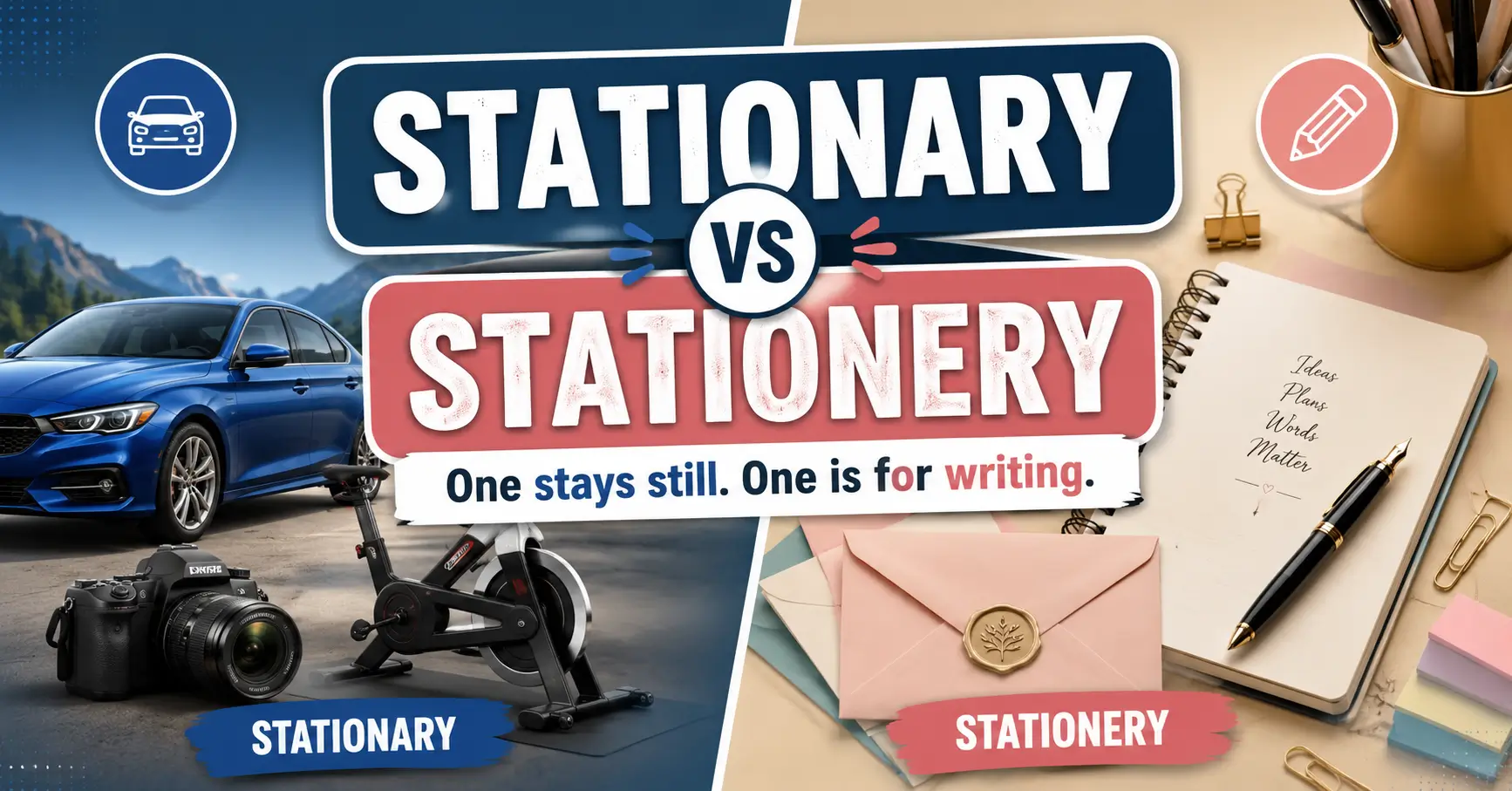
Stationary vs stationery is one of the most commonly confused word pairs in English grammar. Although both words sound the same, they have different meanings, spellings, and uses. Knowing the difference helps you avoid common writing mistakes in emails, school assignments, business documents, and everyday communication. If you’re unsure whether to write stationary or stationery, this guide gives you a clear answer with simple explanations, practical examples, memory tricks, and grammar tips so you can use each word correctly with confidence.
Many people mix up these words because they are homophones, meaning they have the same pronunciation but different spellings and meanings. Stationary is an adjective that describes something that is not moving, while stationery is a noun that refers to writing materials, such as paper, envelopes, and office supplies.
By the end of this guide, you’ll understand the correct word usage, recognize common mistakes, and remember the difference with easy techniques that work in both American English and British English.
Quick Answer
The difference between stationary and stationery is simple:
- Stationary is an adjective that means not moving or remaining in one place.
- Stationery is a noun that refers to writing paper, envelopes, notebooks, cards, and other office or school writing supplies.
Quick Examples
✅ The bus remained stationary during the traffic jam.
✅ I bought beautiful stationery for writing thank-you letters.
Although the words sound the same, they are never interchangeable because they serve different grammatical purposes.
Why People Confuse Stationary and Stationery
These two words are among the most commonly confused words in English. There are several reasons why people mix them up.
They Sound Exactly the Same
Both words are pronounced:
/ˈsteɪʃəˌneri/
Since they are homophones, pronunciation doesn’t help you choose the correct spelling.
Only One Letter Is Different
Compare the spellings:
- Stationary
- Stationery
The only difference is the second-to-last vowel:
- A in stationary
- E in stationery
Because they’re almost identical, it’s easy to type the wrong one.
Spell Check Doesn’t Always Catch the Error
Many writing programs recognize both words because both are correctly spelled English words.
For example:
❌ We ordered company stationary.
The spelling is correct, but the meaning is wrong. Since stationary is a real word, many spell checkers won’t flag it.
That’s why understanding the meaning is more important than relying on software.
What Does Stationary Mean?
Stationary is an adjective.
It describes something that is not moving, not changing position, or remaining still.
Definition
Stationary means:
- staying in one place
- motionless
- fixed
- not moving
It often describes people, vehicles, machines, or objects.
Pronunciation
Stationary
Pronounced:
STAY-shuh-nair-ee
Part of Speech
Adjective
Since it’s an adjective, it describes a noun.
Examples
- The train remained stationary for twenty minutes.
- Please keep the camera stationary while recording.
- The boat stayed stationary despite the wind.
- The patient remained stationary during the examination.
- Traffic became stationary after the accident.
Notice that each example describes something that does not move.
Common Collocations with Stationary
Certain words naturally appear with stationary.
| Common Phrase | Meaning |
| stationary vehicle | a vehicle that isn’t moving |
| stationary bike | an exercise bike that stays in one place |
| stationary object | an object that does not move |
| remain stationary | stay still |
| stationary position | fixed location |
| stationary equipment | equipment that doesn’t move |
These combinations are common in news reports, workplaces, transportation, healthcare, sports, and everyday conversation.
What Does Stationery Mean?
Unlike stationary, stationery is a noun.
It refers to materials used for writing, printing, mailing, or office work.
Definition
Stationery includes:
- writing paper
- envelopes
- notebooks
- greeting cards
- business letterheads
- memo pads
- writing sets
- invitation cards
Many people also use the word to describe decorative writing supplies.
Pronunciation
Stationery
Pronounced:
STAY-shuh-nair-ee
The pronunciation is exactly the same as stationary.
Part of Speech
Noun
It names a thing instead of describing one.
Examples
- She bought new stationery for school.
- Our office ordered custom stationery with the company logo.
- They printed wedding invitations on premium stationery.
- The gift included luxury stationery and matching envelopes.
- Every employee received branded stationery.
Common Collocations with Stationery
These combinations are frequently used in American English.
| Common Phrase | Meaning |
| office stationery | office writing supplies |
| personalized stationery | customized writing paper |
| business stationery | company letterheads and envelopes |
| wedding stationery | invitations and cards |
| luxury stationery | premium paper products |
| stationery set | matching writing supplies |
| school stationery | classroom writing materials |
These expressions appear in schools, businesses, online stores, and professional communication.
Stationary vs Stationery: Side-by-Side Comparison
| Feature | Stationary | Stationery |
| Part of Speech | Adjective | Noun |
| Meaning | Not moving | Writing materials |
| Used For | People, vehicles, objects | Paper, envelopes, notebooks |
| Pronunciation | Same | Same |
| Common Context | Transportation, sports, science | Office, school, business |
| Example | The truck remained stationary. | She bought beautiful stationery. |
This simple comparison makes it easier to remember which word belongs in different situations.
Key Differences Between Stationary and Stationery
Although only one letter separates these words, their meanings are completely different.
| Stationary | Stationery |
| Describes something | Names a thing |
| Means “not moving” | Means writing materials |
| Adjective | Noun |
| Used with vehicles, people, objects | Used with paper and office supplies |
| Cannot be touched as an item | Refers to physical products |
Think of it this way:
If something stays still, it’s stationary.
If you write on it, it’s stationery.
That one idea will help you avoid one of the most common spelling mistakes in English.
When Should You Use Stationary?
Use stationary when you’re describing something that isn’t moving or remains in one place. Because it’s an adjective, it always describes a noun.
You’ll often see stationary in conversations about transportation, sports, medicine, engineering, weather, and everyday life.
Use Stationary When Something Is:
- Standing still
- Not changing position
- Temporarily stopped
- Fixed in one location
Everyday Examples
- The police car remained stationary outside the building.
- Please keep your head stationary during the eye exam.
- The elevator was stationary because of a power outage.
- Our boat stayed stationary near the dock.
- The drone hovered almost stationary in the air.
In each sentence, stationary describes the condition of the noun. Nothing is moving.
Examples at School
Students often see this word in science and math.
Correct Examples
- The object remained stationary throughout the experiment.
- Draw the line while keeping the ruler stationary.
- The globe stayed stationary on the desk.
Examples at Work
Professionals commonly use stationary in reports and meetings.
Correct Examples
- Production stopped while the machinery remained stationary.
- The delivery truck stayed stationary for fifteen minutes.
- Keep the scanner stationary while it calibrates.
Examples in Everyday Conversation
- The dog stood stationary until its owner returned.
- My car was stationary at the red light.
- The camera should remain stationary for clearer photos.
Examples in News and Media
Journalists often use stationary to describe traffic or movement.
Examples include:
- Traffic remained stationary for several miles.
- The rescue helicopter hovered almost stationary above the accident scene.
- Emergency vehicles stayed stationary while crews cleared the road.
When Should You Use Stationery?
Use stationery whenever you’re talking about writing materials or paper products.
Unlike stationary, stationery is always a noun. It names things you can buy, use, or give as gifts.
Stationery Can Include:
- Writing paper
- Envelopes
- Letterheads
- Notebooks
- Greeting cards
- Invitation cards
- Memo pads
- Writing sets
- Journals
- Thank-you cards
Many businesses also include branded folders and business cards as part of their company stationery.
Examples at School
Students regularly buy stationery before the school year begins.
Examples:
- I bought new stationery before classes started.
- My backpack is full of colorful stationery.
- Teachers asked everyone to bring basic stationery.
Examples at Work
Businesses rely on professional stationery for branding.
Examples:
- We ordered new company stationery with our updated logo.
- The lawyer printed the contract on official stationery.
- Every employee received branded stationery.
Examples at Home
Many people enjoy using attractive stationery for personal writing.
Examples:
- She collects vintage stationery.
- My grandmother still writes letters using floral stationery.
- They mailed the invitations on elegant stationery.
Examples for Special Occasions
Stationery is common for celebrations and events.
Examples:
- The couple chose gold wedding stationery.
- Birthday invitations were printed on custom stationery.
- Holiday cards came with matching stationery.
Common Collocations with Stationary
Some words naturally appear with stationary.
| Phrase | Meaning |
| stationary vehicle | A vehicle that isn’t moving |
| stationary bike | An exercise bike that stays in one place |
| stationary camera | A camera kept still |
| stationary position | A fixed location |
| remain stationary | Stay still |
| stationary object | An object that does not move |
| stationary equipment | Equipment installed in one place |
Example Sentences
- The cyclist trained on a stationary bike.
- Keep the microscope stationary while adjusting the lens.
- The truck remained stationary during the inspection.
Common Collocations with Stationery
You’ll often hear these combinations in schools, offices, and stores.
| Phrase | Meaning |
| office stationery | Office writing supplies |
| business stationery | Company paper products |
| personalized stationery | Customized writing paper |
| school stationery | Student writing supplies |
| wedding stationery | Invitations and cards |
| premium stationery | High-quality writing materials |
| stationery set | Matching paper and envelopes |
Example Sentences
- Our office ordered new business stationery.
- She received a beautiful stationery set as a birthday gift.
- The bride selected elegant wedding stationery.
Real-Life Examples of Stationary
Understanding the word becomes easier when you see it in everyday situations.
Driving
“The traffic was stationary because of road construction.”
Here, cars weren’t moving.
Healthcare
“The patient remained stationary during the X-ray.”
The patient needed to stay still.
Fitness
“I exercise on a stationary bike every morning.”
The bike doesn’t move from place to place.
Photography
“Keep the camera stationary for a sharp image.”
Movement can blur the picture.
Sports
“The goalkeeper stayed almost stationary while waiting for the penalty kick.”
The player didn’t move.
Real-Life Examples of Stationery
Office
“We ordered new stationery with the company logo.”
This includes letterheads, envelopes, and business cards.
School
“My teacher asked everyone to bring basic stationery.”
Items might include notebooks, pencils, paper, and folders.
Weddings
“The designer created matching wedding stationery.”
This often includes invitations, RSVP cards, menus, and thank-you cards.
Business
“Our clients received welcome packages with branded stationery.”
Many companies use custom stationery to create a professional image.
Personal Use
“I enjoy writing handwritten letters on decorative stationery.”
Many people still use quality stationery for thank-you notes and special occasions.
Practical Grammar Tips
These quick tips can help you choose the correct word every time.
Ask Yourself One Question
Is it describing something?
If yes, use stationary.
The truck is stationary.
Is it naming writing supplies?
If yes, use stationery.
I bought new stationery.
Look at the Part of Speech
| Word | Part of Speech |
| Stationary | Adjective |
| Stationery | Noun |
If you remember this grammar rule, you’ll rarely confuse the two words.
Quick Usage Guide
Choose stationary if you’re talking about:
- A car
- A train
- A bicycle
- A machine
- A person
- An object
- Anything that isn’t moving
Choose stationery if you’re talking about:
- Paper
- Envelopes
- Notebooks
- Greeting cards
- Letterheads
- Invitations
- Office supplies
This simple rule works in almost every situation.
Grammar Tip: If the word describes movement (or the lack of it), use stationary. If it refers to writing materials or office paper products, use stationery.
Common Mistakes with Stationary and Stationery
Even native English speakers confuse stationary and stationery. Since both words sound the same, it’s easy to choose the wrong spelling, especially when typing quickly.
The good news is that the mistake is easy to avoid once you understand each word’s meaning and part of speech.
Mistake 1: Using Stationary for Office Supplies
❌ Incorrect: I bought new stationary for school.
✅ Correct: I bought new stationery for school.
Why?
The sentence refers to notebooks, paper, and other writing materials. Those items are stationery, not stationary.
Mistake 2: Using Stationery to Describe Something That Isn’t Moving
❌ Incorrect: The truck remained stationery.
✅ Correct: The truck remained stationary.
Why?
The truck isn’t moving. Therefore, you need the adjective stationary.
Mistake 3: Confusing the Parts of Speech
Many writers forget that these words belong to different parts of speech.
| Word | Part of Speech | Purpose |
| Stationary | Adjective | Describes something |
| Stationery | Noun | Names writing materials |
Whenever you aren’t sure, ask yourself whether you’re describing something or naming an item.
Correct vs. Incorrect Examples
The following examples show common mistakes and the correct versions.
| ❌ Incorrect | ✅ Correct | Explanation |
| We ordered company stationary. | We ordered company stationery. | Business paper products are stationery. |
| My bike stayed stationery. | My bike stayed stationary. | The bike wasn’t moving. |
| She loves collecting stationary. | She loves collecting stationery. | She collects writing supplies. |
| The airplane remained stationery. | The airplane remained stationary. | The airplane stayed still. |
| I need new office stationary. | I need new office stationery. | Office supplies are stationery. |
| The camera must stay stationery. | The camera must stay stationary. | It describes the camera’s position. |
These examples highlight how a single letter changes the entire meaning of the sentence.
Grammar Tips for Choosing the Right Word
A few simple grammar rules can help you remember the difference every time you write.
Remember the Part of Speech
- Stationary = Adjective
- Stationery = Noun
If the word describes something, choose stationary.
If it names writing materials, choose stationery.
Look at the Sentence
Ask yourself these questions:
Is something staying still?
If yes, use stationary.
The elevator remained stationary.
Am I talking about paper or office supplies?
If yes, use stationery.
She purchased personalized stationery.
Replace the Word
A helpful trick is to replace the word with another one.
If still, motionless, or fixed makes sense, use stationary.
The vehicle remained motionless.
Therefore:
The vehicle remained stationary.
If paper, writing supplies, or office supplies fits, use stationery.
I bought new writing supplies.
Therefore:
I bought new stationery.
Easy Memory Tricks
Memory tricks make these words much easier to remember.
Memory Trick 1: E for Envelope
The word stationery contains the letter E.
Envelope also contains E.
Since envelopes are stationery, you’ll know which spelling to choose.
Stationery → Envelope
Memory Trick 2: A Means At Rest
The word stationary contains A.
Think of:
At Rest
If something is at rest, it is stationary.
Memory Trick 3: Think About Movement
Ask yourself one simple question:
Can it move?
If the answer is no, it’s probably stationary.
If you’re writing on it, it’s stationery.
Memory Trick 4: Office Supplies
Whenever you think of:
- notebooks
- paper
- envelopes
- letterheads
Your brain should automatically choose stationery.
American vs. British English
One question many learners ask is whether American English and British English spell these words differently.
The answer is simple.
There Is No Difference
Both varieties of English use exactly the same spellings.
| American English | British English |
| stationary | stationary |
| stationery | stationery |
The meanings are also identical.
For example:
American English
Our office ordered new stationery.
British English
Our office ordered new stationery.
Both sentences are correct.
Unlike words such as color/colour or center/centre, these spellings do not change between regions.
Synonyms of Stationary
Depending on the context, these words have similar meanings.
| Synonym | Best Used For |
| Still | Everyday conversation |
| Motionless | Formal writing |
| Immobile | Medical or technical writing |
| Fixed | Engineering or construction |
| Unmoving | General English |
| Stable | Scientific contexts |
Examples
- The horse remained still.
- The machine stayed fixed.
- The patient remained motionless.
These words can sometimes replace stationary, depending on the sentence.
Related Words for Stationery
Although stationery has few direct synonyms, several related terms describe the same category of items.
| Related Word | Meaning |
| Writing paper | Paper for letters |
| Office supplies | General office materials |
| Letterhead | Company paper |
| Notepad | Writing pad |
| Notebook | Bound writing pages |
| Greeting cards | Printed cards |
| Envelopes | Mailing paper |
| Writing set | Matching stationery collection |
These aren’t exact synonyms, but they belong to the same group of products.
Practice Quiz
Test your understanding before moving on.
Choose the correct word.
Question 1
The train remained __________ for ten minutes.
A. stationary
B. stationery
Answer: A. stationary
Question 2
She bought beautiful wedding __________.
A. stationary
B. stationery
Answer: B. stationery
Question 3
Please keep the camera __________ while recording.
A. stationary
B. stationery
Answer: A. stationary
Question 4
Our office ordered new company __________.
A. stationary
B. stationery
Answer: B. stationery
Question 5
The cyclist exercises on a __________ bike.
A. stationary
B. stationery
Answer: A. stationary
Quick Review
Before you continue, remember these simple rules:
| If You’re Talking About… | Use |
| Something that isn’t moving | Stationary |
| Paper or writing supplies | Stationery |
| An adjective | Stationary |
| A noun | Stationery |
| A vehicle | Stationary |
| Letterheads or envelopes | Stationery |
Quick Tip: If you can write on it, it’s stationery. If it won’t move, it’s stationary.
Conclusion
Understanding stationary vs stationery becomes much easier once you remember that the two words have different meanings and different jobs in a sentence. Stationary is an adjective used to describe something that is not moving, while stationery is a noun that refers to writing materials, including paper, envelopes, notebooks, and office supplies.
Since these words are homophones, they often cause spelling mistakes. However, using a simple memory trick—E for Envelope and A for At Rest—can help you choose the correct spelling every time. Paying attention to the sentence context, part of speech, and intended meaning will also improve your grammar and writing accuracy.
Whether you’re writing an email, preparing business correspondence, completing schoolwork, or shopping for office supplies, using the correct word makes your writing clearer and more professional. With regular practice, you’ll quickly stop confusing stationary and stationery and use both words with confidence.
Frequently Asked Questions
Q1. What is the difference between stationary and stationery?
Stationary means not moving and is an adjective. Stationery refers to writing materials such as paper, envelopes, notebooks, and letterheads, and it is a noun.
Q2. Is it stationary or stationery for office supplies?
The correct word is stationery because office supplies include writing materials like paper, envelopes, and notebooks.
Q3. Is a stationary bike spelled with an “A” or an “E”?
It is spelled stationary with an A because the bike stays in one place and does not move.
Q4. Why do people confuse stationary and stationery?
People confuse them because they are homophones. They sound the same but have different spellings, meanings, and grammatical functions.
Q5. Is stationery a noun or an adjective?
Stationery is a noun because it names writing materials and office paper products.
Q6. Is stationary a noun?
No. Stationary is an adjective that describes something remaining still or not moving.
Q7. How can I remember the difference between stationary and stationery?
A simple trick is to remember that stationery contains the letter E, just like Envelope. Stationary contains A, which you can associate with At Rest.
Q8. Is there a difference between American and British English?
No. Both American English and British English use the same spellings and meanings for stationary and stationery.
Q9. What are some examples of stationery?
Examples include writing paper, notebooks, envelopes, greeting cards, letterheads, journals, invitation cards, and other office writing supplies.
Q10. Does spell check always catch the mistake between stationary and stationery?
No. Since both are correctly spelled English words, many spell-check tools do not recognize when the wrong word is used in the wrong context.