
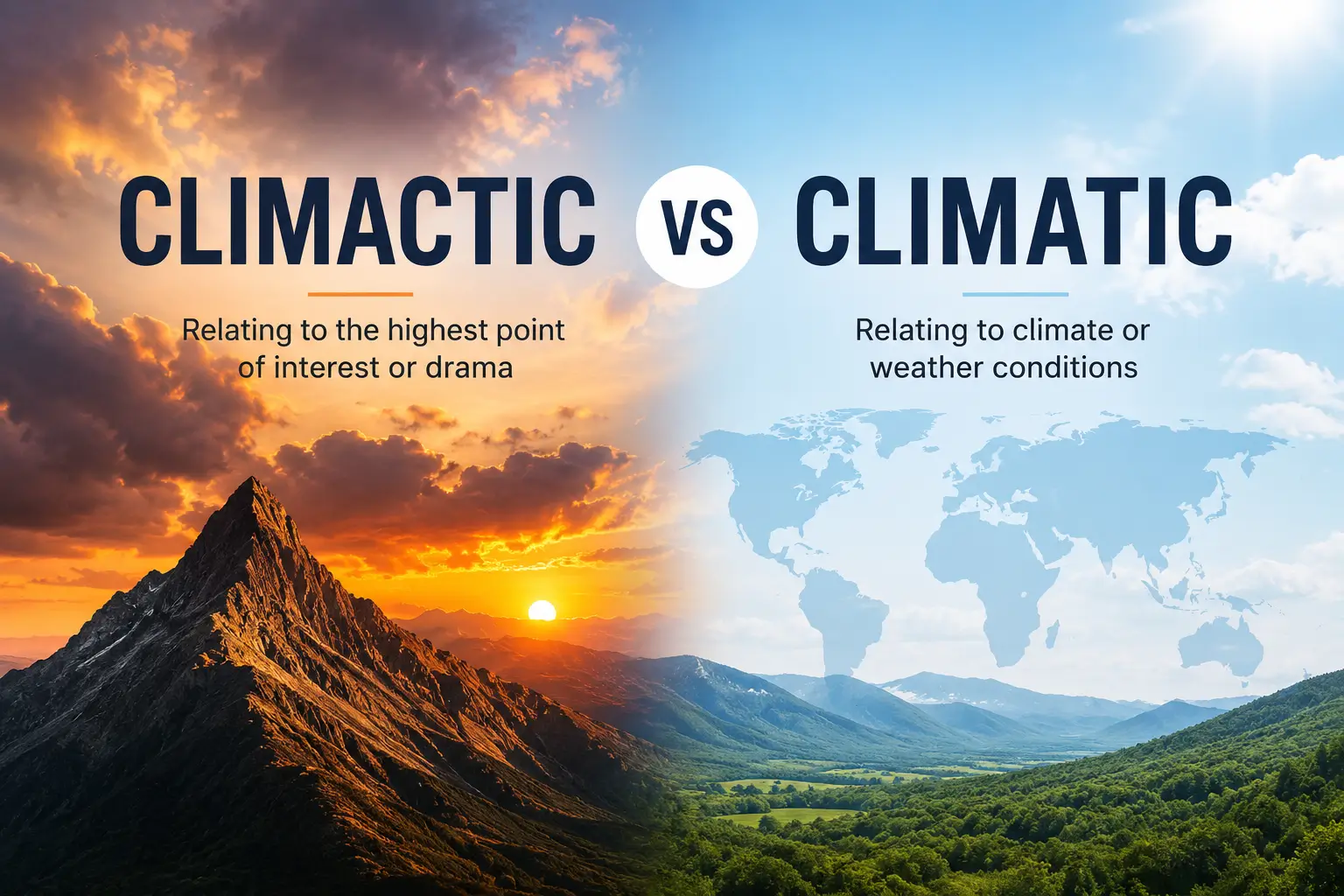
The key difference in climactic vs climatic is simple: climactic refers to a climax, while climatic clearly describes climate and climate patterns. Each is an adjective, and dictionaries may mark it as adj. These two adjectives sound similar and are easy to confuse, yet their meaning is completely different.
Use climactic for a final, decisive, or highest point in a series of events. A film may have a climactic ending, while a speech or trial may reach its most important point. Because the word comes from climax, it suits stories, sports, and other events that build toward a culmination or resolution.
Use climatic for weather conditions, climate change, a climatic system, or environmental conditions in a particular place. Earth scientists may study tree growth, temperature, atmospheric forces, and climatic events. To choose correctly, compare the root words: climax leads to climactic, while climate leads to climatic. This one-letter difference helps protect the meaning of every sentence.
Quick Answer: Climactic or Climatic?
Use climactic when you’re talking about the most important, exciting, intense, or decisive point of something.
The championship game ended with a climactic final play.
Use climatic when something relates to climate, environmental conditions, or long-term weather patterns.
The state’s climatic conditions support several types of agriculture.
Here’s the simplest way to remember the difference:
- Climax → climactic
- Climate → climatic
Although only one letter separates these words, they aren’t spelling variants. Choosing the wrong one changes the meaning of your sentence.
What Is the Difference Between Climactic and Climatic?
Both words are adjectives, which means they modify nouns. However, they come from different root words.
Climactic comes from climax. It describes something connected to a climax or turning point.
Climatic comes from climate. It describes something connected to long-term atmospheric or environmental conditions.
| Word | Meaning | Root word | Part of speech | Common examples |
| Climactic | Related to a climax or high point | Climax | Adjective | Climactic scene, battle, ending, moment |
| Climatic | Related to climate | Climate | Adjective | Climatic conditions, patterns, zones, changes |
Consider these two sentences:
The film’s climactic scene takes place during a hurricane.
The island’s climatic conditions make hurricanes more likely.
The first sentence describes the movie’s most important scene. The second discusses climate-related conditions.
What Does Climactic Mean?
Climactic means relating to a climax, especially the most important, exciting, dramatic, or intense point in a sequence of events.
It often appears in discussions about:
- Movies
- Books
- Television shows
- Sports
- Political campaigns
- Courtroom cases
- Historical events
- Personal conflicts
A climax is usually the point where tension reaches its highest level. Therefore, a climactic event often determines what happens next.
Climactic as an Adjective
Because climactic is an adjective, it normally appears before a noun or after a linking verb.
Before a noun:
The story builds toward a climactic confrontation.
After a linking verb:
The final scene felt climactic.
In both examples, the word describes something related to the story’s high point.
Common Climactic Phrases
You’ll often see climactic used with these nouns:
- Climactic battle
- Climactic scene
- Climactic ending
- Climactic moment
- Climactic event
- Climactic confrontation
- Climactic sequence
- Climactic finish
- Climactic showdown
- Climactic point
Each phrase suggests that the event is central to the outcome.
Climactic Examples in Sentences
The detective revealed the killer’s identity during the climactic scene.
The scene is climactic because it resolves the story’s central mystery.
The teams exchanged three touchdowns in a climactic fourth quarter.
The fourth quarter represents the game’s most intense and decisive stage.
Months of negotiation led to a climactic meeting between the two companies.
The meeting is the high point of a longer process.
The novel ends with a climactic confrontation between the hero and the villain.
The confrontation is where the story’s main conflict reaches its peak.
The trial reached a climactic moment when the witness produced new evidence.
The evidence creates a major turning point in the case.
What Does Climatic Mean?
Climatic means relating to climate. Climate refers to the typical weather patterns of a place over a long period.
These patterns may include:
- Average temperature
- Seasonal rainfall
- Humidity
- Wind patterns
- Snowfall
- Drought frequency
- Length of growing seasons
- Long-term atmospheric trends
Therefore, climatic is common in scientific, environmental, agricultural, and geographic writing.
Climatic as an Adjective
Like climactic, the word climatic is an adjective.
Before a noun:
Farmers must adapt to changing climatic conditions.
After a linking verb:
The differences between the two regions are largely climatic.
The word describes conditions connected to climate rather than a dramatic high point.
Common Climatic Phrases
You’ll often find climatic in these expressions:
- Climatic conditions
- Climatic changes
- Climatic patterns
- Climatic factors
- Climatic regions
- Climatic zones
- Climatic differences
- Climatic variation
- Climatic influences
- Climatic data
These phrases frequently appear in research, geography lessons, weather reports, and environmental discussions.
Climatic Examples in Sentences
The crop grows best under warm and humid climatic conditions.
The sentence describes climate-related growing conditions.
Scientists studied the area’s long-term climatic patterns.
The study concerns weather trends over an extended period.
Coastal and inland communities face different climatic challenges.
The challenges result from differences in climate.
Several animal species migrated because of changing climatic conditions.
The conditions involve long-term environmental changes.
The mountain range creates major climatic differences between the two valleys.
The mountains affect rainfall, temperature, and other climate features.
Climactic vs. Climatic Comparison Table
The following table summarizes the main differences.
| Feature | Climactic | Climatic |
| Basic meaning | Related to a climax | Related to climate |
| Root word | Climax | Climate |
| Part of speech | Adjective | Adjective |
| Main idea | High point or decisive moment | Long-term weather conditions |
| Common fields | Entertainment, sports, literature, history | Science, geography, agriculture, environment |
| Example phrase | Climactic ending | Climatic conditions |
| Simple substitute | Decisive, peak, culminating | Climate-related, environmental |
| Memory clue | Contains the sound of “act” | Looks closer to “climate” |
How to Pronounce Climactic and Climatic
The pronunciation difference is small but important.
Pronunciation of Climactic
Climactic is pronounced:
kly-MAK-tik
The middle of the word includes a clear “ak” sound.
You can break it into parts:
cli-MAC-tic
The stress falls on the second syllable.
Pronunciation of Climatic
Climatic is pronounced:
kly-MAT-ik
You can break it into parts:
cli-MAT-ic
Again, the stress usually falls on the second syllable.
Quick Pronunciation Comparison
- Climactic: kly-MAK-tik
- Climatic: kly-MAT-ik
The extra c in climactic creates an additional k sound before the final syllable.
Why Are Climactic and Climatic Commonly Confused?
These words cause problems for several reasons.
Their Spellings Are Nearly Identical
Compare them carefully:
- Climactic
- Climatic
Climactic has an extra c before the final t. That small difference is easy to miss, especially when typing quickly.
They Sound Similar
In fast conversation, the pronunciation difference may not be obvious. As a result, writers sometimes spell the word based on what they think they heard.
Both Are Adjectives
Because both words can appear before nouns, they fit the same grammatical position.
For example:
- A climactic event
- A climatic event
Both phrases are grammatically possible. However, they mean different things.
A climactic event is a decisive or highly important event.
A climatic event is an event related to climate.
Spell-Check May Not Catch the Error
Both spellings are real English words. Therefore, a spelling checker may accept the wrong word even when it doesn’t fit the sentence.
You must check the meaning, not only the spelling.
The Key Differences Between Climactic and Climatic
The most important difference involves the idea behind each word.
Climactic Describes a High Point
A climactic moment usually comes after a buildup. Tension increases, events develop, and then something decisive happens.
For example:
The candidate’s climactic speech ended the campaign.
The speech represents the final or most important stage of the campaign.
Climatic Describes Climate
Climatic information concerns long-term patterns rather than one isolated weather event.
For example:
The report examines climatic trends across the Midwest.
The report studies climate patterns over time.
Climactic Often Involves a Sequence
Something is normally climactic because it represents the peak of earlier events.
A random exciting moment isn’t always climactic. It needs to function as a climax or turning point.
Climatic Often Involves a Place or Period
Climatic descriptions frequently apply to a region, season, ecosystem, or historical period.
For instance:
- Climatic conditions in Arizona
- Climatic shifts during the Ice Age
- Climatic differences between coastal and inland areas
Climactic Doesn’t Simply Mean Dramatic
People sometimes use climactic as a general synonym for dramatic. However, the words aren’t identical.
A scene can be dramatic without being climactic.
A character may receive upsetting news in the opening scene.
That scene could be dramatic. However, it probably isn’t climactic because it doesn’t represent the story’s climax.
Likewise, a climactic scene is usually dramatic, but its defining feature is its position and purpose. It marks the story’s high point.
Compare:
The argument was dramatic, but it happened early in the movie.
The final argument was climactic because it resolved the main conflict.
Use dramatic for something emotional, exciting, or striking. Use climactic for the point where tension or action reaches its peak.
Climatic Doesn’t Mean Today’s Weather
Climate and weather are related, but they aren’t the same.
Weather describes short-term atmospheric conditions. It may change from hour to hour or day to day.
Climate describes typical weather patterns over a long period.
Therefore, not every weather-related statement needs the word climatic.
Heavy rain delayed today’s game.
This describes weather.
The region’s wet climate supports dense forests.
This describes climate.
You could also write:
The region’s climatic conditions support dense forests.
However, the following sentence sounds inaccurate:
Today’s climatic conditions include a brief afternoon shower.
Because the sentence concerns one day, weather conditions would usually be clearer.
Correct and Incorrect Examples
Examining mistakes can make the distinction easier to remember.
Using Climactic Correctly
Correct:
The movie’s climactic battle lasted nearly twenty minutes.
The battle is the movie’s high point.
Incorrect:
The movie’s climatic battle lasted nearly twenty minutes.
Unless the battle is specifically about climate, climatic is the wrong word.
Using Climatic Correctly
Correct:
The plant can survive a wide range of climatic conditions.
The sentence refers to climate.
Incorrect:
The plant can survive a wide range of climactic conditions.
Plants don’t normally grow under conditions related to a climax.
Another Climactic Example
Correct:
The lawyer’s final question created a climactic moment in the trial.
The question becomes a decisive turning point.
Incorrect:
The lawyer’s final question created a climatic moment in the trial.
The trial moment doesn’t relate to climate.
Another Climatic Example
Correct:
Researchers compared the climatic patterns of the two islands.
The patterns involve long-term weather conditions.
Incorrect:
Researchers compared the climactic patterns of the two islands.
A climax doesn’t fit the intended meaning.
Sentences Where Both Words Are Possible
Sometimes, both words can fit grammatically. However, each creates a different meaning.
Climactic Event vs. Climatic Event
The flood became the climactic event in the novel.
The flood is the story’s decisive high point.
The flood was a major climatic event.
The flood is being discussed in relation to climate or environmental conditions.
Climactic Change vs. Climatic Change
The character undergoes a climactic change during the final chapter.
The change occurs at the story’s climax.
The region experienced a climatic change over several decades.
The area’s climate changed.
Climactic Conflict vs. Climatic Conflict
The episode ends with a climactic conflict between the two families.
The conflict represents the episode’s high point.
The report discusses climatic conflict over water and farmland.
Here, climate-related pressures contribute to conflict. However, phrases such as climate-related conflict may sound clearer.
Real-Life Uses in American English
These words appear in different settings and writing styles.
Movies and Television
Entertainment reviews often use climactic to describe a final battle, revelation, confrontation, or emotional turning point.
The episode’s climactic reveal changes the direction of the series.
However, avoid calling every exciting scene climactic. A scene should represent a climax.
Sports
Sportswriters may use climactic for a final play, deciding goal, last-minute comeback, or championship moment.
The quarterback completed a touchdown pass in the game’s climactic final seconds.
The phrase works because the play decides the outcome.
School and Literary Analysis
Students can use climactic when discussing plot structure.
The confession is the novel’s climactic moment because it resolves the central mystery.
A strong literary analysis should also explain why the moment functions as the climax.
Science and Geography
In academic writing, climatic often modifies words such as conditions, patterns, regions, and variables.
Researchers analyzed climatic variables, including rainfall and temperature.
The wording is formal and appropriate for scientific contexts.
Agriculture
Farmers and agricultural researchers use climatic when discussing crop growth, drought, rainfall, or growing seasons.
Local climatic conditions affect when farmers plant corn.
The sentence connects climate with agricultural planning.
Workplace Writing
Both words may appear in professional emails or reports.
The presentation ends with a climactic product demonstration.
Our expansion plan must account for the region’s climatic risks.
The first describes a high point. The second describes climate-related business risks.
Everyday Conversation
Climactic may appear in casual discussions about sports, movies, or personal events.
The party’s climactic moment came when everyone revealed the surprise.
Climatic sounds more technical, although it still appears in ordinary conversations about travel and the environment.
Hawaii’s climatic conditions vary by elevation and location.
Memory Tricks for Climactic vs. Climatic
A useful memory trick should connect the spelling with the meaning.
Climax Leads to Climactic
Start with the root word:
- Climax
- Climactic
Both contain the climac- sound.
When a sentence describes a climax, choose climactic.
Climate Leads to Climatic
Compare:
- Climate
- Climatic
The spelling of climatic stays close to climate.
When the subject involves climate, choose climatic.
Look for “Act” in Climactic
The letters act appear together inside climactic:
climactic
An act in a play may build toward a climax. Therefore, this visual clue can help you remember the word.
This is only a memory device, not the word’s true grammatical structure.
Ask One Simple Question
Before choosing the word, ask:
Am I describing a climax or a climate?
- Climax → climactic
- Climate → climatic
This test works in nearly every ordinary situation.
Common Mistakes to Avoid
Using Climatic for a Story’s Ending
Incorrect:
The story has a climatic ending.
Correct:
The story has a climactic ending.
A story ends at or near its climax, not its climate.
Using Climactic for Environmental Conditions
Incorrect:
The desert has harsh climactic conditions.
Correct:
The desert has harsh climatic conditions.
The sentence concerns the desert’s climate.
Treating the Words as Spelling Variants
The spellings aren’t interchangeable. Each word has its own meaning and root.
Assuming Every Final Event Is Climactic
A final event isn’t automatically climactic.
The meeting ended when everyone quietly left the room.
The departure is final, but it may not be a climax.
Use climactic only when the ending acts as a high point or turning point.
Confusing Climate with Weather
A single thunderstorm is normally a weather event. Long-term storm patterns may be climatic.
Therefore, consider the time frame before using climatic.
Overusing Climactic as a Fancy Word
Writers sometimes choose climactic because it sounds more powerful than important or dramatic. However, it should describe an actual climax.
Instead of:
We had a climactic team meeting on Monday.
You may need:
We had an important team meeting on Monday.
Use climactic only when the meeting represents the peak of a larger sequence.
Grammar Tips for Choosing the Correct Word
Check the Noun Being Modified
Look at the noun after the adjective.
Nouns such as ending, scene, battle, confrontation, moment, and showdown often take climactic.
Nouns such as conditions, patterns, zones, factors, data, and changes often take climatic.
However, don’t rely only on the noun. Check the complete meaning of the sentence.
Replace the Word Temporarily
Try replacing the adjective with a simpler phrase.
If related to a climax makes sense, use climactic.
The climax-related scene changed everything.
Therefore:
The climactic scene changed everything.
If related to climate makes sense, use climatic.
The climate-related conditions affected the harvest.
Therefore:
The climatic conditions affected the harvest.
Identify the Time Scale
Climactic events often happen at a specific point.
Climatic patterns normally develop or exist over longer periods.
This difference isn’t an absolute grammar rule. Still, it can help you identify the intended meaning.
Proofread for Meaning
Because spell-check may accept both words, read the sentence aloud and identify the intended idea.
Ask whether the sentence discusses:
- A peak or turning point
- Climate or long-term conditions
Then choose the matching adjective.
Synonyms for Climactic
Possible synonyms depend on the sentence.
| Synonym | Best use |
| Culminating | The final result of a process |
| Decisive | Something that determines an outcome |
| Peak | The highest point |
| Pivotal | A major turning point |
| Critical | An extremely important stage |
| Dramatic | Exciting or emotionally intense |
| Conclusive | Bringing something to a clear end |
| Final | Last in a sequence |
These words aren’t perfect replacements in every sentence.
For example, dramatic describes emotional intensity. However, climactic specifically connects that intensity to a climax.
Synonyms for Climatic
Depending on context, you may replace climatic with:
- Climate-related
- Environmental
- Atmospheric
- Meteorological
- Weather-related
- Regional
- Ecological
Choose carefully.
Meteorological relates to weather and atmospheric science. Environmental is broader than climatic. Meanwhile, weather-related may describe short-term events rather than long-term climate patterns.
Related Words and Word Forms
Words Related to Climactic
Climax: The highest or most intense point.
The trial’s climax comes when the witness admits the truth.
Anticlimactic: Disappointing because it follows a buildup but fails to provide an exciting climax.
After weeks of promotion, the short announcement felt anticlimactic.
Anticlimax: A disappointing or less important event that follows an exciting buildup.
The final episode was an anticlimax.
Culmination: The final result or highest point of a process.
Graduation was the culmination of years of study.
Words Related to Climatic
Climate: The typical weather conditions of a region over time.
The Southwest has a generally dry climate.
Climatology: The scientific study of climate.
She studies climatology at the university.
Climatologist: A scientist who studies climate.
The climatologist analyzed decades of rainfall data.
Climatological: Relating to climatology or climate data.
The report includes climatological records from 1950 onward.
Microclimate: The climate of a small, specific area.
The shaded garden creates a cooler microclimate.
Climactic vs. Climatic vs. Climate
These three terms are related in spelling, but only two concern climate.
| Word | Part of speech | Meaning | Example |
| Climactic | Adjective | Related to a climax | The film’s climactic scene was unforgettable. |
| Climatic | Adjective | Related to climate | Climatic conditions affect crop production. |
| Climate | Noun | A region’s long-term weather patterns | The area has a warm climate. |
Here’s one sentence using all three correctly:
The documentary’s climactic scene explains how a changing climate may alter the region’s climatic conditions.
A Practical Editing Example
Imagine you’re reviewing a movie and write:
The climatic battle provides an exciting ending.
The noun battle and the phrase exciting ending suggest that you mean the story’s climax. Therefore, the correct word is climactic.
Revised sentence:
The climactic battle provides an exciting ending.
Now imagine you’re writing a travel guide:
Visitors should prepare for the island’s humid climactic conditions.
The sentence discusses humidity and environmental conditions. Therefore, climatic is correct.
Revised sentence:
Visitors should prepare for the island’s humid climatic conditions.
These examples show why context matters more than spelling alone.
Quick Practice: Climactic or Climatic?
Choose the correct word for each sentence.
- The movie ends with a ______ confrontation between the detective and the suspect.
- Local ______ conditions allow farmers to grow grapes.
- The championship reached a ______ moment in the final inning.
- Scientists compared ______ patterns across five regions.
- The novel’s ______ chapter reveals the family secret.
- Mountain elevation creates major ______ differences.
- The courtroom drama builds toward a ______ confession.
- The species may struggle under changing ______ conditions.
Answer Key
Climactic fits sentence 1 because the confrontation is the movie’s high point.
Climatic fits sentence 2 because the conditions relate to climate.
Climactic fits sentence 3 because the moment is decisive.
Climatic fits sentence 4 because the patterns involve climate.
Climactic fits sentence 5 because the chapter reveals the central secret.
Climatic fits sentence 6 because elevation affects climate.
Climactic fits sentence 7 because the confession represents the drama’s climax.
Climatic fits sentence 8 because the conditions involve long-term environmental change.
Conclusion
The difference between climactic and climatic becomes easy once you connect each word to its root. Climactic comes from climax and describes the highest, most important, or most intense point in a series of events. Climatic comes from climate and refers to long-term weather patterns or environmental conditions.
Use climactic for a final battle, major turning point, decisive scene, or dramatic ending. Use climatic for temperature, rainfall, climate patterns, or regional weather conditions. A simple memory rule can prevent most mistakes: climax leads to climactic, while climate leads to climatic.
Frequently Asked Questions
Q1: What is the main difference between climactic and climatic?
Climactic relates to a climax or high point. Climatic relates to climate and long-term weather conditions.
Q2: Is it a climactic ending or a climatic ending?
The correct phrase is usually climactic ending because it describes the most important or intense part of a story. A climatic ending would only make sense if the ending specifically concerned climate.
Q3:Are climactic and climatic pronounced differently?
Yes. Climactic is pronounced roughly as kly-MAK-tik, while climatic sounds like kly-MAT-ik. The extra c in climactic creates an additional k sound.
Q4:Can climatic describe daily weather?
Not usually. Climatic generally refers to long-term climate patterns. For conditions on a single day, weather-related or weather conditions is often more accurate.
Q5: How can I remember climactic vs. climatic?
Look at the root words. Climax becomes climactic, while climate becomes climatic. You can also remember that climactic contains act, which may remind you of the dramatic high point of a play.