
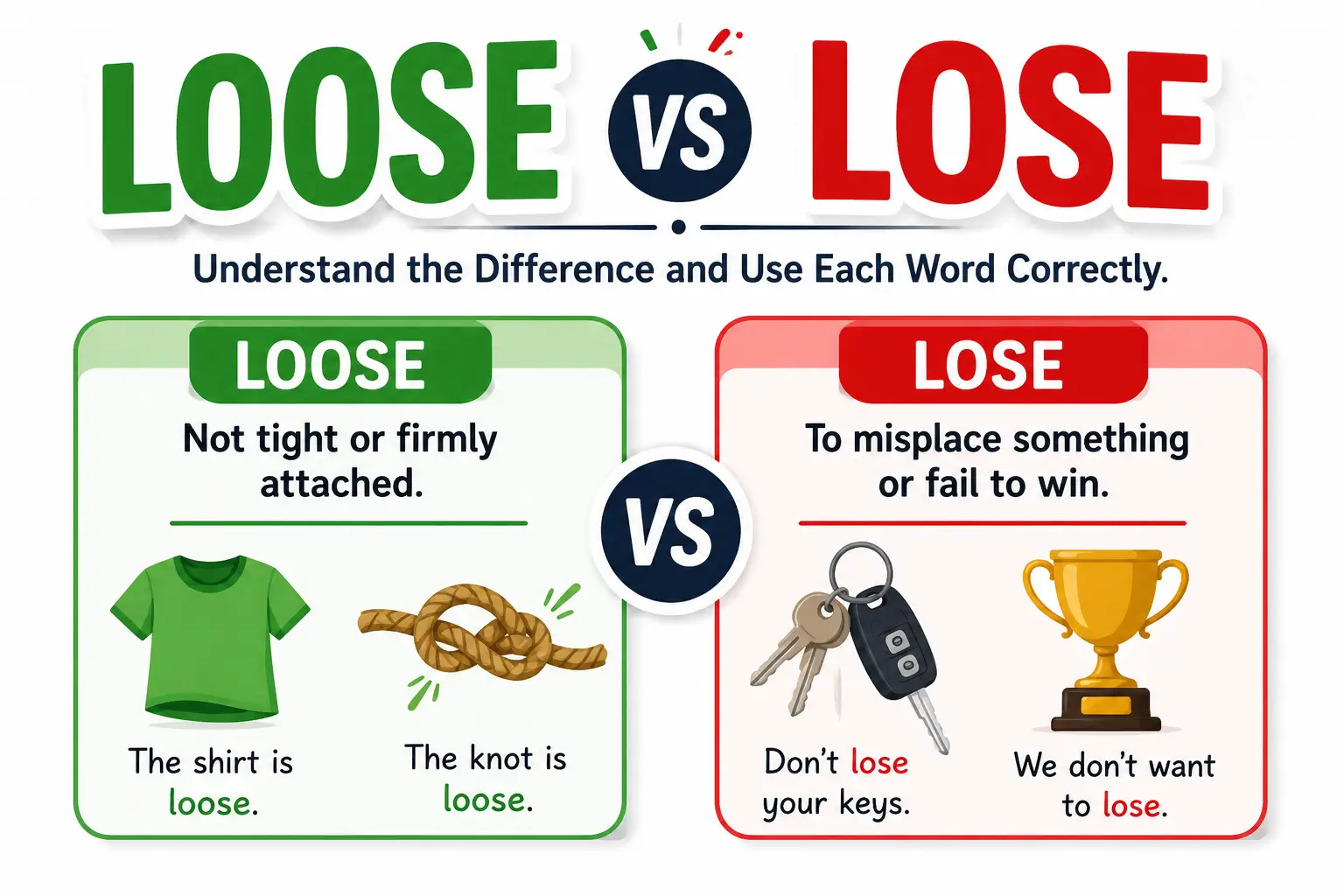
Loose vs lose is one of the most searched grammar questions because these two words look almost identical but have completely different meanings. If you’ve ever wondered whether to write “lose your keys” or “loose your keys,” you’re not alone. The simple answer is this: lose is a verb that means to misplace something or fail to win, while loose usually describes something that is not tight. Learning this difference will help you avoid one of the most common spelling mistakes in English.
Many writers, students, and English learners confuse these words because of their similar spelling and pronunciation. However, once you understand their meaning, pronunciation, parts of speech, and everyday usage, choosing the correct word becomes much easier.
This guide explains the difference between loose and lose, including their definitions, pronunciation, grammar rules, sentence examples, common mistakes, memory tricks, and related words such as loss, loosen, loser, and looser. By the end, you’ll know exactly when to use each word with confidence in school, at work, and in everyday writing.
Quick Answer: Loose vs. Lose
Here’s the simplest way to remember the difference:
- Loose = Not tight, free, or not firmly attached.
- Lose = To no longer have something, fail to keep it, or fail to win.
Quick Examples
✅ My shirt is loose.
✅ Don’t lose your phone.
❌ My shirt is lose.
❌ I always loose my wallet.
Loose vs. Lose at a Glance
| Feature | Loose | Lose |
| Part of Speech | Usually an adjective | Verb |
| Pronunciation | Loos (rhymes with goose) | Looz (ends with a z sound) |
| Meaning | Not tight, free | Misplace, fail to win, no longer have |
| Used to Describe | Nouns | Actions |
| Common Example | Loose shoelaces | Lose your keys |
What Does “Loose” Mean?
The word loose usually describes something that is not tight, firmly fixed, or securely attached. It most often functions as an adjective, although it has a less common use as a verb.
Think of loose as describing the condition of something.
Examples
- The screw is loose.
- Her jacket feels loose after she lost weight.
- The dog is running loose in the park.
- My shoelaces are loose again.
In every example, loose describes a noun rather than showing an action.
Loose as an Adjective
Most of the time, loose means one of the following:
Not Tight
Something doesn’t fit closely.
Examples
- These jeans are too loose.
- I need a tighter belt because my pants are loose.
Not Firmly Attached
An object isn’t securely connected.
Examples
- The door handle is loose.
- One wheel feels loose.
- The battery cable became loose.
Free to Move
Sometimes loose means someone or something isn’t being held.
Examples
- The horse got loose.
- Several chickens were running loose.
- The balloon came loose from the string.
Relaxed or Not Strict
Less commonly, loose can describe rules, behavior, or organization.
Examples
- They have loose guidelines.
- The company follows a loose schedule.
- The meeting had a loose agenda.
Common Expressions with “Loose”
You’ll often hear loose in everyday American English.
| Expression | Meaning |
| Loose change | Coins carried in your pocket |
| Loose clothing | Clothing that isn’t tight |
| Loose tooth | A tooth that moves |
| On the loose | Free and not captured |
| Let loose | Allow someone or something to move freely |
| Cut loose | Relax or leave a situation |
Example Sentences
- I found some loose change in my backpack.
- The child has a loose tooth.
- The escaped dog is still on the loose.
- After finals, everyone wanted to cut loose.
Loose as a Verb (Less Common)
Although uncommon in everyday conversation, loose can also be a verb.
In this form, it means to release, free, or let go.
Examples
- The hunter loosed the arrow.
- The captain loosed the ropes.
Today, most Americans use release, free, or let go instead of this older meaning.
What Does “Lose” Mean?
Unlike loose, lose is always a verb.
It describes an action rather than a condition.
You lose something when you no longer have it, can’t find it, fail to keep it, or fail to win.
Common Meanings of “Lose”
To Misplace Something
This is one of the most common uses.
Examples
- Don’t lose your passport.
- I always lose my sunglasses.
- She almost lost her wallet yesterday.
To Fail to Win
You can lose games, competitions, or elections.
Examples
- Our team didn’t want to lose.
- They lost by two points.
- Nobody likes to lose.
To No Longer Have Something
Sometimes lose means giving up something unexpectedly.
Examples
- He lost his job.
- She lost her confidence.
- We lost power during the storm.
To Reduce Something
The verb also appears when talking about health and fitness.
Examples
- She’s trying to lose weight.
- He wants to lose ten pounds.
- I hope I can lose a little body fat.
To Become Unable to Follow Something
Examples
- I lost track of time.
- Don’t lose focus.
- She lost interest halfway through the movie.
Common Expressions with “Lose”
These expressions appear frequently in American English.
| Expression | Meaning |
| Lose weight | Become lighter |
| Lose your keys | Misplace something |
| Lose your temper | Become angry |
| Lose confidence | Feel less confident |
| Lose focus | Stop concentrating |
| Lose track of time | Forget how much time has passed |
| Lose sleep | Stay awake because of worry |
Example Sentences
- Don’t lose your temper during the meeting.
- I completely lost track of time.
- Many people try to lose weight before summer.
- She didn’t want to lose confidence after one mistake.
Loose vs. Lose: Key Differences Explained
Although only one letter separates these words, they have different meanings, pronunciation, and grammar.
| Feature | Loose | Lose |
| Meaning | Not tight or free | To misplace or no longer have |
| Part of Speech | Usually adjective | Verb |
| Describes | A thing or condition | An action |
| Example | Loose knot | Lose your keys |
The Biggest Difference
Ask yourself this question:
Am I describing something?
If yes, use loose.
The screw is loose.
Am I talking about an action?
If yes, use lose.
Don’t lose your wallet.
This simple question helps you choose the correct spelling almost every time.
Loose vs. Lose Pronunciation
Pronunciation is another reason these words confuse many people.
| Word | Pronunciation | Sounds Like |
| Loose | /luːs/ | Goose |
| Lose | /luːz/ | Choose |
Notice the ending sound.
- Loose ends with an S sound.
- Lose ends with a Z sound.
Say Them Aloud
Loose
“Those shoes feel loose.”
Lose
“I don’t want to lose those shoes.”
Even though they look similar, the final sound changes completely.
Why Do People Confuse Loose and Lose?
There are several reasons why this mistake happens so often.
Similar Spelling
The words differ by only one letter.
- Loose
- Lose
That makes them easy to mistype, especially when you’re writing quickly.
Similar Pronunciation
Although they end with different sounds, both begin with the same long “oo” vowel.
Because of this, many people rely on sound instead of spelling.
Autocorrect Doesn’t Always Help
Both words are correctly spelled English words.
As a result, spell check usually won’t catch mistakes like these:
❌ I always loose my keys.
Since loose is a real word, your writing software may not flag the error.
Fast Typing and Texting
People often type quickly in text messages, emails, and social media posts. Consequently, spelling errors become more common.
For example:
❌ Don’t loose your ticket.
Even though readers usually understand the meaning, the sentence is grammatically incorrect.
Grammar Tip: If you’re talking about an action, the correct word is almost always lose. If you’re describing how something fits or moves, the correct word is loose.
Loose vs. Lose in Sentences
One of the best ways to understand loose vs. lose is by seeing each word in real-life sentences. Notice how loose describes something, while lose expresses an action.
Correct Examples Using “Loose”
Use loose when something is not tight, not firmly attached, or free to move.
| Sentence | Why It’s Correct |
| My shoelaces are loose. | Describes the condition of the shoelaces. |
| This shirt feels loose after washing. | Describes how the shirt fits. |
| The dog got loose from the yard. | Means the dog is no longer restrained. |
| The cabinet door is loose. | Describes the door’s condition. |
| She prefers loose clothing during summer. | Describes the style and fit of the clothing. |
| A loose screw caused the chair to wobble. | Describes the screw. |
| Keep all loose papers in one folder. | Describes papers that are not attached together. |
| His grip became loose after the race. | Describes the strength of the grip. |
Notice the Pattern
In every example above, loose describes a noun. It never shows an action.
Correct Examples Using “Lose”
Use lose when someone misplaces something, fails to win, or no longer has something.
| Sentence | Why It’s Correct |
| Don’t lose your wallet. | Shows the action of misplacing something. |
| Our team might lose the game. | Shows the action of failing to win. |
| I don’t want to lose my job. | Means no longer having a job. |
| She hopes to lose weight before vacation. | Means reducing body weight. |
| We always lose track of time together. | Means forgetting how much time has passed. |
| He didn’t lose confidence after the interview. | Means no longer having confidence. |
| Please don’t lose this receipt. | Action of keeping something safe. |
| They lost power during the storm. | Means power was no longer available. |
Notice the Pattern
Every sentence uses lose as a verb because it expresses an action.
Incorrect Examples and Their Corrections
Many spelling mistakes happen because people choose the wrong word. Here are some of the most common errors.
| ❌ Incorrect | ✅ Correct | Why |
| I always loose my keys. | I always lose my keys. | Misplacing something is an action. |
| My shoes are lose. | My shoes are loose. | You’re describing the shoes. |
| Don’t loose your phone. | Don’t lose your phone. | Losing is an action. |
| My backpack feels lose. | My backpack feels loose. | Describes the fit. |
| We don’t want to loose today. | We don’t want to lose today. | Refers to failing to win. |
| His belt became lose. | His belt became loose. | Describes the belt. |
Quick Rule: If you can replace the word with tight, you’re probably talking about loose. If you’re talking about an action, use lose.
Common Mistakes People Make
Because loose and lose look similar, writers often confuse them. Fortunately, once you know the patterns, these mistakes become easy to avoid.
Mistake 1: Using “Loose” Instead of “Lose”
This is the most common error.
❌ I don’t want to loose my phone.
✅ I don’t want to lose my phone.
Why?
The sentence describes an action, so you need the verb lose.
Mistake 2: Using “Lose” Instead of “Loose”
Some writers accidentally use lose when describing something.
❌ These pants are too lose.
✅ These pants are too loose.
Here, the sentence describes how the pants fit.
Mistake 3: Mixing Them Up in Emails
Imagine sending this message at work:
Please don’t loose these documents.
Although people understand what you mean, the mistake looks unprofessional.
The correct sentence is:
Please don’t lose these documents.
Mistake 4: Errors on Social Media
You’ll often see posts like:
- “Don’t loose hope.”
- “I always loose everything.”
Both sentences should use lose because they describe actions.
Mistake 5: Confusing Pronunciation with Spelling
Many people spell words based on how they sound.
However, English spelling doesn’t always match pronunciation exactly.
That’s why it’s important to remember the grammar role rather than relying only on sound.
How to Remember the Difference Between Loose and Lose
Simple memory tricks can help you choose the correct spelling every time.
Memory Trick 1: Count the O’s
Loose has two O’s.
Think of those two O’s as something wide or loose.
Loose = More room.
Memory Trick 2: Lose Lost an O
Notice this pattern:
Loose
Lose
One “O” disappeared.
Imagine that lose has lost one O.
If something is lost, think lose.
Memory Trick 3: Think About the Meaning
Ask yourself:
Am I describing something?
Use loose.
Am I talking about an action?
Use lose.
Memory Trick 4: Think of Tight
Opposite of tight?
Loose
Opposite of win?
Lose
Memory Trick 5: Say the Last Sound
Loose → ends with S
Lose → ends with Z
Repeating them aloud helps many learners remember the difference.
Loose vs. Lose vs. Loosen vs. Loss
These related words often confuse learners, but each has a different job.
| Word | Part of Speech | Meaning | Example |
| Loose | Adjective | Not tight | My shirt is loose. |
| Lose | Verb | Misplace or fail to keep | Don’t lose your keys. |
| Loosen | Verb | Make less tight | Loosen the lid first. |
| Loss | Noun | The act of losing | The company reported a loss. |
What Does “Loosen” Mean?
Loosen means to make something less tight.
Examples
- Please loosen your tie.
- Can you loosen this bolt?
- The mechanic loosened the wheel nuts.
Unlike loose, loosen expresses an action.
What Does “Loss” Mean?
Loss is the noun form related to lose.
Examples
- The loss of power lasted two hours.
- His biggest loss was his confidence.
- The company reported a financial loss.
Notice the pattern:
- Verb → lose
- Noun → loss
Is It “Looser” or “Loser”?
These two words are also commonly confused.
| Word | Meaning |
| Looser | More loose; less tight |
| Loser | A person who loses |
Examples
The new sweater is looser than the old one.
Our team wasn’t happy because every loser had to clean the locker room.
Incorrect Example
❌ He is a looser.
✅ He is a loser.
Why?
Looser compares how something fits.
Loser refers to someone who loses.
American English Usage Tips
Although the rules stay the same everywhere English is spoken, these tips reflect common American English usage.
At School
Correct
- Don’t lose your homework.
- My backpack feels loose.
At Work
Correct
- Please don’t lose these files.
- The handle became loose after years of use.
In Text Messages
Instead of writing:
❌ Don’t loose it!
Write:
✅ Don’t lose it!
On Social Media
People frequently misspell lose as loose.
Although readers usually understand the message, correct spelling makes your writing look more polished and trustworthy.
In Professional Writing
Always proofread words like lose and loose because spell check may not catch the mistake.
Since both are real English words, grammar software sometimes misses the error if the sentence is otherwise correct.
Common Collocations
Some words naturally appear together more often than others.
Words Commonly Used with “Loose”
- Loose clothing
- Loose soil
- Loose connection
- Loose screw
- Loose grip
- Loose knot
- Loose pages
- Loose thread
- Loose fit
- Loose change
Examples
- The electrician found a loose connection.
- My jacket has a loose thread.
- He likes a loose fit when buying jeans.
Words Commonly Used with “Lose”
- Lose money
- Lose confidence
- Lose patience
- Lose focus
- Lose weight
- Lose interest
- Lose balance
- Lose sleep
- Lose control
- Lose your keys
Examples
- Don’t lose focus during the exam.
- Many people lose sleep before an important interview.
- She didn’t lose confidence after making one mistake.
Quick Practice Quiz
Choose the correct word.
Fill in the blanks.
- My belt is too ______.
- Don’t ______ your passport.
- The dog got ______.
- We don’t want to ______ the championship.
- This bolt feels ______.
Answers
- loose
- lose
- loose
- lose
- loose
Why?
- Loose describes a condition.
- Lose describes an action.
Grammar Tips to Avoid Confusing Loose and Lose
Even experienced writers occasionally mix up loose and lose. The good news is that a few simple grammar habits can help you avoid this common mistake.
Check the Part of Speech First
Before choosing a word, ask yourself whether you need a description or an action.
- If you’re describing something, use loose.
- If you’re describing an action, use lose.
Examples
- The lid is loose. ✅ (Description)
- Don’t lose the lid. ✅ (Action)
Replace the Word to Test It
A quick replacement test can confirm your choice.
If you can replace the word with tight, then loose is probably correct.
Example
- The rope isn’t tight.
- The rope is loose. ✅
If you can replace the word with misplace, fail to keep, or fail to win, then lose is the correct choice.
Example
- I don’t want to misplace my phone.
- I don’t want to lose my phone. ✅
Proofread Carefully
Because both words are spelled correctly, spell check may not catch the mistake.
Take a moment to reread sentences that contain lose or loose, especially in:
- Emails
- School assignments
- Business reports
- Blog posts
- Social media captions
Practice with Real Sentences
Reading and writing complete sentences is one of the fastest ways to remember the difference.
For example:
- My backpack is loose.
- Don’t lose your backpack.
The more you see these patterns, the easier they become to remember.
Real-Life Examples of Loose and Lose
These examples show how the words appear in everyday American English.
At School
Teacher:
“Don’t lose your worksheet before class.”
Student:
“My backpack strap is loose.”
At Work
Manager:
“Please don’t lose the client files.”
Employee:
“One screw on the office chair is loose.”
At the Gym
- My shoelaces came loose while I was running.
- She’s trying to lose ten pounds before summer.
At Home
- The kitchen cabinet handle feels loose.
- I always lose the TV remote.
While Traveling
- Don’t lose your passport.
- My suitcase has a loose zipper.
On Social Media
Incorrect:
I always loose my phone.
Correct:
I always lose my phone.
Synonyms of Loose and Lose
Although these words have different meanings, knowing similar words can improve your vocabulary.
Synonyms for Loose
Depending on the context, loose may mean:
- Free
- Unfastened
- Untied
- Slack
- Relaxed
- Detached
- Unsecured
- Baggy
- Flexible
- Open
Example
The rope became slack after the knot came loose.
Synonyms for Lose
Depending on the sentence, lose can mean:
- Misplace
- Forget
- Drop
- Forfeit
- Surrender
- Miss
- Waste
- Give up
- Be defeated
- No longer have
Example
She didn’t misplace her wallet.
She didn’t lose her wallet.
Related Words You Should Know
Several related words often appear with loose and lose.
| Word | Meaning | Example |
| Loose | Not tight | My belt is loose. |
| Loosen | Make less tight | Loosen the cap. |
| Loosely | In a loose way | Tie it loosely. |
| Lose | Misplace or fail to keep | Don’t lose it. |
| Lost | Past tense of lose | I lost my wallet. |
| Loss | The act of losing | The loss was unexpected. |
| Loser | Someone who loses | The loser congratulated the winner. |
| Looser | More loose | These pants are looser now. |
Understanding this word family makes it easier to recognize the correct spelling in different situations.
Quick Recap
Before moving on to the FAQs, here’s a simple summary.
| Loose | Lose |
| Describes something | Describes an action |
| Usually an adjective | Always a verb |
| Means not tight | Means misplace, fail to keep, or fail to win |
| “The knot is loose.” | “Don’t lose the knot instructions.” |
Remember This Rule
Loose describes. Lose acts.
If you keep that sentence in mind, you’ll avoid most spelling mistakes.
Conclusion
Understanding loose vs lose doesn’t have to be difficult. The easiest way to remember the difference is that lose is a verb used when you misplace something, fail to win, or no longer have something, while loose usually describes something that is not tight, not secure, or free to move. Although the words look similar, they have different meanings, pronunciations, and grammatical roles.
Whenever you’re unsure, ask yourself one simple question: Am I describing something or talking about an action? If you’re describing a condition, choose loose. If you’re describing an action, choose lose. With a little practice and the memory tips in this guide, you’ll avoid this common mistake and write more accurate, natural English with confidence.
Frequently Asked Questions
Q1. Is it “lose weight” or “loose weight”?
The correct phrase is lose weight because lose is a verb that means to reduce body weight. Loose weight is incorrect.
Q2. Why do people confuse loose and lose?
People often confuse them because they have similar spellings and pronunciations. However, they have different meanings and grammar functions.
Q3. What is the main difference between loose and lose?
Loose usually means not tight, while lose means to misplace something, fail to win, or no longer have something.
Q4. Is loose a verb or an adjective?
Loose is most commonly an adjective, but it can also be used as a verb in formal or literary English to mean release or set free.
Q5. Is lose always a verb?
Yes. Lose is always used as a verb in modern English.
Q6. How do you pronounce lose and loose?
Lose is pronounced /luːz/ with a z sound, while loose is pronounced /luːs/ with a soft s sound.
Q7. What is the difference between lose and loss?
Lose is a verb, while loss is the noun form that refers to the result of losing something.
Q8. What’s the easiest way to remember the correct spelling?
Think of it this way: loose has two O’s, giving it extra room, while lose has lost one O, making it easier to remember its meaning.
Q9. Can loose and lose ever be used interchangeably?
No. They have different meanings and grammatical roles, so they should never replace each other.
Q10. What are some common examples of loose and lose?
Correct examples include “My shoelaces are loose,” “Don’t lose your wallet,” “The screw is loose,” and “Our team might lose the game.” These examples show the difference between describing a condition and expressing an action.