
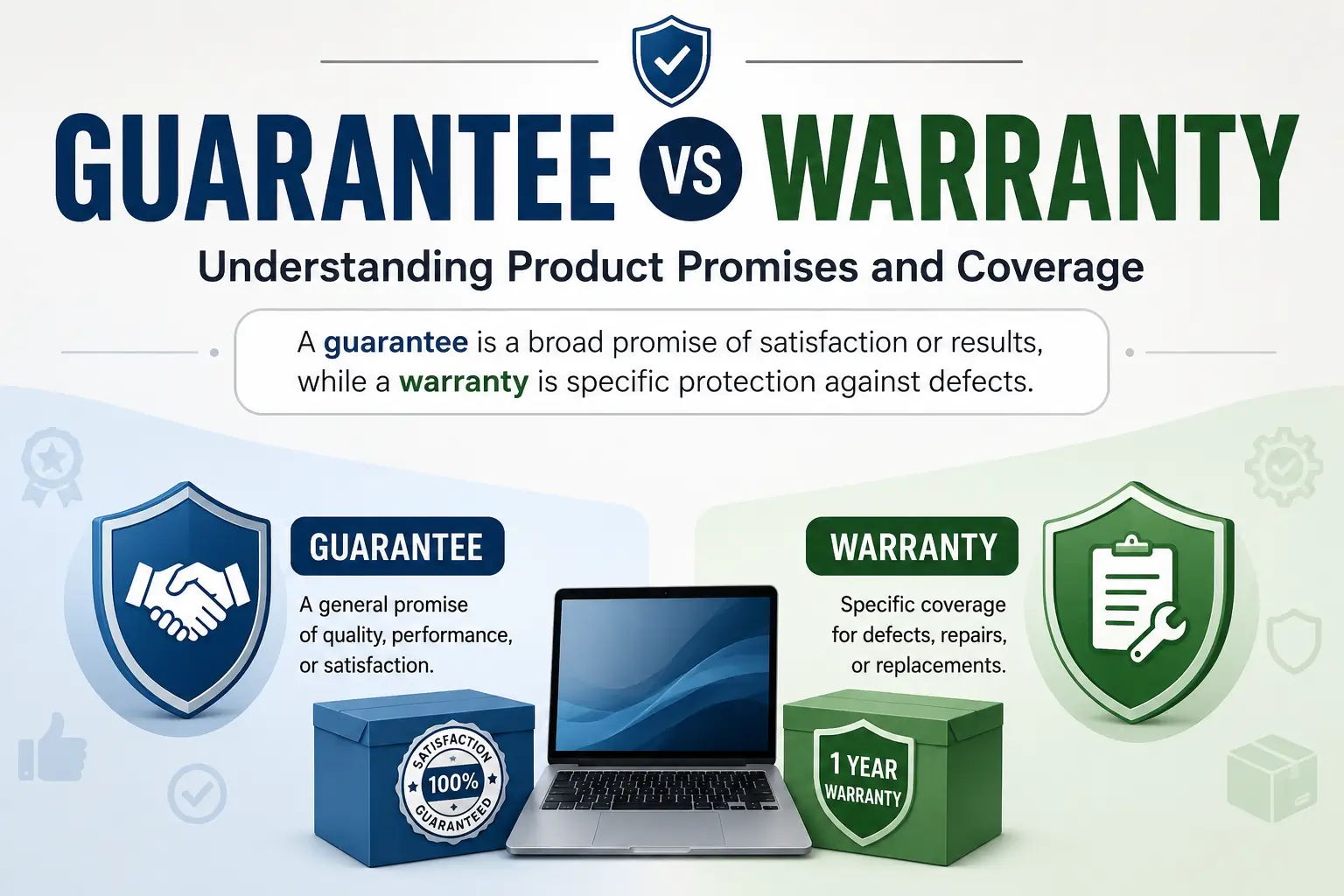
The key difference in guarantee vs warranty is that a guarantee gives a broad promise, while a warranty explains formal product protection terms. After a purchase, this assurance may support a product, its integrity, and overall product integrity.
Warranties offer several types of protections and available coverage. A manufacturer may use carefully written terms to define the manufacturer obligation, maker’s responsibility, repair limits, and each party’s responsibility. However, technical jargon, complex rules, and challenging language can reduce understanding and weaken practical consumer protection.
The common confusion in warranty versus guarantee comes from their close relationship, same origin, original meaning, and closer meaning as legal words. Still, differentiating them is useful: guarantee is the more general term, while warranty is the more specific term. A written guarantee, legal warranty, written term, or legal term should clearly explain refund, repair, or replacement duties.
Quick Answer: What Is the Difference?
A guarantee is a promise that something will happen, work properly, meet a standard, or produce a certain result.
A warranty is a specific promise about a product’s condition, quality, or freedom from defects. It often explains what the manufacturer or seller will do if the product fails within a stated period.
Simple rule: A guarantee is a general promise. A warranty is usually formal product coverage.
Consider these examples:
- “The company offers a money-back guarantee.”
- “The laptop comes with a one-year warranty.”
The first sentence promises a refund under certain conditions. The second refers to formal coverage for the laptop.
Guarantee vs. Warranty Comparison Table
| Feature | Guarantee | Warranty |
| Basic meaning | A promise or assurance | A promise about product quality, condition, or defects |
| Common purpose | To promise satisfaction, performance, quality, or results | To provide repair, replacement, or service coverage |
| Typical form | Spoken or written | Usually written |
| Common subjects | Products, services, payments, results, delivery, authenticity | Electronics, vehicles, appliances, tools, equipment |
| Time limit | May or may not have one | Usually includes a defined period |
| Conditions | May be simple or broad | Often contains detailed terms and exclusions |
| Common remedy | Refund, correction, replacement, or another promised result | Repair, replacement, parts, or service |
| Grammar role | Noun and verb | Mainly a noun |
| Example | “We guarantee next-day delivery.” | “The motor has a five-year warranty.” |
This distinction works well in most everyday situations. Still, businesses sometimes use the two terms differently. Always read the actual policy before deciding what protection it provides.
What Does “Guarantee” Mean?
A guarantee is a firm promise that something is true, reliable, certain, or likely to meet a stated condition.
The word can describe promises about products, services, events, payments, and results. Unlike warranty, it isn’t limited to physical goods.
For example:
- “The restaurant guarantees fresh ingredients.”
- “The program doesn’t guarantee employment.”
- “The store offers a 30-day satisfaction guarantee.”
- “Nothing can guarantee success.”
In each sentence, guarantee expresses a strong assurance.
Guarantee as a Noun
As a noun, guarantee names the promise itself.
- “The product includes a money-back guarantee.”
- “There’s no guarantee that the event will sell out.”
- “The contractor gave us a written guarantee.”
- “A college degree isn’t a guarantee of employment.”
In these examples, the guarantee may concern money, performance, quality, or a future result.
Guarantee is normally a countable noun:
- one guarantee
- several guarantees
- a written guarantee
- no guarantees
It can also appear in the common structure a guarantee of something:
- “Experience is no guarantee of success.”
- “The reservation is a guarantee of your seat.”
Guarantee as a Verb
As a verb, guarantee means to promise, assure, or make something certain.
- “We guarantee the quality of our work.”
- “The seller guaranteed the watch’s authenticity.”
- “A larger budget doesn’t guarantee better results.”
- “The reservation guarantees you a table.”
The verb changes form normally:
| Form | Example |
| Base form | guarantee |
| Third-person singular | guarantees |
| Past tense | guaranteed |
| Past participle | guaranteed |
| Present participle | guaranteeing |
Notice the spelling of guaranteeing. The final e disappears before -ing.
Common Types of Guarantees
Businesses use several kinds of guarantees.
Money-back guarantee
A money-back guarantee promises a refund when the customer meets the stated conditions.
Example:
“Return the item within 30 days for a full refund.”
The customer may need a receipt, original packaging, or proof that the product didn’t meet expectations.
Satisfaction guarantee
A satisfaction guarantee promises to correct a problem if the customer isn’t satisfied.
The company may offer:
- A refund
- A replacement
- A repeat service
- Store credit
- Another solution
However, “satisfaction guaranteed” doesn’t always mean an automatic cash refund. The policy should explain the available remedy.
Performance guarantee
A performance guarantee promises that a product or service will meet a stated standard.
For example:
- A battery may be guaranteed to last a certain number of hours.
- A delivery company may guarantee arrival by a stated time.
- A contractor may guarantee that completed work will meet agreed specifications.
Price guarantee
A price guarantee promises a particular price or offers a refund of the difference if the buyer finds a lower qualifying price.
These offers often include limits involving:
- Competing retailers
- Identical models
- Sale periods
- Online-only prices
- Membership discounts
Personal guarantee
In business and finance, a personal guarantee is a person’s promise to repay a debt if another party fails to pay.
This meaning is more formal than everyday promises. It may create serious financial obligations.
What Does “Warranty” Mean?
A warranty is a promise about the quality, condition, performance, or reliability of a product.
It commonly explains what a seller or manufacturer will do if the product develops a covered defect. For example, the company may repair the item, replace a part, or provide a replacement product.
Examples include:
- “The refrigerator has a ten-year compressor warranty.”
- “Accidental damage isn’t covered by the warranty.”
- “The car is still under warranty.”
- “You’ll need the receipt to make a warranty claim.”
Unlike a broad guarantee, a warranty usually includes specific rules.
Warranty as a Noun
In modern American English, warranty is mainly used as a noun.
Common patterns include:
- a warranty
- the warranty
- under warranty
- covered by a warranty
- a warranty claim
- the warranty period
Examples:
- “The printer comes with a two-year warranty.”
- “The screen repair isn’t covered under warranty.”
- “Please submit your warranty claim online.”
- “The warranty expires next month.”
The plural is warranties, not warrantys.
- one warranty
- two warranties
Words ending in a consonant plus y usually change the y to i before adding -es.
Is “Warranty” a Verb?
Some businesses use warranty as a verb, especially in technical or commercial writing.
For example:
- “We warranty all replacement parts for 90 days.”
However, this form sounds less natural in general American English. The traditional verb is warrant.
More natural:
- “The manufacturer warrants the motor for five years.”
- “The company guarantees the repair for 90 days.”
- “The repair comes with a 90-day warranty.”
For everyday writing, use warranty as a noun and warrant or guarantee as the verb.
Common Types of Warranties
Manufacturer’s warranty
A manufacturer’s warranty comes from the company that made the product.
It may cover:
- Manufacturing defects
- Faulty materials
- Defective parts
- Problems that occur during normal use
It usually doesn’t cover accidental damage, misuse, or normal wear.
Full warranty
A full warranty generally provides broad coverage and fewer restrictions than a limited warranty.
However, the word full doesn’t mean that every possible problem is covered. The written terms still control what the company must do.
Limited warranty
A limited warranty covers only certain parts, defects, users, or situations.
For example, it may:
- Cover parts but not labor
- Apply only to the original buyer
- Exclude cosmetic damage
- Last for different periods on different components
- Require the customer to pay shipping
Extended warranty
An extended warranty provides coverage beyond the original warranty period.
Customers often pay extra for it. Depending on the agreement, it may function more like a service contract than a traditional manufacturer’s warranty.
Before buying one, compare:
- The price
- Length of coverage
- Deductibles
- Repair limits
- Existing manufacturer coverage
- Exclusions
- Replacement rules
Express warranty
An express warranty is a clear promise about a product.
It may appear in:
- A written warranty document
- A product description
- Packaging
- Advertising
- A sales statement
For example, a claim that a watch is waterproof to a stated depth may create a specific expectation about its performance.
Implied warranty
An implied warranty is a basic expectation that may exist under applicable law even when the seller doesn’t write it down.
For example, a new toaster should normally work as a toaster when used properly.
The exact rights and exceptions depend on the location, seller, product, and transaction. Therefore, consumers should check the rules that apply where they live.
Key Differences Between a Guarantee and a Warranty
Although both words involve promises, several practical differences help you choose the correct term.
A Guarantee Is Broader
A guarantee can apply to almost any promise.
You can guarantee:
- Product quality
- Customer satisfaction
- A refund
- Delivery time
- Payment
- Authenticity
- Attendance
- A result
- A reservation
For example:
- “I guarantee that she’ll remember your name.”
- “The ticket guarantees admission.”
- “The company guarantees payment within ten days.”
A warranty usually doesn’t work in these contexts.
You wouldn’t normally say:
- “The ticket warranties admission.”
- “I warranty that she’ll arrive.”
- “The company offers a payment warranty.”
A Warranty Usually Concerns Products
Warranties most often apply to products, parts, workmanship, or repairs.
Common examples include:
- Car warranties
- Appliance warranties
- Phone warranties
- Tool warranties
- Roof warranties
- Battery warranties
- Repair warranties
A service can also have warranty coverage, especially when the promise concerns workmanship. Still, guarantee is often more natural for general customer satisfaction.
A Warranty Usually Has Detailed Terms
A warranty commonly tells you:
- How long coverage lasts
- Which defects are covered
- Which parts are included
- What the company will provide
- What the buyer must submit
- Which actions may void coverage
- Who must pay shipping or labor costs
A guarantee may also contain conditions. However, it often sounds simpler and more customer-focused.
A Guarantee May Be Spoken
A person can make a guarantee during a conversation.
For example:
“I guarantee the repair will be finished by Friday.”
A warranty is more often written. Customers generally expect a warranty document, policy, registration, or written statement.
Still, spoken promises can matter in some situations. Therefore, important promises should be recorded in writing.
Neither Word Automatically Means “Refund”
Many buyers assume that a guarantee always provides a refund and a warranty always provides a replacement. That isn’t correct.
A guarantee may offer:
- A refund
- Store credit
- A repeated service
- A correction
- A replacement
A warranty may offer:
- Repair
- Replacement parts
- A refurbished replacement
- Product replacement
- Reimbursement up to a limit
The available remedy depends on the policy.
Legal Meaning: Does the Label Matter?
The words guarantee and warranty can carry legal importance. However, the title of the policy isn’t the only factor.
A document called a “guarantee” may contain detailed warranty-style coverage. Meanwhile, a “warranty” may offer only narrow protection.
The actual language matters more than the heading.
Before relying on either promise, check:
- Who provides the coverage
- Who qualifies
- What problems are covered
- When coverage begins
- When it ends
- What proof is required
- Which costs the customer must pay
- Whether repairs affect the coverage
- Whether the policy transfers to a new owner
Important Warranty Phrases
Certain phrases can change the value of the coverage.
“Original purchaser only”
This phrase means the coverage may end when the product is sold or given to another person.
“Normal wear and tear excluded”
The warranty may cover defects but not damage caused by regular aging or use.
“Parts only”
The company may provide replacement parts while charging the customer for labor.
“Limited lifetime warranty”
The word lifetime doesn’t always mean the buyer’s entire life. It may refer to:
- The useful life of the product
- The time the original owner possesses it
- The time the product remains in production
- A period defined elsewhere in the policy
“Void if opened”
This phrase suggests that opening or modifying the product may affect coverage. However, the enforceability of such restrictions may depend on applicable consumer law and the specific circumstances.
Because legal rights vary, contact a qualified local professional when a dispute involves significant money or property.
Guarantee vs. Warranty in American English
In everyday American English, warranty is especially common for formal product coverage.
You’ll often hear:
- “Is it still under warranty?”
- “The warranty has expired.”
- “I filed a warranty claim.”
- “The repair is covered by the manufacturer.”
By contrast, guarantee appears frequently in advertising, customer service, and general conversation.
Common phrases include:
- “Satisfaction guaranteed”
- “Money-back guarantee”
- “Guaranteed delivery”
- “Lowest-price guarantee”
- “I can’t guarantee it”
- “There are no guarantees”
Therefore, American speakers often associate warranty with written product terms and guarantee with broader promises.
British and American Usage
Both guarantee and warranty are used in British and American English.
However, British companies may use guarantee more often for written product coverage that an American company might call a warranty.
For example, a British appliance may come with a “two-year guarantee.” In the United States, the same coverage might be described as a “two-year warranty.”
Neither wording is automatically wrong. Regional preference and company style affect the choice.
Grammar Rules for “Guarantee”
Because guarantee works as both a noun and a verb, it appears in several sentence patterns.
Guarantee + Noun
Use this structure when naming the thing being promised.
- “The company guarantees quality.”
- “The reservation guarantees entry.”
- “The policy guarantees payment.”
- “No strategy guarantees success.”
Guarantee + That-Clause
Use guarantee that before a complete statement.
- “The seller guarantees that the item is authentic.”
- “We can’t guarantee that every application will succeed.”
- “The service guarantees that your order will arrive by noon.”
In casual speech, people sometimes leave out that:
- “I guarantee you’ll enjoy the movie.”
Both forms are correct.
Guarantee + Person + Thing
A guarantee can take two objects: the person receiving the benefit and the promised result.
- “The reservation guarantees you a seat.”
- “The policy guarantees employees paid leave.”
- “The program doesn’t guarantee graduates a job.”
Guarantee of + Noun
Use guarantee of when the guarantee concerns a result or condition.
- “There is no guarantee of success.”
- “The contract provides a guarantee of payment.”
- “A high price isn’t a guarantee of quality.”
Grammar Rules for “Warranty”
Warranty normally functions as a countable noun.
Have or Come With a Warranty
- “The vacuum has a three-year warranty.”
- “The headphones come with a limited warranty.”
Both structures describe included coverage.
Under Warranty
Use under warranty when the product remains within the coverage period.
- “The computer is still under warranty.”
- “The repair was free because the part was under warranty.”
Covered by or Covered Under a Warranty
Both expressions are common.
- “The motor is covered by the warranty.”
- “Water damage isn’t covered under the warranty.”
Warranty on Something
Use warranty on to identify the covered product or component.
- “What is the warranty on the battery?”
- “The company offers a ten-year warranty on the frame.”
Warranty for a Period
Use for to state the length of coverage.
- “The repair has a warranty for 90 days.”
- “The motor is warranted for five years.”
A more natural version is often:
- “The repair comes with a 90-day warranty.”
Pronunciation and Spelling
How to Pronounce “Guarantee”
Guarantee is pronounced approximately:
gar-un-TEE
The strongest stress falls on the final syllable.
The verb and noun have the same pronunciation.
How to Pronounce “Warranty”
Warranty is pronounced approximately:
WOR-un-tee
The strongest stress falls on the first syllable.
Common Spelling Mistakes
| Incorrect | Correct |
| guarentee | guarantee |
| garantee | guarantee |
| guaranttee | guarantee |
| warrenty | warranty |
| waranty | warranty |
| warrantys | warranties |
| guaranteeing | guaranteeing |
A useful spelling reminder is that guarantee ends in -tee, while warranty contains warrant + y.
Correct Real-Life Examples
Shopping
Correct: “The coffee maker includes a two-year warranty.”
Why it works: The sentence refers to formal product coverage lasting two years.
Correct: “The store offers a 30-day money-back guarantee.”
Why it works: The store promises to return the buyer’s money under stated conditions.
Work and Business
Correct: “The contractor guarantees the workmanship for one year.”
Why it works: Guarantees acts as a verb and promises a standard of work.
Correct: “Replacement parts are covered by a six-month warranty.”
Why it works: Warranty names the formal coverage for the parts.
Everyday Conversation
Correct: “I can’t guarantee that I’ll arrive before six.”
Why it works: The speaker can’t make a firm promise about arrival time.
Incorrect: “I can’t warranty that I’ll arrive before six.”
Why it’s wrong: Warranty isn’t normally used as an everyday verb for a personal promise.
Email and Customer Service
Correct: “Please send your receipt so we can process the warranty claim.”
Why it works: A warranty claim is a formal request for covered service.
Correct: “We guarantee a response within two business days.”
Why it works: The company promises a specific response time.
Social Media and Advertising
Correct: “Better results guaranteed—or your money back.”
This wording combines a performance promise with a refund offer.
However, businesses should use guarantee claims carefully. A strong promise can mislead customers when the company can’t reliably provide the stated outcome.
Common Mistakes and Corrections
Using “Warranty” for a Personal Promise
Incorrect: “I warranty that I’ll help you.”
Correct: “I guarantee that I’ll help you.”
A personal assurance calls for guarantee, not warranty.
Assuming Every Guarantee Is Unlimited
Incorrect idea: “A money-back guarantee means I can return the item whenever I want.”
Correction: A guarantee may have deadlines, conditions, and exclusions.
Always check the return period and required proof.
Assuming a Warranty Covers All Damage
Incorrect idea: “The phone is under warranty, so the cracked screen will be repaired free.”
Correction: Many warranties cover manufacturing defects but exclude accidental damage.
The cause of the problem matters.
Confusing “Warranted” and “Warrantied”
Preferred: “The part is warranted for five years.”
Also clear: “The part comes with a five-year warranty.”
Less common: “The part is warrantied for five years.”
Warrantied appears in commercial writing, but warranted is the more established form.
Misspelling “Guaranteed”
Incorrect: “Your satisfaction is guarenteed.”
Correct: “Your satisfaction is guaranteed.”
The base word keeps its spelling before -d: guarantee + d = guaranteed.
Using “Guarantee” When “Warranty” Is More Precise
Less precise: “My laptop has a one-year guarantee.”
More natural in US English: “My laptop has a one-year warranty.”
The first sentence isn’t necessarily wrong. However, warranty more clearly suggests formal repair or replacement coverage.
Guarantee, Warranty, and Related Words
Guarantee vs. Promise
A promise is a general commitment. A guarantee usually sounds stronger and more certain.
- “I promise to try.”
- “I guarantee it will be finished.”
The second statement creates a firmer expectation.
Guarantee vs. Assurance
An assurance is a statement intended to build confidence. A guarantee is usually more definite.
- “The manager gave us assurances that the issue was being reviewed.”
- “The manager guaranteed a full refund.”
An assurance may comfort the listener without promising a specific result.
Warranty vs. Insurance
A warranty generally covers product defects or failures under stated conditions.
Insurance covers defined risks, often in exchange for a premium. Those risks may include:
- Theft
- Fire
- Accidental damage
- Collision
- Natural disasters
- Liability
For example, a car warranty may cover a defective transmission. Auto insurance may cover collision damage.
Warranty vs. Return Policy
A return policy explains when a customer may return a product.
A warranty explains what happens when the product has a covered defect or failure.
A store may allow returns for 30 days while the manufacturer provides a one-year warranty.
Warranty vs. Service Contract
A service contract is an agreement to provide repair, maintenance, or support for a stated period.
It may require an additional payment. Although businesses often market service contracts as “extended warranties,” the exact legal and practical structure may differ.
Synonyms for Guarantee
Possible synonyms depend on the sentence.
As a Noun
- Promise
- Assurance
- Pledge
- Commitment
- Security
- Protection
Example:
- “The company gave us a guarantee.”
- “The company gave us an assurance.”
The second version sounds less definite.
As a Verb
- Promise
- Assure
- Confirm
- Secure
- Ensure
- Certify
These words aren’t always interchangeable.
For example:
- Guarantee means to make a firm promise.
- Ensure means to make sure something happens.
- Assure means to remove someone’s doubt.
- Insure usually relates to insurance coverage.
Compare:
- “I assure you that the report is accurate.”
- “Careful testing helps ensure accuracy.”
- “The company guarantees accurate results under stated conditions.”
- “The policy insures the building against fire.”
Synonyms for Warranty
Possible alternatives include:
- Coverage
- Product protection
- Written promise
- Service commitment
- Quality assurance
However, these terms may not carry the same specific meaning.
For example, coverage may refer to insurance, warranties, or service plans. Therefore, use warranty when you mean formal protection against covered product defects.
A Practical Case Study
Imagine that Maya buys a blender from a kitchen supply store.
The store advertises a 30-day satisfaction guarantee. The manufacturer also provides a two-year limited warranty.
After ten days, Maya decides that the blender is too loud. It works correctly, but she doesn’t like it.
The satisfaction guarantee may allow her to return it because she isn’t satisfied.
Now imagine that the motor stops working after eight months. The store’s 30-day guarantee has expired. However, the manufacturer’s two-year warranty may cover the defective motor.
This example shows the practical difference:
- The guarantee addresses customer satisfaction.
- The warranty addresses a covered product failure.
- The guarantee lasts 30 days.
- The warranty lasts two years.
- Each promise has different conditions and remedies.
How to Choose the Correct Word
Ask yourself what kind of promise you’re describing.
Use guarantee when:
- Someone makes a broad promise.
- A company promises satisfaction.
- A seller promises a refund.
- A service promises a result or deadline.
- You’re talking about certainty.
- The promise isn’t limited to product defects.
Use warranty when:
- A product has formal coverage.
- The promise concerns defects.
- The policy offers repairs or replacement.
- Coverage lasts for a stated period.
- You’re discussing a claim.
- You’re referring to a manufacturer’s written terms.
Easy Memory Tricks
Use this quick reminder:
Guarantee = General promise
Warranty = Written product protection
Both guarantee and general begin with g. Meanwhile, warranties are often written documents connected to products.
Another useful question is:
“Am I promising a result, or describing repair coverage?”
- Promising a result: guarantee
- Describing repair coverage: warranty
Conclusion
The difference between guarantee vs warranty becomes simple when you focus on the type of promise. A guarantee is a broad assurance about quality, satisfaction, performance, or results. A warranty usually gives specific product protection for defects, repairs, replacement parts, or workmanship.
However, the exact label isn’t always enough. Some companies use the words differently, so always check the written terms, coverage period, exclusions, and claim process. In most American English contexts, use guarantee for a general promise and warranty for formal product coverage.
Frequently Asked Questions
Q1: What is the main difference between a guarantee and a warranty?
A guarantee is a broad promise about quality, satisfaction, or performance. A warranty is usually written coverage for product defects, repairs, or replacements.
Q2: Is a guarantee better than a warranty?
Not always. A guarantee may offer a refund, while a warranty may provide longer repair or replacement coverage. The better option depends on the terms.
Q3: Can a product include both a guarantee and a warranty?
Yes. A store may offer a money-back guarantee, while the manufacturer provides a separate warranty for defects or repairs.
Q4: Does a warranty always cover accidental damage?
No. Most standard warranties cover manufacturing defects, not accidental damage, misuse, or normal wear and tear.
Q5: Is it correct to say “I warrant this product”?
The phrase may appear in business writing, but it sounds less natural in everyday American English. Say “I guarantee this product” or “This product comes with a warranty.”