
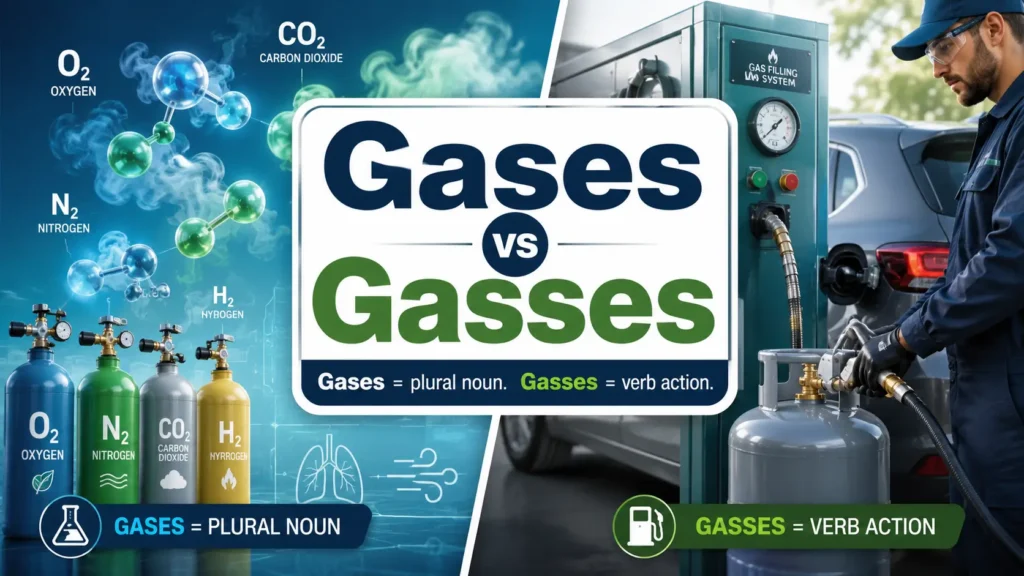
Gases vs. gasses is a common spelling question because both words exist, but they usually perform different jobs. Gases is the standard plural of gas, while gasses is commonly used as the third-person singular form of the verb gas.
For example, oxygen and nitrogen are gases. However, a machine gasses a sealed container when it fills or treats it with gas. Identifying whether the word is a plural noun or a verb form helps you choose the correct spelling.
This distinction matters in scientific writing, school assignments, workplace reports, and everyday communication. Although some dictionaries accept gasses as an alternative plural, gases is the clearer and more widely preferred plural in modern American English. The simple rule is: use gases for substances and gasses for an action.
Quick Answer: Gases or Gasses?
Here’s the most useful rule:
Use gases for multiple substances. Use gasses for an action performed by one person or thing.
| Word | Main role | Meaning | Example |
| gases | Plural noun | More than one gas | The detector identified three gases. |
| gasses | Singular present-tense verb | Fills, treats, or exposes something with gas | The system gasses the container. |
| gasses | Alternative plural noun | More than one gas | Some dictionaries accept this spelling, but it is less common. |
In most situations, the best distinction is simple:
- Multiple forms or types of gas = gases
- A singular subject performs an action = gasses
Therefore, write greenhouse gases, noble gases, and toxic gases. Write the machine gasses, she gasses up the car, or the technician gasses the chamber.
What Does Gas Mean?
Before comparing the spellings, it helps to understand how gas works in a sentence. The word can be a noun or a verb. Its meaning also changes with context.
Gas as a Countable Noun
A countable noun names something you can count as separate units. In science, gas becomes countable when you discuss different substances, samples, or types.
For example:
- Oxygen and nitrogen are gases.
- The experiment produced two colorless gases.
- Several greenhouse gases trap heat in the atmosphere.
- The hospital monitors blood gases in some patients.
In these sentences, the writer refers to more than one gas. Therefore, the plural form is gases.
Common countable uses include:
- noble gases
- industrial gases
- anesthetic gases
- exhaust gases
- greenhouse gases
- dissolved gases
- toxic gases
- compressed gases
Although gas often describes an entire state of matter, each substance can still count as a separate gas.
Gas as an Uncountable Noun
A noun is uncountable when it refers to a substance, material, or general idea rather than separate units. In these cases, gas usually stays singular.
For example:
- The house uses natural gas.
- We smelled gas near the stove.
- The tank contains gas under pressure.
- The patient complained of abdominal gas.
- I need to stop for gas before work.
The final example reflects common American English. In the United States, gas often means gasoline, even though gasoline is a liquid.
You wouldn’t normally say, “I need to buy three gases” when you mean gasoline for your car. Instead, you might say:
- I need to buy gas.
- We used three gallons of gas.
- The station sells several grades of gasoline.
The context determines whether gas should remain singular or become gases.
Gas as a Verb
As a verb, gas can mean:
- to fill a space or object with gas
- to treat a product with gas
- to expose something to gas
- to supply a vehicle with gasoline
- informally, to exhaust someone
The verb changes according to its subject and tense:
| Subject or tense | Form |
| I, you, we, they | gas |
| he, she, it | gasses |
| past tense | gassed |
| present participle | gassing |
Examples include:
- Workers gas the storage area according to the safety procedure.
- The machine gasses each package before sealing it.
- The technician gassed the chamber yesterday.
- The facility is gassing the containers now.
Here, gasses doesn’t name substances. Instead, it describes an action.
The Main Difference Between Gases and Gasses
The clearest difference is grammatical. Gases usually names things, while gasses usually describes what someone or something does.
Gases Usually Names Multiple Substances
The plural noun gases answers questions such as:
- What substances are present?
- How many kinds of gas were detected?
- Which gases entered the atmosphere?
- What gases did the experiment produce?
Consider this sentence:
The sensor detected several dangerous gases.
The word gases names the substances detected by the sensor. Because it refers to more than one gas, the standard spelling is gases.
Here are more examples:
- Scientists measured the gases released by the volcano.
- The atmosphere contains a mixture of gases.
- Some gases are colorless and odorless.
- The company stores compressed gases in marked cylinders.
In each case, gases functions as a plural noun.
Gasses Usually Describes an Action
The verb gasses normally appears after a singular third-person subject. That subject might be he, she, it, a person’s name, or a singular noun.
For example:
- The technician gasses the chamber.
- She gasses up the car every Sunday.
- The machine gasses the package before sealing it.
- This system gasses each container for ten seconds.
The subjects—technician, she, machine, and system—are singular. Therefore, the verb takes its third-person singular form: gasses.
Now compare a plural subject:
- The technician gasses the chamber.
- The technicians gas the chamber.
The first sentence uses gasses because the subject is singular. The second uses gas because the subject is plural.
Why the Noun-vs.-Verb Rule Has an Exception
The simple distinction works in nearly all practical writing. However, English spelling isn’t always perfectly consistent.
Some dictionaries recognize gasses as an alternative plural of gas. As a result, a sentence such as “The laboratory tested several gasses” may not be technically wrong under every dictionary.
Still, gases is much more familiar and widely preferred as the plural noun. It also creates a useful visual distinction:
- gases = plural noun
- gasses = singular verb
For clarity, use that pattern unless a specific publication or style guide tells you otherwise.
When to Use Gases
Use gases whenever you refer to more than one kind, sample, or quantity of gas. This spelling works in formal and informal American English.
Scientific and Technical Writing
Scientific fields strongly favor gases as the plural noun. You’ll see it in chemistry, physics, medicine, environmental science, engineering, and workplace safety.
Common phrases include:
- noble gases
- greenhouse gases
- blood gases
- exhaust gases
- industrial gases
- toxic gases
- dissolved gases
- flue gases
Examples:
- Noble gases have low chemical reactivity.
- The device measures dissolved gases in water.
- Engineers analyzed the engine’s exhaust gases.
- The safety team tested the room for toxic gases.
In technical writing, consistency matters. Using gases keeps the text aligned with standard scientific terminology and reduces confusion.
Academic and Professional Writing
Use gases in essays, reports, presentations, manuals, research papers, and workplace communication.
For example:
- The report identifies the gases released during production.
- Several gases were present in the sample.
- Employees must store compressed gases safely.
- The laboratory records the concentration of each gas.
Even when gasses appears as an accepted plural in a dictionary, it may look unusual to teachers, editors, scientists, and professional readers. Therefore, gases is the safer editorial choice.
Everyday American English
The same rule works in ordinary conversation, email, news writing, and social media.
- Firefighters checked the building for dangerous gases.
- Different gases can collect in a closed room.
- The article explains how greenhouse gases affect the climate.
- We learned about atmospheric gases in science class.
However, use singular gas when you mean the substance generally:
- The detector found gas in the basement.
- The house uses natural gas.
- We stopped for gas on the way home.
When to Use Gasses
Use gasses primarily as a present-tense verb with a singular subject.
Gasses as a Present-Tense Verb
The ending -es marks the third-person singular form of the verb.
Compare these forms:
- I gas the chamber.
- You gas the chamber.
- We gas the chamber.
- They gas the chamber.
- He gasses the chamber.
- She gasses the chamber.
- The machine gasses the chamber.
Examples in full sentences include:
- The system gasses each package before shipment.
- The technician gasses the container according to the procedure.
- The equipment gasses the storage unit automatically.
- The facility gasses certain products during processing.
In each sentence, the subject is singular and performs the action.
Gasses in the Phrase “Gas Up”
In informal American English, gas up means to put gasoline in a vehicle or piece of equipment.
For example:
- She gasses up the car before a long trip.
- Marcus gasses up the truck every Friday.
- My neighbor gasses up his lawn mower in the garage.
- The driver gasses up before leaving town.
This phrase is natural in conversation. However, a formal report might use refuels instead:
- Informal: The driver gasses up the truck.
- Formal: The driver refuels the truck.
Both sentences describe the same basic action, but their tone differs.
Gasses as an Alternative Plural
You may occasionally see gasses used as a plural noun:
- The experiment produced several gasses.
- The container held two different gasses.
Some dictionaries accept this spelling. Nevertheless, most modern edited writing prefers:
- The experiment produced several gases.
- The container held two different gases.
Using gases is especially important in:
- school assignments
- scientific papers
- technical manuals
- environmental reports
- journalism
- professional emails
- business documents
The alternative spelling isn’t always an error. Still, it is less common and may distract readers.
Why Is the Plural Spelled Gases?
English often adds -es to nouns that end in an s sound. The added ending creates another syllable and makes the plural easier to pronounce.
Examples include:
| Singular | Plural |
| gas | gases |
| bus | buses |
| class | classes |
| lens | lenses |
| kiss | kisses |
Therefore:
- gas + es = gases
The spelling produces the pronunciation GAS-iz, with two syllables.
Why Does Gasses Have Two S’s?
The doubled s also appears in other forms of the verb:
- gas
- gasses
- gassed
- gassing
The doubled consonant helps preserve the short vowel sound in gas. However, English spelling develops through both rules and established usage. No single doubling rule explains every accepted form.
The practical result is more important than the history:
- Use gases as the standard plural noun.
- Use gasses as the clearest third-person singular verb.
- Use gassed for the past tense.
- Use gassing for the continuous form or gerund.
Gases vs. Gasses Comparison Table
| Feature | Gases | Gasses |
| Most common grammar role | Plural noun | Third-person singular verb |
| Main meaning | More than one gas | Performs the action of gassing |
| Standard example | Oxygen and nitrogen are gases. | The machine gasses the package. |
| Accepted as a plural | Yes | Accepted by some dictionaries |
| Best choice for science | Yes | Usually no |
| Best choice for formal writing | Yes, as a plural | Yes, as a verb |
| Common in American English | Very common | Common as a verb |
| Pronunciation | GAS-iz | GAS-iz |
| Number of syllables | Two | Two |
Do Gases and Gasses Sound Different?
No. Gases and gasses are usually pronounced the same way: GAS-iz.
Both words have two syllables:
- gas: one syllable
- gases: two syllables
- gasses: two syllables
Because the pronunciation is the same, listeners rely on sentence structure and context.
Compare:
- These gases are dangerous.
- The machine gasses the room.
In the first sentence, these signals a plural noun. In the second, machine is the subject, so gasses functions as a verb.
The difference is visible in writing but usually not audible in speech.
Is Gases vs. Gasses a US and UK Difference?
The spelling difference isn’t mainly about American English versus British English.
Writers in both varieties generally prefer gases as the plural noun. Likewise, gasses can function as the verb form in either variety.
Therefore, these choices work for international readers:
- plural noun: gases
- singular present-tense verb: gasses
Don’t assume that gasses is British and gases is American, or the other way around. That explanation oversimplifies the issue.
A genuine regional difference appears in the meaning of gas:
- In American English, gas commonly means gasoline.
- In British English, drivers usually say petrol.
However, that vocabulary difference doesn’t change the standard plural gases.
Correct Examples of Gases
The following sentences use gases as a plural noun.
Science and School Examples
- Oxygen and nitrogen are atmospheric gases.
- The students tested three unknown gases.
- Some gases become liquids at very low temperatures.
- Greenhouse gases absorb heat in the atmosphere.
- Noble gases appear in the far-right column of the periodic table.
Each sentence refers to multiple substances or types of gas.
Work and Professional Examples
- The monitor detects harmful gases in the warehouse.
- The company stores compressed gases in secure cylinders.
- Engineers measured the gases leaving the exhaust system.
- The report lists all gases used in the production process.
- Employees received training on handling flammable gases.
Here, gases is clear, standard, and appropriate for professional communication.
Everyday Examples
- Some gases don’t have a noticeable smell.
- The firefighters tested the basement for dangerous gases.
- Different gases can build up in a poorly ventilated space.
- We discussed greenhouse gases at dinner.
- The documentary explains how volcanic gases affect air quality.
Correct Examples of Gasses
The following sentences use gasses as a verb.
Equipment and Process Examples
- The machine gasses every package before sealing it.
- The system gasses the chamber for five minutes.
- The technician gasses each sample separately.
- This equipment gasses the storage space automatically.
- The facility gasses certain materials during processing.
The subject in each sentence is singular. As a result, the verb takes the form gasses.
Vehicle and Daily-Life Examples
- Jordan gasses up the car every Monday.
- She gasses up before starting the road trip.
- The driver gasses up at the station near the highway.
- My neighbor gasses up his snow blower before a storm.
These examples use the informal American phrasal verb gas up.
Singular and Plural Subject Examples
Compare how the subject changes the verb:
- The technician gasses the chamber.
- The technicians gas the chamber.
- She gasses up the truck.
- They gas up the truck.
- The machine gasses the packages.
- The machines gas the packages.
Remember that a singular subject takes gasses, while a plural subject takes gas.
Common Mistakes with Gases and Gasses
Several errors appear frequently in schoolwork, online content, and professional drafts.
Using Gasses as the Default Scientific Plural
Less clear:
- Carbon dioxide and methane are greenhouse gasses.
Preferred:
- Carbon dioxide and methane are greenhouse gases.
Some dictionaries may accept the first spelling. However, greenhouse gases is the standard phrase in scientific and environmental writing.
Treating Gasses as Always Wrong
Incorrect assumption:
- “Gasses is never a real word.”
Correct explanation:
- Gasses is a valid verb form.
- Some dictionaries also recognize it as an alternative plural.
For example:
- The machine gasses each container.
Here, changing gasses to gases would make the verb less clear.
Using Gases as a Verb Without Considering Clarity
Some references allow gases as a verb form. Still, gasses usually creates a clearer contrast between the noun and verb.
Less clear:
- The system gases the chamber.
Clearer:
- The system gasses the chamber.
The first may be accepted under some dictionary conventions. However, the second immediately signals a verb to most readers.
Adding an Apostrophe to Form the Plural
An apostrophe doesn’t make a regular noun plural.
Incorrect:
- Several gas’s escaped from the container.
Correct:
- Several gases escaped from the container.
The form gas’s shows possession:
- The gas’s odor was noticeable.
Meanwhile, the plural possessive form is gases’:
- The gases’ effects were carefully measured.
Using the Wrong Subject-Verb Agreement
Incorrect:
- These gases is dangerous.
Correct:
- These gases are dangerous.
Because gases is plural, it needs the plural verb are.
Now compare a sentence in which gasses is the verb:
- The machine gasses each container.
Here, machine is singular, so the verb correctly ends in -es.
Gas, Gases, Gas’s, and Gases’
These forms may look similar, but they perform different jobs.
| Form | Function | Example |
| gas | Singular noun | The gas escaped. |
| gas | Base verb | Workers gas the chamber. |
| gases | Standard plural noun | The gases escaped. |
| gas’s | Singular possessive | The gas’s odor was strong. |
| gases’ | Plural possessive | The gases’ effects were measured. |
| gasses | Third-person singular verb | The machine gasses the chamber. |
| gassed | Past-tense verb | The technician gassed the container. |
| gassing | Present participle or gerund | Gassing the chamber takes ten minutes. |
Apostrophes show possession. They don’t create ordinary plurals.
A Simple Way to Choose the Correct Spelling
Use this short decision process whenever you hesitate.
- Does the word mean more than one gas? Use gases.
- Does one person, machine, or system perform an action? Use gasses.
- Are you writing a scientific, academic, or professional document? Prefer gases as the plural.
- Are you using the past tense? Write gassed.
- Are you using an -ing form? Write gassing.
You can also try a replacement test.
Replace the word with substances:
- The detector found several substances.
- The detector found several gases.
Because the replacement works, you need a plural noun.
Now replace the word with treats or fills:
- The machine treats the package.
- The machine gasses the package.
Because the replacement is a verb, gasses is the clearer form.
Memory Tricks for Gases vs. Gasses
A simple memory aid can prevent mistakes:
Multiple substances are gases. One subject gasses something.
You can also connect the verb forms:
- gassed
- gassing
- gasses
All three use a doubled s.
Another useful trick focuses on sentence role:
- If you can place these before the word, choose gases.
- These gases are harmless.
- If you can place he, she, or it before the word, choose gasses.
- It gasses the container.
These tricks cover most real-life uses.
Related Forms of Gas
Several related words follow different spelling patterns. Learning them can help you avoid nearby mistakes.
Gassed and Gassing
Gassed is the past tense and past participle of gas.
- The technician gassed the chamber yesterday.
- The package was gassed before shipment.
Gassing is the present participle or gerund.
- The machine is gassing the container.
- Gassing the chamber requires careful monitoring.
Both forms double the final s.
Gaseous
Gaseous is an adjective that means “in the form of gas” or “related to gas.”
Examples:
- Water can exist in a gaseous state.
- The reaction produced a gaseous substance.
- The material changes from liquid to gaseous form.
The correct spelling is gaseous, not gasseous.
Gassy
Gassy can describe something that contains, produces, or resembles gas.
Examples:
- The mixture became gassy during fermentation.
- The drink tasted unusually gassy.
- He felt gassy after dinner.
In health-related conversation, gassy is common but informal. A medical document may use more precise wording, such as abdominal gas or bloating.
Gasify, Gasified, and Gasification
Gasify means to convert a solid or liquid into gas.
- The process gasifies the material.
- The plant gasified the fuel.
- Gasification converts carbon-based material into a fuel gas.
These words appear mainly in scientific, industrial, and engineering contexts.
Synonyms and Related Words
Words such as vapor, fumes, and emissions relate to gas, but they aren’t always exact synonyms.
| Word | General meaning | Usage note |
| gas | A substance in the gaseous state | Broad scientific term |
| vapor | The gas phase of a substance often found as a liquid or solid | Common with water, fuel, and chemicals |
| fumes | Gas, smoke, or vapor that may smell strong or be harmful | Often suggests danger or irritation |
| emissions | Substances released into the air | May include gases and solid particles |
| exhaust | Waste material released by an engine or machine | Can include gases and particles |
| air | The mixture of gases surrounding Earth | Not a synonym for every type of gas |
| gasoline | Liquid fuel used in many vehicles | Informally called gas in American English |
| steam | Water vapor, often mixed with tiny water droplets | Not a general synonym for gas |
Choose the word that matches the exact meaning.
For example:
- Water vapor is more precise than “water gas.”
- Vehicle emissions may include both gases and particles.
- Fumes often suggests an unpleasant or harmful airborne substance.
- Air is a mixture of gases, not one individual gas.
- Gasoline is a liquid even though Americans commonly call it gas.
Real-Life Editing Cases
The best spelling often becomes obvious when you identify the word’s role.
Chemistry Assignment
Original:
The experiment produced three gasses.
Recommended edit:
The experiment produced three gases.
The word names three substances, so it functions as a plural noun. Scientific writing strongly favors gases.
Workplace Procedure
Original:
The machine gases each package before sealing it.
Recommended edit:
The machine gasses each package before sealing it.
Here, the word describes the machine’s action. Although some dictionaries may allow gases as a verb, gasses makes the sentence easier to understand.
Environmental Report
Original:
The company reduced its greenhouse gasses.
Recommended edit:
The company reduced its greenhouse gases.
Greenhouse gases is the standard environmental and scientific phrase.
Road-Trip Text Message
Example:
Sam gasses up while we buy snacks.
The phrase gasses up is natural in informal American English. In a formal business record, refuels may fit better.
Safety Email
Original:
We detected gas in two areas, and both gasses require further testing.
Recommended edit:
We detected gas in two areas, and both gas samples require further testing.
Although gases could work, gas samples may be more precise if the writer means two collected samples rather than two different chemical substances.
This example shows an important editing principle: sometimes the best correction involves choosing a clearer noun, not simply changing the spelling.
Frequently Asked Questions
Is Gasses a Misspelling?
No. Gasses is a valid word.
It most commonly functions as the third-person singular form of the verb gas:
- The machine gasses the package.
Some dictionaries also accept gasses as a plural noun. However, gases is the preferred plural in most modern writing.
What Is the Correct Plural of Gas?
The standard plural of gas is gases.
For example:
- oxygen and nitrogen are gases
- greenhouse gases
- toxic gases
- noble gases
Although gasses appears as an alternative plural in some references, gases is the safest choice.
Is It Greenhouse Gases or Greenhouse Gasses?
Write greenhouse gases.
This is the standard phrase in scientific, environmental, government, academic, and news writing.
Example:
- Carbon dioxide and methane are greenhouse gases.
Is It Exhaust Gases or Exhaust Gasses?
Write exhaust gases in technical and professional contexts.
For example:
- Engineers analyzed the engine’s exhaust gases.
You may also use exhaust as a general mass noun:
- The sensor measures substances in the vehicle’s exhaust.
Can Gases Be a Verb?
Some dictionaries recognize gases as a possible verb spelling. However, gasses usually creates a clearer distinction between the verb and the plural noun.
For clarity:
- plural noun: The container holds several gases.
- verb: The system gasses the container.
Is Gasses American or British English?
Gasses isn’t exclusively American or British.
Both American and British writers generally use gases as the plural noun. The word gasses can function as a verb in either variety.
The regional difference concerns gas and petrol, not the plural spelling:
- American English: gas
- British English: petrol
Why Does Gasses Have Two S’s?
The doubled s connects gasses with other forms of the verb:
- gassed
- gassing
- gasses
The doubling also helps preserve the short vowel sound in gas. However, conventional usage matters more than one universal spelling rule.
Do Gases and Gasses Have the Same Pronunciation?
Yes. Both are normally pronounced GAS-iz.
The listener understands the meaning through grammar and context:
- These gases are dangerous.
- The machine gasses the room.
What Is the Possessive Form of Gas?
The singular possessive is gas’s:
- The gas’s odor was noticeable.
The plural possessive is gases’:
- The gases’ effects were measured.
The ordinary plural doesn’t need an apostrophe:
- Several gases were present.
Which Spelling Should Students Use?
Students should use:
- gases for the plural noun
- gasses for the singular present-tense verb
This distinction is clear, widely accepted, and appropriate for school assignments.
Is It Natural Gases or Natural Gas?
Both forms can be correct, but they mean different things.
Natural gas usually names the fuel as a general substance:
- The house uses natural gas.
Natural gases may refer to several naturally occurring gaseous substances:
- The researchers studied several natural gases found underground.
In most household and energy contexts, use the singular phrase natural gas.
Should I Write Types of Gas or Types of Gases?
Both phrases are possible.
Types of gas treats gas as a general category:
- The course covers several types of gas.
Types of gases emphasizes separate gaseous substances:
- The detector can identify several types of gases.
In many scientific sentences, the shorter phrase types of gas sounds more natural. However, the best choice depends on the intended emphasis.
Conclusion: How to Choose Between Gases and Gasses
The difference between gases vs. gasses becomes simple once you identify the word’s role.
Use gases when you mean more than one gas. This is the standard plural in American English, especially in scientific, academic, environmental, and professional writing. Common examples include greenhouse gases, noble gases, toxic gases, and exhaust gases.
Use gasses when a singular person, machine, or system performs the action of the verb gas. For example, “The machine gasses each package” and “She gasses up the car” both use the verb correctly.
Some dictionaries recognize gasses as an alternative plural and gases as a possible verb form. Even so, the clearest modern convention is easy to remember:
Multiple substances are gases. One person or thing gasses something.
Frequently Asked Questions
Q1. What is the correct plural of gas?
The standard plural of gas is gases.
Examples include:
- Oxygen and nitrogen are gases.
- The detector found several harmful gases.
- Greenhouse gases affect Earth’s climate.
Although some dictionaries recognize gasses as an alternative plural, gases is the preferred spelling in scientific, academic, and professional writing.
Q2. Is gasses a correct word?
Yes, gasses is a correct word. It usually functions as the third-person singular form of the verb gas.
For example:
- The machine gasses each package.
- She gasses up the car before work.
- The technician gasses the chamber carefully.
In these examples, a singular subject performs an action.
Q3. What is the main difference between gases and gasses?
The main difference is their usual grammatical role.
| Word | Usual role | Example |
| gases | Plural noun | The test detected two gases. |
| gasses | Singular present-tense verb | The system gasses the container. |
Use gases when naming more than one gas. Use gasses when one person, machine, or system performs the action of gassing.
Q4. Is it greenhouse gases or greenhouse gasses?
The correct and preferred phrase is greenhouse gases.
For example:
- Carbon dioxide and methane are greenhouse gases.
- The company plans to reduce its greenhouse gas emissions.
Because the phrase refers to several gaseous substances, it requires the plural noun gases.
Q5. Is gases vs. gasses an American and British English difference?
No. The distinction is not mainly a difference between American English and British English.
Writers in both varieties generally use gases as the standard plural noun. They may use gasses as a verb. Therefore, the clearest international pattern remains:
- gases for the plural noun
- gasses for the singular verb
Q6. Can gasses be used as a plural noun?
Some dictionaries accept gasses as an alternative plural of gas. Therefore, it is not always technically incorrect.
However, gases is much more common and easier for readers to recognize. Use gases in lab reports, essays, technical documents, news articles, and professional communication.
Q7. Why is the plural of gas spelled gases?
The plural usually takes -es because gas ends in an “s” sound.
The pattern is similar to:
- bus → buses
- class → classes
- lens → lenses
- gas → gases
The added ending also creates another syllable. Gases is normally pronounced “GAS-iz.”
Q8. Why does gasses have two s’s?
The doubled s appears in common verb forms of gas:
- gas
- gasses
- gassed
- gassing
This spelling also helps distinguish the verb gasses from the plural noun gases. English spelling has exceptions, so the distinction is based partly on established usage.
Q9. What is the difference between gas’s, gases, and gases’?
These forms have different grammatical functions.
- gas’s is the singular possessive form: “The gas’s odor was strong.”
- gases is the standard plural: “Several gases were present.”
- gases’ is the plural possessive form: “The gases’ effects were measured.”
An apostrophe shows possession. It does not create the ordinary plural of gas.
Q10. What is the easiest way to remember gases vs. gasses?
Use this memory rule:
Multiple substances are gases, but one person or machine gasses something.
You can also test the word in the sentence. If you can replace it with substances, use gases. If you can replace it with fills, treats, or another action verb, use gasses.
Conclusion
The difference between gases vs. gasses becomes clear when you check how the word functions in the sentence. Gases is the standard plural noun for more than one gas. Therefore, write greenhouse gases, noble gases, toxic gases, and exhaust gases.
By contrast, gasses usually works as a verb form. It describes an action performed by a singular person, machine, or system, as in “The machine gasses each package.”
Although gasses may appear as an alternative plural in some dictionaries, gases is the clearest choice for modern scientific writing, academic work, and professional communication. Remember the practical rule: multiple substances are gases, while one subject gasses something.
Basic SEO Settings
SEO Title: Gases vs. Gasses: Meaning, Difference, and Correct Usage
Slug: gases-vs-gasses
Meta Description: Learn the difference between gases and gasses, when to use each spelling, and how to avoid common noun and verb mistakes in English.
Tags: gases vs gasses, gases or gasses, plural of gas, English spelling, confusing words, grammar rules, noun and verb forms, American English

1 thought on “Gases vs. Gasses: Which Spelling Is Correct?”