
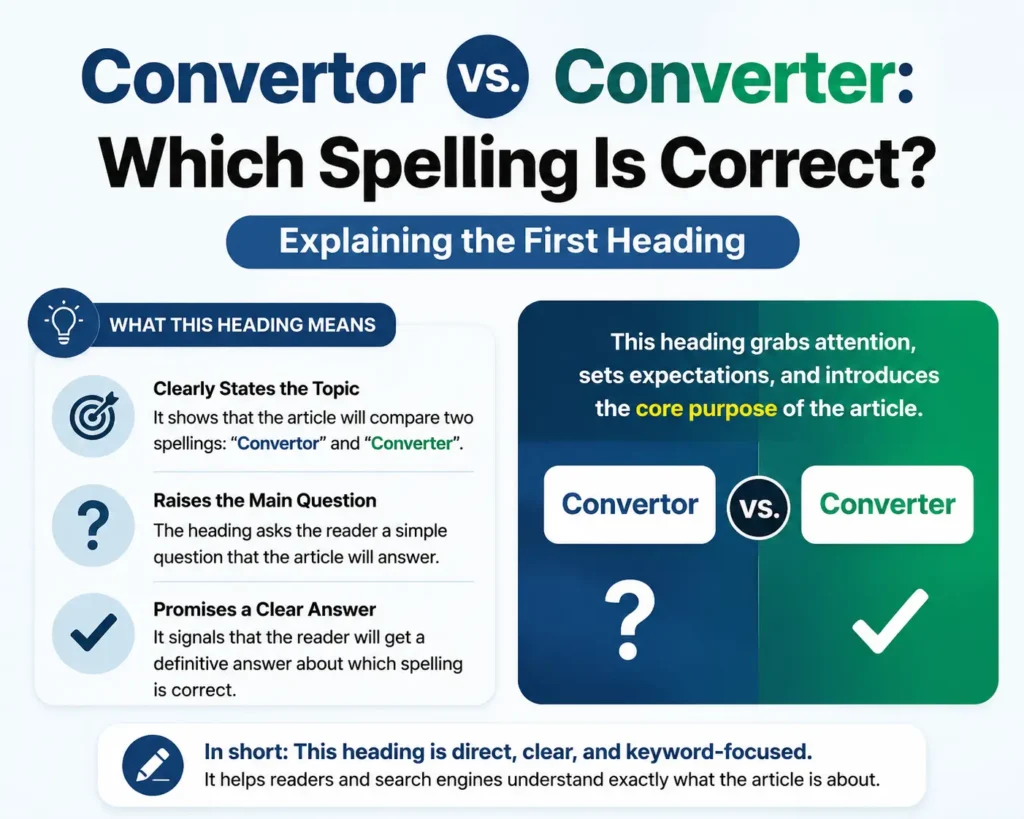
Convertor vs. Converter is simple: converter is the standard spelling, while convertor is a less common variant used in limited technical usage.
Both words are nouns and have the same meaning: a person, device, or tool that can convert one form into another. However, converter is the preferred form in modern English, everyday writing, academic writing, business communication, technology, electronics, and engineering. It is also common in digital tools, apps, and conversion tools.
Use convertor only when it appears in an official name or specialized source. For clear language and accurate usage, keep one spelling throughout your document. This simple spelling choice reduces reader confusion, supports professional writing, and helps students, writers, business owners, and English learners choose the correct word with writing confidence. This also makes online content easier to read and understand. When unsure, check trusted dictionaries before publishing.
Quick Answer: Convertor or Converter?
Use “converter” in almost every situation. “Convertor” is a recognized alternative spelling, but it is less common and may look unusual to many readers.
Here is the main difference at a glance:
| Point | Converter | Convertor |
| Is it a real word? | Yes | Yes, as a variant |
| Meaning | A person or thing that converts | Usually the same |
| Status in dictionaries | Main spelling | Alternative spelling |
| American English usage | Standard | Uncommon |
| British English usage | Standard | Uncommon variant |
| Best choice for general writing | Yes | Usually no |
| Possible specialized use | Common | Sometimes used |
| Pronunciation | kuhn-VUR-ter | The same |
Major American and British learner dictionaries list converter as the main form. They may also show convertor as an alternative. Merriam-Webster gives the variant a more specific technical role in some electrical and radio senses.
What Does “Converter” Mean?
Converter is a countable noun. It means a person, device, machine, program, or tool that changes something from one form into another.
The word comes from the verb convert, which means “to change.” For example, you can convert dollars into euros, convert a file into another format, or convert a spare room into an office.
A converter performs or enables that change.
Part of Speech, Pronunciation, and Plural
- Part of speech: noun
- Singular: converter
- Plural: converters
- American pronunciation: kuhn-VUR-ter
- Stress: the second syllable, VUR
Both spellings have the same pronunciation. Therefore, you cannot hear the difference in conversation. You only notice it in writing.
The Basic Grammar Pattern
The usual word-building pattern is simple:
convert + -er = converter
The ending -er often creates an “agent noun.” An agent noun names someone or something that performs an action.
Consider these examples:
| Verb | Person or thing that performs the action |
| teach | teacher |
| printer | |
| scan | scanner |
| mix | mixer |
| convert | converter |
This pattern helps explain why converter feels natural to most English readers. Still, English spelling is shaped by usage, not by one rule alone.
Words such as actor and editor end in -or. As a result, some people naturally wonder whether convertor follows the same pattern.
Read this also: Comment vs. Coment: Which Spelling Is Correct?
Common Meanings of “Converter”
A converter can change a form, format, measurement, signal, or type. Common uses include:
- A power converter that changes electrical energy
- A file converter that changes data formats
- A currency or unit converter that calculates equivalent values
- A catalytic converter in a vehicle’s exhaust system
- A person or company that converts raw materials into usable products
Examples:
The technician replaced the damaged power converter.
I used a PDF converter to change the document into an image.
The recipe uses grams, so open a unit converter.
In every example, the converter performs a change. The specific type of change depends on the context.
Is “Convertor” a Correct Word?
Yes, convertor appears in respected dictionaries. It is not automatically a misspelling. However, that fact needs context.
A dictionary may record a form because people use it. That does not mean the form is equally common, equally preferred, or equally suitable in every type of writing.
The American Heritage Dictionary identifies convertor as a variant of converter. Cambridge and Oxford also show it as an alternative form, while keeping converter as the main entry.
As a result, these two statements can both be true:
- Convertor is a recognized word.
- Converter is the better spelling for most readers.
That distinction matters. A word can be valid but still be rare, specialized, dated, or unexpected.
Converter vs. Convertor: The Key Differences
The two words usually share the same meaning. Their main difference involves frequency, convention, and context.
| Feature | Converter | Convertor |
| Core meaning | One that converts | One that converts |
| Pronunciation | Same | Same |
| Main dictionary form | Yes | No, usually a variant |
| General American English | Normal and expected | Rare |
| General British English | Normal and expected | Rare |
| Technology writing | Standard | Occasionally appears |
| Engineering writing | Standard in most contexts | May appear in a narrow tradition |
| School and academic work | Recommended | Risky unless required |
| Branding and official names | Use when chosen officially | Preserve when official |
| Reader familiarity | High | Lower |
| Chance of being viewed as a typo | Low | Higher |
The difference is not usually about meaning. Instead, it is about which spelling readers expect.
Why “Converter” Is the Preferred Spelling
Several practical reasons support converter.
It Is the Main Dictionary Form
Major dictionaries lead with converter. Even when they recognize convertor, they usually treat it as the secondary form.
That makes the headword the safest choice for general writing.
It Follows a Familiar Pattern
The verb is convert, and the common agent ending is -er. Therefore, converter resembles printer, scanner, and reader.
The pattern is not absolute. Still, it is a useful memory aid.
It Looks Familiar
Readers often see phrases such as:
- File converter
- Currency converter
- Power converter
- Video converter
- Unit converter
- Catalytic converter
Because these phrases are familiar, converter supports fast, clear reading. It also avoids the chance that readers will mistake convertor for a typo.
It Reduces Unnecessary Doubt
Clear writing should not force readers to stop and question a basic spelling.
Although convertor may be defensible, many people will assume it is an error. Using converter removes that distraction and creates a more polished result.
Is “Convertor” British and “Converter” American?
No. This is not a standard British-versus-American spelling pair.
True regional pairs include:
| American English | British English |
| color | colour |
| center | centre |
| organize | organise or organize |
| traveling | travelling |
However, converter is the normal spelling in both American and British English. Oxford’s British and American learner entries both use converter as the headword and mention convertor as an alternative.
Therefore, avoid this incorrect rule:
Incorrect claim: “Converter is American, while convertor is British.”
A more accurate explanation is:
Correct explanation: “Converter is standard in both varieties. Convertor is a less common alternative.”
When You Should Use “Converter”
Use converter by default unless you have a clear reason not to.
In School and Academic Writing
Students should normally write converter in essays, tests, lab reports, and research papers.
Preferred:
The circuit uses an analog-to-digital converter.
Less advisable:
The circuit uses an analog-to-digital convertor.
The second spelling may be recognized. However, the first is more standard and less likely to be marked as an error.
If your teacher, textbook, or academic department requires a specific term, follow that guidance. Otherwise, choose converter.
In Business and Professional Writing
Choose converter in:
- Emails
- Proposals
- Reports
- Product descriptions
- Training material
- Technical instructions
- Presentations
Example:
Please confirm that the new power converter meets the required specifications.
This spelling looks professional and familiar. It also keeps terminology consistent across departments and documents.
In Technology and Software
Use converter for tools that change data or files.
Common examples include:
- Image converter
- Audio converter
- Video converter
- Document converter
- File converter
- Data converter
Sentence example:
The image converter supports JPG, PNG, and WebP files.
The term is clear even for readers who do not have technical knowledge.
In Automotive Writing
Use catalytic converter.
Correct:
Thieves stole the catalytic converter from the truck.
Not recommended:
Thieves stole the catalytic convertor from the truck.
Even though readers may understand the second version, it does not match the familiar name of the vehicle part. A catalytic converter helps reduce harmful substances in vehicle exhaust.
In General Online Content
Bloggers, editors, and website owners should prefer converter because readers recognize it quickly.
Spelling should serve clarity first, not a guessed search advantage. Use the form your audience expects.
When “Convertor” May Be Appropriate
Although converter is the default, convertor can be appropriate in limited situations.
An Official Product or Company Name
Names should usually keep their official spelling.
Suppose a manufacturer calls a product the Universal Signal Convertor. In that case, changing Convertor to Converter could make the product name inaccurate.
Example:
The manual covers installation of the Universal Signal Convertor.
Here, the unusual spelling is intentional because it belongs to the official name.
You may still use the standard spelling when referring to the product by its general category:
The Universal Signal Convertor is a compact signal converter.
The first term is the official name. The second is a general noun.
A Technical Glossary Requires It
Some organizations use internal terminology. A company, engineering team, or standards document may define convertor for a specific device.
When that happens, follow the approved glossary. Consistency matters more than personal preference within controlled documentation.
However, confirm the requirement first. Do not assume every engineering context needs convertor.
A Source Title Uses the Variant
Keep the original spelling in:
- Book titles
- Article titles
- Patent titles
- Report titles
- Bibliographic references
- Direct quotations
Changing the spelling inside a title or quotation can misrepresent the source.
Historical Material Uses It
Older documents may use spelling conventions that differ from current practice. When quoting or discussing them, preserve the original wording.
You may add a short explanation if modern readers could mistake the form for an error.
Correct Examples of “Converter” in Sentences
The following examples show how converter works in everyday American English.
Technology
This file converter changes Word documents into PDFs.
The noun names software that changes a file’s format.
School
Mia used a temperature converter to change Celsius to Fahrenheit.
Here, the converter calculates an equivalent value.
Work
Please check the currency converter before submitting the travel budget.
The term fits ordinary professional communication.
Conversation
Do you know a good audio converter?
This sounds natural in casual American English.
Social Media
I found a video converter that works without creating a watermark.
The noun identifies an online or downloadable tool.
Automotive Use
The repair shop replaced the catalytic converter.
The phrase is the established name of the vehicle part.
Engineering
The system sends the signal through an analog-to-digital converter.
The converter changes an analog signal into digital data.
Limited Examples of “Convertor” in Sentences
These examples show contexts where the variant may have a reason.
The diagram labels the component as a “frequency convertor.”
The writer preserves the label used in the original diagram.
The museum displayed an early electrical convertor.
A historical label or source may use the variant spelling.
The company sells the device under the name PowerMax Convertor.
The word remains unchanged because it belongs to a product name.
The research paper’s title uses the spelling “signal convertor.”
A citation should reproduce the original title accurately.
Without one of these special reasons, converter would normally be better.
Common Mistakes with Convertor and Converter
Saying “Convertor” Is Never a Word
This claim is too strong.
Incorrect explanation:
Convertor is always misspelled.
Better explanation:
Convertor is a recognized but uncommon variant of converter.
Accuracy matters, especially in grammar content. You can recommend one form without pretending the other does not exist.
Treating Both Spellings as Equal
The spellings may share a meaning, but they do not have equal status in normal usage.
Converter is familiar and standard. Convertor is less common and more likely to look wrong.
Therefore, “both are correct” is incomplete advice. A helpful answer must also tell readers which one to choose.
Mixing the Forms in One Document
Inconsistent terminology creates doubt.
Inconsistent:
Connect the converter to the outlet. The convertor will start after five seconds.
Revised:
Connect the converter to the outlet. The converter will start after five seconds.
The revision is easier to follow because one device has one name.
Assuming Every “-or” Noun Creates a Rule
Words such as actor, editor, and instructor end in -or. However, that does not mean every related noun must use the same ending.
English developed through several languages and historical patterns. As a result, suffix spelling is not always predictable.
When uncertain, check the main dictionary form rather than guessing from a similar word.
Using “Convertor” to Sound More Technical
A rarer spelling is not automatically more professional.
In fact, convertor can look less polished when the field normally uses converter. Technical writing values precision and consistency, not unusual wording.
Changing an Official Name
The opposite mistake also occurs. An editor may “correct” Convertor inside a registered or official name.
Before changing it, check the source. A name can intentionally use a nonstandard or uncommon spelling.
Choosing a Spelling Only for SEO
Writers sometimes assume they should repeat both spellings throughout a page. However, that can make the writing sound unnatural.
Use converter in the main text. You can mention convertor when explaining the spelling difference, but do not switch between the forms without a reason.
Grammar Tips for Using “Converter”
Use an Article with a Singular Countable Noun
Because converter is countable, a singular form usually needs an article or another determiner.
Correct:
- I bought a converter.
- The technician tested the converter.
- This device includes one converter.
- We replaced our converter.
Incorrect in normal prose:
- I bought converter.
The last sentence lacks a determiner.
Form the Plural with “-s”
The plural is converters.
Correct:
The store sells several travel converters.
The rare variant forms its plural in the same way: convertors.
Use the Right Preposition with “Convert”
The noun is converter, but the related verb is convert.
Common verb patterns include:
- Convert A into B
- Convert from A to B
- Convert between A and B
Examples:
The app converts PNG files into PDFs.
You can convert the temperature from Celsius to Fahrenheit.
This tool converts between metric and US customary units.
The patterns describe either the result, the direction of change, or movement between two systems.
Hyphenate Multiword Modifiers When Needed
A phrase before a noun may need hyphens for clarity.
Example:
The system includes an analog-to-digital converter.
The connected words act together as one modifier describing converter.
However, ordinary open compounds may not need hyphens:
- Currency converter
- File converter
- Power converter
- Video converter
- Voltage converter
Keep Capitalization Consistent
Use lowercase for the general noun:
We ordered a new signal converter.
Capitalize the word only when it appears in a title, heading, or official name:
Download Pro Video Converter.
Converter, Adapter, Inverter, and Transformer
These words are related, but they are not perfect synonyms.
| Term | Basic meaning | Everyday example |
| Converter | Changes one form, format, unit, signal, or type into another | Voltage converter |
| Adapter | Helps parts or systems connect | Plug adapter |
| Inverter | Commonly changes direct current into alternating current | Solar power inverter |
| Transformer | Changes AC voltage | Step-down transformer |
| Transducer | Changes one form of energy or signal into another | Microphone |
| Encoder | Changes information into a coded form | Video encoder |
A travel adapter, for example, may only change the plug shape. It may not change the voltage. Therefore, calling every adapter a converter could be misleading.
Similarly, an inverter is a conversion device with a more specific electrical function. The US Department of Energy describes an inverter as equipment that converts direct current into alternating current.
Use the narrow term when the technical distinction matters.
Synonyms and Related Words
Possible alternatives include adapter, transformer, inverter, transducer, translator, and processor. However, each word has a narrower meaning, so none replaces converter in every context.
For example, a translator may convert language. Meanwhile, a transducer changes one type of energy or signal into another.
Related Words
| Word | Part of speech | Meaning |
| convert | verb | To change something into another form |
| convert | noun | A person who adopts a new belief or practice |
| converted | adjective or verb form | Changed into another form |
| converting | verb form | Performing the process of change |
| conversion | noun | The act or process of converting |
| convertible | adjective or noun | Able to be converted; something designed to change form |
| converter | noun | A person or thing that converts |
Notice that the noun convert can also mean a person who has adopted a new religion, belief, or habit.
Its pronunciation changes because the stress moves to the first syllable: CON-vert. By contrast, the verb is pronounced con-VERT.
A Practical Editing Case Study
Consider a fictional software company preparing a product page.
The first draft says:
Our online convertor changes image files into PDF documents. The converter works on phones and laptops. Try the Image Convertor today.
The meaning is clear, but the spelling changes three times. The product name is also uncertain.
An editor would first ask whether Image Convertor is an official brand name.
If it is not official, the improved version should read:
Our online converter changes image files into PDF documents. The converter works on phones and laptops. Try the image converter today.
The revision improves consistency and follows standard usage.
However, suppose Image Convertor is the registered product name. Then the editor should preserve that name while using the common spelling generically:
Image Convertor is an online converter that changes image files into PDF documents.
This example shows why context matters. The general noun uses converter, while the official name keeps its chosen spelling.
Easy Memory Tricks
Add “-er” to “Convert”
Remember the basic pattern:
convert + er = converter
This is the simplest memory trick.
Think of Familiar Online Tools
Picture common phrases:
- PDF converter
- Currency converter
- Video converter
- Unit converter
The repeated -er ending makes the standard spelling easier to remember.
Use the Reader Test
Ask yourself:
Which spelling will look familiar to the average reader?
In nearly every general context, the answer is converter.
Remember the Exception Rule
Use this short rule:
Choose converter unless an official or specialized source requires convertor.
A Quick Editing Checklist
Before submitting your writing, ask these questions:
- Did I use converter as the default spelling?
- Is convertor part of an official name?
- Does a required technical glossary specify convertor?
- Am I reproducing an original title or quotation?
- Did I use one spelling consistently?
- Will my intended audience recognize the term immediately?
If no special exception applies, choose converter.
Frequently Asked Questions
Q1. Is “convertor” a correct word?
Yes, convertor is listed as a variant in some dictionaries. However, it is much less common than converter and may look like a spelling mistake to many readers.
Q2. Which is correct: convertor or converter?
Converter is the standard and preferred spelling. It is the safest choice for general, academic, technical, and professional writing.
Q3. Is “convertor” the British spelling of “converter”?
No. Converter is standard in both American and British English. Convertor is only a less common alternative spelling.
Q4. Can I use “convertor” and “converter” interchangeably?
They usually have the same meaning, but they are not equally common. Use converter unless convertor appears in an official name, quotation, or required technical term.
Q5. What is an example of a converter?
A converter can be a file converter, currency converter, power converter, video converter, or catalytic converter. Each one changes something from one form, format, unit, or type into another.
Conclusion
The difference between convertor vs. converter is mainly about standard usage. Converter is the correct and preferred spelling in modern American and British English. It works best in school, business, technology, engineering, and everyday writing.
Convertor is a recognized but uncommon variant. You may see it in older documents, technical material, or official product names. However, unless a specific source requires it, choose converter and use the same spelling throughout your content.
