
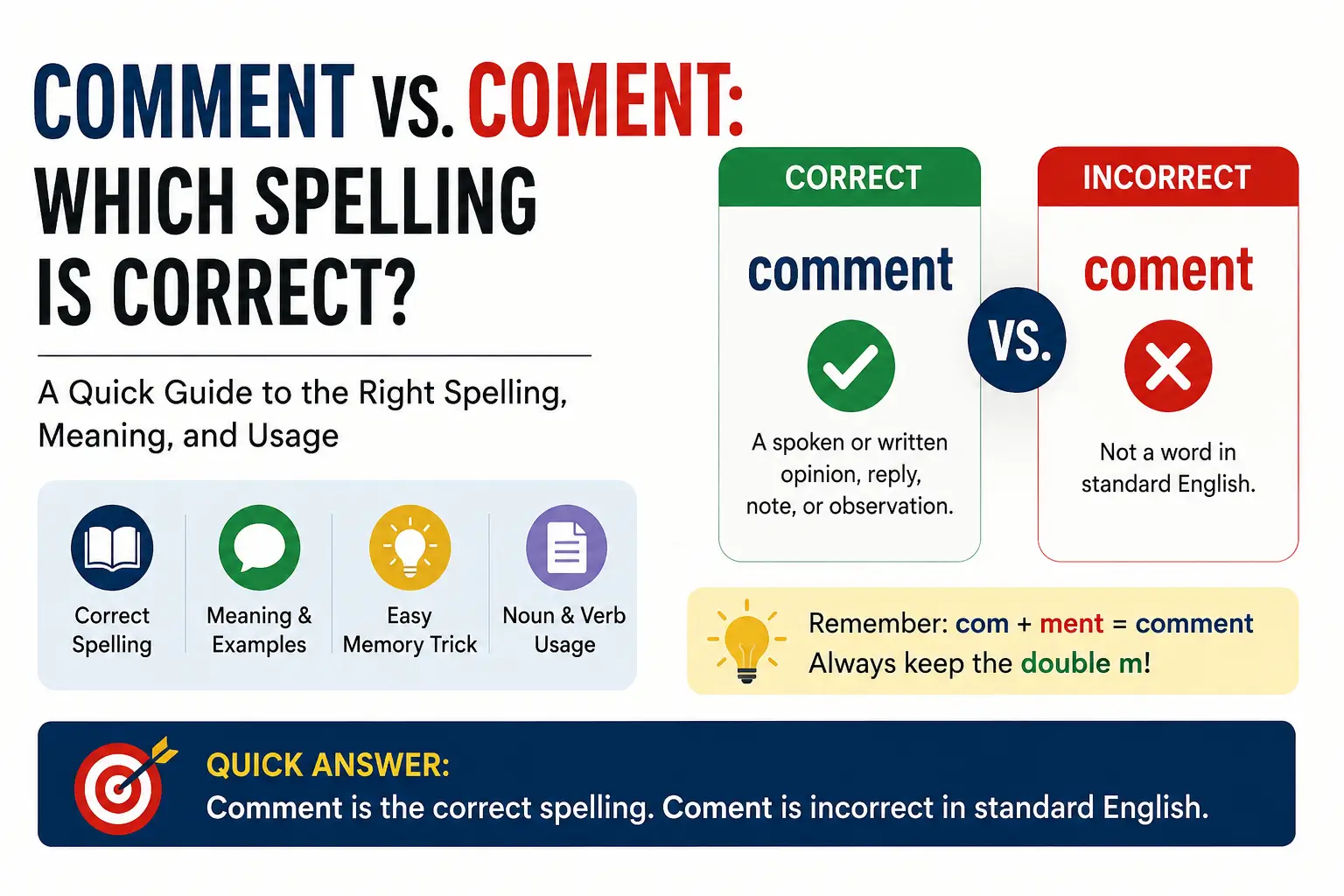
The comment vs coment choice is simple: comment is the correct English spelling, while coment is only a common error caused by a missing letter. Standard dictionaries recognize comment, which can mean a spoken or written opinion, reply, note, or observation.
Use comment as a noun in “She left a comment,” or as a verb in “He commented on the report.” The spelling stays the same in formal writing, academic work, professional emails, social media, and programming. Always keep the double m in comment, commented, and commenting. This rule supports clear, credible communication in every setting.
The mistake often happens during fast typing or when writers rely on sound instead of spelling. Remember com + ment to avoid the single-m form. Before you submit schoolwork or send a business message, check for coment, comented, and comenting, then replace them with the correct forms. This quick check helps readers trust your writing.
Quick Answer: Is It Comment or Coment?
Comment is the correct spelling.
Coment is incorrect in standard English.
| Word | Status | Meaning | Example |
| Comment | Correct | A spoken or written opinion, observation, or response | She left a helpful comment. |
| Coment | Incorrect | No standard English meaning | She left a helpful coment. |
| Comments | Correct plural | More than one opinion or response | I read all the comments. |
| Commented | Correct past tense | Expressed an opinion or observation | He commented on the report. |
| Commenting | Correct continuous form | Expressing an opinion | They are commenting on the news. |
The easiest rule to remember is:
Comment has two m’s in the middle: com + ment.
Read this also: IKK Meaning in Text: What Does IKK Mean in Texting?
What Does Comment Mean?
The word comment means a spoken or written remark about a person, subject, event, or piece of work.
A comment may express:
- An opinion
- A reaction
- An observation
- A suggestion
- A criticism
- A question
- A response
- A brief explanation
For example:
- Maya made a thoughtful comment during the meeting.
- The teacher wrote several comments on my essay.
- Please comment on the proposed schedule.
- Hundreds of people commented on the video.
The exact meaning depends on the situation. However, the central idea remains the same: someone is sharing a thought or reaction about something.
Comment as a Noun
As a noun, comment refers to the remark itself.
Consider this sentence:
Daniel made a useful comment about the presentation.
Here, comment names the thing Daniel said. Therefore, it functions as a noun.
Other noun examples include:
- Her comment made everyone laugh.
- I received a positive comment from my supervisor.
- That comment sounded rude.
- The editor added a comment beside the paragraph.
- We welcome your questions and comments.
Because comment is a countable noun, you can use it with numbers and articles.
Correct forms include:
- A comment
- One comment
- Several comments
- Many comments
- A few comments
Incorrect:
- She gave me an advice and a comment.
Correct:
- She gave me some advice and a comment.
The word advice is generally uncountable, but comment is countable.
Comment as a Verb
As a verb, comment means to express an opinion, observation, or reaction.
For example:
The manager commented on the team’s progress.
In this sentence, commented describes what the manager did. Therefore, it functions as a verb.
Common verb forms are:
| Verb form | Example |
| Base form | I often comment on industry news. |
| Third-person singular | She comments on every draft. |
| Past tense | He commented on the error. |
| Past participle | Several experts have commented on the change. |
| Present participle | They are commenting on the proposal. |
The verb often appears with the preposition on:
- Comment on a post
- Comment on an idea
- Comment on a report
- Comment on someone’s behavior
- Comment on current events
For example:
- Would you comment on the new policy?
- The coach refused to comment on the decision.
- Several readers commented on the article.
The Correct Spelling: Why Comment Has Two M’s
The word comment comes into English through French and Latin roots. However, you don’t need to study its history to spell it correctly.
Simply divide it into two visual parts:
com + ment = comment
The first part ends with m, and the second part begins after it. Together, they create the double m.
This pattern also stays consistent in related forms:
- Comment
- Comments
- Commented
- Commenting
- Commenter
- Commentary
You should never remove one of the m’s when adding an ending.
Incorrect:
- Comented
- Comenting
- Comentary
Correct:
- Commented
- Commenting
- Commentary
Is Coment a Real English Word?
Coment is not the standard English spelling of comment. In normal American English writing, it should be treated as an error.
You may still see coment in:
- Misspelled social media posts
- Quick text messages
- Usernames
- Brand names
- Website addresses
- Writing by English learners
- Text translated from another language
- Typing errors
However, seeing a misspelling online doesn’t make it correct.
A search engine may understand that someone who types coment probably means comment. Similarly, a phone may autocorrect the word. Still, neither situation changes the accepted spelling.
Use comment in school assignments, emails, articles, reports, captions, messages, and professional documents.
Why Do People Write Coment?
Most people write coment because the second m is easy to overlook.
When spoken aloud, the two m’s don’t sound like two separate consonants. The word sounds smooth and continuous. As a result, some writers spell it according to sound rather than standard spelling.
Several other factors may cause the mistake.
Fast Typing
A writer may press the m key only once while typing quickly.
For example:
- “Leave a coment below.”
The sentence makes sense, but the spelling is wrong.
Correct:
- “Leave a comment below.”
Influence From Other Languages
Words related to comment may use different spellings in other languages. Therefore, multilingual writers may transfer a familiar spelling pattern into English.
That’s a normal learning issue. However, standard English still requires comment with two m’s.
Weak Double-Consonant Awareness
English contains many words with doubled consonants, such as:
- Address
- Beginning
- Occur
- Recommend
- Success
- Committee
Writers often miss one of the repeated letters because both spellings may look believable at first glance.
Informal Online Writing
Spelling errors appear frequently in texts, captions, and social media replies. People often focus on speed rather than accuracy.
However, repeated exposure to incorrect spelling can make it look familiar. That familiarity may cause the error to appear in formal writing later.
Comment vs. Coment Comparison Table
| Feature | Comment | Coment |
| Correct English spelling | Yes | No |
| Number of m’s | Two | One |
| Can function as a noun | Yes | No |
| Can function as a verb | Yes | No |
| Accepted in formal writing | Yes | No |
| Accepted in academic writing | Yes | No |
| Used on social media | Yes | Appears only as an error or name |
| Standard plural | Comments | None |
| Standard past tense | Commented | None |
| Example | Please leave a comment. | Please leave a coment. |
The important difference isn’t meaning. Coment has no separate standard English meaning. It’s simply a misspelling of comment.
How to Pronounce Comment in American English
In American English, comment is commonly pronounced:
KAH-ment
The stress falls on the first syllable:
COM-ment
The noun and verb usually have the same pronunciation.
- Noun: That was an interesting comment.
- Verb: Would you like to comment?
Unlike some English words that change stress when their grammatical role changes, comment generally keeps the same stress pattern.
The double m affects spelling, not pronunciation. You don’t pause or produce two separate m sounds.
How to Use Comment in a Sentence
The word appears in many parts of everyday American life. Its tone may be casual, neutral, academic, or professional depending on the context.
Comment in Everyday Conversation
In normal conversation, a comment is often a short opinion or observation.
Examples:
- That was a strange comment.
- I didn’t understand his comment.
- She made a funny comment about the weather.
- Your comment helped me see the issue differently.
- He commented that the restaurant seemed unusually quiet.
A comment doesn’t have to be negative. It may be positive, neutral, humorous, critical, or informative.
Comment on Social Media
On social media, a comment is a message posted in response to content.
Examples:
- She left a comment on my photo.
- Please read the pinned comment.
- The post received more than 500 comments.
- I turned off the comment section.
- He commented on the video.
- Users can like, share, or comment.
The noun often appears in these phrases:
- Leave a comment
- Post a comment
- Delete a comment
- Pin a comment
- Reply to a comment
- Read the comments
- Disable comments
As a verb, it normally takes on:
- Comment on a photo
- Comment on a post
- Comment on a video
Incorrect:
- She commented my picture.
Correct:
- She commented on my picture.
Comment in School and Academic Writing
Teachers and students often use comment when discussing feedback.
Examples:
- The professor wrote detailed comments on my paper.
- Please review the instructor’s comments.
- My classmate made a useful comment during the discussion.
- The reviewer commented on the strength of the evidence.
- Students were asked to comment on the author’s argument.
In academic writing, comment on may also mean to analyze or discuss.
For example:
Comment on the role of technology in modern education.
This instruction doesn’t ask for a one-sentence reaction. Instead, it asks you to explain, evaluate, or discuss the subject.
Comment in Professional Communication
In business settings, comment often refers to feedback on a document, plan, decision, or proposal.
Examples:
- Please send your comments by Friday.
- The client added several comments to the draft.
- Do you have any comments on the budget?
- The director declined to comment on the rumor.
- I’ve reviewed the report and have no further comments.
Professional phrases include:
- Please review and comment.
- Thank you for your comments.
- I welcome your comments.
- Please add your comments to the document.
- Let me know whether you have any comments.
- The proposal is open for public comment.
In formal communication, feedback may sometimes sound more constructive than comments. However, both words are common.
Comment in Email
You can use comment politely in workplace email.
For example:
- Please review the attached file and share your comments.
- I’ve addressed all your comments in the revised draft.
- Thank you for your helpful comments.
- Could you comment on the final section?
- I’d appreciate your comments before the meeting.
Avoid awkward patterns such as:
- Please comment me.
- Send me your commentings.
- Give your comments about on this.
Better versions are:
- Please send me your comments.
- Please comment on this.
- Please share your feedback.
- Let me know what you think.
Comment On, Comment About, and Comment That
Different sentence patterns can follow the verb comment.
Comment On
Comment on is the most common pattern. It means to express an opinion about a subject.
Examples:
- She commented on the report.
- The mayor refused to comment on the investigation.
- Could you comment on this paragraph?
- Several experts commented on the results.
Use this pattern in most formal, academic, and professional situations.
Comment About
Comment about is possible, especially in casual speech. However, comment on is often more natural and concise.
Examples:
- He made a comment about my new haircut.
- She commented about the noise outside.
The noun phrase a comment about is very common.
- That was an unfair comment about her work.
- I heard his comment about the schedule.
With the verb, many editors would prefer:
- She commented on the noise outside.
Comment That
Use comment that before a complete clause.
Examples:
- The teacher commented that my writing had improved.
- He commented that the room felt cold.
- She commented that the deadline seemed unrealistic.
The words after that form a full statement.
Comment to Someone
You can use to when identifying the person who heard the remark.
Examples:
- She commented to me that the office was unusually quiet.
- He commented to his coworker about the long meeting.
However, this pattern may sound wordy. Often, a simpler verb works better.
Instead of:
- He commented to me that the meeting was long.
You could write:
- He told me the meeting was long.
- He said the meeting was long.
Correct and Incorrect Examples
Seeing the error in context makes the spelling easier to remember.
| Incorrect | Correct | Explanation |
| Leave a coment below. | Leave a comment below. | Comment requires two m’s. |
| She comented on my post. | She commented on my post. | The past tense keeps both m’s. |
| He is comenting on the game. | He is commenting on the game. | The continuous form keeps both m’s. |
| I read every coment. | I read every comment. | The singular spelling is comment. |
| We received useful comment. | We received useful comments. | Use the plural for multiple remarks. |
| She commented my photo. | She commented on my photo. | The verb usually requires on. |
| He made a comment on me. | He made a comment about me. | Use about for a remark concerning a person. |
| Please comment me your opinion. | Please send me your opinion. | Comment doesn’t normally take a person as a direct object. |
| I have no commentaries. | I have no comments. | Commentary has a different meaning. |
Singular and Plural Forms
The singular form is comment.
- I have one comment.
- She made a comment.
The plural form is comments.
- I have three comments.
- She made several comments.
- The video received thousands of comments.
Because comment is countable, use many, not much.
Incorrect:
- The article received much comments.
Correct:
- The article received many comments.
You may also use a lot of:
- The article received a lot of comments.
Common Phrases With Comment
Understanding common word combinations will make your English sound more natural.
Make a Comment
To make a comment means to say or write a remark.
- He made a helpful comment during the meeting.
- She made an unnecessary comment about his clothes.
Leave a Comment
To leave a comment means to post or write a response, usually online.
- Leave a comment if you have a question.
- She left a kind comment on the post.
Add a Comment
To add a comment means to insert a note or response.
- I added a comment to the shared document.
- Click the button to add a comment.
No Comment
No comment means someone doesn’t want to answer or discuss a subject.
- When reporters asked about the decision, she said, “No comment.”
- The company had no comment on the complaint.
This phrase often appears in journalism, public relations, legal matters, and celebrity news. However, it can also be used humorously in casual conversation.
Without Comment
Without comment means without giving an explanation or opinion.
- He returned the document without comment.
- She read the message and left without comment.
Public Comment
Public comment refers to feedback collected from members of the public.
- The proposal is open for public comment.
- Residents submitted written comments.
Comment Section
A comment section is the area below online content where users can respond.
- The comment section became argumentative.
- The publisher closed the comments section.
Both comment section and comments section appear in common usage. Comments section emphasizes that it contains multiple comments.
Comment, Reply, Post, and Feedback
These words overlap, but they aren’t identical.
| Word | Main meaning | Example |
| Comment | A remark about content or a subject | I left a comment on the article. |
| Reply | A direct response to a message or comment | She replied to my comment. |
| Post | Original content published online | He shared a new post. |
| Feedback | Information intended to evaluate or improve something | The editor gave useful feedback. |
| Review | A detailed evaluation of a product, service, or work | She wrote a restaurant review. |
A comment may be casual and brief. In contrast, feedback often aims to help someone improve.
Compare:
- “I like this!” is a comment.
- “The introduction is clear, but the conclusion needs more evidence” is feedback.
However, one statement may function as both a comment and feedback.
Comment in Programming
In programming, a comment is explanatory text written inside a computer file for human readers.
A programming comment usually doesn’t become part of the program’s visible output. Instead, it helps developers understand the purpose, structure, or behavior of the code.
Programmers use comments to:
- Explain a difficult section
- Describe why a decision was made
- Add reminders
- Identify unfinished work
- Document assumptions
- Clarify unusual behavior
- Temporarily prevent code from running
The exact format depends on the programming language. Some languages support single-line comments, while others support both single-line and multiline comments.
Comment Out
To comment out something means to temporarily mark code so the computer ignores it.
For example, a developer may comment out a feature while testing a different part of an application.
Uncomment
To uncomment means to remove the comment markers so the code becomes active again.
These are standard technical expressions:
- Comment out this line.
- Uncomment the testing section.
- I commented out the old function.
- The developer uncommented the feature after fixing it.
Even in programming, the correct spelling remains comment with two m’s.
Comment vs. Similar Words
Several words resemble comment in spelling or meaning. However, they aren’t interchangeable.
Comment vs. Commend
Comment means to express an opinion or observation.
Commend means to praise, approve of, or recommend someone.
| Word | Meaning | Example |
| Comment | Express a thought or reaction | She commented on the proposal. |
| Commend | Praise someone | The principal commended the students. |
Compare:
- I’d like to comment on your performance.
This means you want to discuss it. - I’d like to commend your performance.
This means you want to praise it.
The words differ by only one letter, but their meanings are very different.
Comment vs. Compliment
A comment may be positive, negative, or neutral.
A compliment expresses praise or admiration.
Examples:
- “The room looks different” is a comment.
- “The room looks beautiful” is a compliment.
Someone may make a positive comment that also functions as a compliment.
Comment vs. Complaint
A comment is any remark or observation.
A complaint expresses dissatisfaction.
Examples:
- She made a comment about the service.
- She filed a complaint about the poor service.
A complaint is a type of negative response, while a comment can have any tone.
Comment vs. Commentary
A comment is usually one short remark.
Commentary is extended discussion, explanation, or analysis.
Examples:
- The reader posted a brief comment.
- The documentary includes expert commentary.
- The article provides political commentary.
Commentary is usually uncountable when it means analysis.
Correct:
- The program includes expert commentary.
Less natural:
- The program includes three commentaries.
However, commentaries can be correct when referring to separate written works, especially academic or religious analyses.
Comment vs. Feedback
A comment can be any observation.
Feedback usually provides an evaluation that may help improve work, behavior, or performance.
Examples:
- Her comment was, “This page is long.”
- Her feedback explained which sections should be shortened.
In workplace and educational settings, feedback often sounds more purposeful and constructive.
Synonyms for Comment
The best synonym depends on context.
Common alternatives include:
- Remark
- Observation
- Response
- Reaction
- Statement
- Note
- Opinion
- View
- Feedback
- Message
- Reply
- Criticism
- Suggestion
For example:
- He made a rude comment.
- He made a rude remark.
Or:
- Please share your comments.
- Please share your feedback.
These pairs are similar, but not always identical. Choose the word that best matches the purpose and tone.
Common Mistakes With Comment
Correct spelling is only one part of using the word well.
Writing Coment With One M
Incorrect:
- I liked your coment.
Correct:
- I liked your comment.
Removing an M in Other Forms
Incorrect:
- She comented yesterday.
- He is comenting now.
Correct:
- She commented yesterday.
- He is commenting now.
Forgetting the Preposition On
Incorrect:
- He commented the article.
Correct:
- He commented on the article.
However, comment can introduce a clause without on:
- He commented that the article was informative.
Using a Singular Noun After Many
Incorrect:
- I received many comment.
Correct:
- I received many comments.
Adding an Unnecessary Preposition
Incorrect:
- She commented about on the decision.
Correct:
- She commented on the decision.
- She made a comment about the decision.
Choose one structure rather than combining both.
Using Comment as a Direct Request for a Person
Incorrect:
- Comment me when you arrive.
Correct:
- Message me when you arrive.
- Let me know when you arrive.
In social media language, people sometimes say “comment me,” but it isn’t standard American English.
Formal and Informal Usage
Comment works in both casual and formal contexts.
Casual
- Nice comment!
- I saw your comment.
- Why did you comment that?
- Don’t read the comments.
Professional
- Please provide your comments by Monday.
- I’ve incorporated the reviewer’s comments.
- The company declined to comment.
- We welcome comments from all departments.
Academic
- The professor commented on the weak evidence.
- Students must comment on two classmates’ posts.
- The article offers useful commentary on language change.
Public or Official
- The agency opened a public comment period.
- The spokesperson had no comment.
- Officials declined to comment on the ongoing investigation.
The spelling remains the same in every context.
Memory Tricks for Comment
A strong memory trick should be quick and visual.
Break It Into Parts
Think:
COM + MENT
The first part already ends in m, so don’t remove it.
Remember “Two M’s Make a Comment”
Use this sentence:
A comment needs two m’s because one m isn’t enough to make a remark.
Connect the Word Family
Write the forms together:
- Comment
- Comments
- Commented
- Commenting
Seeing the repeated mm builds visual memory.
Check Before You Publish
Before sending a message or posting online, search for the single-m form.
Look for:
- Coment
- Comented
- Comenting
Then replace each with:
- Comment
- Commented
- Commenting
Real-Life Examples
At Work
A project manager writes:
Please review the document and send your comments before 3 p.m.
Here, comments means suggestions, corrections, or observations.
At School
A teacher writes:
Your argument is clear, but you need stronger evidence.
That sentence is a teacher’s comment on the student’s work.
On Social Media
A user writes:
I left a comment on your latest post.
The word refers to an online response.
In Conversation
Someone says:
That comment hurt my feelings.
Here, comment refers to something another person said.
In the News
A reporter may write:
The organization declined to comment.
This means the organization chose not to provide a public statement.
In Software Development
A team member may say:
I added a comment explaining why that section is necessary.
Here, comment means a note for other people reading the computer file.
Practice: Comment or Coment?
Choose the correct spelling.
- Please leave a ______ below the video.
- She ______ on the final draft.
- I read all the ______ last night.
- He is ______ on the wrong post.
- The teacher added a helpful ______.
Answers
- Comment
- Commented
- Comments
- Commenting
- Comment
In every form, the word keeps both m’s.
Fix the Grammar
Correct these sentences:
- She commented my new profile picture.
- I received many useful comment.
- He made a comment on my personality.
- Please comment me your answer.
- The manager comented about on the issue.
Corrected Versions
- She commented on my new profile picture.
- I received many useful comments.
- He made a comment about my personality.
- Please send me your answer.
- The manager commented on the issue.
Frequently Asked Questions
Q1.Is it comment or coment?
Comment is correct. Coment is not an accepted spelling in standard English.
Q2.Why does comment have two m’s?
The standard spelling of comment includes a double m. A useful memory trick is to divide it into com + ment.
Q3.Is comment a noun or a verb?
Comment can be both. As a noun, it means a remark or opinion. As a verb, it means to express a thought or reaction.
Q4.What is the plural of comment?
The plural form is comments. For example, “The post received many comments.”
Q5.How do you use comment in a sentence?
You can say, “She left a helpful comment,” or “He commented on the report.” When used as a verb, comment on is the most common pattern.
Conclusion
The difference between comment vs coment is easy to remember. Comment is the correct spelling in standard English, while coment is a misspelling. The word comment always keeps the double m, including in related forms such as comments, commented, and commenting.
You can use comment as a noun or a verb in everyday conversation, academic writing, professional communication, social media, and programming. To avoid mistakes, remember the simple pattern com + ment and check your spelling before publishing or submitting your work.