
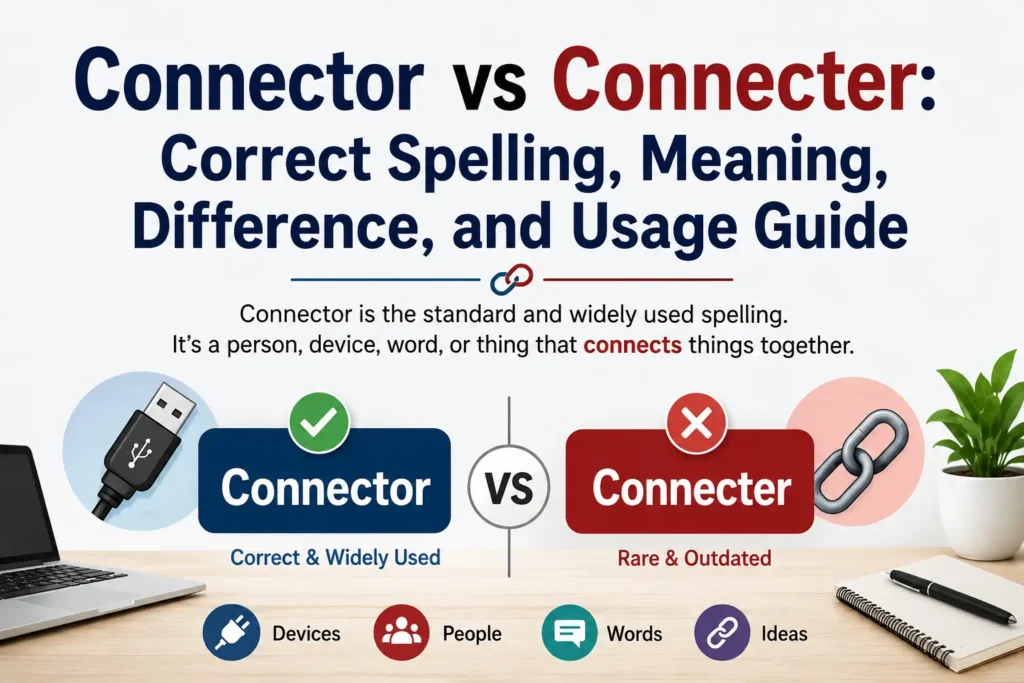
The main difference between connecter vs connector is that connector is the standard and widely accepted spelling in modern English, while connecter is a rare and outdated alternative. Both words come from the verb connect, but connector is the form most people use in professional writing, technical communication, and everyday language. A connector can be a device, link, person, or word that joins things together. For example, a USB connector links devices, while a grammar connector links ideas in writing.
Many learners get confused because connecter follows a familiar word formation pattern where verbs become nouns by adding -er, like teach becoming teacher. However, English does not always follow one fixed rule. Through common usage and language evolution, connector became the accepted form. When writing reports, emails, school assignments, or technical documents, choosing connector improves clarity and makes your writing sound more natural. Understanding this spelling difference, grammar rule, and proper usage helps avoid common mistakes and supports clear communication.
Quick Answer: Connector or Connecter?
The correct choice in almost every situation is connector.
- Connector ✅: A person, device, tool, object, or word that connects things.
- Connecter ⚠️: A rare alternative spelling with the same basic meaning.
Quick Examples
✅ The USB connector is damaged.
❌ The USB connecter is damaged.
✅ “However” is a connector that links two ideas.
❌ “However” is a connecter that links two ideas.
For everyday English, professional communication, technical documentation, and academic writing, choose connector.
Connecter vs Connector: Meaning and Basic Difference
Both words come from the verb connect, meaning to join, link, or bring things together.
The main difference isn’t their basic meaning. Instead, the difference involves accepted spelling, frequency, and modern usage.
What Does Connector Mean?
A connector is something or someone that connects two or more things.
The word can describe:
- A physical object that joins parts together
- A person who introduces people or builds relationships
- A word or phrase that links ideas in writing
- A software component that allows systems to communicate
Examples:
- The charger connector does not fit my phone.
- She is a great connector who helps people build professional relationships.
- “Therefore” is a connector that shows a result.
The word connector is especially common in technology, engineering, communication, software, and grammar.
Read this also: Lier vs. Liar : Meaning and Key Differences
What Does Connecter Mean?
A connecter has the same basic meaning: something or someone that connects.
However, the spelling is much less common.
English frequently creates nouns by adding -er to verbs:
- teach → teacher
- drive → driver
- write → writer
That pattern might make connecter appear logical. However, English doesn’t form every noun in the same way.
In this case, modern English generally uses:
connect → connector
For example:
Rare:
He works as a connecter between different departments.
More natural:
He works as a connector between different departments.
The second sentence sounds more familiar because connector is the established spelling.
Connecter vs Connector Comparison
The following table shows the main differences between the two spellings.
| Feature | Connector | Connecter |
| Correct spelling | ✅ Standard | ⚠️ Rare alternative |
| Meaning | Something or someone that connects | Something or someone that connects |
| Modern usage | Very common | Uncommon |
| American English | Preferred | Usually avoided |
| British English | Preferred | Rare |
| Technical writing | Widely used | Rarely used |
| Grammar writing | Common | Unusual |
| Professional writing | Recommended | Generally avoided |
The main difference is frequency and acceptance, not the basic meaning.
Why Is Connector the Preferred Spelling?
English doesn’t use one universal rule when turning verbs into nouns.
Some nouns end in -er, while others end in -or. The form that becomes established often depends on historical development and common usage.
The Word Formation Pattern Behind Connector
Many English nouns use -er:
- teach → teacher
- run → runner
- paint → painter
Others use -or:
- create → creator
- operate → operator
- calculate → calculator
The verb connect might logically appear to become connecter, but common English usage developed differently.
The established form became:
connect → connector
This pattern is similar to:
- collect → collector
- inspect → inspector
- protect → protector
Because connector became widely used in technical fields and everyday communication, it became the standard spelling.
Why Does Connecter Feel Wrong to Many English Speakers?
The spelling connecter isn’t impossible, but it looks unusual because English speakers see and hear connector far more often.
Language develops through repeated use. When a particular spelling regularly appears in:
- Product names
- Instruction manuals
- Technology terminology
- Educational materials
- Professional documents
- Technical specifications
that form becomes familiar and expected.
For example, people commonly use:
- phone connector
- network connector
- sentence connector
- cable connector
They rarely use:
- phone connecter
- network connecter
- sentence connecter
- cable connecter
As a result, connector looks natural, while connecter can appear incorrect or outdated to many readers.
How to Use Connector Correctly
The word connector can have several meanings depending on the context.
Understanding these different uses will help you choose the word naturally.
Connector as a Physical Object
A connector can be a device or part that joins two objects or components.
Examples:
- The HDMI connector connects the computer to the monitor.
- The electrical connector needs replacement.
- Check whether the cable connector is properly attached.
Common physical connectors include:
- USB connector
- Audio connector
- Power connector
- Cable connector
- Network connector
Connector in Technology and Electronics
Technology is one of the most common areas where connector appears.
A connector allows devices, systems, or electronic components to join or communicate.
Examples:
- A USB connector links a device to a computer.
- An Ethernet connector connects a network cable.
- An audio connector transfers sound signals.
You might also write:
The technician replaced the damaged connector on the circuit board.
Using connecter in this context would look unusual because connector is the standard technical term.
Connector in Software and IT
In software and information technology, a connector can be a tool or system that links different applications, databases, or platforms.
Examples:
- The payment connector links the website with the banking system.
- The API connector transfers data between two platforms.
- The cloud connector allows applications to communicate.
Modern technology documentation generally uses connector.
Connector in Grammar and Writing
In grammar, a connector is a word or phrase that links ideas, sentences, or clauses.
Common connectors include:
| Connector | Purpose | Example |
| However | Shows contrast | I wanted to go; however, I was busy. |
| Therefore | Shows a result | It rained; therefore, the match was canceled. |
| Because | Shows a reason | I stayed home because I was tired. |
| Meanwhile | Shows a time relationship | She cooked while he worked. |
Connectors make writing easier to follow because they show relationships between ideas.
Without a connector:
I studied hard. I passed the exam.
With a connector:
I studied hard; therefore, I passed the exam.
The second sentence clearly shows the relationship between studying and passing.
When Can Connecter Appear?
Although connecter is uncommon, you may occasionally encounter it.
It can appear in:
- Older texts
- Specialized writing
- Personal word choices
- Dictionaries that recognize alternative forms
Its existence doesn’t make it the best spelling for modern writing.
For most readers, connector looks clearer, more familiar, and more professional.
Should You Use Connecter in Formal Writing?
Generally, no.
When writing:
- Academic papers
- Business emails
- Reports
- Articles
- Technical documents
- School assignments
- Professional correspondence
use connector.
Professional and standard:
The connector improves communication between the two systems.
Rare and less natural:
The connecter improves communication between the two systems.
The first sentence matches modern English expectations.
Read this also: Sweet vs Sweat Differences
Common Mistakes With Connecter vs Connector
Understanding the most common mistakes can make the correct spelling much easier to remember.
Mistake 1: Choosing Connecter Because It Follows an “-er” Pattern
Many learners assume:
Connect + er = connecter
The reasoning seems logical because many English nouns use this pattern.
However, English contains numerous exceptions.
Correct:
The network connector is faulty.
Avoid:
The network connecter is faulty.
Remember that common usage determines which word form becomes standard.
Mistake 2: Using Both Spellings in the Same Document
Consistency matters in professional writing.
Inconsistent:
The device uses a connector. The connecter connects the two parts.
Better:
The device uses a connector. The connector connects the two parts.
Choose one spelling throughout your document. In modern English, that spelling should normally be connector.
Mistake 3: Confusing Connector With Connection
Connector and connection are related, but they don’t mean exactly the same thing.
| Word | Meaning | Example |
| Connect | The action of joining | Connect the cable. |
| Connection | The link or relationship | The internet connection is slow. |
| Connector | The thing that creates the link | The connector is broken. |
For example:
❌ The connection is broken on my charger part.
✅ The connector is broken on my charger.
A connector helps create a connection.
Connector vs Connection vs Connective
Several English words come from the same general idea of joining or linking things.
However, they serve different grammatical purposes.
Connect
Connect is a verb.
It describes the action of joining things.
Examples:
- Connect your phone to Wi-Fi.
- Connect the two wires carefully.
Connection
Connection is a noun.
It describes the link, relationship, or state of being connected.
Examples:
- I lost my internet connection.
- They have a strong connection.
Connector
Connector is a noun.
It describes the thing or person that creates a connection.
Examples:
- The cable connector is damaged.
- This word is a connector between two ideas.
Connective
Connective can function as an adjective or noun related to joining or linking things.
Examples:
- Connective tissue connects body parts.
- Connective words improve writing.
The words are related, but they aren’t interchangeable.
Connector Usage in Different Fields
The meaning of connector can change slightly depending on the field in which it appears.
Engineering
Engineers commonly use connector for parts that join components or systems.
Examples include:
- Electrical connectors
- Mechanical connectors
- Cable connectors
In engineering documents, specifications, and manuals, connector is the expected spelling.
Computer Networking
Networking professionals use connector for hardware components that help establish physical connections.
Examples include:
- Ethernet connector
- Fiber connector
- Network connector
Business Communication
A connector doesn’t always have to be a physical object.
The word can describe someone who introduces people, builds professional relationships, or creates communication between groups.
Example:
A good manager acts as a connector between employees and leadership.
In this context, a connector is a person who helps other people communicate or work together.
American English vs British English Usage
Both American English and British English generally prefer connector.
There isn’t a major regional distinction in which American English strongly favors one spelling while British English strongly favors the other.
In modern English:
Connector = standard choice
This is particularly true in:
- Technology
- Engineering
- Education
- Business writing
- Academic writing
- Online content
- Everyday communication
If you’re writing for an international audience, connector remains the safest choice.
How to Remember the Correct Spelling
A few simple memory techniques can help you avoid confusing connecter with connector.
Remember Common Technology Terms
Think about familiar phrases such as:
- USB connector
- Cable connector
- Network connector
- HDMI connector
You almost always see these phrases written with connector.
That familiar pattern can help you remember the standard spelling.
Use the Professional Writing Rule
Whenever you’re writing something important, choose connector.
This includes:
- Emails
- Reports
- Articles
- Assignments
- Technical documents
If you’re unsure, connector is almost always the safer choice.
Remember Similar “-or” Words
Several related or technical nouns use -or:
- operator
- calculator
- creator
- collector
- protector
- connector
Connecting connector with these familiar words can make the spelling easier to remember.
Real-Life Examples of Connector in Sentences
Seeing the word in different situations can make its meaning and spelling clearer.
Everyday Examples
- The phone connector stopped working after years of use.
- This adapter needs a different connector.
- The connector between the two parts is loose.
- I need a new connector for this cable.
Workplace Examples
- The software connector helps different systems share information.
- She became a connector between the marketing and sales teams.
- The connector allows information to move between the two platforms.
Writing and Grammar Examples
- Use connectors like however and therefore to improve your paragraphs.
- A strong connector makes your ideas easier to follow.
- The writer used a connector to show the relationship between the two sentences.
Technology Examples
- The USB connector isn’t fitting properly.
- Check the network connector before replacing the cable.
- The technician found damage inside the power connector.
- This device requires a different audio connector.
Practice: Connector or Connecter?
Choose the correct word for each sentence.
- The USB ______ is damaged.
- “Although” is a sentence ______.
- The technician replaced the cable ______.
- She is a natural ______ who brings people together.
Answers
- Connector
- Connector
- Connector
- Connector
In modern English, connector is the correct choice in almost every normal writing situation.
Final Difference Between Connecter and Connector
Here’s the easiest way to remember the distinction:
| Connector | Connecter |
| Standard modern spelling | Rare alternative |
| Used in American English | Rarely used |
| Used in British English | Rarely used |
| Common in technology | Uncommon |
| Common in grammar | Uncommon |
| Recommended for professional writing | Generally best avoided |
| Safe choice for almost all contexts | Only appears occasionally |
When you’re unsure which version to use, choose connector.
Conclusion
The difference between connecter and connector comes down to modern usage rather than meaning. While both words can refer to a person, device, or thing that connects two or more things, connector is the standard and widely accepted spelling in American and British English. It is the preferred choice in technology, engineering, grammar, business communication, and everyday writing, whereas connecter is now considered a rare and outdated alternative.
To write clearly and professionally, always choose connector in reports, emails, technical documents, academic papers, and online content. A simple way to remember the correct spelling is to think of familiar terms like USB connector, HDMI connector, or sentence connector. Sticking with the standard spelling will help you avoid confusion and ensure your writing looks polished and accurate.
Frequently Asked Questions (FAQs)
Q1: Which is correct, connecter or connector?
Connector is the correct and standard spelling in modern English. Although connecter exists as a rare alternative, it is generally avoided in professional, academic, and everyday writing.
Q2: What does connector mean?
A connector is a person, device, tool, or word that joins two or more things together. It can refer to a physical component, a relationship builder, or a linking word in grammar.
Q3: Is connecter a real English word?
Yes, connecter is recognized as a rare alternative spelling in some dictionaries. However, it is outdated and much less common than connector, so most writers should use connector instead.
Q4: Why is connector more common than connecter?
Over time, connector became the preferred spelling through widespread use in technology, engineering, education, and professional writing. Today, it is the form most English speakers expect to see.
Q5: Is connector used in both American and British English?
Yes. Both American English and British English overwhelmingly prefer the spelling connector, especially in technical, academic, and business contexts.
Q6: What is the difference between connect, connection, and connector?
- Connect is a verb that means to join things together.
- Connection is the link or relationship between things.
- Connector is the person, device, or object that creates the connection.
Q7: What are some examples of connector in a sentence?
Here are a few examples:
- The USB connector is broken.
- However is a connector that shows contrast.
- She acts as a connector between different teams in the company.
Q8: Should I use connecter in formal writing?
No. For business emails, school assignments, reports, articles, and technical documents, you should always use connector because it is the accepted standard spelling.
Q9: What is a connector in grammar?
In grammar, a connector is a word or phrase that links ideas, sentences, or clauses. Common connectors include however, therefore, because, although, and meanwhile.
Q10: How can I remember the correct spelling of connector?
Think of common terms you see every day, such as USB connector, HDMI connector, network connector, or cable connector. Since these always use connector, it’s easy to remember that this is the correct spelling for modern English.
