
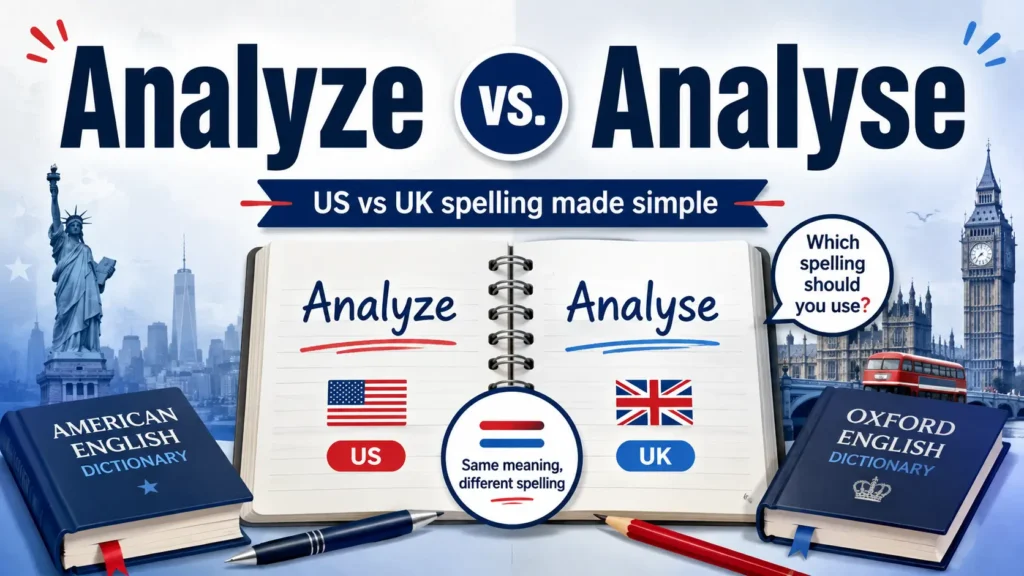
Analyze vs. analyse can be confusing because both spellings have the same meaning and pronunciation. The main difference is regional spelling: analyze is the standard form in American English, while analyse is commonly used in British English.
If you’re writing for a US audience, use analyze. For example, you might write, “Students analyze the evidence before reaching a conclusion.” British writers would typically use analyse in the same sentence.
The good news is that you don’t need to memorize two different meanings. Both words are verbs that mean to examine something carefully, study its parts, or understand its meaning. Once you know which type of English you’re using, choosing between analyze vs. analyse becomes much easier.
Quick Answer: Analyze vs. Analyse
The main difference between analyze and analyse is regional spelling.
| Word | English Variety | Meaning | Example |
| analyze | American English | To examine something carefully | We need to analyze the data. |
| analyse | British English | To examine something carefully | We need to analyse the data. |
Both words are verbs, and both generally have the same pronunciation: AN-uh-lyze.
For American readers, the easiest rule is:
Use analyze in American English. Use analyse in British English.
Therefore, if you’re writing a school paper in the United States, preparing a business report for a US company, or publishing content for an American audience, analyze is the spelling you should normally choose.
What Does Analyze Mean?
Analyze is a verb that means to examine something carefully and systematically. The purpose is usually to understand its meaning, parts, causes, patterns, or relationships.
When you analyze something, you go beyond simply looking at it. You study the details and use them to reach a better understanding or conclusion.
For example:
The researchers analyzed the test results.
The researchers didn’t just look at the results. They examined the information to understand what it showed.
You can analyze many different things, including:
- Data
- Evidence
- Information
- Problems
- Situations
- Arguments
- Poems
- Novels
- Speeches
- Financial reports
- Customer behavior
- Scientific results
The word appears often in academic, professional, scientific, and everyday English.
Examples of Analyze in American English
Students must analyze the author’s argument.
Here, students need to examine the argument closely and explain how it works.
The marketing team will analyze customer feedback.
The team will study the feedback to identify useful patterns or insights.
Let’s analyze the problem before we choose a solution.
The speaker wants to understand the problem carefully before making a decision.
Scientists analyze samples in the laboratory.
The scientists examine the samples to learn more about their contents or properties.
In each example, analyze involves careful examination rather than simple observation.
What Does Analyse Mean?
Analyse has the same meaning as analyze. It is the spelling commonly associated with British English.
For example:
The researchers will analyse the results.
This sentence means the same as:
The researchers will analyze the results.
The only difference is the spelling convention used by the writer.
You may see analyse in writing from the United Kingdom and in some other English-speaking regions that traditionally follow British spelling conventions.
Examples of Analyse in British English
Students are expected to analyse the poem carefully.
The company will analyse its sales figures.
Researchers analyse the evidence before reaching a conclusion.
These examples use analyse in exactly the same way that American English uses analyze.
Therefore, you shouldn’t assume that analyse and analyze have different definitions. They don’t. The distinction is mainly American English vs. British English spelling.
Analyze vs. Analyse: The Main Difference
The key difference is the spelling of the final part of the word.
American English generally uses:
analyze
British English generally uses:
analyse
The difference becomes clearer when you look at related forms.
| Meaning or Form | American English | British English |
| Base verb | analyze | analyse |
| Third-person singular | analyzes | analyses |
| Past tense | analyzed | analysed |
| Present participle | analyzing | analysing |
| Meaning | Examine carefully | Examine carefully |
| Pronunciation | AN-uh-lyze | AN-uh-lyze |
This table shows an important point: the spelling difference can continue through the word family.
For US writing, you’ll generally use analyze, analyzes, analyzed, and analyzing.
For British writing, you’ll generally use analyse, analyses, analysed, and analysing.
American English Uses Analyze
American English uses the -yze spelling:
The analyst will analyze the financial report.
The software analyzes customer data.
The researchers analyzed the results.
The team is analyzing the evidence.
These forms are standard choices for American English.
British English Uses Analyse
British English commonly uses the -yse spelling:
The analyst will analyse the financial report.
The software analyses customer data.
The researchers analysed the results.
The team is analysing the evidence.
Again, the meaning remains the same.
The difference is simply part of the broader spelling differences that exist between American and British English.
Is Analyze or Analyse Correct?
Both analyze and analyse are correct. The correct choice depends on which variety of English you’re using.
For American English, use:
analyze
For British English, use:
analyse
This means that analyse isn’t a misspelling in British English. Likewise, analyze is not wrong simply because a British writer would normally choose analyse.
The important thing is to match the spelling to your audience and maintain consistency.
For example, if you’re writing an essay for a US college, analyze is the natural choice:
This essay will analyze the role of symbolism in the novel.
If you’re writing for a British university, you may write:
This essay will analyse the role of symbolism in the novel.
Both sentences are grammatically correct.
Which Spelling Should US Writers Choose?
If your target audience is American, choose analyze.
This applies to:
- US school assignments
- College essays
- Business reports
- Professional emails
- American websites
- Research papers
- Marketing content
- Workplace documents
However, if you’re quoting a source, you may preserve the original spelling used by that source when appropriate.
The same principle applies when following a specific publication or institutional style guide. Always follow the required convention if one has been provided.
How to Spell Analyze in American English
The base form in American English is:
analyze
However, the verb changes form depending on how it appears in a sentence.
Analyze vs. Analyzes
Use analyze with subjects such as I, you, we, and they.
I analyze the data every week.
We analyze customer feedback.
They analyze market trends.
Use analyzes with a singular third-person subject such as he, she, it, or a singular noun.
She analyzes the results.
The software analyzes the data.
The researcher analyzes each sample.
A common mistake is writing analyzies. That spelling is incorrect.
Correct:
The program analyzes the information.
Incorrect:
The program analyzies the information.
Analyzed vs. Analysed
In American English, the past tense is:
analyzed
For example:
The scientists analyzed the samples yesterday.
British English generally uses:
analysed
For example:
The scientists analysed the samples yesterday.
Therefore, American writers should normally choose analyzed.
Analyzing vs. Analysing
The present participle in American English is:
analyzing
For example:
We are analyzing the survey results.
British English generally uses:
analysing
For example:
We are analysing the survey results.
A frequent spelling error is analyzeing.
That’s incorrect.
The correct American form is:
analyzing
The final e in analyze is dropped before the -ing ending.
Analyze vs. Analyse Pronunciation
Despite their different spellings, analyze and analyse are generally pronounced the same way.
A simple pronunciation guide is:
AN-uh-lyze
The final sound is similar to the sound in size or wise.
The spelling analyse can sometimes confuse English learners. However, the -yse ending isn’t pronounced like the word ease.
So, the difference is primarily written rather than spoken.
Pronunciation Example
Analyze → AN-uh-lyze
Analyse → AN-uh-lyze
This makes the words an example of a regional spelling difference rather than a difference in pronunciation or meaning.
How to Use Analyze in American English
Analyze is common in many types of American writing. The exact meaning can depend on the context.
Analyze in Academic Writing
In school and college writing, analyze often means to examine a text, idea, argument, or piece of evidence in detail.
For example:
Students were asked to analyze the author’s use of symbolism.
This doesn’t simply mean “read the book.” The student needs to examine how symbolism works and explain its importance.
Another example is:
The essay analyzes the causes of the American Revolution.
Here, the writer examines different causes and explains their relationships.
In academic writing, analyze often requires you to:
- Identify important information.
- Break the subject into meaningful parts.
- Examine relationships between those parts.
- Interpret the evidence.
- Explain what the evidence means.
Therefore, analyze often represents a deeper process than simply describe.
Analyze in Business Writing
Businesses frequently use analyze when discussing data and decision-making.
For example:
Our team will analyze the sales data before the quarterly meeting.
The company analyzes customer behavior to improve its services.
Managers should analyze the financial report before making a decision.
In these examples, analysis helps people identify trends, understand performance, and make informed choices.
Analyze in Science and Research
Scientists and researchers also use analyze frequently.
Researchers analyzed the samples collected during the experiment.
The laboratory will analyze the test results.
Here, analysis involves examining information or materials carefully to draw meaningful conclusions.
Analyze in Everyday Conversation
Although analyze is common in formal writing, it also appears in casual speech.
Let’s analyze what happened.
You’re analyzing this situation too much.
I need some time to analyze my options.
In casual conversation, people sometimes use analyze to mean thinking carefully about a situation.
However, depending on the context, simpler words such as look at, study, or think about may sound more conversational.
How to Use Analyse in British English
British English uses analyse in the same grammatical situations where American English uses analyze.
Compare:
American English:
The students will analyze the evidence.
British English:
The students will analyse the evidence.
The meaning doesn’t change.
The same applies to other forms.
| American English | British English |
| analyze | analyse |
| analyzes | analyses |
| analyzed | analysed |
| analyzing | analysing |
If you’re writing for a British audience, these forms help maintain the expected spelling convention.
However, British English spelling can vary in some words ending in -ize and -ise. Some British style guides accept -ize spellings in certain words. Analyse, however, is normally written with -yse in British English.
Therefore, don’t assume that every word follows exactly the same pattern.
Analyze vs. Analyse in Formal and Professional Writing
The spelling you choose can matter when you’re writing for a specific audience.
Academic Writing
For American academic writing, use:
The purpose of this study is to analyze the relationship between the two variables.
For British academic writing, use:
The purpose of this study is to analyse the relationship between the two variables.
Both versions are correct within their respective varieties.
Professional Writing
An American company might write:
We will analyze the quarterly sales figures.
A British company might write:
We will analyse the quarterly sales figures.
Again, the meaning remains unchanged.
Website and Content Writing
If you’re creating content for a US audience, analyze is generally the better choice.
For example:
Learn how to analyze your website traffic.
If your content targets British readers:
Learn how to analyse your website traffic.
The best practice is to choose your target variety before writing and then apply it consistently.
Analyze vs. Analyse: Common Mistakes to Avoid
Understanding the difference between the two spellings is easy. However, writers often make mistakes with the related forms.
Using Analyse in Standard American English
For a US audience, the preferred spelling is analyze.
Less suitable for standard American English:
We need to analyse the results.
Preferred:
We need to analyze the results.
The first version may still be understood by American readers, but it doesn’t follow the usual American spelling convention.
Mixing American and British Spellings
Mixing spelling systems can make your writing look inconsistent.
For example:
The researcher analysed the data and organized the results.
If you’re following American English, you would normally write:
The researcher analyzed the data and organized the results.
If you’re following British English, you may write:
The researcher analysed the data and organised the results.
However, remember that British style guides can differ on certain -ise/-ize spellings. Follow the specific style guide you’re using.
Writing Analyzies
The correct third-person singular form is:
analyzes
Not:
analyzies
Correct:
The software analyzes the data.
Writing Analyzeing
The correct American -ing form is:
analyzing
Not:
analyzeing
Correct:
The team is analyzing the results.
Confusing Analyze With Analysis
Analyze and analysis are related, but they have different grammatical roles.
We will analyze the data.
Here, analyze is a verb.
The analysis was detailed.
Here, analysis is a noun.
This distinction is important in academic and professional writing.
Analyze vs. Analysis: Understanding the Word Family
The word analyze belongs to a larger family of related words.
| Word | Part of Speech | Meaning | Example |
| analyze | Verb | Examine carefully | We will analyze the data. |
| analyzes | Verb | Examines carefully | She analyzes the results. |
| analyzed | Verb | Examined carefully | They analyzed the evidence. |
| analyzing | Verb | Examining carefully | He is analyzing the report. |
| analysis | Noun | Detailed examination | The analysis was useful. |
| analyses | Plural noun | Multiple examinations | Several analyses were completed. |
| analyst | Noun | A person who analyzes | The analyst reviewed the report. |
| analytical | Adjective | Related to careful examination | She has strong analytical skills. |
Analysis vs. Analyses
The singular noun is:
analysis
The plural is:
analyses
For example:
The analysis revealed one major problem.
Several analyses produced similar results.
Don’t confuse analyses with analyzes.
Analyses is the plural noun form of analysis.
Analyzes is the third-person singular form of the verb analyze in American English.
Compare:
The researcher analyzes the data.
The researcher completed several analyses.
This distinction is especially useful for students and professional writers.
Analyze vs. Examine: Are They Interchangeable?
Analyze and examine are closely related, but they aren’t always exact synonyms.
Examine generally means to look at or inspect something carefully.
Analyze often suggests a more detailed process of breaking something down, identifying patterns, or interpreting information.
Compare these examples:
The doctor examined the patient.
The doctor carefully checked the patient’s condition.
The doctor analyzed the test results.
The doctor studied the results to understand what they indicated.
In another example:
The teacher asked students to examine the historical document.
This may simply mean they should look at it closely.
The teacher asked students to analyze the historical document.
This suggests a deeper study of its content, meaning, evidence, and significance.
The two words can overlap, but analyze often carries a stronger sense of detailed interpretation.
Useful Synonyms for Analyze
Depending on context, possible alternatives include:
- Examine
- Study
- Evaluate
- Assess
- Investigate
- Break down
- Review
- Interpret
These words aren’t always perfect replacements.
For example, evaluate often means judging the quality or value of something. Analyze focuses more on understanding its parts, structure, or relationships.
Therefore, choose the synonym that matches your exact meaning.
A Simple Memory Trick for Analyze vs. Analyse
If you’re writing for an American audience, remember:
Analyze = American English
The Z in analyze can remind you to use this spelling in US English.
For British English:
Analyse = British English
The S can help you remember the British spelling.
This is a useful memory trick, but it’s not a universal rule for every English word.
For example, British spelling conventions can vary between words and style guides. Therefore, don’t automatically change every American -ize word to -ise without checking the expected convention.
For this particular word, however, the basic distinction is easy:
US → analyze
UK → analyse
Analyze vs. Analyse in Real-Life Examples
Seeing both forms side by side makes the difference easier to remember.
School and College
American English:
The professor asked students to analyze the poem.
British English:
The professor asked students to analyse the poem.
Both sentences ask students to study the poem carefully and explain its meaning or structure.
Workplace and Business
American English:
Our team will analyze the customer survey.
British English:
Our team will analyse the customer survey.
The goal is to examine the survey results and identify useful information.
Data and Research
American English:
The scientists analyzed the data from the experiment.
British English:
The scientists analysed the data from the experiment.
Both sentences describe the same research process.
Everyday Conversation
American English:
Don’t analyze every text message I send.
British English:
Don’t analyse every text message I send.
The meaning is the same, even though the spelling changes.
A Practical Guide: Which Spelling Should You Use?
When you’re unsure, follow these steps.
If You’re Writing for a US Audience
Use:
- analyze
- analyzes
- analyzed
- analyzing
If You’re Writing for a British Audience
Use:
- analyse
- analyses
- analysed
- analysing
If You’re Following a Style Guide
Follow the spelling required by your:
- School
- University
- Employer
- Publisher
- Client
- Organization
Consistency matters more than trying to mix different spelling systems.
If You’re Writing for an International Audience
Choose the English variety that best matches your primary audience.
If your main readers are in the United States, analyze is the natural choice. If your readers are primarily in the UK, analyse is generally more appropriate.
Analyze vs. Analyse: Quick Usage Guide
Use this quick reference when you’re editing your writing:
| If you mean… | American English | British English |
| Examine carefully | analyze | analyse |
| Examines carefully | analyzes | analyses |
| Examined carefully | analyzed | analysed |
| Examining carefully | analyzing | analysing |
The simplest rule
Writing in American English? Use analyze.
Writing in British English? Use analyse.
Writing for a specific organization? Follow its style guide.
That approach will help you avoid most spelling problems involving this word.
Here is a concise conclusion followed by 10 FAQs for the Analyze vs. Analyse article.
Conclusion: Analyze vs. Analyse
The difference between analyze vs. analyse is mainly based on regional spelling. In American English, analyze is the standard spelling, while analyse is commonly used in British English. Both words have the same meaning: to examine something carefully and understand it better.
If you’re writing for a US audience, choose analyze, analyzes, analyzed, and analyzing. If you’re following British English, use analyse, analyses, analysed, and analysing. The most important tip is to choose the spelling that matches your audience and use it consistently throughout your writing.
Frequently Asked Questions About Analyze vs. Analyse
Q1. Is analyze or analyse correct?
Both analyze and analyse are correct. Analyze is the standard spelling in American English, while analyse is commonly used in British English.
Q2. Should Americans use analyze or analyse?
Americans should generally use analyze. It is the standard spelling in American English and is the preferred choice for US academic, professional, and general writing.
Q3. Is analyse British or American?
Analyse is the spelling commonly associated with British English. American English generally uses analyze instead.
Q4. Do analyze and analyse mean the same thing?
Yes. Both words mean to examine something carefully, often to understand its meaning, parts, patterns, or relationships.
Q5. How do you pronounce analyze and analyse?
Both analyze and analyse are generally pronounced AN-uh-lyze. The spelling difference doesn’t normally change the pronunciation.
Q6. What is the past tense of analyze?
The past tense in American English is analyzed.
The researchers analyzed the results.
In British English, the usual spelling is analysed.
Q7. Is it analyzing or analyseing?
The correct American English form is analyzing. British English generally uses analysing. Analyseing is incorrect.
Q8. Is analysis the same as analyze?
No. Analyze is a verb, while analysis is a noun.
We will analyze the data.
The analysis was detailed.
Q9. Can I use analyse in an American English essay?
If you’re following standard American English, analyze is the preferred spelling. However, analyse may be retained when quoting a British source or preserving original wording.
Q10. Which spelling should I use for a US website?
Use analyze if your website targets a US audience. It is the standard American English spelling and will be the most familiar choice for American readers.
Blog :
Allude vs Elude: What’s the Difference? Meaning, Examples, and Easy Ways to Remember
Preform vs Perform: What’s the Difference? Meaning, Usage, and Examples
Onsite vs On Site: What’s the Difference and Which One Is Correct?
