
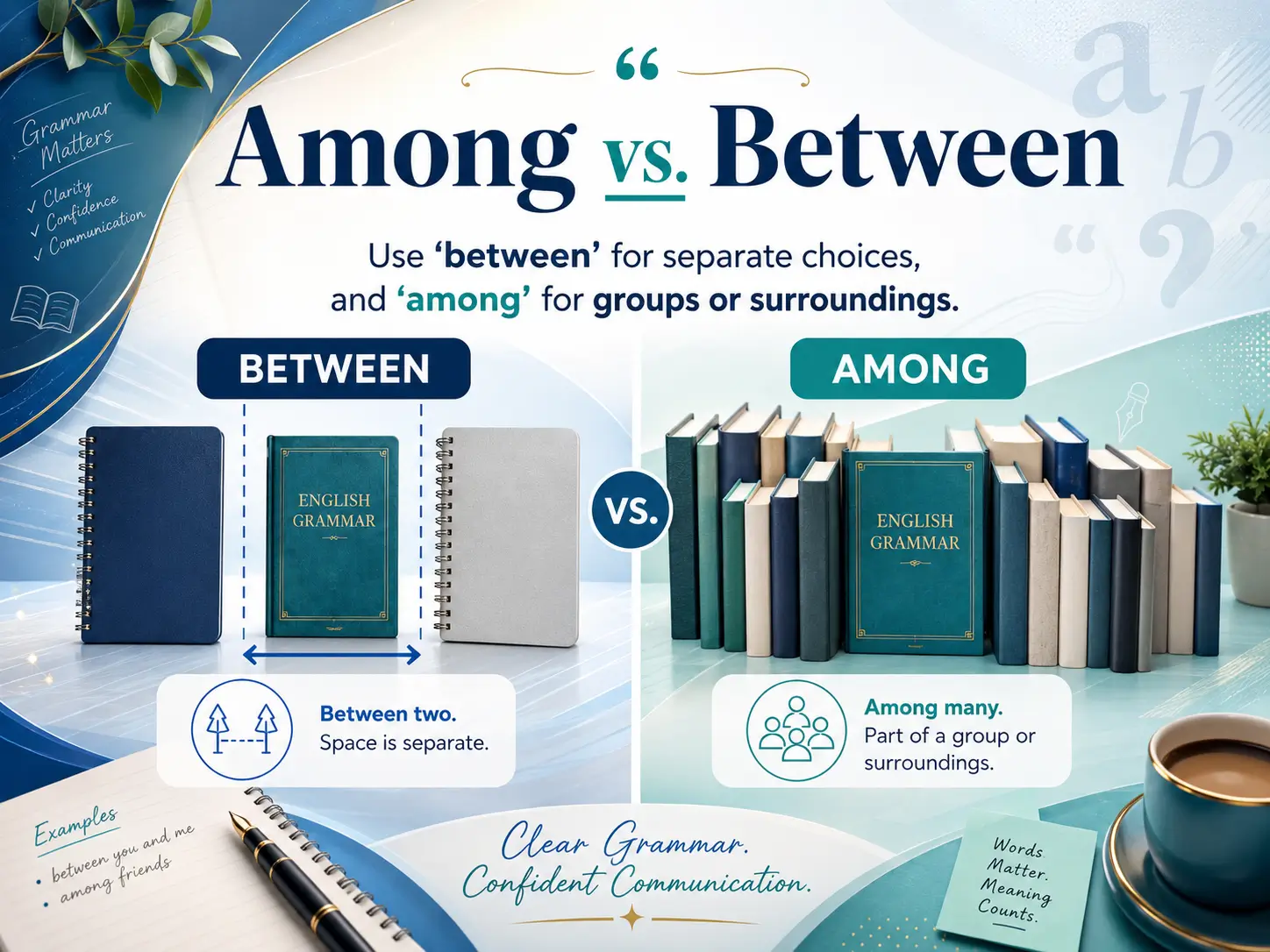
Among vs. Between explains when to use each preposition correctly. Use between for separate people, things, choices, or relationships. Use among when someone or something is part of a group or surrounded by several people or objects.
Many learners hear that between is only for two items, while among is for three or more. However, that rule is incomplete. You can use between with more than two items when each person or thing remains separate and identifiable.
For example, you can choose between three job offers because each offer is a distinct option. In contrast, you may feel comfortable among your coworkers because you are part of a larger group.
Understanding the difference between among and between helps you write clearer emails, school assignments, reports, and social media posts. It also prevents common mistakes such as using among for two people or writing between 5 to 10 instead of between 5 and 10.
Quick Answer: When to Use Among vs. Between
Use between when you’re talking about distinct people, things, locations, choices, or relationships.
- The pharmacy is between the bank and the grocery store.
- We must choose between four insurance plans.
- The agreement was made between the five companies.
Use among when someone or something is part of a group, surrounded by a group, or included as one of many.
- She felt comfortable among her coworkers.
- The cabin stood among the trees.
- He was among the first students to arrive.
Here’s the most useful memory rule:
Use between for separate relationships. Use among for group membership.
Among vs. Between Comparison Table
| Situation | Correct word | Example |
| Two distinct people or things | Between | The table sits between two windows. |
| Several named choices | Between | Choose between red, blue, and green. |
| Someone within a group | Among | She was among the finalists. |
| Something surrounded by many objects | Among | We found the cabin among the trees. |
| A comparison of distinct items | Between | The report compares three plans. |
| A trend within a population | Among | The trend is common among teenagers. |
| A time, number, or distance range | Between | Arrive between 8:00 and 9:00. |
| Something included as one of many | Among | Cost was among our concerns. |
| A relationship involving several named parties | Between | Talks continued between the four countries. |
| An action spreading through a group | Among | The news spread among employees. |
What Do “Among” and “Between” Mean?
Both words usually function as prepositions. A preposition shows how one part of a sentence relates to another. It may describe position, direction, time, connection, inclusion, or another relationship.
Although among and between sometimes appear in similar sentences, they don’t always create the same meaning.
Meaning of “Between”
Between usually presents people or things as separate points, units, sides, or choices.
It can describe:
- A position separating two or more things
- A relationship involving distinct parties
- A choice from specific alternatives
- A comparison of identifiable items
- A range with two endpoints
- Something shared by separate recipients
Examples:
- The café is between the library and the theater.
- Communication between the departments improved.
- I’m deciding between three apartments.
- The temperature stayed between 60 and 70 degrees.
The pronunciation is approximately bih-TWEEN, with stress on the second syllable.
Meaning of “Among”
Among usually means “in the middle of,” “surrounded by,” “included in,” or “as part of a group.”
It can describe:
- A person or object within a collection
- Something surrounded by many things
- Membership in a larger group
- A feeling, action, or trend shared by a group
- One example included with many others
Examples:
- She recognized a familiar face among the crowd.
- Wildflowers grew among the rocks.
- He is among the most experienced employees.
- Concern spread among local residents.
The pronunciation is approximately uh-MUNG.
The Key Difference Between Among and Between
The most accurate rule isn’t based only on numbers. Instead, it depends on whether the sentence treats the items as distinct units or as one collective group.
Use between when the items remain separate.
Use among when the items form a group or collection.
Compare these sentences:
- The road runs between the trees.
- The cabin is hidden among the trees.
In the first sentence, the writer focuses on a space separating particular trees. In the second, the cabin sits within a larger wooded area.
Now compare another pair:
- Negotiations continued between the four companies.
- Trust increased among the four companies.
The first sentence treats each company as a separate participant in negotiations. The second focuses on trust spreading throughout the group.
Therefore, both words can sometimes appear with the same number of people or things. The intended meaning determines the better choice.
When to Use “Between”
Between has several common uses in American English. Understanding these patterns makes the choice much easier.
Use “Between” for Two Separate People or Things
When a sentence mentions two distinct people, objects, places, or ideas, between is usually correct.
- The teacher stood between Maya and Noah.
- There’s a fence between the two houses.
- What’s the difference between a phrase and a clause?
- The meeting is scheduled between lunch and the afternoon presentation.
In each example, the sentence establishes a relationship involving two separate points.
Using among with only two people or things is usually unnatural.
Incorrect: The responsibility was divided among Jordan and Alex.
Correct: The responsibility was divided between Jordan and Alex.
Use “Between” for More Than Two Distinct Items
A common grammar myth says that between can refer only to two items. That rule is too strict.
You may use between with three or more items when the sentence treats those items as separate, named, or individually identifiable.
- The agreement was signed between the four organizations.
- I’m choosing between the basic, standard, and premium plans.
- The conversation stayed between Ava, Marcus, Elena, and me.
- The border dispute involved negotiations between several neighboring countries.
Each participant or option remains distinct. As a result, between works even though the sentence mentions more than two.
However, among may be more natural when the same people or things act as one general group.
- Cooperation grew among the participating organizations.
- Excitement spread among the travelers.
Use “Between” for Specific Choices
Use between when choosing from clear, separate alternatives.
- You can choose between coffee and tea.
- We’re deciding between three meeting dates.
- The customer compared prices between several service plans.
- I can’t decide between driving, flying, and taking the train.
The choices don’t have to total two. Instead, they need to be specific enough for the reader to consider them separately.
Compare:
- Choose between the three designs shown below.
- Choose among the designs in our full catalog.
The first sentence points to three specific choices. The second suggests a larger collection.
Use “Between” for Comparisons and Differences
Writers often use between after nouns that describe a direct relationship or comparison.
Common combinations include:
- difference between
- distinction between
- comparison between
- connection between
- relationship between
- link between
- balance between
- conflict between
Examples:
- The lesson explains the difference between adjectives and adverbs.
- Researchers examined the relationship between sleep, exercise, and concentration.
- The company needs a balance between speed, quality, and cost.
- The report identifies a connection between employee training and customer satisfaction.
Even when several factors appear, between is correct because the sentence examines them as distinct variables or categories.
Use “Between” for Time and Number Ranges
Use between when describing a range with two endpoints.
- The office is open between 8:00 a.m. and 5:00 p.m.
- The package should weigh between five and ten pounds.
- Attendance usually falls between 100 and 150 people.
- She lived in Seattle between 2019 and 2023.
The standard structure is:
between + first endpoint + and + second endpoint
Don’t combine between with to.
Incorrect: The appointment will take place between 2:00 to 3:00.
Correct: The appointment will take place between 2:00 and 3:00.
You can also use the structure from … to:
- The appointment will take place from 2:00 to 3:00.
Use “Between” for Physical Position
Use between when something sits in a space separating distinct objects or locations.
- The keys fell between the couch cushions.
- A narrow path runs between the buildings.
- The hotel sits between downtown and the airport.
- He parked between two large trucks.
The word highlights boundaries, gaps, or reference points.
Use “Between” for Private Information
The phrase between you and me means that information should remain private.
- Keep this between you and me.
- The decision must stay between the department heads.
- This conversation is between the three of us.
Notice that the correct pronoun is me, not I. A preposition takes an object pronoun.
Incorrect: Between you and I, the proposal needs more work.
Correct: Between you and me, the proposal needs more work.
The incorrect version appears in casual conversation, but you should avoid it in professional, academic, and edited writing.
When to Use “Among”
Use among when the sentence focuses on a group, collection, population, or surrounding environment.
Use “Among” for Someone or Something Within a Group
Among often shows that someone or something is included in a larger set.
- She was among the finalists.
- His name appeared among the winners.
- That issue was among our main concerns.
- The restaurant is among the most popular in the city.
In these examples, the subject is one member or example within a broader category.
The construction among the first is especially common:
- She was among the first employees to volunteer.
- The school was among the first to adopt the program.
This wording doesn’t mean the person or organization was literally surrounded by others. Instead, it means they belonged to an early group.
Use “Among” for Something Surrounded by Many Objects
Use among when something sits within a collection rather than between separate reference points.
- We found the receipt among the papers.
- A small cottage stood among the pine trees.
- The child disappeared among the crowd.
- Colorful flowers grew among the weeds.
The objects form a surrounding group. Their individual positions don’t matter.
Use “Among” for Trends Within a Population
In academic, professional, and news writing, among often introduces a population or demographic group.
- The survey measured satisfaction among first-year students.
- Remote work is common among technology employees.
- The campaign increased awareness among local voters.
- The product became popular among young professionals.
Here, the sentence describes a trend, opinion, behavior, or condition within a broad group.
Use “Among” for Something Shared by a Group
Among can show that an action, feeling, object, or responsibility extends through a group.
- The rumor spread among employees.
- There was growing concern among parents.
- The teacher distributed the worksheets among the students.
- Volunteers shared the supplies among the families.
The focus falls on the group as a whole rather than on separate one-to-one relationships.
Use “Among” to Mean “Included With Others”
The phrases among other things and among others mean that the sentence mentions only part of a larger list.
- The job requires writing, editing, and research, among other skills.
- The event attracted teachers, nurses, and engineers, among others.
- Cost was among the reasons we delayed the project.
- The plan includes new training materials, among other improvements.
These expressions help you show that your examples aren’t complete.
Can “Between” Be Used for More Than Two Things?
Yes. Between can refer to more than two people or things when they remain distinct.
Consider these correct sentences:
- The treaty was negotiated between six countries.
- The manager divided the responsibilities between four specialists.
- The committee chose between five final proposals.
- Communication between sales, marketing, finance, and operations improved.
The items are separately identifiable. Therefore, between makes sense.
Now compare these examples:
- Cooperation grew among the six countries.
- The manager encouraged trust among the specialists.
- Support for the proposal increased among committee members.
- The announcement caused confusion among employees.
Here, the people or organizations act as groups.
| Common myth | More accurate rule |
| Use between only for two. | Use between for distinct items, even when there are more than two. |
| Use among whenever there are three or more. | Use among when the items form or belong to a group. |
| Number always determines the answer. | Meaning and sentence structure determine the answer. |
Choose Between or Choose Among?
Both phrases can be correct, but their emphasis differs.
Use “Choose Between” for Specific Alternatives
Use choose between when the options are clearly identified.
- Choose between the red, blue, and black jackets.
- Customers can choose between four payment plans.
- We must choose between hiring a contractor and expanding the internal team.
The reader can view each option separately.
Use “Choose Among” for a Larger Selection
Use choose among when selecting from a broad group or collection.
- Students may choose among hundreds of online courses.
- The committee will choose among the qualified applicants.
- Visitors can choose among several activities.
However, this isn’t an absolute division. Sometimes both words work:
- Choose between the five finalists.
- Choose among the five finalists.
The first sentence emphasizes five separate options. The second treats the finalists as a selection pool.
Divide Between or Divide Among?
Writers often hesitate between divide between and divide among. Again, both may be correct.
Use between when emphasizing separate shares or recipients:
- The estate was divided between the four named beneficiaries.
- We divided the work between the designers, writers, and editors.
- The prize money was split between the three winners.
Use among when emphasizing distribution throughout a group:
- The charity distributed food among local families.
- The teacher divided the materials among the students.
- Responsibilities were shared among team members.
In many cases, the difference is subtle. Choose the word that best reflects your focus.
Real-Life Examples of Among and Between
The following examples show how the words appear in school, work, email, conversation, and online writing.
School and Academic Writing
- The professor explained the difference between a hypothesis and a theory.
- The study compared outcomes between three age groups.
- Stress was common among first-year students.
- The teacher walked among the desks during the test.
- Students chose between four essay topics.
Workplace Communication
- The manager divided the client accounts between four sales representatives.
- Trust has improved among team members.
- The contract is between the agency, the client, and the software provider.
- Confusion spread among employees after the policy change.
- We need to find a balance between cost, speed, and quality.
Email and Professional Messages
- Please keep this information between the project leads.
- We’re deciding between Tuesday, Wednesday, and Thursday.
- The document was shared among regional offices.
- There appears to be some confusion among attendees.
- Communication between the departments needs improvement.
Conversation, Texting, and Social Media
- I can’t decide between these three photos.
- That phrase is popular among teenagers.
- Keep this between us.
- I found your message among hundreds of comments.
- Which one would you choose between these options?
The final example is common in casual speech, but which would you choose from these options? may sound smoother in formal writing.
Practical Case Study: Editing a Workplace Report
Consider this sentence from a fictional workplace report:
Communication among the sales, marketing, and finance departments has improved.
The sentence is grammatical. However, among presents the departments as a collective group.
Suppose the writer wants to emphasize direct communication links involving three separate departments. In that case, between may be more precise:
Communication between the sales, marketing, and finance departments has improved.
Now consider another sentence:
Morale improved between employees after the policy change.
This version sounds unnatural because morale is a general condition within the workforce. The better choice is:
Morale improved among employees after the policy change.
The lesson is simple: don’t count the nouns and apply a mechanical rule. Instead, decide whether the sentence describes distinct relationships or a condition within a group.
Common Mistakes With Among and Between
Using “Among” Automatically for Three or More Items
Weak choice: We compared the prices among Plan A, Plan B, and Plan C.
Better: We compared the prices between Plan A, Plan B, and Plan C.
The plans are named and individually compared. Therefore, between is clearer.
Using “Between” for a General Population
Incorrect or unnatural: The problem is common between college students.
Correct: The problem is common among college students.
The sentence describes a pattern within a population, not a relationship connecting separate students.
Using “Among” With Two People
Incorrect: She divided the work among Ben and Olivia.
Correct: She divided the work between Ben and Olivia.
Because there are only two separate recipients, between is the natural choice.
Writing “Between X to Y”
Incorrect: Prices range between $20 to $50.
Correct: Prices range between $20 and $50.
Also correct: Prices range from $20 to $50.
Remember the matching pairs:
- between … and
- from … to
Saying “Between You and I”
Incorrect in standard edited English: Between you and I, the deadline is unrealistic.
Correct: Between you and me, the deadline is unrealistic.
The pronoun follows the preposition between, so it needs the object form me.
Missing a Change in Meaning
Compare:
- The bicycle stood between the trees.
- The bicycle stood among the trees.
The first sentence suggests a position relative to specific trees. The second suggests that many trees surrounded the bicycle.
Both may be grammatical, but they describe different scenes.
Using “Amongst” to Sound More Formal
Amongst isn’t more correct than among. In American English, it may sound literary, old-fashioned, or intentionally dramatic.
For most US writing, use:
- among friends
- among employees
- among the trees
- among the best
Rather than:
- amongst friends
- amongst employees
- amongst the trees
- amongst the best
Among vs. Amongst in American English
Among and amongst have the same basic meaning. The difference is mainly style and regional preference.
| Word | Meaning | US usage |
| Among | Within, surrounded by, or included in a group | Standard and common |
| Amongst | Same meaning as among | Less common; may sound British, literary, or old-fashioned |
Examples:
- Natural in US English: She felt relaxed among friends.
- Grammatically possible but less natural: She felt relaxed amongst friends.
You may still see amongst in novels, historical writing, or writing designed to create a traditional tone. However, among is the safer choice for American business, academic, web, and everyday writing.
Synonyms and Related Words
Among and between don’t have perfect synonyms in every sentence. Still, several related words may express a similar idea.
Words Related to “Between”
Depending on the sentence, you may use:
- amid two points
- separating
- connecting
- linking
- in the middle of
- from one to another
- shared by
- involving
Examples:
- A wall separates the two offices.
- A hallway connects the lobby and conference room.
- The responsibility is shared by three managers.
Words Related to “Among”
Possible alternatives include:
- amid
- amidst
- within
- surrounded by
- included in
- one of
- in the company of
- throughout
Examples:
- She stood amid the crowd.
- His name was included in the final list.
- Concern spread throughout the community.
- He is one of the strongest candidates.
Be careful with amid and amidst. They often refer to surrounding conditions, events, or environments rather than individual group members.
- The company expanded amid rising demand.
- She remained calm amidst the confusion.
In American English, amid is usually more common than amidst.
Grammar Tips for Choosing the Right Word
Identify the Relationship
Ask what the sentence is showing:
- Separate choices?
- A direct comparison?
- A physical gap?
- A range?
- Membership in a group?
- A trend within a population?
- Something surrounded by many objects?
Your answer usually points to the correct word.
Look for Named Items
If the sentence names each item separately, between is often the better choice.
- between Boston, New York, and Washington
- between Plan A, Plan B, and Plan C
- between the owner, tenant, and property manager
However, if the sentence treats those items as one community, among may be more natural.
- cooperation among East Coast cities
- agreement among committee members
- trust among neighbors
Don’t Depend Only on Number
The “two versus three” rule may help beginners with simple sentences. Still, it causes errors in more advanced writing.
Instead, use this two-step test:
- Are the items separate and identifiable? Use between.
- Are they members of one group? Use among.
Read the Sentence Aloud
Sometimes your ear can detect the more natural choice.
- popular among customers
- relationship between customers and employees
- hidden among the boxes
- space between the boxes
Reading aloud also helps you notice whether the sentence emphasizes a group or separate units.
Easy Memory Tricks
Use these quick reminders when you’re unsure.
The “Separate or Surrounded” Trick
- Between = separate points
- Among = surrounded by a group
The “Choice or Crowd” Trick
- Choose between clear options.
- Stand among a crowd.
The “Endpoints or Inclusion” Trick
- A range has endpoints, so use between.
- Group membership shows inclusion, so use among.
The Best One-Sentence Reminder
Use between when items stay separate; use among when they blend into a group.
This reminder is more accurate than simply counting the nouns.
Practice: Choose Among or Between
Complete each sentence with among or between.
- The secret remained ___ the three attorneys.
- A deer appeared ___ the trees.
- Choose ___ the four available plans.
- The teacher distributed the worksheets ___ the students.
- What’s the difference ___ affect and effect?
- The store is open ___ 10:00 a.m. and 8:00 p.m.
- She was ___ the youngest people promoted.
- Keep this ___ you and me.
- Communication improved ___ the three department heads.
- Concern spread ___ local parents.
Answer Key
- Between: The attorneys are separate, identified participants.
- Among: The deer appeared within a group of trees.
- Between: The four plans are distinct options.
- Among: The worksheets went throughout a group of students.
- Between: The sentence compares two distinct words.
- Between: The sentence gives a range with two endpoints.
- Among: She belongs to a larger group of younger employees.
- Between: The phrase refers to a private relationship.
- Between: The department heads are distinct individuals.
- Among: The concern existed throughout a population.
Some distribution examples may allow either word. In those cases, use between to emphasize separate shares and among to emphasize the group.
Frequently Asked Questions
Q1. What is the main difference between among and between?
Use between when people or things are separate and identifiable. Use among when someone or something belongs to, appears within, or is surrounded by a group.
For example:
- The bank is between the pharmacy and the café.
- The cabin is hidden among the trees.
Q2. Is between only used for two things?
No. Between can refer to more than two people or things when they remain separate or individually identified.
For example:
- The agreement was signed between the four companies.
- We must choose between three different plans.
The old two-item rule is a useful shortcut, but it isn’t a complete grammar rule.
Q3. When should I use among?
Use among when referring to people or things as one general group. It can also mean “surrounded by” or “included as one of many.”
Examples include:
- She was among the finalists.
- The news spread among employees.
- I found the receipt among the papers.
Q4. Can among be used for two people?
Usually, no. When a sentence refers to two separate people, use between.
Incorrect: Divide the work among Jack and Mia.
Correct: Divide the work between Jack and Mia.
However, among may refer to a group that includes many people, even when only two members are later named as examples.
Q5. Is it correct to say “between three people”?
Yes. The phrase between three people is correct when the people are viewed as separate participants.
For example:
- Keep this information between the three of us.
- The discussion took place between the three department heads.
Q6. Should I say “choose between” or “choose among”?
Use choose between when the options are specific and clearly identified.
- Choose between the red, blue, and green designs.
Use choose among when selecting from a larger or less clearly defined group.
- Students may choose among hundreds of courses.
Both forms can sometimes be correct. The best choice depends on whether you see separate options or one selection group.
Q7. Is it “difference between” or “difference among”?
Use difference between when comparing separate people, objects, words, or ideas.
- What is the difference between a noun and a verb?
- The report explains the differences between the four plans.
Use differences among when discussing variation within a group.
- The study found differences among students.
Q8. Is “between you and I” correct?
No. In standard American English, the correct phrase is between you and me.
The word between is a preposition. Therefore, it must be followed by an object pronoun such as me, not the subject pronoun I.
Incorrect: Between you and I, the plan may fail.
Correct: Between you and me, the plan may fail.
Q9. What is the difference between among and amongst?
Among and amongst have the same meaning. However, among is much more common in American English.
Amongst is more common in British English and may sound formal, literary, or old-fashioned to American readers. For most US writing, among is the better choice.
Q10. What is the easiest way to remember among vs. between?
Use this simple memory trick:
Between separates; among surrounds.
Choose between when you see separate choices, points, or relationships. Choose among when someone or something is part of a larger group.
Conclusion
Understanding among vs. between doesn’t require you to count every person or object in a sentence. Instead, look at the relationship the sentence describes.
Use between for separate choices, comparisons, locations, and distinct items. It can refer to two, three, or more people or things. Use among when someone or something is part of a group, surrounded by several things, or included as one of many.
The most useful rule is simple: between focuses on separate units, while among focuses on group membership. Once you remember that difference, choosing the correct preposition becomes much easier in conversation, schoolwork, emails, and professional writing.