
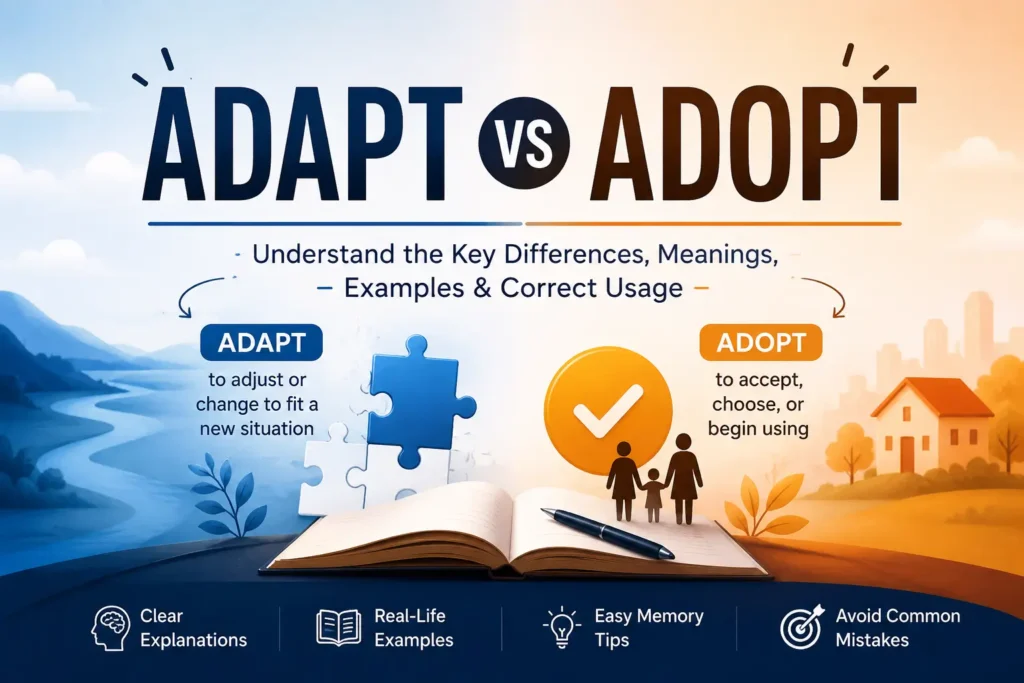
Adapt vs Adopt is a common English comparison that can confuse learners because both verbs look and sound similar. The key difference is simple: adapt means to adjust or modify something so it fits a new situation, while adopt means to accept, choose, or begin using something. For example, you adapt to a new environment, but you adopt a new strategy. Understanding this difference helps you choose the correct word in everyday conversation, academic writing, business communication, and professional documents.
The easiest way to remember the difference is adapt = adjust and adopt = accept or choose. Use adapt when something changes to fit new conditions. For example, “The teacher adapted the lesson for younger students.” Use adopt when someone accepts or starts using something. For example, “The school adopted a new teaching method.” This simple rule also explains why adapt to is correct when you mean “adjust to,” while adopt to is usually incorrect for that meaning.
The two words can sometimes appear in the same situation. A company might adopt a new policy and then adapt it for different departments. Likewise, a person can adopt a new routine and later adapt that routine to fit a changing schedule. Once you focus on whether something is being changed or accepted, the difference between these confusing words becomes much easier to understand and use correctly.
Quick Answer: Adapt vs Adopt
The easiest way to remember the difference is:
- Adapt = adjust or modify
- Adopt = accept, choose, or begin using
| Word | Basic meaning | Example |
| Adapt | Adjust to fit a new situation | She adapted to her new job. |
| Adapt | Modify something | We adapted the lesson for beginners. |
| Adopt | Accept or choose something | The company adopted a new policy. |
| Adopt | Begin using something | He adopted a healthier routine. |
| Adopt | Legally become a child’s parent | They adopted a child. |
A useful question can help you choose the right word:
Are you changing something to make it fit, or are you accepting or choosing something new?
If you’re adjusting, adapt is usually the answer. If you’re accepting, choosing, or starting to use something, adopt is usually correct.
Read this also: Flavour vs Flavor
What Does “Adapt” Mean?
Adapt is a verb that means to change or adjust something so it works in a different situation.
It can describe a person adjusting to new circumstances. It can also describe changing an object, plan, method, story, or system.
For example:
Maria adapted to her new school quickly.
Maria changed her behavior or approach so she could function comfortably in the new environment.
Another example is:
The teacher adapted the lesson for younger students.
Here, the lesson itself was changed to make it suitable for a different group.
Therefore, adapt is strongly connected with adjustment, modification, and suitability.
Adapt Means Adjust
When people adapt, they respond to a change.
You might:
- adapt to a new job
- adapt to a new city
- adapt to a different schedule
- adapt to changing circumstances
- adapt to new technology
- adapt to a new learning environment
For example:
After moving to Chicago, Jake had to adapt to the colder winters.
He didn’t simply choose winter. Instead, he had to adjust to conditions that were already there.
That idea of adjusting to something is one of the clearest uses of adapt.
Adapt Something to a New Purpose
You can also adapt something rather than adapting yourself.
For example:
The engineer adapted the design to meet new safety requirements.
The original design was modified.
Other examples include:
- The company adapted its marketing strategy to reach younger customers.
- She adapted the recipe for a smaller family.
- The professor adapted the course materials for online learning.
- The writer adapted the speech for a younger audience.
In each case, something is being changed to fit a particular need.
Adapt Something for an Audience
Adapt … for is especially common when talking about communication, education, entertainment, and content.
For example:
The publisher adapted the textbook for high school students.
The textbook may have been simplified, reorganized, or changed in some other way.
Similarly:
The speaker adapted her presentation for a business audience.
The presentation was modified to suit that audience.
What Does “Adopt” Mean?
Adopt is also a verb, but its meaning is different. It commonly means to accept, choose, or begin using something deliberately.
For example:
The school adopted a new attendance policy.
The school officially accepted and began using the policy.
You might also say:
She adopted a more flexible approach to studying.
She chose to use that approach.
The key idea is not modification. Instead, it is acceptance, selection, or taking something on.
Adopt Means Accept or Choose
You can adopt an:
- idea
- opinion
- position
- approach
- attitude
- policy
- principle
- strategy
For example:
The committee adopted the proposal after a long discussion.
The committee accepted it.
Similarly:
He adopted a positive attitude toward the challenge.
He chose or took on that attitude.
Adopt Means Begin Using
Adopt is also common when someone starts using a method, system, habit, or practice.
For example:
The company adopted a four-day workweek.
The company chose to implement that system.
Other examples include:
- She adopted a healthier diet.
- The team adopted a new training method.
- The school adopted digital textbooks.
- Many businesses adopted cloud-based software.
- He adopted a new study routine.
In these sentences, the person or organization isn’t necessarily modifying the thing. They are choosing to use or follow it.
Adopt Has a Family-Related Meaning
There is another important meaning of adopt.
To adopt a child means to legally become the child’s parent.
For example:
The couple adopted a child last year.
This meaning is distinct from the meanings involving ideas, policies, and habits.
The related words adoption, adopted, and adoptive can also refer to this family relationship.
Adapt vs Adopt: The Core Difference
The difference becomes clearer when you focus on the action involved.
Adapt focuses on change.
Adopt focuses on choice or acceptance.
| Question | Use |
| Are you adjusting to a new situation? | Adapt |
| Are you modifying something? | Adapt |
| Are you changing something so it fits a purpose? | Adapt |
| Are you accepting an idea? | Adopt |
| Are you choosing a policy? | Adopt |
| Are you beginning to use a method? | Adopt |
| Are you legally becoming a child’s parent? | Adopt |
Consider these two sentences:
The company adapted its strategy to changing market conditions.
The strategy was changed.
The company adopted a new strategy.
The company chose or began using the strategy.
Both sentences are correct. However, they communicate different actions.
Adapt vs Adopt Examples That Make the Difference Clear
Sometimes the best way to understand these words is to compare them in nearly identical situations.
Adapting to a New Workplace
Sarah adapted to her new workplace within a few weeks.
Sarah adjusted to the environment, people, expectations, or routines.
You wouldn’t normally say:
Sarah adopted to her new workplace. ❌
That’s incorrect because adopt doesn’t normally take to when you mean “adjust to.”
The correct expression is:
Sarah adapted to her new workplace. ✅
Adopting a New Workplace Policy
Now consider:
The company adopted a new workplace policy.
The company officially accepted and began using the policy.
Here, adopt takes a direct object:
adopt + a new policy
You don’t need to.
Adapting a Lesson
The teacher adapted the lesson for younger students.
The teacher changed the lesson.
Adopting a Teaching Method
The teacher adopted a new teaching method.
The teacher chose to use the method.
These examples show the central distinction:
Adapt changes something. Adopt chooses something.
How to Use “Adapt” Correctly
The grammar pattern you use with adapt depends on what you’re describing.
Adapt to Something
Use adapt to when someone or something adjusts to a situation or condition.
Examples:
- I adapted to my new schedule.
- The students adapted to online classes.
- She adapted to life in a new city.
- The team adapted to the unexpected changes.
The structure is:
adapt + to + situation
You can also use a gerund after to:
He adapted to working from home.
Here, working is a gerund, or an -ing form functioning as a noun.
Adapt Something
Use adapt + object when you change something.
Examples:
We adapted the plan.
The company adapted its product.
She adapted the lesson.
This pattern does not necessarily say what the thing was changed for. Context may provide that information.
Adapt Something to Something
You can identify the specific target of the adjustment:
The company adapted the software to the customer’s needs.
The software was changed so it would better fit those needs.
Adapt Something for Something
You can also use for when identifying the intended audience, purpose, or use:
The writer adapted the article for a general audience.
This pattern is particularly useful in education, publishing, media, and professional communication.
How to Use “Adopt” Correctly
Adopt usually takes a direct object.
Adopt an Idea
The team adopted her suggestion.
The team accepted the suggestion.
Adopt a Policy
The city adopted a new recycling policy.
The city officially accepted and implemented the policy.
Adopt a Strategy
The company adopted a new marketing strategy.
The company chose the strategy.
Adopt a Habit
He adopted a regular exercise routine.
He began following that routine.
Notice the common structure:
adopt + noun
Unlike adapt, you generally don’t say adopt to when you mean “accept” or “begin using.”
Common Collocations With Adapt and Adopt
A collocation is a group of words that commonly appear together. Learning these combinations can make your English sound more natural.
Common Collocations With Adapt
- adapt to change
- adapt to a new environment
- adapt to new circumstances
- adapt to a new role
- adapt to technology
- adapt a plan
- adapt a strategy
- adapt a lesson
- adapt a story
- adapt a product
- adapt something for an audience
Common Collocations With Adopt
- adopt a policy
- adopt a strategy
- adopt an approach
- adopt a method
- adopt a habit
- adopt a practice
- adopt an idea
- adopt a standard
- adopt a system
- adopt a position
- adopt a child
These combinations aren’t absolute rules. However, they are useful patterns to recognize in everyday American English.
Adapt vs Adopt in Real-Life American English
The distinction appears in many areas of modern life.
At Work
Imagine a new employee joins a company.
She adapted to the company’s culture.
She adjusted to the workplace.
Now imagine the company changes its procedures:
The company adopted a new hiring policy.
The company chose and implemented the policy.
At School
A student might say:
It took me a month to adapt to college life.
The student adjusted to a new environment.
Meanwhile:
I adopted a new study method.
The student began using a different method.
In Technology
Technology provides another useful contrast.
The company adopted artificial intelligence tools for customer service.
The company chose to begin using those tools.
However:
The company adapted its customer service process to work with the new technology.
The process itself was changed.
In Personal Life
Consider a person trying to improve their routine:
I adopted a healthier morning routine.
The person chose to begin following a new routine.
But:
I had to adapt to getting up earlier.
The person adjusted to the change.
In Writing and Entertainment
Adapt has a particularly common use in books, movies, television, and theater.
The studio adapted the novel for the screen.
The original story was changed to work in a different medium.
You can also say:
The director adapted the story for a younger audience.
Again, the focus is on modification.
Adapt vs Adopt in Academic and Professional Writing
These words are especially important in formal writing because using the wrong one can change the meaning of a sentence.
In Academic Writing
Suppose a researcher uses an existing questionnaire but changes several questions.
The researcher might write:
The researchers adapted the questionnaire for the study.
That tells the reader the original questionnaire was modified.
If researchers use an established framework without describing substantial changes, they may say:
The researchers adopted the framework.
The framework was accepted or used.
Therefore, academic writers should distinguish between using something as it is and modifying it for a particular purpose.
In Business Communication
Business writing frequently uses both words.
The company adopted a new customer-service policy.
The company accepted and implemented the policy.
The company adapted the policy for international customers.
The company modified the policy to fit a different group.
This distinction can make business reports much more precise.
Adapt, Adopt, and Adept: Three Different Words
Adapt, adopt, and adept are easy to confuse because they look similar. Their meanings, however, are very different.
| Word | Part of speech | Meaning | Example |
| Adapt | Verb | Adjust or modify | We adapted the plan. |
| Adopt | Verb | Accept, choose, or begin using | We adopted the plan. |
| Adept | Adjective | Highly skilled | She is adept at solving problems. |
The third word is particularly important.
You might say:
He is adept at using spreadsheets.
You wouldn’t use adapt or adopt in that sentence because you need an adjective describing his skill.
Related Words You Should Know
Understanding related forms can strengthen your vocabulary.
Adaptation
Adaptation is the noun related to adapt.
It can mean the process of adjusting or modifying something.
Examples:
The adaptation of the novel changed several characters.
Animals develop adaptations that help them survive.
The word is also common in entertainment:
The movie is an adaptation of a popular novel.
Adaptable
Adaptable describes someone or something that can adjust easily.
She is highly adaptable in changing work environments.
It can describe people, systems, organizations, and other things.
Adaptive
Adaptive often describes something designed to adjust or respond to changing conditions.
For example:
The software uses an adaptive system.
The distinction between adaptable and adaptive depends on context, but both connect to the idea of adjustment.
Adoption
Adoption is the noun related to adopt.
It can describe accepting or beginning to use something:
The adoption of new technology changed the company’s workflow.
It can also refer to legally becoming a child’s parent:
The adoption was finalized in June.
Adopted
Adopted is the past tense and past participle of adopt.
The company adopted the new policy.
It can also describe a child who has been legally adopted.
Adoptive
Adoptive is commonly used when describing a relationship connected with adoption.
For example:
She visited her adoptive parents.
Pronunciation of Adapt and Adopt
The words differ in both spelling and vowel sound.
In standard American English:
- adapt is commonly pronounced approximately uh-DAPT
- adopt is commonly pronounced approximately uh-DOPT
The final consonant sound also differs:
- adapt → /t/
- adopt → /t/
The important distinction is the vowel in the stressed second syllable:
- adapt → “dapt”
- adopt → “dopt”
Because the words are short and similar in sound, learners can easily mix them up in fast conversation.
Word Origins: Why Do Adapt and Adopt Look Similar?
The similarity isn’t accidental.
Both words ultimately trace back to Latin words formed with ad-, a prefix associated with movement toward or connection, combined with different roots.
Over time, English developed separate words from these Latin forms.
The modern meanings are now distinct:
- adapt developed around the idea of making something suitable or fitting.
- adopt developed around the idea of choosing or taking something as one’s own.
The history helps explain why the words look related, but modern usage should guide your word choice.
Common Mistakes With Adapt and Adopt
Mistake 1: Using Adopt for “Adjust”
Incorrect:
She adopted to her new environment. ❌
Correct:
She adapted to her new environment. ✅
The verb adapt is used with to when someone adjusts to a situation.
Mistake 2: Using Adapt for Accepting a Policy
Incorrect:
The company adapted a new policy. ❌
If the meaning is that the company accepted and implemented the policy, use adopt.
Correct:
The company adopted a new policy. ✅
Mistake 3: Writing “Adopt To”
Incorrect:
We adopted to the changes. ❌
Correct:
We adapted to the changes. ✅
However, adopt can be followed by to in unusual structures where to belongs to something else. The important point is that adopt to isn’t the normal pattern for “adjust to.”
Read this also: Canvas vs Canvass
Mistake 4: Assuming “Adapt a Plan” Is Always Wrong
It’s not.
Both of these can be correct:
We adapted the plan.
We adopted the plan.
But they mean different things.
Adapted the plan means the plan was changed or modified.
Adopted the plan means the plan was accepted or chosen for use.
Mistake 5: Confusing “Adapt to” With “Adopt”
Compare:
The employee adapted to the new schedule.
The employee adjusted.
The employee adopted a new schedule.
The employee chose or began following a new schedule.
The difference is small in form but important in meaning.
Mistake 6: Treating the Words as Synonyms
Adapt and adopt aren’t interchangeable synonyms.
Replacing one with the other can change the entire message.
For example:
The school adopted the new curriculum.
The school chose to use it.
The school adapted the new curriculum.
The school modified it.
A Simple Way to Choose the Correct Word
When you’re unsure, ask what happened.
If Something Was Changed to Fit → Adapt
Ask:
Was it adjusted or modified?
If yes, choose adapt.
Examples:
- adapt a lesson
- adapt a plan
- adapt a strategy
- adapt to change
If Something Was Accepted or Chosen → Adopt
Ask:
Was it accepted, selected, or put into use?
If yes, choose adopt.
Examples:
- adopt a policy
- adopt an idea
- adopt a method
- adopt a habit
If Someone Becomes a Parent Through Adoption → Adopt
This is a separate but important meaning:
They adopted a child.
Easy Memory Tricks for Adapt vs. Adopt
A simple mnemonic is:
Adapt = Adjust.
Both words begin with A, and both ideas involve making something fit a situation.
For adopt, think:
Adopt = Accept.
The first letters provide a useful memory clue:
Adapt → Adjust
Adopt → Accept
Another helpful trick is to focus on direction.
If something is moving toward a better fit, think adapt.
If someone is taking or choosing something, think adopt.
These tricks aren’t grammar rules. They’re simply ways to remember the difference quickly.
When Both Words Can Appear Together
One of the most useful patterns is that adopt and adapt can describe two stages of the same process.
Imagine a company chooses a new software system.
First:
The company adopted the new software.
It chose to use the software.
Later:
The company adapted the software to its specific workflow.
It changed or customized the system to fit its needs.
The same pattern works with strategies, policies, teaching methods, and plans.
For example:
The school adopted a new teaching approach and adapted it for different grade levels.
The school first accepted and used the approach. Then it modified it for specific needs.
Synonyms and Near-Synonyms
Knowing related words can make the distinction even clearer.
Synonyms for Adapt
Depending on context, adapt can be close in meaning to:
- adjust
- modify
- alter
- tailor
- customize
- change
- accommodate
For example:
We adapted the presentation for the audience.
You could often use tailored or customized instead, depending on the context.
Synonyms for Adopt
Depending on the meaning, adopt can be close to:
- accept
- choose
- embrace
- take on
- implement
- use
- approve
However, these aren’t perfect replacements in every sentence.
For example, adopt a child cannot normally be replaced with implement a child or choose a child without changing the meaning.
Formal and Informal Usage
Both adapt and adopt are standard words in American English. They’re appropriate in casual conversation as well as formal writing.
In professional writing, however, precision matters.
Instead of writing:
The company changed its policy.
you might write:
The company adopted a new policy.
if you mean that it formally accepted the policy.
Likewise, instead of simply saying:
The company changed its training program.
you might write:
The company adapted its training program for remote employees.
if the change was made specifically to fit a new situation.
The more precise verb tells readers what kind of change took place.
Adapt vs Adopt in American and British English
The basic distinction between these words is the same in American and British English.
American English:
The company adopted a new policy.
She adapted to the new environment.
British English uses the same meanings and basic grammar.
There is no major American-versus-British difference that changes the core rule. Therefore, learners should focus on the meaning and sentence pattern, not regional spelling.
Quick Practice: Adapt or Adopt?
Choose adapt or adopt in each sentence.
- The company decided to ___ a new privacy policy.
- It took the new employee several weeks to ___ to the schedule.
- The teacher ___ the lesson for students with different learning needs.
- She decided to ___ a healthier morning routine.
- The researchers ___ the questionnaire for their specific study.
- The organization ___ the international standard.
- The team had to ___ to the unexpected changes.
- The director ___ the novel for television.
Answers and Explanations
- adopt — The company accepted and implemented the policy.
- adapt — The employee adjusted to the schedule.
- adapted — The lesson was modified.
- adopt — She began following a new routine.
- adapted — The questionnaire was modified for a particular study.
- adopted — The organization accepted and began using the standard.
- adapt — The team needed to adjust to changing conditions.
- adapted — The novel was changed to work in another medium.
Quick Reference: Adapt vs Adopt
| Feature | Adapt | Adopt |
| Core idea | Adjust | Accept or choose |
| Main focus | Making something fit | Taking something on |
| Common pattern | adapt to something | adopt something |
| Can mean “modify”? | Yes | Not usually |
| Can mean “begin using”? | Sometimes in a broader sense, but adopt is more precise | Yes |
| Common object | plan, strategy, lesson, story | policy, idea, method, habit |
| Family meaning | No | Yes, adopt a child |
| Example | Adapt to change. | Adopt a new policy. |
Frequently Asked Questions
Q1: What is the difference between adapt and adopt?
Adapt means to adjust, change, or modify something so it fits a new situation. Adopt means to accept, choose, or begin using something. You adapt to change, but you adopt a new policy.
Q2: Is adapt the same as adopt?
No. Although adapt and adopt look and sound similar, they have different meanings. Adapt focuses on adjustment or modification, while adopt focuses on acceptance, choice, or starting to use something.
Q3: Is it “adapt to” or “adopt to”?
Use adapt to when you mean “adjust to.”
She adapted to her new job quickly.
For the meaning “accept” or “begin using,” use adopt with a direct object:
The company adopted a new policy.
Q4: Do you adapt or adopt a new policy?
Usually, you adopt a new policy when you accept and begin using it.
The company adopted a new remote-work policy.
You can adapt a policy when you modify it to suit particular needs.
Q5: Do you adapt or adopt a new habit?
You normally adopt a new habit when you begin practicing it.
He adopted a healthier eating habit.
However, you might adapt your routine if you change it to fit a new schedule or situation.
Q6: Do you adapt or adopt a strategy?
Both can be correct, but the meaning changes. You adopt a strategy when you choose or begin using it. You adapt a strategy when you modify it to respond to new conditions.
The company adopted a new strategy and later adapted it to changing customer needs.
Q7: Can you adapt a plan?
Yes. Adapt a plan means to change or modify the plan so it works better in a particular situation.
We adapted the plan after the budget was reduced.
If you simply accept or choose an existing plan, you can say:
The team adopted the plan.
Q8: Can you adopt an idea?
Yes. Adopt an idea means to accept or choose the idea for use.
The committee adopted her idea after reviewing the proposal.
If you change the idea to make it suitable for a particular purpose, you can use adapt instead.
Q9: Can adapt and adopt appear in the same sentence?
Yes. They can naturally describe two different actions.
The school adopted a new curriculum and adapted it for different grade levels.
The school first chose the curriculum and then modified it for specific needs.
Q10: What is the difference between adapt, adopt, and adept?
Adapt means to adjust or modify. Adopt means to accept, choose, or begin using. Adept is an adjective that means skilled or capable.
She adapted to the new system.
She adopted the new system.
She is adept at using the new system.
Conclusion
The difference between adapt vs adopt becomes clear when you focus on the action involved. Adapt means to adjust, modify, or change something so it fits a new condition. Adopt means to accept, choose, or begin using something. This distinction applies to plans, strategies, policies, habits, methods, ideas, and many everyday situations.
A quick memory trick can make the choice easier: adapt = adjust, while adopt = accept. If you change something to make it fit, use adapt. If you accept or start using something, use adopt. With this simple rule, you can use both words accurately in everyday English, academic writing, and professional communication.
