
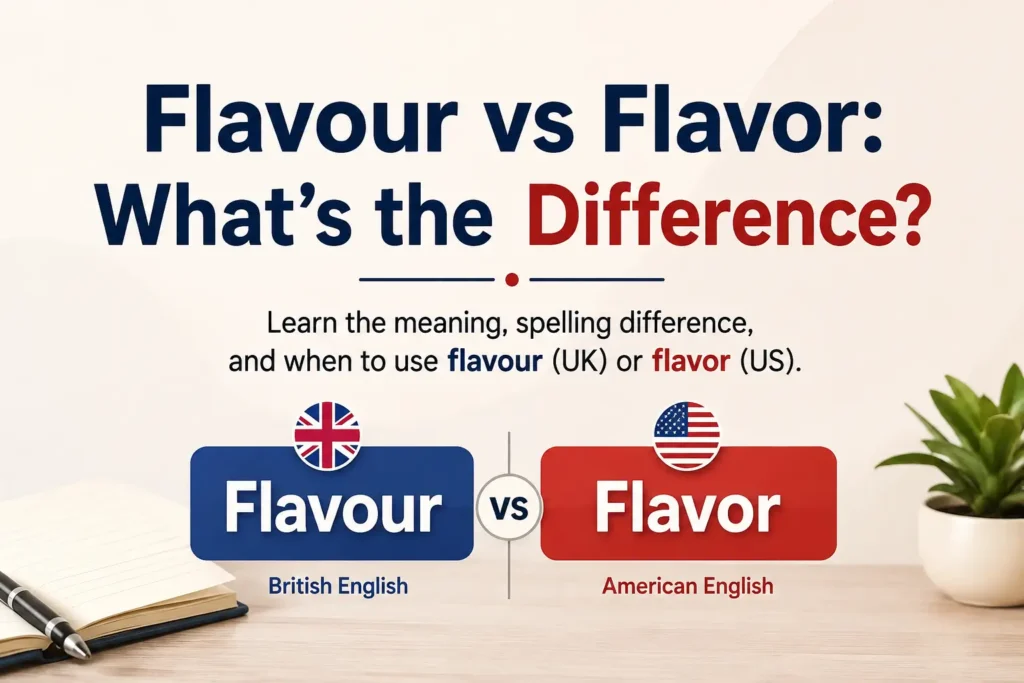
Understanding flavour vs flavor becomes easier when you know that both words have the same meaning, same pronunciation, and the same role in English writing. The difference comes from regional spelling rules. In American English, writers use flavor, while British English prefers flavour. This small spelling difference often appears in food labels, product descriptions, blogs, emails, academic writing, and professional communication. For example, a US recipe may say “chocolate flavor,” while a UK recipe may use “chocolate flavour.”
In everyday word usage, both forms describe taste, style, or a unique quality. A restaurant might advertise different flavors in the United States or different flavours in the United Kingdom. The same pattern applies to related words, including flavored and flavoured, flavoring and flavouring, and flavorful and flavourful. When creating online content for a specific audience, consistency matters. A US website should usually follow US spelling, while a UK website should follow UK spelling.
From years of reviewing English language content, one common mistake is mixing both systems in the same document. Writers sometimes combine American spelling and British spelling without noticing, which can make professional writing look inconsistent. The easiest way to remember the rule is that American English often removes the extra “u” in words like color, favor, and flavor, while British English keeps colour, favour, and flavour. Choosing one style and applying it throughout your writing creates clearer, more natural communication.
Quick Answer: Flavour vs Flavor
| Word | English Variety | Meaning |
| Flavor | American English | Taste, quality, or character of something |
| Flavour | British English | Same meaning, different regional spelling |
Both words:
- Have the same pronunciation
- Can function as nouns or verbs
- Can describe taste, character, style, or quality
- Are grammatically correct
- Differ mainly because of regional spelling conventions
Simple rule: Use flavor for American audiences and flavour for British audiences.
Read this also: Should vs. Must: Meaning, Differences, Rules, and Examples
What Do Flavour and Flavor Mean?
The words flavour and flavor describe a taste or quality that makes something recognizable or different.
Although they are commonly connected with food and drinks, their meanings are not limited to taste. They can also describe the character, atmosphere, style, or influence of something.
Meaning as a Noun
As a noun, flavor/flavour can refer to a particular taste.
Examples:
- The lemon flavor makes the drink refreshing.
- The soup has a strong garlic flavour.
- Vanilla is one of the most popular ice cream flavors.
- This tea has a unique herbal flavour.
In these examples, the word refers directly to taste.
Meaning Beyond Food
Flavor and flavour can also describe the character or style of something.
Examples:
- The movie has a strong historical flavor.
- The restaurant has an Italian flavour.
- His writing has a humorous flavor.
Here, the word does not literally describe taste. Instead, it refers to a noticeable quality, style, feeling, or influence.
Flavour and Flavor as Verbs
Both flavor and flavour can also function as verbs.
As a verb, the word can mean:
- To add taste to something
- To give something a particular quality or character
American English Example
The chef flavored the sauce with fresh herbs.
British English Example
The chef flavoured the sauce with fresh herbs.
The grammatical meaning remains the same. Only the spelling changes.
Another example:
- The report was flavored with personal opinions.
- The article was flavoured with personal opinions.
Pronunciation and Grammar of Flavor and Flavour
Flavor and flavour are generally pronounced the same way.
Pronunciation:
FLAY-ver
American pronunciation may be represented as:
/ˈfleɪ.vɚ/
The spelling difference does not normally affect pronunciation.
Parts of Speech
| Part of Speech | Example |
| Noun | This cake has a chocolate flavor. |
| Verb | Add spices to flavor the dish. |
| Adjective form | It is a flavorful meal. |
Both spellings follow the same basic grammatical rules.
Flavour vs Flavor: Key Differences
The main difference between flavour and flavor is spelling tradition rather than meaning.
American English often removes the letter “u” from certain words that retain it in British English.
| British English | American English |
| flavour | flavor |
| colour | color |
| favour | favor |
| humour | humor |
| behaviour | behavior |
This difference developed as American English adopted its own spelling conventions.
However, you should not assume every British word containing -our loses the “u” in American English.
For example:
- hour remains hour
- tour remains tour
The spelling change applies only to particular groups of words.
Flavour vs Flavor Comparison Table
Here is a simple comparison:
| Feature | Flavor | Flavour |
| English variety | American English | British English |
| Meaning | Taste, quality, or character | Taste, quality, or character |
| Pronunciation | Same | Same |
| Word type | Noun and verb | Noun and verb |
| Example | The flavor is sweet. | The flavour is sweet. |
| Common usage | United States | UK, Australia, New Zealand and other British-English contexts |
When to Use Flavor
Use flavor when writing in American English or creating content primarily for readers in the United States.
You will commonly see flavor in:
- US schools and universities
- American newspapers
- US websites
- Product descriptions targeting American customers
- Business communication in the United States
- American recipes and food packaging
Examples of Flavor
- This coffee has a rich caramel flavor.
- The new snack comes in three flavor options.
- The recipe combines traditional Mexican flavors.
- I love the fresh lemon flavor in this cake.
For American readers, flavor usually looks more natural and consistent.
When to Use Flavour
Use flavour when writing in British English.
This spelling is commonly used in:
- The United Kingdom
- Australia
- New Zealand
- Many countries and organizations that follow British English conventions
Examples of Flavour
- This chocolate has a smooth hazelnut flavour.
- The restaurant offers several ice cream flavours.
- The dish has a Mediterranean flavour.
- The tea has a surprisingly strong flavour.
If your publication follows British English, flavour is normally the appropriate choice.
Which Spelling Should You Use for an International Audience?
When writing for an international audience, consistency is more important than switching between spellings.
If your website primarily targets readers in the United States, use:
- flavor
- flavored
- flavoring
- flavorful
If your website follows British English, use:
- flavour
- flavoured
- flavouring
- flavourful
Avoid Mixing American and British Spellings
For example:
❌ The chocolate-flavoured cake has a delicious flavor.
This sentence mixes British and American spelling.
For American English, write:
✅ The chocolate-flavored cake has a delicious flavor.
For British English, write:
✅ The chocolate-flavoured cake has a delicious flavour.
Neither version is inherently better. What matters is that you remain consistent.
Where Are Flavor and Flavour Used?
The spelling you see most often depends largely on the variety of English being used.
Countries That Commonly Use Flavor
The spelling flavor is mainly associated with:
- The United States
- American-based companies
- US media
- American academic writing
- US-focused websites and publications
Common expressions include:
- flavor profile
- artificial flavor
- natural flavor
- flavor enhancer
Countries That Commonly Use Flavour
The spelling flavour is common in:
- The United Kingdom
- Australia
- New Zealand
- Many regions that follow British English conventions
Common expressions include:
- natural flavour
- flavour profile
- artificial flavour
- flavour enhancer
What About Canada?
Canada can be slightly more complicated because Canadian English contains features associated with both British and American English.
Many Canadian writers use spellings such as:
- flavour
- colour
- centre
However, individual businesses, publishers, and organizations may follow their own style guidelines.
If you are writing for a Canadian publication or company, check its preferred style and use it consistently.
Read this also: Vicious vs. Viscous Word Choice: How Viscous and Vicious Differences
Flavour vs Flavor in Real-Life Writing
Seeing the two spellings in context makes the difference easier to understand.
Food Writing
American English:
This restaurant is known for bold flavors and creative recipes.
British English:
This restaurant is known for bold flavours and creative recipes.
Product Descriptions
US product listing:
Available in four delicious flavors: vanilla, chocolate, strawberry, and coffee.
UK product listing:
Available in four delicious flavours: vanilla, chocolate, strawberry, and coffee.
Academic Writing
Academic writing should follow the required language or style guide.
For example:
- A US university paper will normally use flavor.
- A UK university paper will normally use flavour.
The most important rule is consistency.
Emails and Professional Writing
Both spellings are understandable, but professional writing should normally match your audience.
For a US company:
Our new product features a natural strawberry flavor.
For a UK company:
Our new product features a natural strawberry flavour.
Related Spellings: Flavored, Flavoured, Flavoring, and More
The American and British spelling difference continues in related forms of the word.
| American English | British English |
| flavored | flavoured |
| flavoring | flavouring |
| flavorful | flavourful |
| flavorless | flavourless |
American English Example
The flavored water contains natural fruit flavors.
British English Example
The flavoured water contains natural fruit flavours.
The same basic rule applies: choose one English variety and stay consistent throughout your writing.
Why Does American English Use Flavor Instead of Flavour?
The difference between flavor and flavour comes from historical changes in English spelling.
American English developed its own spelling conventions during the 18th and 19th centuries. Over time, American writers and dictionary makers promoted shorter or simplified spellings for a number of words.
One common pattern involved dropping the letter “u”.
Examples include:
- colour → color
- flavour → flavor
- favour → favor
- honour → honor
British English retained many of the traditional spellings, while American English adopted the shorter versions.
Neither system is incorrect. They simply represent different regional standards.
Common Mistakes With Flavour and Flavor
Understanding a few common mistakes can help you use these words correctly.
Mixing Both Spellings
One of the most common mistakes is combining American and British spelling conventions in the same sentence or article.
Incorrect:
Our favourite flavor is chocolate.
Here, favourite follows British spelling while flavor follows American spelling.
For American English:
Our favorite flavor is chocolate.
For British English:
Our favourite flavour is chocolate.
Choose one system and follow it consistently.
Assuming They Have Different Meanings
Some people assume flavour refers specifically to food while flavor can have a broader meaning.
That is not the case.
Both words can describe:
- Taste
- Character
- Style
- Quality
- Influence
- Atmosphere
The difference is spelling, not meaning.
Changing Official Names
Regional spelling rules should not be used to change an official name.
This can apply to:
- Brand names
- Product names
- Company names
- Book titles
- Organizations
If an official name uses a particular spelling, keep that spelling unchanged.
How to Remember Flavor vs Flavour
A simple memory trick can make the distinction easier:
American English often prefers the shorter spelling.
Remember:
- US = flavor
- UK = flavour
You can also connect it with color vs colour:
- US: color, flavor
- UK: colour, flavour
If you remember one pair, the other becomes much easier.
Synonyms for Flavor and Flavour
The best synonym depends on how the word is being used.
Synonyms for Food and Taste
Possible alternatives include:
- taste
- aroma
- essence
- seasoning
- character
Example:
The flavor of the sauce is strong.
You could write:
The taste of the sauce is strong.
Synonyms for Style or Character
When flavor/flavour does not refer literally to food, possible alternatives include:
- quality
- style
- tone
- feeling
- atmosphere
- character
Example:
The movie has a unique flavor.
You could also say:
The movie has a unique style.
Flavor vs Flavour: Which One Is Correct?
Both flavor and flavour are correct spellings.
The correct choice depends on which variety of English you are following.
Use:
Flavor → American English
Flavour → British English
The meaning and pronunciation remain essentially the same.
The most important thing is not to switch unnecessarily between the two systems within the same piece of writing.
Final Summary: Flavour vs Flavor
The difference between flavour vs flavor is simple: flavor is the standard spelling in American English, while flavour is the standard spelling in British English. Both words have the same meaning, same pronunciation, and the same grammatical use. The choice depends on your target audience, writing style, and regional spelling conventions.
If you are writing for readers in the United States, use flavor, flavored, and flavoring. If your readers follow British English, choose flavour, flavoured, and flavouring. The most important rule is to stay consistent throughout your professional writing, academic writing, websites, and other forms of online content.
Understanding this small spelling difference helps you create clearer and more natural English writing. Whether you are preparing a recipe, blog post, product description, or business document, choosing the correct form shows attention to detail and improves communication with your readers.
FAQs About Flavour vs Flavor
Q1: What is the difference between flavour and flavor?
The difference between flavour and flavor is only spelling. Flavor is used in American English, while flavour is used in British English. Both words have the same meaning and pronunciation.
Q2: Is flavor or flavour the correct spelling?
Both spellings are correct. The correct choice depends on the type of English you are using. Use flavor for US audiences and flavour for British English audiences.
Q3: Does flavour mean something different from flavor?
No. Flavour and flavor mean the same thing. They can describe the taste of food, a drink, or the general character and style of something.
Q4: Should I use flavor or flavour on a website?
Choose the spelling based on your target audience. A website targeting American readers should use flavor, while a website targeting British readers should use flavour. Consistency is more important than using both forms.
Q5: Is flavored or flavoured correct?
Both are correct, but they follow different spelling systems. Flavored is the American English form, while flavoured is the British English form.
Q6: Is flavoring or flavouring the correct spelling?
The correct spelling depends on your region. Flavoring is used in American English, while flavouring is used in British English.
Q7: Why does American English remove the “u” in flavor?
American English simplified some spellings over time by removing letters that were not pronounced. This created differences such as flavor/flavour, color/colour, and favor/favour.
Q8: Can I use flavour in American English writing?
Yes, people in the United States will understand flavour, but flavor is the standard American spelling. Using flavour in US-focused writing may look inconsistent.
Q9: Which countries use the spelling flavour?
Flavour is commonly used in the United Kingdom, Australia, New Zealand, and many other regions that follow British English spelling traditions.
Q10: Do flavor and flavour have the same pronunciation?
Yes. Flavor and flavour are pronounced the same in normal English usage. The difference is only in the written spelling, not in the spoken word.

1 thought on “Flavour vs Flavor: What’s the Difference? British and American English Spelling Guide”