
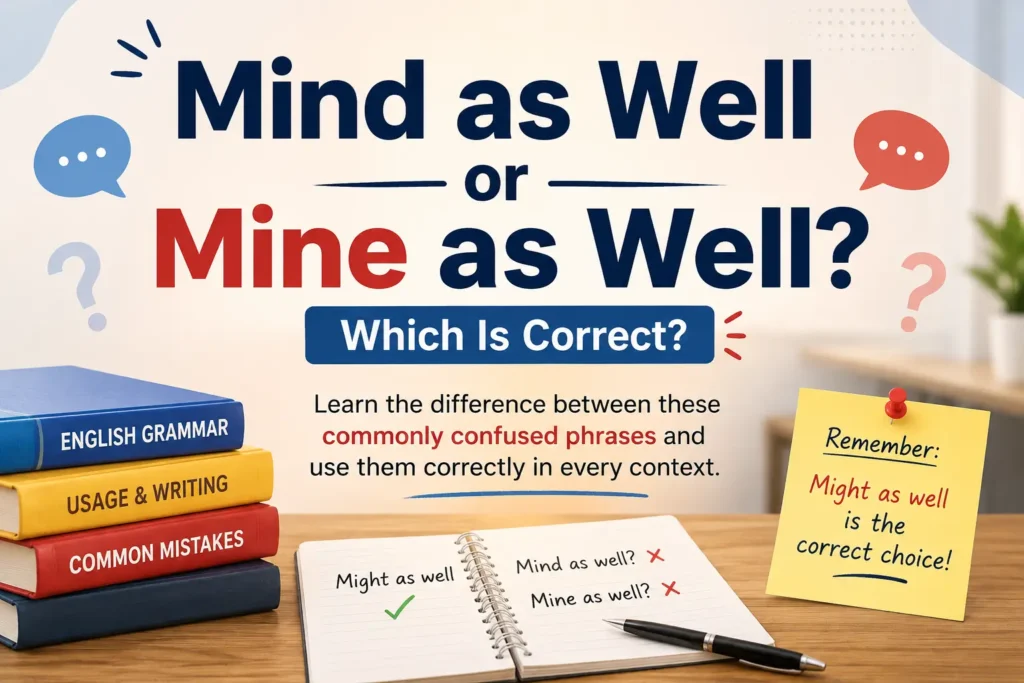
Mind as well or mine as well are common spellings people use when they hear the phrase “might as well” in fast conversation. However, neither mind as well nor mine as well is the standard expression when you mean that something is a sensible choice because there’s little reason not to do it. The correct phrase is might as well.
For example, “We’re already here, so we might as well stay” means staying is a reasonable choice. The phrase can also mean “why not?” or introduce a casual suggestion. This guide explains the meaning, grammar, correct usage, and common spelling mistakes so you can choose the right phrase confidently.
Quick Answer: Is It “Mine as Well,” “Mind as Well,” or “Might as Well”?
If you mean “why not?”, “there’s little reason not to,” or “this is a practical choice,” use “might as well.”
| Expression | Is it the standard idiom? | Main meaning |
| Might as well | Yes | It makes sense to do something under the circumstances |
| Mine as well | No, not in this idiom | Mine normally shows possession |
| Mind as well | No, not in this idiom | Mind has other meanings and functions |
For example:
- ✅ We might as well go now.
- ❌ We mine as well go now.
- ❌ We mind as well go now.
The key is simple: if you’re talking about choosing an action, the phrase is usually “might as well.
Read this also: Traveler or Traveller: Which Spelling Is Correct in American English?
What Does “Might as Well” Mean?
Might as well is an English idiom used when an action seems reasonable, practical, or worthwhile because there isn’t a strong reason not to do it.
It often has the feeling of:
- Why not?
- There’s no good reason not to.
- This is probably the most practical option.
- Since we’re in this situation anyway, let’s do it.
Consider this example:
“We’re already at the mall, so we might as well get groceries.”
The speaker isn’t saying that getting groceries is required. Instead, the situation makes it seem like a sensible choice.
Similarly:
“You’re already awake, so you might as well finish your homework.”
The sentence suggests that finishing the homework is practical because the person is already awake.
“Might as Well” Does Not Always Express Enthusiasm
One important point is that might as well doesn’t necessarily mean the speaker is excited about the action.
Sometimes it expresses resignation.
“The movie doesn’t start for another hour, so we might as well wait.”
The speaker may not want to wait. However, waiting makes sense because there isn’t a better option.
That difference matters. Might as well can sound practical, neutral, reluctant, resigned, or even sarcastic depending on the situation and tone.
Why Do People Confuse “Might,” “Mine,” and “Mind”?
The confusion is largely a sound-and-spelling problem.
In quick conversation, speakers don’t always pronounce every sound as clearly as they would when reading a word aloud. As a result, might as well can sometimes be heard incorrectly as something resembling mine as well or mind as well.
This is especially common for English learners because might, mine, and mind are all familiar words with similar sounds.
However, similar pronunciation doesn’t mean the words have the same grammatical function.
Why “Might” Can Sound Like “Mine”
The word might ends with a /t/ sound. In connected speech, that sound can become less noticeable before another consonant.
In might as well, the words flow together naturally:
might as well
Because people often speak quickly, a listener may not clearly hear the final t in might.
That can lead to a mistaken spelling such as:
❌ mine as well
The problem becomes more obvious when you look at the meaning. Mine doesn’t function as a modal verb, so it cannot normally introduce the action in the same way.
Why “Mind” Gets Confused With “Might”
Mind and might also sound similar, especially when spoken quickly.
However, their grammar is completely different.
Compare:
You might leave early.
Here, might is a modal verb.
Now compare:
Mind the door.
Here, mind is a verb meaning something like “pay attention to” or “be careful about.”
So although mind and might may sound somewhat alike, they aren’t interchangeable.
“Mine as Well” or “Might as Well”: The Real Difference
The easiest way to understand the difference is to look at the grammatical role of each word.
“Might” Is a Modal Verb
Might is a modal auxiliary verb. It can express possibility, but in might as well, the entire expression has an idiomatic meaning.
The basic structure is:
subject + might as well + base verb
Examples:
- I might as well stay.
- She might as well call him.
- We might as well leave.
- They might as well try.
The verb after might as well stays in its base form.
“Mine” Is Usually a Possessive Pronoun
Mine normally tells you that something belongs to the speaker.
Examples:
- “That jacket is mine.”
- “The red notebook is mine.”
- “This seat is mine.”
Therefore, mine doesn’t normally work before an action verb in the pattern mine as well + verb.
For example:
❌ “I mine as well go home.”
The intended meaning is almost certainly:
✅ “I might as well go home.”
“Mind” Has Several Other Meanings
Mind can be a noun or a verb.
As a noun:
“She has a brilliant mind.”
As a verb:
“Please mind the step.”
It can also mean to object to something:
“Do you mind if I open the window?”
None of these meanings produces the standard idiom mind as well.
Is “Mine as Well” Ever Correct?
There is an important nuance here.
Mine as well isn’t the standard replacement for might as well, but the individual words mine and as well can appear together in a sentence when mine has its normal possessive meaning.
For example:
“Your phone is expensive, but mine as well.”
This sentence is awkward and incomplete in ordinary modern American English. A clearer version would be:
“Your phone is expensive, and mine is as well.”
That example shows why context matters. Mine can legitimately appear near as well, but that doesn’t make mine as well an alternative spelling of might as well.
Compare these:
❌ “I mine as well leave.”
✅ “I might as well leave.”
The first sentence attempts to use mine as a modal. That isn’t standard English.
Is “Mind as Well” Correct?
When you’re trying to express the meaning of might as well, mind as well is not standard English.
For example:
❌ “We mind as well take the train.”
The correct sentence is:
✅ “We might as well take the train.”
However, mind itself is perfectly correct in many other expressions.
For example:
“Do you mind waiting?”
“Mind your step.”
“Keep that in mind.”
“I don’t mind.”
The issue isn’t that mind is an incorrect word. The issue is that it doesn’t belong in the idiom might as well.
How “Might as Well” Works Grammatically
The grammar becomes easier once you recognize might as a modal verb.
Modal verbs include words such as can, could, may, might, must, shall, should, and will.
A modal is normally followed by the base form of another verb.
Therefore:
might + go
not:
❌ might + goes
and not:
❌ might + to go
The same rule applies to might as well.
Basic Pattern: Subject + Might as Well + Base Verb
Examples:
- I might as well go.
- You might as well ask.
- He might as well stay.
- We might as well start.
- They might as well wait.
Notice that the main verb doesn’t change for different subjects.
I might as well go.
She might as well go.
They might as well go.
That’s because might carries the modal grammar.
Why “Might as Well to Go” Is Wrong
A common mistake is adding to before the verb.
❌ “We might as well to go.”
The correct structure is:
✅ “We might as well go.”
Unlike phrases such as want to go, modal constructions don’t normally use to before the main verb.
Why “Might as Well Goes” Is Wrong
Another mistake is adding -s to the verb.
❌ “She might as well goes.”
The correct form is:
✅ “She might as well go.”
Again, might is the modal, so the following verb remains in its base form.
Common Ways Americans Use “Might as Well”
The phrase appears frequently in everyday American conversation. Its exact tone depends on context.
1. Making a Practical Decision
“We’re already downtown, so we might as well get lunch.”
The speaker sees lunch as a convenient choice because they’re already there.
2. Taking Advantage of an Opportunity
“You’re visiting Chicago for the first time. You might as well see the riverwalk.”
The suggestion makes sense because the opportunity is available.
3. Accepting an Unavoidable Situation
“The flight is delayed for three hours, so we might as well get some food.”
The speaker isn’t necessarily happy about the delay. Getting food is simply a useful way to spend the time.
4. Trying Something Because There Is Little to Lose
“I don’t know if I’ll get the job, but I might as well apply.”
Here, might as well means that applying is worth trying despite uncertainty.
5. Making a Casual Suggestion
“We’re finished early. We might as well head home.”
This sounds softer and more casual than giving a direct command.
“Might as Well” Can Sound Resigned or Sarcastic
Context and tone can change the emotional effect of the phrase.
Compare:
“The weather is beautiful, so we might as well go for a walk.”
This sounds positive and practical.
Now consider:
“We’ve waited two hours already. We might as well wait another ten minutes.”
This sounds resigned.
A sarcastic use is also possible:
“Well, we’ve already spent this much money. We might as well buy the expensive one too.”
The speaker may be joking about continuing to spend money.
Therefore, might as well doesn’t have one fixed emotional tone. The surrounding context determines how it sounds.
Might as Well vs. May as Well
Both might as well and may as well are grammatical.
In American English, might as well is very common in everyday conversation.
For example:
“We might as well leave now.”
You can also say:
“We may as well leave now.”
In many contexts, the meaning is nearly identical.
However, may can sometimes sound slightly more formal or deliberate, while might as well is especially natural in casual speech.
The important point is that may as well isn’t an error. It simply isn’t the phrase most learners are asking about when they confuse might with mine or mind.
Might as Well vs. Should
These expressions overlap, but they aren’t always identical.
Might as Well
Might as well usually presents an action as reasonable under the circumstances.
“We’re already here, so we might as well stay.”
Should
Should more directly expresses advice, expectation, or what seems like the right thing to do.
“We should stay.”
The first sentence focuses on practical reasoning. The second focuses more directly on what is advisable.
That’s why replacing one with the other can slightly change the meaning.
Might as Well vs. Had Better
Had better is generally stronger.
“You’d better leave now.”
This can suggest a warning or serious consequence.
By contrast:
“You might as well leave now.”
This usually sounds more like a practical suggestion.
Therefore, don’t treat might as well as a softer version of every expression containing should or had better. Each phrase carries its own meaning and tone.
Common Sentence Patterns With “Might as Well”
Learning a few natural patterns can make the phrase easier to use.
Subject + Might as Well + Base Verb
“I might as well call her.”
“They might as well start.”
Since + Reason + Might as Well
“Since we’re already here, we might as well stay.”
This structure clearly explains why the action makes sense.
Might as Well + Base Verb
In casual conversation, the subject can sometimes be understood from context:
“Might as well go.”
This is common in informal speech and texting.
A fuller version would be:
“We might as well go.”
Might as Well Not + Base Verb
You can also make the expression negative:
“You might as well not bring an umbrella.”
This means that bringing one probably isn’t useful under the circumstances.
Common Mistakes With “Mine as Well” and “Mind as Well”
Mistake 1: Writing “Mine as Well”
❌ “I mine as well finish this tonight.”
✅ “I might as well finish this tonight.”
Why? The sentence needs the modal might to form the idiom.
Mistake 2: Writing “Mind as Well”
❌ “We mind as well take the bus.”
✅ “We might as well take the bus.”
Why? Mind doesn’t function as the modal in this construction.
Mistake 3: Adding “To”
❌ “You might as well to ask.”
✅ “You might as well ask.”
Why? A modal verb is followed directly by the base form.
Mistake 4: Changing the Verb
❌ “She might as well goes home.”
✅ “She might as well go home.”
Why? The verb after might stays in the base form.
Mistake 5: Treating It Like a Requirement
“You might as well leave.”
This doesn’t necessarily mean:
“You are required to leave.”
Instead, it generally suggests that leaving is the sensible choice.
Correct vs. Incorrect Examples
| Incorrect | Correct | Explanation |
| ❌ I mine as well go. | ✅ I might as well go. | The idiom uses might. |
| ❌ We mind as well leave. | ✅ We might as well leave. | Mind doesn’t work as the modal here. |
| ❌ She might as well goes. | ✅ She might as well go. | Use the base verb after might. |
| ❌ You might as well to stay. | ✅ You might as well stay. | Don’t add to after the modal. |
| ❌ They might as well went. | ✅ They might as well go. | The base form follows might. |
How to Tell Which Word You Need
A simple meaning test can prevent most mistakes.
Ask yourself:
Am I saying “why not?” or “there’s little reason not to”?
If yes, use:
might as well
For example:
“It’s already 9 p.m. We might as well order dinner.”
If you’re talking about ownership, mine may be the right word:
“That laptop is mine.”
If you’re talking about paying attention or objecting, mind may be correct:
“Do you mind if I sit here?”
This simple test is more reliable than trying to remember how the words sound.
A Memory Trick for “Might as Well”
Use this shortcut:
WHY NOT? → MIGHT AS WELL
If you can replace the phrase with “why not?” without losing the basic idea, might as well is probably what you need.
For example:
“We’re already at the restaurant. We might as well eat here.”
Think:
“We’re already at the restaurant. Why not eat here?”
The meaning is close.
By contrast, you can’t replace mine with “why not”:
“That backpack is mine.”
And you can’t replace mind with “why not”:
“Do you mind waiting?”
That makes the distinction much easier to remember.
Is “Might as Well” Formal or Informal?
Might as well is standard English. It’s not an incorrect slang expression.
It’s particularly natural in:
- everyday conversation
- text messages
- casual emails
- workplace discussions
- informal writing
- dialogue
It can also appear in professional or academic writing when the meaning and tone fit.
However, formal writing sometimes benefits from a more precise alternative.
For example:
“We might as well postpone the meeting.”
A more formal version might be:
“It would be reasonable to postpone the meeting.”
The first isn’t grammatically wrong. The second simply has a more formal tone.
Read this also: Domino Affect or Effect: Which One Is Correct?
Real-Life American English Examples
Here are some examples from situations you may encounter in the US.
At Work
“We’re waiting for the client, so we might as well review the presentation.”
This suggests using the available time productively.
At School
“The professor hasn’t arrived yet. We might as well start reviewing the notes.”
The speaker proposes a practical use of the waiting time.
While Traveling
“We’re only ten minutes from the museum, so we might as well walk.”
The distance makes walking a sensible option.
In a Text Message
“I’m already heading downtown. Might as well grab coffee.”
The shortened version is natural in casual texting because the subject I is understood.
In Conversation
“If you’re going to the store, I might as well come with you.”
The speaker sees little reason to stay behind.
Related Words and Expressions
Understanding nearby expressions can help you use might as well more precisely.
| Expression | Typical meaning |
| might as well | A practical choice; little reason not to |
| may as well | Similar meaning; often interchangeable |
| why not? | A casual way to suggest or accept an option |
| should | Advice, expectation, or a recommended action |
| had better | Strong advice or warning |
| could | Possibility, ability, or a softer suggestion |
| have to | Necessity or requirement |
| must | Strong necessity or obligation |
These expressions can overlap, but they aren’t exact synonyms in every situation.
Quick Grammar Tips
Keep these rules in mind:
- Use “might as well” when an action seems reasonable under the circumstances.
- Use “might as well + base verb.”
- Don’t write “might as well to go.”
- Don’t write “might as well goes.”
- Mine normally expresses possession.
- Mind has meanings related to thought, attention, or objection.
- Don’t use mine or mind simply because they sound similar to might.
- Remember that might as well can sound practical, resigned, or sarcastic depending on context.
- May as well is also grammatical.
- Might as well doesn’t normally mean that an action is mandatory.
Frequently Asked Questions About Mine as Well or Mind as Well
Q1. Is it “mind as well” or “might as well”?
The correct expression is might as well when you mean that an action is reasonable or that there is little reason not to do it.
“We might as well leave now.”
Q2. Is “mine as well” correct English?
Mine as well isn’t the standard idiom used to mean might as well. Mine is normally a possessive pronoun, as in “That book is mine.”
Q3. Is “mind as well” grammatically correct?
Not when you’re trying to express the meaning of might as well. The correct phrase is might as well.
❌ “We mind as well go.”
✅ “We might as well go.”
Q4. Why do people confuse “might” with “mine” or “mind”?
The confusion usually comes from pronunciation. In fast speech, the final sound in might can be less noticeable, making might as well sound different from its written form.
Q5. What does “might as well” mean?
Might as well means that doing something seems like a reasonable or practical choice because there isn’t a strong reason not to do it.
“It’s already late, so we might as well go home.”
Q6. Does “might as well” mean “why not”?
Often, yes. In casual American English, might as well can express an idea similar to “why not?”
“We’re already at the store, so we might as well buy it.”
Q7. What verb comes after “might as well”?
Use the base form of the verb after might as well.
Correct:
“You might as well ask.”
Incorrect:
“You might as well asks.”
The modal verb might keeps the following verb in its base form.
Q8. Is “may as well” also correct?
Yes. May as well is a standard expression and can have a similar meaning to might as well. However, might as well is very common in everyday American conversation.
Q9. Is “might as well” the same as “should”?
Not exactly. Should often gives advice or describes what is advisable. Might as well focuses more on a practical choice when there is little reason not to act.
Compare:
“You should call her.” — This sounds like advice.
“You might as well call her.” — Calling her seems like the practical option.
Q10. Can “might as well” sound negative or sarcastic?
Yes. The meaning depends on the context and tone. It can express resignation, reluctance, humor, or sarcasm as well as a simple practical suggestion.
“We’ve already waited two hours, so we might as well wait another ten minutes.”
Here, the speaker may sound resigned rather than enthusiastic.
Conclusion: Use “Might as Well” When You Mean “Why Not?”
The difference between mind as well, mine as well, and might as well becomes much easier once you focus on meaning instead of sound. When you mean “why not?”, “there’s little reason not to,” or a practical choice, the correct expression is might as well.
Remember that might is a modal verb, so it is followed by a base verb: “I might as well go,” not “I might as well goes” or “I might as well to go.” Meanwhile, mine usually shows possession, while mind can refer to thoughts or function as a verb.
The confusion often comes from fast speech, connected speech, and similar sounds. Therefore, when you’re unsure, check the meaning and sentence structure. If the sentence suggests a sensible action or casual suggestion, might as well is almost certainly the phrase you need.
