
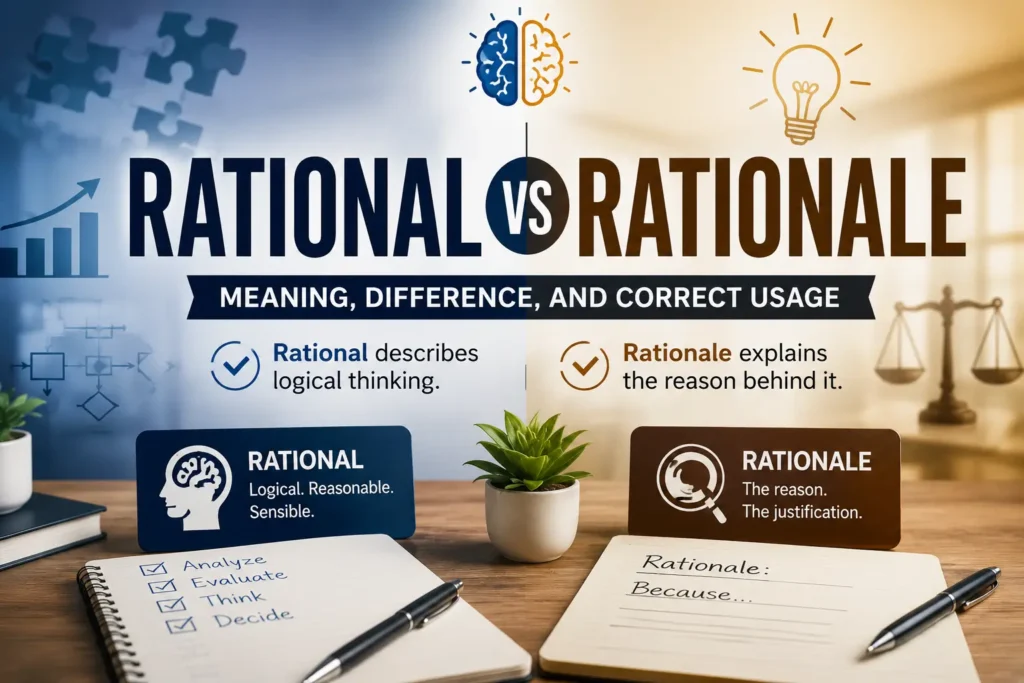
The rational vs rationale difference becomes clear when you know that one describes logical thinking while the other names the reason behind it.
Rational is an adjective for a sensible decision, clear idea, logical plan, or reasoned behavior. Rationale is a noun for the underlying reason, reasoning, or justification behind an action, belief, or choice. Both words come from the Latin root ratio, meaning reason, but their grammatical roles and different purposes clearly separate them.
This distinction improves understanding, clarity, precision, and credibility in everyday communication, academic papers, business documents, professional discussions, casual writing, and professional writing. In careful editing, misusing or misapplying the wrong form can create confusion, ambiguity, unclear communication, and weak arguments. It may also make a strong sentence appear careless in formal academic contexts or professional contexts. Use this simple guide: rational describes; rationale explains.
Quick Answer: Rational vs. Rationale
Rational is usually an adjective. It means logical, sensible, or guided by reason.
She made a rational choice after reviewing the facts.
Rationale is a noun. It means the reasoning, explanation, or justification behind something.
She explained the rationale for her choice.
The easiest way to remember the difference is this:
- A rational decision is a logical decision.
- A rationale is the reason behind that decision.
Rational vs. Rationale Comparison Table
| Word | Part of Speech | Main Meaning | Common Sentence Pattern | Example |
| Rational | Adjective | Logical, sensible, or based on reason | rational + noun | It was a rational response. |
| Rationale | Noun | The reasoning or explanation behind something | rationale for/behind + noun | What is the rationale for the change? |
Although the two words come from the same family, they aren’t interchangeable. Their grammar roles are different, and using one in place of the other usually creates an obvious error.
Read this also: Switch vs Swap: Difference, Meaning, and Easy Examples
What Does Rational Mean?
Rational most often means logical, reasonable, or based on clear thinking rather than emotion, impulse, or confusion.
It commonly describes:
- decisions
- arguments
- explanations
- people
- behavior
- thoughts
- responses
- choices
For example:
Choosing the less expensive plan was a rational decision.
In this sentence, rational describes the noun decision. It tells you what kind of decision it was.
Rational as an Adjective
The most common use of rational is as an adjective. An adjective describes a noun or pronoun.
Consider these examples:
- a rational argument
- a rational explanation
- a rational person
- a rational approach
- a rational response
In each phrase, rational tells you that the noun involves reason, logic, or sound judgment.
We need a rational approach to the budget problem.
Here, rational describes the approach. The sentence suggests that the approach should rely on facts and careful thought.
Rational Can Describe a Person
When rational describes a person, it means that the person can think clearly and make decisions based on reason.
Even under pressure, Maya remained rational.
This doesn’t mean Maya had no emotions. Instead, it means she controlled her response and thought carefully before acting.
However, be cautious when describing another person as irrational. In conversation, that word can sound harsh or dismissive.
Rational Can Describe an Idea or Argument
An argument is rational when its conclusion follows from evidence or clear reasoning.
His argument was rational, but it didn’t address every concern.
This example shows that a rational argument isn’t automatically complete or correct. It may be logically developed while still missing important facts.
Rational in Mathematics
In mathematics, rational also has a technical meaning.
A rational number is a number that can be written as a fraction of two integers, as long as the denominator isn’t zero.
Examples include:
- 1/2
- 3
- -7/4
- 0.75
In this technical use, rational still relates to the idea of a ratio. However, this mathematical meaning differs from the everyday meaning of logical or sensible.
What Does Rationale Mean?
Rationale is a noun that refers to the reasoning, explanation, or set of principles behind a decision, action, belief, policy, or plan.
The manager explained the rationale for the new schedule.
The rationale is not the schedule itself. It is the reasoning behind the schedule.
Rationale as a Noun
Because rationale is a noun, it can serve as a subject, object, or complement in a sentence.
As a subject:
The rationale was clear.
As an object:
The committee questioned the rationale.
After a preposition:
We discussed the reasoning behind the rationale.
In most everyday sentences, rationale appears with words such as the, a, this, that, your, or their.
Examples include:
- the rationale
- a rationale
- your rationale
- their rationale
- this rationale
Rationale Usually Refers to Organized Reasoning
A reason can be simple and personal.
I left early because I was tired.
A rationale often sounds more organized, formal, or deliberate.
The rationale for ending the meeting early was to give employees more preparation time.
For this reason, rationale appears often in academic, professional, legal, scientific, and policy-related writing.
A Rationale Is Not Proof
A rationale explains why someone made a decision. However, it doesn’t automatically prove that the decision was wise, ethical, or correct.
The company offered a rationale for the policy, but employees still disagreed with it.
The company explained its reasoning. Still, the explanation may not have persuaded everyone.
This distinction is important. A decision can have a rationale without being rational.
The Main Difference Between Rational and Rationale
The central difference is grammatical:
- Rational usually describes.
- Rationale names.
In other words, rational is mainly an adjective, while rationale is a noun.
Compare these sentences:
That was a rational decision.
She explained the rationale for the decision.
In the first sentence, rational describes the decision. In the second, rationale identifies the reason behind it.
Rational Describes Quality
Use rational when you want to describe something as logical, reasonable, or based on thought.
His response was calm and rational.
The word tells you about the quality of his response.
Rationale Identifies Reasoning
Use rationale when you want to name or discuss the explanation behind something.
What was the rationale behind his response?
The question asks why he responded that way.
One Decision Can Be Rational and Have a Rationale
The two words often appear in related contexts.
The board made a rational choice and provided a clear rationale.
Here, rational describes the choice. Rationale refers to the reasoning supporting it.
How Rational and Rationale Work in a Sentence
Knowing where each word appears in a sentence can prevent most errors.
Rational Usually Comes Before a Noun
The most common pattern is:
rational + noun
Examples:
- rational choice
- rational thought
- rational explanation
- rational response
- rational behavior
- rational plan
A rational plan should consider both cost and risk.
Rational can also appear after a linking verb, such as be, seem, remain, or become.
Her decision seemed rational.
He remained rational during the emergency.
Rationale Often Follows a Determiner
A determiner is a word such as the, a, this, or your that introduces a noun.
Common patterns include:
- the rationale
- a rationale
- this rationale
- your rationale
- their rationale
The committee requested a rationale.
Because rationale is a countable noun, it can also have a plural form.
The report presented several competing rationales.
The plural rationales is correct, although it appears less often than the singular form.
Rationale Commonly Appears With For
The most natural pattern is:
the rationale for + noun or action
What is the rationale for the new attendance policy?
She explained the rationale for delaying the launch.
Use for when introducing the decision, policy, action, or idea being explained.
Rationale Can Also Appear With Behind
Another common pattern is:
the rationale behind + noun
We don’t understand the rationale behind the price increase.
Both rationale for and rationale behind are correct. However, rationale for is often more direct and formal.
Examples of Rational in Sentences
The following examples show how rational works in different settings.
Everyday Conversation
Buying a used car was the most rational option for our budget.
The speaker describes the option as sensible.
Let’s stay rational and review what actually happened.
Here, rational means calm and guided by facts.
School
The student gave a rational explanation for choosing that research topic.
The explanation was logical and understandable.
Her conclusion was rational, but she needed more evidence.
The reasoning made sense, although the support was incomplete.
Workplace
Management took a rational approach to reducing expenses.
The approach relied on careful thought.
It would be rational to test the software before releasing it.
The sentence describes testing as a sensible action.
I believe extending the deadline would be a rational solution.
This wording sounds professional and measured.
Technology
The program uses a rational process to rank the available options.
The process follows defined logic or rules.
Examples of Rationale in Sentences
These examples show how rationale appears in real communication.
Workplace
Please explain the rationale for changing the project deadline.
The speaker wants to know the reasoning behind the change.
The proposal includes a detailed business rationale.
The proposal explains why the project makes sense from a business perspective.
Academic Writing
The introduction should state the rationale for the study.
In research writing, the rationale explains why the study is needed.
The author provides a clear rationale for using interviews instead of surveys.
This sentence identifies the reasoning behind a research method.
Policy
Officials published the rationale behind the new safety rule.
The statement refers to the explanation supporting the rule.
Technology
The design document records the rationale for each major feature.
This helps future team members understand why the choices were made.
Everyday Use
I understand your decision, but I’m not sure I understand the rationale.
The speaker accepts what happened but doesn’t fully understand why.
Rational vs. Rationale in Real-Life American English
Both words are common in American English, but they don’t appear equally often in every setting.
Workplace and Business Communication
In business writing, rational often describes a decision or approach.
We need a rational plan for managing the transition.
Rationale often appears in proposals, reports, presentations, and planning documents.
The proposal should include the rationale for the investment.
A clear rationale answers questions such as:
- Why is this action necessary?
- What problem does it solve?
- What evidence supports it?
- Why was this option chosen?
- What result is expected?
Academic and Research Writing
In academic writing, rationale has a specific and useful role. A research rationale explains why a study matters and why the chosen method fits the research question.
For example:
The rationale for the study is the lack of recent data on remote learning outcomes.
A strong academic rationale usually identifies:
- a problem
- a gap in current knowledge
- a reason for further study
- the value of the proposed work
Meanwhile, rational may describe an argument, method, or conclusion.
The researcher made a rational case for expanding the sample size.
Technology and Artificial Intelligence
In technology, rationale often refers to documented decision-making.
A development team may record:
- design rationale
- security rationale
- testing rationale
- product rationale
- architecture rationale
The team documented the rationale for storing the data locally.
This record helps others understand why the team selected one method over another.
In discussions about artificial intelligence, rational may describe an agent or system that selects actions based on goals and available information. However, a system described as rational isn’t necessarily humanlike, emotional, or morally correct. It simply follows a defined decision process.
Everyday Conversation
Rational sounds natural in casual speech.
Try to be rational about the situation.
By contrast, rationale sounds somewhat formal.
What’s your rationale for doing that?
In an informal conversation, many speakers would simply say:
Why did you do that?
or:
What’s your reason?
Therefore, choose rationale when the organized reasoning matters. Use reason when you want a simpler, more conversational word.
Common Mistakes With Rational and Rationale
Most mistakes happen because the words look similar. Checking the part of speech usually solves the problem.
Using Rational When a Noun Is Needed
Incorrect:
What is the rational behind the policy?
Correct:
What is the rationale behind the policy?
The sentence needs a noun after the. Therefore, rationale is correct.
Using Rationale as an Adjective
Incorrect:
That was a rationale decision.
Correct:
That was a rational decision.
The word before decision must describe the noun. Therefore, use the adjective rational.
Confusing Rationale With Reason
Incorrect or unnatural:
My rationale is that I was tired.
Grammatically, the sentence may be possible. However, it sounds overly formal in casual conversation.
More natural:
My reason is that I was tired.
Use rationale when the explanation is organized, professional, strategic, or analytical.
Forgetting the Final E in Rationale
Incorrect:
The report explains the rational for the change.
Correct:
The report explains the rationale for the change.
The final e is part of the noun’s spelling.
Assuming a Rationale Must Be Rational
A person may explain the rationale behind an action even when others consider the action unreasonable.
He gave a rationale for ignoring the warning, but the decision still seemed irrational.
Here, rationale simply means explanation. It doesn’t guarantee sound judgment.
Correct and Incorrect Examples
| Incorrect Sentence | Correct Sentence | Why |
| What is the rational for this rule? | What is the rationale for this rule? | The sentence needs a noun. |
| She made a rationale choice. | She made a rational choice. | Choice needs an adjective. |
| The manager explained his rational. | The manager explained his rationale. | The object must be a noun. |
| That rationale argument convinced us. | That rational argument convinced us. | Argument needs a describing word. |
| The rational behind the update is unclear. | The rationale behind the update is unclear. | The phrase refers to the reason behind something. |
| They followed a rationale process. | They followed a rational process. | Process is being described as logical. |
A Simple Decision Test
When you’re unsure which word to use, apply these quick tests.
Replace Rational With Logical
If logical fits, use rational.
It was a rational response.
Test:
It was a logical response.
The sentence still works. Therefore, rational is correct.
Replace Rationale With Reasoning
If reasoning or justification fits, use rationale.
She explained the rationale for the change.
Test:
She explained the reasoning for the change.
The meaning remains close. Therefore, rationale is correct.
Check Whether You Need a Noun or Adjective
Ask yourself:
- Am I describing a person, decision, argument, or action? Use rational.
- Am I naming the reason behind something? Use rationale.
Use the Decision-and-Reason Trick
Remember this pair:
a rational decision
the rationale for the decision
This pattern captures the difference clearly.
Pronunciation and Spelling
The words share several sounds, but their endings differ.
How to Pronounce Rational
In American English, rational is commonly pronounced like:
RASH-uh-nuhl
The stress falls on the first syllable.
The word has three syllables:
- rash
- uh
- nuhl
How to Pronounce Rationale
Rationale is commonly pronounced like:
rash-uh-NAL
The strongest stress falls on the final syllable.
That final stress helps separate it from rational in speech.
Why Rationale Ends in E
The final e belongs to the established spelling of rationale. It doesn’t create an extra syllable.
Correct:
- rationale
Incorrect:
- rational, when you mean the noun
- rationalle
- rationalé
Word Origin and Relationship
Both words come from roots connected to reason, calculation, and thinking.
This shared history explains why their meanings are related. However, English developed them into different grammatical forms.
- Rational became a describing word for something based on reason.
- Rationale became a noun for the reasoning behind something.
Their connection is similar to other word-family relationships in English. Related words may share a root while serving different roles.
For example:
- logic and logical
- reason and reasonable
- explanation and explanatory
Recognizing the word family helps, but grammar still determines which form belongs in a sentence.
Read this also: Scarf vs Scarves vs. Scarfs: Which Plural Is Correct?
Formal, Informal, and Professional Usage
The best word may depend on the setting.
When Rational Sounds Natural
Rational works in both formal and informal English.
Casual:
Let’s be rational about this.
Professional:
The committee selected the most rational option.
Academic:
The argument presents a rational interpretation of the evidence.
When Rationale Sounds Formal
Rationale is common in professional, academic, policy, and technical settings.
The report outlines the rationale for the recommendation.
In casual conversation, reason is often more natural.
Formal:
What is the rationale behind your decision?
Casual:
Why did you decide that?
Neither is wrong. The choice depends on tone.
Using Rationale in Reports and Proposals
A good rationale shouldn’t merely repeat the decision. It should explain why the decision makes sense.
Weak:
The rationale for the new system is that we need a new system.
This statement repeats the idea without explaining it.
Stronger:
The rationale for the new system is to reduce processing time, lower error rates, and improve customer access.
The second version gives specific reasons and expected benefits.
Rational vs. Reasonable vs. Logical
These words overlap, but they aren’t exact synonyms.
| Word | Main Focus | Example |
| Rational | Based on reason or clear thought | She made a rational choice. |
| Reasonable | Fair, practical, moderate, or acceptable | The price seems reasonable. |
| Logical | Following a clear line of reasoning | His conclusion is logical. |
Rational Focuses on Reasoned Thinking
A rational decision comes from thought rather than impulse.
It was rational to compare the offers first.
Reasonable Can Mean Fair or Acceptable
Reasonable has a broader everyday meaning.
The landlord gave us a reasonable deadline.
Here, reasonable means fair or acceptable, not simply logical.
Logical Focuses on Structure
Something is logical when the ideas connect properly.
Her argument was logical from beginning to end.
An argument can be logical but still rely on incorrect information. Likewise, a choice may be rational based on the information available at the time.
Rationale vs. Reason vs. Justification
These nouns are related, but each has a slightly different tone.
| Word | Best Use | Tone |
| Reason | A general cause or explanation | Neutral and common |
| Rationale | Organized reasoning behind a decision or plan | Formal and analytical |
| Justification | An explanation meant to defend or support something | Often defensive or evaluative |
Reason Is the Broadest Word
What was your reason for leaving?
This sounds natural in almost any setting.
Rationale Suggests Structured Reasoning
The proposal explains the rationale for expanding the program.
The sentence suggests a developed explanation based on goals, evidence, or principles.
Justification Often Defends a Choice
The company offered no justification for the sudden fee.
Justification often appears when someone must prove that an action was acceptable or necessary.
Synonyms for Rational
Useful synonyms include:
- logical
- reasonable
- sensible
- sound
- clear-headed
- thoughtful
- levelheaded
- practical
However, these words aren’t always interchangeable.
For example, practical focuses on usefulness. Logical focuses on reasoning. Reasonable may mean fair. Rational focuses on thought guided by reason.
Synonyms for Rationale
Possible synonyms include:
- reasoning
- reason
- explanation
- basis
- justification
- grounds
- logic
- purpose
Choose carefully because each word carries a different shade of meaning.
The rationale for the policy was public safety.
You could replace rationale with reasoning or basis, but purpose would shift the meaning slightly. A purpose tells what the policy aims to achieve, while a rationale explains why the policy was chosen.
Real-Life Usage Case Studies
Workplace Policy Change
A company changes its remote-work policy.
The company made a rational adjustment based on office costs and employee productivity.
Here, rational describes the adjustment as logical.
The company explained the rationale for the adjustment in a staff memo.
Here, rationale refers to the reasoning behind the change.
Academic Research
A student chooses interviews instead of online surveys.
Using interviews was a rational choice because the research focused on personal experiences.
The choice made sense.
The student explained the rationale for using interviews in the methods section.
The student described why that method fit the study.
Software Design
A development team removes a rarely used feature.
Removing the feature was a rational decision because it caused frequent errors.
The decision was logical.
The design notes recorded the rationale behind the removal.
The notes preserved the explanation for future team members.
Grammar Tips for Using Rational and Rationale
Keep these rules in mind:
- Use rational before a noun you want to describe.
- Use rationale when you mean reason, reasoning, or justification.
- Use rationale for when naming the action or decision being explained.
- Use rationale behind when discussing the underlying reasoning.
- Don’t use rational as a substitute for the noun rationale.
- Remember that having a rationale doesn’t make a decision rational.
- Use reason instead of rationale when a casual word sounds more natural.
Quick Practice: Choose Rational or Rationale
Fill in each blank with rational or rationale.
- The team gave no clear ______ for delaying the project.
- It was ______ to save money before buying a car.
- What is the ______ behind the new grading policy?
- Her response was calm and ______.
- The proposal needs a stronger business ______.
- We chose the most ______ solution.
- The researcher explained the ______ for using a small sample.
- His argument sounded ______ at first.
- The board questioned the ______ for closing the branch.
- A ______ person considers the available evidence.
Answers
- rationale — The sentence needs a noun meaning explanation.
- rational — The word describes the action as sensible.
- rationale — The phrase asks for the reasoning behind a policy.
- rational — The word describes her response.
- rationale — Business rationale is a common noun phrase.
- rational — The word describes the solution.
- rationale — The sentence names the reasoning behind the method.
- rational — The word describes the argument.
- rationale — The board questioned the reason for the action.
- rational — The word describes the person.
Frequently Asked Questions About Rational vs. Rationale
Q1: What is the main difference between rational and rationale?
Rational is usually an adjective that means logical, sensible, or based on reason. Rationale is a noun that means the reason, explanation, or justification behind a decision, action, or idea.
Q2: Is rational an adjective or a noun?
Rational is mainly used as an adjective.
She made a rational decision.
In mathematics, it may also appear in the term rational number. However, in everyday English, it usually describes a person, thought, choice, response, or action.
Q3: Is rationale a noun?
Yes, rationale is a noun. It refers to the reasoning behind something.
The manager explained the rationale for the policy change.
It often appears after words such as the, a, this, your, or their.
Q4: Can I say “the rational behind the decision”?
No. The correct phrase is the rationale behind the decision.
Incorrect:
What is the rational behind the decision?
Correct:
What is the rationale behind the decision?
The sentence needs a noun, so rationale is the correct choice.
Q5: What is the plural of rationale?
The plural of rationale is rationales.
The committee considered several possible rationales for the change.
Although the plural form is correct, the singular form is more common in everyday and professional writing.
Q6: What does “rationale for” mean?
The phrase rationale for means the reason or explanation behind an action, choice, policy, or belief.
The report explains the rationale for increasing the budget.
In this example, the rationale explains why the budget increase was proposed.
Q7: Is rationale the same as reason?
The words are similar, but they are not always exact substitutes. Reason is broader and more common in casual conversation. Rationale usually refers to a more organized, formal, or detailed explanation.
Casual:
What is your reason for leaving?
Formal:
What is the rationale for changing the policy?
Q8: Can a decision have a rationale but still be irrational?
Yes. A rationale only explains why someone made a decision. It does not prove that the decision was logical, wise, or fair.
He gave a rationale for ignoring the warning, but the choice still seemed irrational.
Therefore, a decision can have an explanation without being rational.
Q9: Is rationale a formal word?
Yes, rationale is more formal than reason. It is common in academic writing, research papers, workplace reports, business plans, policies, and professional discussions.
In everyday conversation, reason often sounds more natural and direct.
Q:10 What is the easiest way to remember rational vs. rationale?
Use this simple memory trick:
A rational choice is a logical choice.
The rationale for the choice is the reason behind it.
Remember that rational describes, while rationale explains.
Conclusion
The difference between rational vs. rationale becomes simple once you understand their grammar roles. Rational is usually an adjective that describes a person, choice, argument, response, or action as logical and sensible. Rationale is a noun that names the reasoning or justification behind a decision, belief, policy, or plan.
Use rational when you can replace it with logical, reasonable, or sensible. Use rationale when you can replace it with reasoning, explanation, or justification. For example, a team may make a rational decision and then explain the rationale for that decision.
Using these words correctly improves clarity, precision, and credibility in everyday communication, academic papers, business documents, and professional writing. The final rule is easy to remember: rational describes the choice, while rationale explains the reason behind it.
