
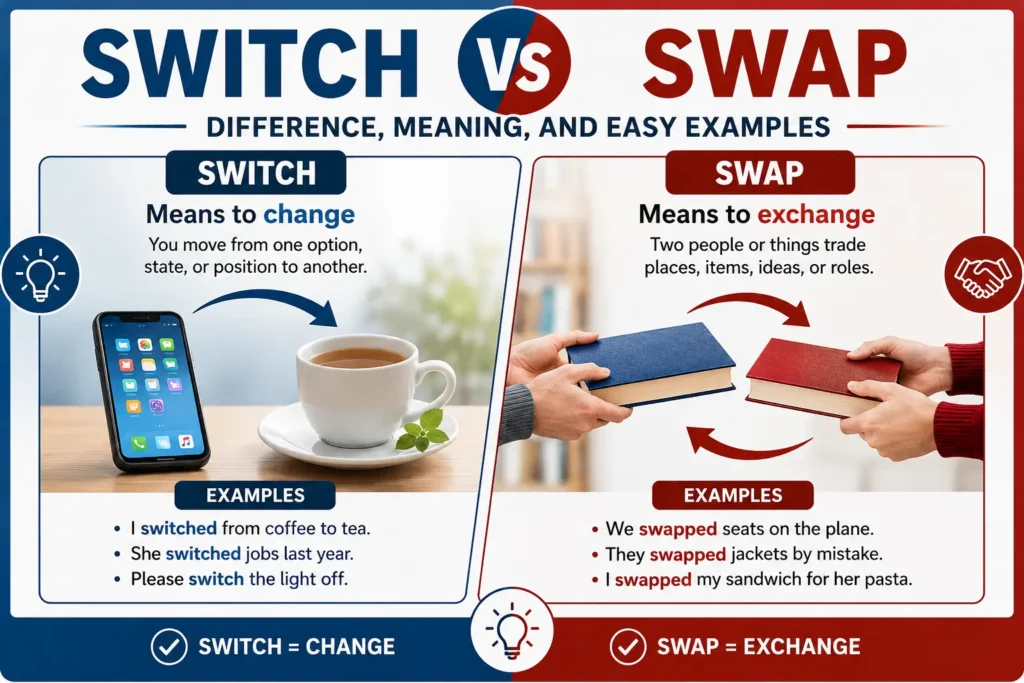
Switch and swap are two common English words that can look similar, but they do not always mean the same thing. The main difference is simple: switch usually means to change from one option, state, place, or position to another, while swap usually means to exchange one thing for another.
For example, you can switch from coffee to tea, switch to a new phone plan, or switch off a light. In these examples, something changes, but nothing is necessarily exchanged. On the other hand, you can swap seats with a friend, swap jackets by mistake, or swap sugar for honey in a recipe. In these cases, one thing replaces or trades places with another.
Understanding this difference helps you choose the right word in everyday conversations, work messages, travel situations, technology, and formal writing. This guide explains the meaning of switch and swap, shows where they overlap, and gives simple examples to help you use both words correctly.
Quick Answer: Switch vs. Swap
Use switch when the meaning is change.
Use swap when the meaning is exchange.
| Word | Simple Meaning | Best Used When |
| Switch | To change | Moving from one option, state, position, or system to another |
| Swap | To exchange | Trading one thing, place, role, or item for another |
Examples:
- I switched from coffee to tea.
- We swapped seats on the plane.
- She switched jobs last year.
- They swapped jackets by mistake.
Ask yourself one simple question:
Is something being exchanged?
If yes, use swap.
If no, use switch.
What Does “Switch” Mean?
Switch means to change from one thing to another. It can describe a change in choice, position, setting, habit, role, plan, device, or system.
Examples:
- I switched to a new phone.
- She switched from tea to coffee.
- He switched seats after lunch.
- They switched to a cheaper plan.
- Please switch off the light.
In these examples, the main idea is change. No direct exchange is required.
Common Uses of “Switch”
1. Switch for choices and preferences
Use switch when someone changes their choice, habit, or preference.
Examples:
- I switched from coffee to green tea.
- She switched brands after one bad experience.
- They switched to a cheaper internet plan.
- He switched from running to cycling.
- We switched restaurants because the first one was full.
The pattern switch from A to B is very common.
Examples:
- switch from Android to iPhone
- switch from coffee to tea
- switch from one bank to another
- switch from a free plan to a paid plan
2. Switch for jobs, careers, and teams
Use switch when someone changes jobs, careers, teams, departments, or roles.
Examples:
- She switched jobs last month.
- He switched careers after ten years in sales.
- The player switched teams after the season.
- I switched departments in June.
- They switched managers during the project.
Do not say:
- I swapped to a new job.
Say:
- I switched to a new job.
A job change is not usually an exchange with another person.
3. Switch for settings, devices, and technology
Technology often uses switch because users change modes, accounts, tabs, screens, apps, or systems.
Examples:
- Switch your phone to silent mode.
- Switch the app to dark mode.
- Switch tabs.
- Switch accounts.
- Switch from Wi-Fi to mobile data.
- Switch the camera to portrait mode.
You should not say:
- Swap your phone to silent mode.
That sounds unnatural because silent mode is not being exchanged. The phone is simply changing state.
4. Switch for movement or position
Use switch when someone changes position or moves from one place to another.
Examples:
- The driver switched lanes.
- I switched seats after lunch.
- She switched sides during the debate.
- The teacher switched the students’ places.
- He switched to the left side of the room.
In these examples, switch shows movement or change in position.
“Switch” as a Noun
Switch can also be a noun. As a noun, it often means a button, control, or device that turns something on or off.
Examples:
- The light switch is near the door.
- Turn off the switch before cleaning the machine.
- This switch controls the fan.
- The safety switch stopped the motor.
Even as a noun, the idea is connected to change. A switch changes something from one state to another, such as from off to on or from running to stopped.
What Does “Swap” Mean?
Swap means to exchange one thing for another. It usually involves two people, two objects, two places, two roles, or two ideas. One thing goes out, and another thing comes in.
Examples:
- We swapped seats.
- They swapped phone numbers.
- I swapped my sandwich for her pasta.
- She swapped shifts with her coworker.
- He swapped the old battery for a new one.
In each sentence, there is an exchange. That is the key meaning of swap.
Common Uses of “Swap”
1. Swap for physical items
Use swap when people exchange physical things.
Examples:
- We swapped jackets.
- She swapped books with her friend.
- The kids swapped toys after school.
- I swapped my broken charger for a working one.
- The mechanic swapped the old tire for a new one.
Here, one item replaces or trades places with another.
2. Swap for seats, places, and shifts
Use swap when two people exchange seats, places, rooms, desks, or work shifts.
Examples:
- Can we swap seats?
- The twins swapped places.
- I swapped shifts with my coworker.
- They swapped rooms at the hotel.
- We swapped desks because mine was near the window.
Compare these two sentences:
- I switched to the morning shift.
- I swapped shifts with Maria.
The first sentence means your schedule changed. The second sentence means you and Maria traded shifts.
3. Swap for information and ideas
People can also swap things that are shared, such as stories, notes, ideas, numbers, recipes, and tips.
Examples:
- We swapped phone numbers.
- The travelers swapped stories on the train.
- The team swapped ideas during the meeting.
- They swapped recipes after dinner.
- The students swapped notes before the test.
These phrases sound natural because information moves both ways.
4. Swap for replacement
Use swap when one thing replaces another, especially in recipes, repairs, product use, and practical advice.
Examples:
- Swap butter for olive oil.
- Swap sugar for honey.
- Swap white rice for brown rice.
- Swap the old filter for a clean one.
- Swap the damaged part with a new one.
The pattern swap A for B means you replace A with B.
Example:
- Swap butter for olive oil.
This means use olive oil instead of butter.
Switch vs. Swap: Main Difference
The main difference is this:
Switch focuses on change.
Swap focuses on exchange.
| Feature | Switch | Swap |
| Core meaning | Change | Exchange |
| Main idea | Move from one option to another | Trade one thing for another |
| Direction | Often one-way | Usually two-way |
| Common with settings | Yes | Usually no |
| Common with physical items | Sometimes | Yes |
| Common with jobs/careers | Yes | Usually no |
| Common with seats | Yes | Yes |
| Tone | Neutral | More casual |
| Formal alternative | Change | Exchange |
Examples:
- I switched banks.
- We swapped books.
The first sentence means you changed banks. The second sentence means two people exchanged books.
Where “Switch” and “Swap” Can Overlap
Some situations allow both words, but the meaning may change slightly. This often happens with seats, places, shifts, and devices.
Switch seats vs. swap seats
Both phrases can be correct.
Use switch seats when someone changes seats.
Example:
- I switched seats because the sun was in my eyes.
This means the person moved to another seat. It does not clearly say who took the old seat.
Use swap seats when two people exchange seats.
Example:
- I swapped seats with my sister.
This means your sister took your seat, and you took hers.
Switch places vs. swap places
Both can work, but swap places makes the exchange clearer.
Examples:
- Let’s switch places so you can see the screen.
- The two players swapped places during the drill.
The first sentence focuses on changing position. The second focuses on exchanging positions.
Switch shifts vs. swap shifts
This pair is important in work situations.
Use switch shifts when your schedule changes.
Example:
- I switched to the night shift.
Use swap shifts when two people trade shifts.
Example:
- I swapped shifts with Daniel.
This difference matters because it tells your manager exactly what happened.
Switch devices vs. swap devices
Use switch devices when you start using a different device.
Example:
- I switched from my laptop to my tablet.
Use swap devices when two people exchange devices or one device replaces another.
Example:
- We swapped devices during the test.
Again, switch shows change. Swap shows exchange.
Common Mistakes With Switch and Swap
Mistake 1: Using “swap” when there is no exchange
Incorrect:
- I swapped to a new school.
- She swapped to another job.
- We swapped to a cheaper plan.
- He swapped to dark mode.
Correct:
- I switched to a new school.
- She switched to another job.
- We switched to a cheaper plan.
- He switched to dark mode.
Use switch to when you mean “change to.”
Mistake 2: Using “switch” for a clear exchange
Sometimes switch is understandable, but swap is more accurate.
Weak:
- We switched phone numbers.
- They switched jackets.
- Can we switch shifts?
- The kids switched toys.
Better:
- We swapped phone numbers.
- They swapped jackets.
- Can we swap shifts?
- The kids swapped toys.
These sentences involve exchange, so swap fits better.
Mistake 3: Saying “swap to”
The phrase swap to often sounds unnatural when you mean “change to.”
Awkward:
- Let’s swap to another app.
- I swapped to a new browser.
- She swapped to night mode.
Better:
- Let’s switch to another app.
- I switched to a new browser.
- She switched to night mode.
Use switch to for a change.
Use swap A for B when one thing replaces another.
Mistake 4: Using “exchange” in casual writing too often
Exchange is correct, but it sounds more formal than swap.
Formal:
- We exchanged contact information.
Natural:
- We swapped numbers.
Formal:
- The passengers exchanged seats.
Natural:
- The passengers swapped seats.
Use exchange in official, business, legal, or formal writing. Use swap in everyday conversation and casual writing.
Common collocations:
Common Patterns With “Swap”
| Pattern | Example | Meaning |
| swap + noun | We swapped numbers. | Exchange something |
| swap A for B | Swap butter for oil. | Replace A with B |
| swap A with B | I swapped seats with Tom. | Exchange A and B |
| swap out | Swap out the old bulb. | Remove and replace |
| swap places | The players swapped places. | Exchange positions |
| swap shifts | We swapped shifts. | Trade work schedules |
| swap stories | They swapped stories. | Share stories |
| swap ideas | The team swapped ideas. | Share ideas |
Common collocations:
- swap seats
- swap places
- swap shifts
- swap stories
- swap ideas
- swap numbers
- swap recipes
- swap clothes
- swap files
- swap gifts
- swap cards
- swap batteries
- swap ingredients
- swap tips
Examples:
- The nurses swapped shifts.
- The guests swapped stories after dinner.
- You can swap sugar for honey.
Side-by-Side Examples
| Switch | Swap |
| I switched my alarm to 6 a.m. | I swapped alarm clocks with my brother. |
| She switched seats after lunch. | She swapped seats with her friend. |
| He switched from coffee to tea. | He swapped his coffee for my tea. |
| We switched restaurants. | We swapped meals halfway through dinner. |
| I switched my phone to silent. | I swapped phones with my cousin. |
| I switched departments last year. | I swapped shifts with John. |
| The company switched suppliers. | The managers swapped responsibilities. |
| She switched to remote work. | We swapped meeting notes. |
| Switch to dark mode. | Swap the old battery for a new one. |
| We switched trains in Chicago. | We swapped seats on the plane. |
Quick Test: Which Word Should You Use?
| Ask Yourself | Better Word |
| Am I changing from one option to another? | Switch |
| Are two things being exchanged? | Swap |
| Is a setting or mode changing? | Switch |
| Is one item replacing another item? | Swap |
| Is someone changing jobs, teams, or plans? | Switch |
| Are two people trading seats, shifts, or items? | Swap |
| Does “from A to B” fit? | Switch |
| Does “A for B” fit? | Swap |
Shortcut:
If the sentence means “change to,” use switch.
If the sentence means “exchange for,” use swap.
Practice Examples
Choose the correct word.
| Sentence | Correct Answer |
| I need to ___ my phone to silent mode. | switch |
| Can we ___ seats so I can sit by the window? | swap |
| She ___ from biology to chemistry. | switched |
| They ___ jackets after the game. | swapped |
| The company ___ suppliers last year. | switched |
| We ___ stories around the fire. | swapped |
| He ___ the old battery for a new one. | swapped |
| Please ___ off the heater. | switch |
| I ___ between two email accounts all day. | switch |
| The workers ___ shifts this weekend. | swapped |
FAQs About Switch and Swap
1. What is the main difference between switch and swap?
The main difference is that switch means to change from one option, state, or position to another, while swap means to exchange one thing for another.
Example:
- I switched from coffee to tea.
- I swapped my coffee for her tea.
2. When should I use switch?
Use switch when the sentence shows a change. It works well for choices, settings, jobs, apps, plans, positions, and habits.
Examples:
- She switched jobs last year.
- I switched to dark mode.
- He switched from Android to iPhone.
3. When should I use swap?
Use swap when two people or things exchange places, items, roles, ideas, or information.
Examples:
- We swapped seats.
- They swapped phone numbers.
- I swapped sugar for honey.
4. Is “swap to” correct?
In most cases, swap to sounds unnatural. Use switch to when you mean “change to.”
Correct:
- I switched to a new browser.
Better for replacement:
- I swapped the old battery for a new one.
5. Can switch and swap both be used with seats?
Yes, but the meaning changes slightly. Switch seats means someone changes seats. Swap seats means two people exchange seats.
Examples:
- I switched seats because the sun was in my eyes.
- I swapped seats with my friend.
Conclusion
The easiest way to remember switch vs swap is to focus on change and exchange. Use switch when the action shows a change from one option, setting, position, system, habit, or state to another. Use swap when two people or things trade places, items, roles, ideas, or information. This simple difference between switch and swap helps you avoid common mistakes like saying “swap to dark mode” or “switched numbers” when a clearer word is available. Once you understand the switch meaning and swap meaning, choosing the correct word becomes much easier in speaking and writing. Keep practicing with real example sentences, and this English grammar rule will feel natural in conversations, professional messages, travel situations, technology, and daily communication contexts.
