
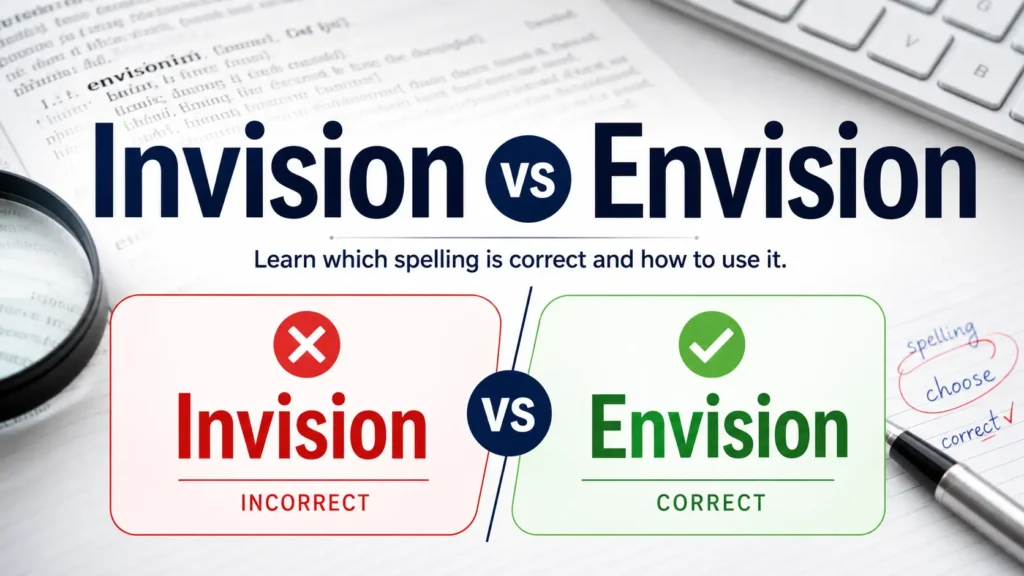
When people compare invision vs envision, the confusion usually comes from the similar spelling, sound, and connection to the word vision. The correct English word is envision, which means to imagine, picture, or create a mental image of a future possibility. Many writers, editors, and students accidentally use invision because it looks logical, but standard English dictionaries recognize envision as the correct verb form.
The mistake often appears in professional writing, emails, captions, and business proposals because invision can look right when written quickly. It also appears familiar because InVision is a brand name connected with a design platform. However, when discussing grammar, spelling, and sentence usage, envision is the accepted form. It functions as a verb, while InVision works as a proper noun only when referring to the company or product.
A clear way to remember the difference is that envision describes a future idea, goal, or possibility. For example, a company may envision a new strategy, or a person may envision a better career path. Understanding this small spelling difference helps writers avoid grammar mistakes, improve spelling accuracy, and create clearer sentences with confidence.
Quick Answer: Is It Invision or Envision?
The correct English word is envision.
Use envision when you mean:
- To imagine something clearly
- To picture a future situation
- To form a mental image
- To think about a future goal
- To consider a possible outcome
Correct Example
✅ She envisions building her own company one day.
Incorrect Example
❌ She invisions building her own company one day.
The lowercase spelling invision is generally not used as a standard English verb. InVision, with capitalization, may appear as a proper name or brand.
What Is the Difference Between Envision and Invision?
The main difference is straightforward: envision is a standard English verb, while invision is usually a spelling mistake when someone means “to imagine.”
| Word | Correct Usage | Meaning | Example |
| Envision | Standard English verb | To imagine or picture something mentally | I envision a future where technology improves education. |
| invision | Usually incorrect | Not normally accepted as the verb meaning “imagine” | I invision a better future. ❌ |
| InVision | Proper noun | A brand or product name | The team discussed using InVision. |
The confusion makes sense because English contains many words beginning with in-, including include, inform, and inspire. As a result, some writers assume invision should follow the same pattern.
English spelling doesn’t always follow what looks logical, though. The accepted verb is envision.
Envision Meaning: Definition and Grammar Role
Envision is a verb meaning to imagine, picture, or form a clear idea of something in your mind, particularly something that could happen in the future.
The word often relates to:
- Goals
- Plans
- Future possibilities
- Strategies
- Dreams
- Expected outcomes
- Mental pictures
For example:
The company envisions a cleaner and faster transportation system.
Here, the company mentally pictures a possible future system.
Envision as a Verb
Because envision describes a mental action, it functions as a verb.
| Verb Form | Example |
| envision | I envision success. |
| envisions | She envisions a new career path. |
| envisioned | They envisioned a different outcome. |
| envisioning | He is envisioning a new design. |
Unlike physical verbs such as run, jump, or build, envision describes something happening in your mind.
What Does Envision Mean in Simple Words?
In simple English, envision means:
“To see something in your mind before it happens.”
Suppose you’re planning your dream home. Before anyone starts building it, you may picture the rooms, furniture, location, garden, and the way your family will use the space.
At that moment, you’re envisioning your future home.
Everyday Examples of Envision
- I envision myself graduating next year.
- She envisions a peaceful retirement.
- The coach envisions the team winning the championship.
- They envision raising their children in a quieter town.
- He envisioned owning his own business someday.
Each example involves forming a mental picture of something possible.
Why Do People Confuse Invision and Envision?
The spelling mistake appears for several understandable reasons.
Similar Pronunciation Creates Confusion
When people say envision quickly, the first syllable may sound similar to in-.
That can make these two forms look equally believable:
- envision → correct
- invision → common spelling mistake
English pronunciation doesn’t always make spelling obvious, so hearing a word isn’t always enough to know how to write it.
The Word “Vision” Makes Invision Look Logical
The noun vision can mean sight or a mental picture.
Because vision already exists, someone may mentally break invision into:
in + vision
That may feel logical, almost as if the word means “inside your vision.”
However, English didn’t form the standard verb that way. The accepted spelling is envision.
The InVision Name Adds More Confusion
You may also encounter InVision written with capital letters as a proper name.
Compare these examples:
The designer discussed InVision during the project. ✅
I invision a better future. ❌
The first uses a proper noun. The second requires the verb envision.
How to Use Envision Correctly in Sentences
Knowing the spelling is only the first step. You also need to know how envision fits naturally into a sentence.
Envision + Noun
Use this structure when the thing being imagined comes directly after envision.
Examples:
- She envisions a successful business.
- They envision a world without unnecessary waste.
- The architect envisioned a modern building.
- We envision a stronger community.
- The company envisions long-term growth.
The noun tells the reader exactly what someone imagines.
Envision + Verb Phrase
You can also use envision before an action.
Examples:
- I envision working abroad someday.
- He envisions creating a nonprofit organization.
- The students envision becoming engineers.
- She envisioned traveling around the world.
- They envision building a more sustainable company.
This structure works particularly well when describing future goals.
Envision in Professional Writing
Envision also fits naturally into business, academic, strategic, and professional writing.
People often use it when discussing:
- Future plans
- Business goals
- Research opportunities
- Long-term strategies
- Innovation
- Organizational change
Business example:
The company envisions expanding into international markets.
Education example:
The university envisions creating more opportunities for online learning.
Research example:
Scientists envision new solutions for renewable energy challenges.
The word works well in professional contexts because it suggests thoughtful planning and forward thinking.
Correct and Incorrect Examples of Envision
The easiest way to understand invision vs envision is to compare incorrect and correct sentences.
| Incorrect Sentence | Correct Sentence | Reason |
| I invision a better future. | I envision a better future. | Envision is the correct verb. |
| She is invisioning success. | She is envisioning success. | The continuous form is envisioning. |
| We invisioned a new plan. | We envisioned a new plan. | The past tense is envisioned. |
| He has an envision of success. | He has a vision of success. | Envision normally functions as a verb. |
| They invision future growth. | They envision future growth. | Use envision when you mean imagine. |
Seeing the two forms side by side makes the spelling difference easier to remember.
Envision vs Imagine: Are They the Same?
Envision and imagine have similar meanings, but they aren’t always identical.
| Word | Meaning | Common Use |
| Envision | To picture a possible future situation | Goals, plans, strategies |
| Imagine | To create any idea or picture mentally | General thoughts, creativity, fantasy |
Consider these examples.
Imagine
Imagine living on a tropical island.
The situation could simply be a fantasy.
Envision
She envisions becoming a doctor.
This sentence sounds more connected to a possible future goal.
So, imagine is broader. Envision often carries a stronger sense of looking ahead.
Envision vs Envisage: What Is the Difference?
Envision and envisage are very close in meaning.
The main distinction often comes down to regional preference.
| Word | Common Region | Example |
| Envision | American English | I envision a successful future. |
| Envisage | British English | I envisage a successful future. |
Both forms are correct.
In US English, envision is generally the more natural choice. British speakers may use envisage more often.
Envision Word Forms and Related Words
Understanding related forms can help you use envision naturally in different sentences.
Envisioned
Envisioned is the simple past and past participle form.
The founders envisioned a company that would change the industry.
The imagining happened in the past.
Envisioning
Envisioning is the present participle form.
She is envisioning new possibilities for her career.
This suggests an ongoing mental process.
Envisionment
Envisionment exists, but it sounds uncommon in everyday English.
In most situations, words such as these sound more natural:
- Vision
- Idea
- Concept
- Plan
Instead of writing:
His envisionment was ambitious.
A more natural sentence would be:
His vision was ambitious.
Envision Synonyms and When to Use Them
Several words can replace envision, but each carries a slightly different shade of meaning.
| Synonym | Meaning | Example |
| Imagine | Create a mental picture | Imagine a world without pollution. |
| Visualize | Create a clear mental image | Athletes visualize success before competitions. |
| Picture | Think of something clearly | I can picture my future home. |
| Foresee | Predict something before it happens | Experts foresee major changes. |
| Anticipate | Expect something in the future | The company anticipates growth. |
| Conceive | Form an idea mentally | They conceived a new approach. |
Choosing the right synonym depends on your intended meaning.
For instance, foresee emphasizes prediction, while envision focuses more on mentally creating or considering a possible future.
Common Mistakes When Using Envision
Even after learning the definition, writers can still make a few common mistakes.
Mistake: Writing Invision Instead of Envision
This is the most frequent error.
Remember:
✅ I envision success.
❌ I invision success.
If you mean imagine, envision is the spelling you need.
Mistake: Using Envision as a Noun
Because the word contains vision, some writers mistakenly use it as a noun.
Incorrect:
❌ My envision is to become a writer.
Better:
✅ My vision is to become a writer.
You can also write:
✅ I envision becoming a writer.
Mistake: Treating Envision and Visualize as Identical
The two words overlap, but they often emphasize different things.
Visualize usually focuses on creating a vivid mental image.
Envision often focuses on a future plan, possibility, or desired result.
For example:
- Athletes visualize their performance.
- Entrepreneurs envision future growth.
Both involve the mind, but the emphasis changes.
Easy Tricks to Remember Envision vs Invision
A few simple memory tricks can prevent the mistake.
Remember “Envision = Future Vision”
Connect the word envision with the idea of creating a vision for what comes next.
Think:
Envision → Future vision
If you’re imagining something that might happen, envision is probably the word you need.
Remember InVision as a Proper Name
If you see InVision with capital letters, you may be looking at a proper name.
When your intended meaning is imagine, picture, or form a future idea, use:
envision
That distinction makes the spelling much easier to remember.
Real-Life Examples of Envision
Real-world examples show how naturally envision fits into everyday English.
School Examples
- Students envision their careers after graduation.
- Teachers envision classrooms where every student succeeds.
- She envisions studying medicine after high school.
Workplace Examples
- Managers envision new strategies for company growth.
- The team envisioned a simpler customer experience.
- Executives envision expanding the company globally.
Personal Goal Examples
- I envision buying my first home someday.
- She envisions traveling around the world.
- He envisioned starting a family in a quieter city.
Creative Writing Examples
- The author envisioned a world filled with magical creatures.
- The filmmaker envisioned a powerful story about friendship.
- The designer envisioned a modern space filled with natural light.
In each case, envision introduces a mental picture, possibility, or future outcome.
Conclusion: Choose Envision for Correct English Usage
The difference between invision vs envision is simple once you understand the meaning and usage of each term. Envision is the correct English verb used when you want to express an idea, imagine a future possibility, or create a mental picture of something. On the other hand, invision is usually a spelling mistake when used as a verb, while InVision is only correct when referring to a specific brand name.
Using the correct word helps you write better emails, professional documents, academic work, and everyday conversations. Remember that envision connects with future goals, plans, and possibilities, making it the right choice whenever you mean “to imagine” or “to picture.”
Frequently Asked Questions About Invision vs Envision
Q1: What is the correct spelling: invision or envision?
The correct spelling is envision when you mean “to imagine” or “to picture something in your mind.” The word invision is generally considered an incorrect spelling in standard English.
Q2: Is invision a real English word?
Invision is not commonly accepted as a standard English verb. Most dictionaries do not recognize it as the correct form for expressing imagination or future ideas. However, InVision with capital letters can be correct as a brand name.
Q3: What does envision mean?
Envision means to imagine, visualize, or mentally picture something that may happen in the future. It is often used when talking about goals, plans, dreams, or possible outcomes.
Example:
She envisions starting her own business someday.
Q4: Is envision the same as imagine?
Envision and imagine have similar meanings, but they are slightly different. Imagine can describe any mental picture, including creative ideas or fantasies. Envision usually focuses on a future plan, goal, or possibility.
Q5: Why do people write invision instead of envision?
People often write invision because it looks similar to the word vision and sounds natural when spoken. The existence of the InVision brand name also increases confusion. However, the standard English spelling is envision.
Q6: Can I use envision in formal writing?
Yes, envision is suitable for formal writing, including business documents, academic writing, reports, and professional communication. It is a common word for describing future goals and strategies.
Example:
The organization envisions a future with improved customer experiences.
Q7: Is InVision different from envision?
Yes. InVision and envision have different roles. InVision is a proper noun used for a brand or product, while envision is an English verb meaning to imagine or picture something.
Q8: What are some synonyms of envision?
Common synonyms for envision include:
- Imagine
- Visualize
- Picture
- Foresee
- Anticipate
- Conceive
The best choice depends on the meaning you want to express.
Q9: What is the difference between envision and visualize?
Both words involve creating a mental picture, but they are used differently. Visualize often focuses on seeing details clearly in your mind, while envision usually relates to imagining a future situation, goal, or possibility.
Example:
- Athletes visualize their performance before a competition.
- Entrepreneurs envision future business growth.
Q10: How can I remember the difference between invision and envision?
A simple memory trick is to connect envision with future vision. When you are imagining a future goal, plan, or possibility, use envision. Remember that InVision with capital letters refers only to a brand name, not the general English verb.
Blog :
Inter vs Intra: Meaning, Difference, Examples, and Easy Rules
Frances vs Francis: Meaning, Spelling, and Correct Use
Someday vs Some Day: Meaning, Difference, Examples, and Easy Rules
