
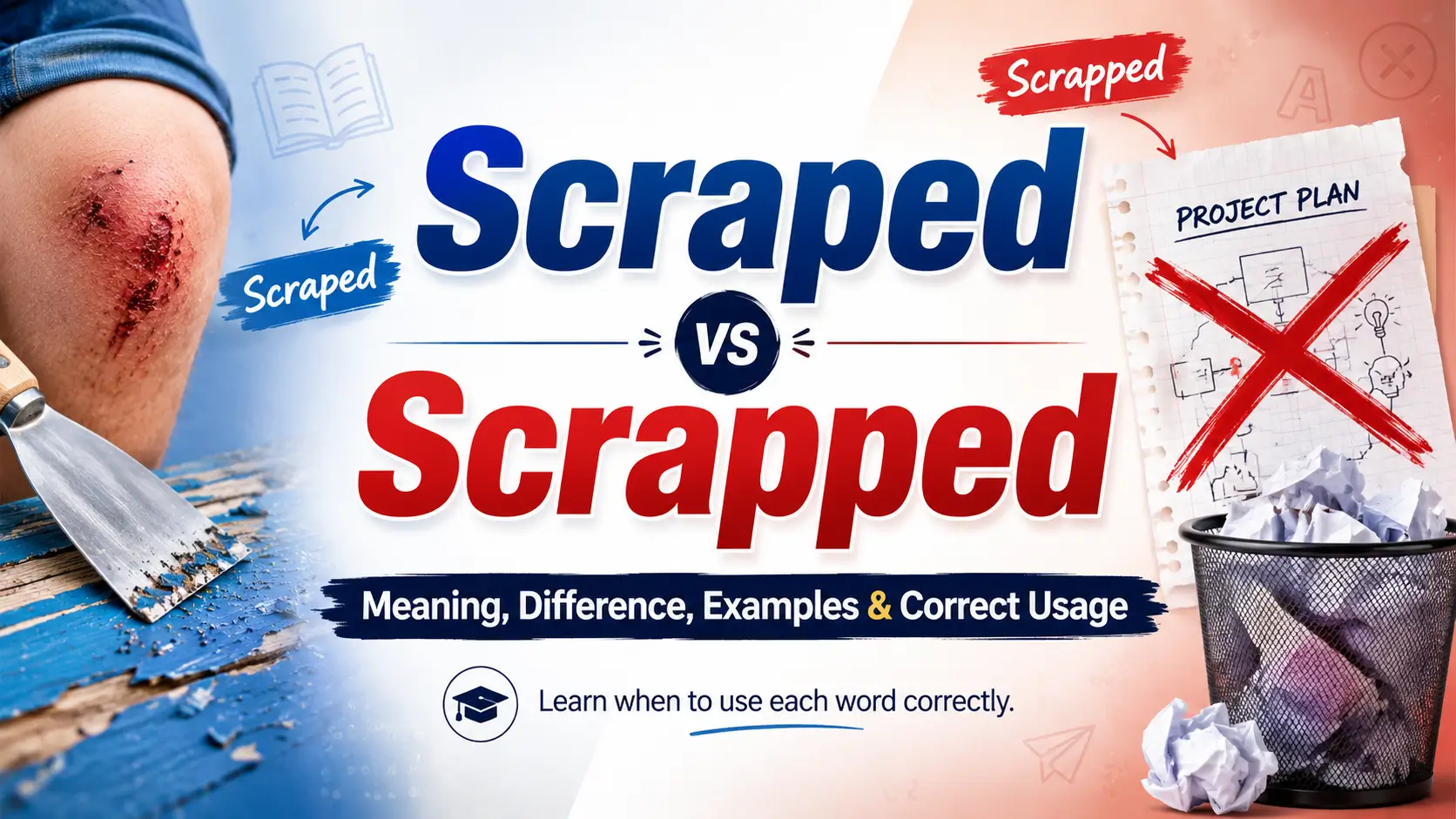
Confused about scraped vs scrapped? You’re not alone. These two words look and sound similar, but they have different meanings and uses. Scraped comes from scrape and usually means rubbed against, removed from a surface, or collected, as in scraped data. Scrapped comes from scrap and usually means canceled, abandoned, rejected, or discarded, as in a scrapped project.
The difference is small in spelling but important in meaning. For example, you may have scraped your knee after falling, but a company may have scrapped a plan after deciding not to use it. Learning this simple distinction can help you avoid mistakes in emails, schoolwork, professional writing, and everyday conversation.
This guide explains the meanings, grammar, spelling, pronunciation, examples, common mistakes, and easy memory tricks for using scraped and scrapped correctly.
Quick Answer: Scraped vs. Scrapped
Scraped and scrapped are both correct words, but they have different meanings.
- Scraped is the past tense and past participle of scrape.
- Scrapped is the past tense and past participle of scrap.
| Word | Base Verb | Main Meaning | Example |
| Scraped | Scrape | Rubbed against, removed, or collected | I scraped ice off my windshield. |
| Scrapped | Scrap | Canceled, abandoned, rejected, or discarded | We scrapped the old plan. |
A simple memory trick is:
Scraped = surface
Scrapped = stopped
If something is physically rubbed, removed from a surface, or gathered from a website, scraped is usually the right word. If a plan, project, idea, or object is abandoned or discarded, use scrapped.
What Does “Scraped” Mean?
Scraped is the past tense and past participle of the verb scrape. The word has several meanings, but most are connected to the ideas of friction, removal, or collection.
In everyday American English, you might scrape your knee, scrape ice from a car, or scrape food from a pan. In technology, you might also hear about data being scraped from websites.
The meaning depends on the context.
Scraped Means “Rubbed Against Something”
One common meaning of scraped is to rub against a rough or hard surface.
For example:
I scraped my knee when I fell off my bike.
The person injured the knee by rubbing it against the ground.
Another example is:
The car scraped against the side of the garage.
Here, part of the car rubbed against the garage wall.
You can use scraped for many situations involving accidental contact:
- I scraped my elbow on the wall.
- She scraped her hand against the fence.
- The truck scraped the side of the building.
- My shoe scraped against the concrete.
In these examples, scraped describes physical contact or friction.
Scraped Means “Removed From a Surface”
Scrape can also mean to remove something by dragging a hard or sharp object across a surface.
For example:
She scraped the ice off the windshield.
The ice was attached to the windshield, and she removed it.
Similarly:
He scraped the burnt food from the bottom of the pan.
The food was stuck to the pan, so he removed it by scraping.
Other natural examples include:
- scraped paint from a door
- scraped mud from a boot
- scraped wax from a table
- scraped dirt from a shoe
- scraped food from a plate
The key idea is removal from a surface.
Scraped Can Describe a Minor Injury
A scrape can also be a minor injury caused by rubbing against something rough.
She has a scraped knee.
I scraped my elbow while playing basketball.
The correct phrase is scraped knee, not scrapped knee, because the injury comes from scraping the skin.
This distinction is especially useful because scraped knee is a common phrase in everyday American English.
Scraped Has a Technical Meaning in Web Scraping
In technology, scraped can describe information collected from websites.
For example:
The software scraped publicly available information from several webpages.
This means the software collected data from those pages, usually through an automated process known as web scraping.
You may encounter phrases such as:
- scraped data
- scraped content
- scraped information
- data scraped from a website
The technical meaning is different from physically scraping paint or ice. However, the underlying idea is still related to extracting or collecting information.
Therefore, if a company says it scraped data, it usually means that it gathered information from an online source. It doesn’t mean that someone physically rubbed a computer screen.
What Does “Scrapped” Mean?
Scrapped is the past tense and past participle of scrap.
The verb scrap commonly means to cancel, abandon, reject, or discard something.
For example:
The company scrapped its original marketing plan.
This means the company decided not to use the plan.
The word is common in business, government, education, news reporting, and everyday conversation.
Scrapped Means “Canceled”
One of the most common meanings of scrapped is canceled or discontinued.
For example:
The city scrapped the proposed construction project.
The city decided not to continue with the project.
You might also say:
- The company scrapped the new policy.
- We scrapped our vacation plans.
- The school scrapped the old dress code.
- The team scrapped the proposal.
- The director scrapped the original ending.
In each case, something was planned or considered, but someone decided to stop it.
Scrapped Means “Abandoned”
Sometimes scrapped means that an idea or project was abandoned after people had already invested time or effort in it.
The developers scrapped the project after discovering major technical problems.
The project wasn’t physically scraped away. Instead, the developers abandoned it.
This meaning is especially common in professional and technical contexts.
For example:
The engineering team scrapped the original design and started over.
Here, scrapped means the original design was rejected.
Scrapped Means “Discarded”
The verb scrap can also mean to throw something away because it is no longer useful, practical, or worth repairing.
The mechanic said the damaged car should be scrapped.
The car is considered unsuitable for continued use, so it may be discarded or dismantled.
Similarly:
The factory scrapped the outdated machinery.
The machinery was removed from use and discarded.
This meaning connects scrapped with the noun scrap, especially in phrases such as scrap metal.
Scraped vs. Scrapped: The Main Difference
The difference between scraped and scrapped becomes clear when you focus on the action involved.
Scraped usually involves physical contact, removal, or collection.
Scrapped usually involves cancellation, abandonment, rejection, or disposal.
Consider these two sentences:
I scraped the old paint off the wall.
The paint was physically removed from the wall.
I scrapped the old painting project.
The project was abandoned or canceled.
The spelling is similar, but the meaning is completely different.
| Situation | Correct Word | Example |
| Injured your knee | Scraped | I scraped my knee. |
| Removed ice | Scraped | She scraped ice from the windshield. |
| Removed paint | Scraped | He scraped paint off the door. |
| Collected website information | Scraped | The program scraped the data. |
| Canceled a project | Scrapped | They scrapped the project. |
| Abandoned an idea | Scrapped | We scrapped the original idea. |
| Discarded an old car | Scrapped | The damaged car was scrapped. |
| Rejected a proposal | Scrapped | The committee scrapped the proposal. |
The best question to ask is: What happened to the thing?
If it was rubbed, removed, or collected, scraped may be correct.
If it was canceled, abandoned, rejected, or discarded, scrapped is usually correct.
Scraped vs. Scrapped Grammar and Spelling Rules
The difference also comes from the way the two base verbs are spelled.
Why “Scraped” Has One P
The base verb is scrape.
scrape → scraped
The word scrape ends in a silent e. To form the simple past tense, you add -d.
Examples:
- hope → hoped
- save → saved
- bake → baked
- scrape → scraped
Therefore:
She scraped her knee.
The spelling scrapped would come from a different verb.
Why “Scrapped” Has Two Ps
The base verb is scrap.
scrap → scrapped
Because scrap has one syllable and ends in a consonant preceded by a short vowel, the final consonant is doubled before adding -ed.
This gives us:
scrap + p + ed = scrapped
The same spelling pattern appears in words such as:
- stop → stopped
- plan → planned
- shop → shopped
- drop → dropped
So, the two Ps in scrapped aren’t optional. They are part of the standard spelling.
Scrape and Scrap: Verb Forms
| Verb Form | Scrape | Scrap |
| Base form | scrape | scrap |
| Third-person singular | scrapes | scraps |
| Past tense | scraped | scrapped |
| Present participle | scraping | scrapping |
| Past participle | scraped | scrapped |
Notice another spelling difference in the -ing forms:
scrape → scraping
scrap → scrapping
The silent e is dropped before -ing in scraping, while the final p is doubled in scrapping.
How to Pronounce Scraped and Scrapped
In standard American English, scraped and scrapped don’t have the same vowel sound.
- Scraped: /skreɪpt/
- Scrapped: /skræpt/
Scraped has the long a sound found in words such as name and game.
Scrapped has the short a sound found in words such as cat and map.
This pronunciation difference can help you distinguish the words when speaking.
For example:
I scraped my knee.
The vowel sounds like the a in game.
They scrapped the plan.
The vowel sounds like the a in cat.
Therefore, the spelling and pronunciation both reflect the fact that these words come from different verbs.
Scraped vs. Scrapped Examples in Real-Life Contexts
The best way to understand these words is to see how they work in different situations.
Everyday Life
I scraped my knee while riding my bike.
She scraped the ice off her car.
He scraped the last bit of food from the bowl.
The chair scraped against the floor.
In each case, scraped relates to physical contact or removal.
Now compare:
We scrapped our weekend plans because of the storm.
The family scrapped the idea of moving.
Here, scrapped means abandoned or canceled.
School and Academic Writing
Students may use scraped when discussing research or data:
The researchers scraped publicly available information for their study.
A student might use scrapped when discussing a rejected idea:
The team scrapped its first research topic and selected a new one.
These words aren’t interchangeable.
Workplace and Business Communication
Business writing often uses scrapped when discussing canceled plans or strategies.
The company scrapped its expansion strategy.
Management scrapped the proposed policy.
On the other hand, a technology team might use scraped when discussing data collection:
The analysts scraped product information from public webpages.
The context tells you which word makes sense.
Technology
In technical writing, scraped often refers to collecting online information.
The application scraped pricing information from public websites.
By contrast, scrapped may describe a technology project that was abandoned.
The company scrapped the software project after the testing phase.
Although both words can appear in technology-related writing, they express different actions.
News and Formal Writing
News reports frequently use scrapped to describe canceled government programs, business plans, or public projects.
Officials scrapped the proposal after public opposition.
The word scraped is more likely to describe physical damage or data collection.
The vehicle scraped a concrete barrier.
The researchers scraped data from public sources.
Commonly Confused Phrases: Scraped or Scrapped?
Certain phrases cause more confusion than others.
Scraped Knee or Scrapped Knee?
The correct phrase is:
scraped knee
Example:
I got a scraped knee when I fell.
A scraped knee is a minor injury caused by rubbing the skin against a rough surface.
Scrapped knee doesn’t express this meaning.
Scraped Project or Scrapped Project?
If a project was canceled or abandoned, use:
scrapped project
Example:
The company announced its scrapped project would not continue.
However, scraped project could theoretically appear in a technical context if you’re describing a project involving data scraping. The intended meaning would be different.
Scraped Plan or Scrapped Plan?
For an abandoned or canceled plan, use:
scrapped plan
Example:
The team returned to the drawing board after the scrapped plan failed to gain approval.
Scraped Paint or Scrapped Paint?
If paint is physically removed from a surface, use:
scraped paint
Example:
The workers removed the scraped paint from the old door.
More naturally, you might say:
The workers scraped the paint from the old door.
If paint is thrown away as unwanted material, scrapped paint could theoretically be used, but this is much less common. The context must support that meaning.
Scraped Data or Scrapped Data?
If data is collected from a website, the standard term is:
scraped data
If data is discarded or rejected, you could use:
scrapped data
However, the second phrase is much less common. Usually, writers say discarded data, deleted data, or rejected data when discussing information that is no longer used.
Common Mistakes With Scraped and Scrapped
Mistake: Using “Scraped” for a Canceled Project
Incorrect:
The company scraped the project.
Correct:
The company scrapped the project.
The company abandoned or canceled the project. Therefore, scrapped is correct.
Mistake: Using “Scrapped” for a Knee Injury
Incorrect:
I scrapped my knee while running.
Correct:
I scraped my knee while running.
The knee was injured through contact with a rough surface.
Mistake: Using “Scrapped” for Removing Paint
Incorrect:
He scrapped the paint off the wall.
Correct:
He scraped the paint off the wall.
The paint was physically removed from the surface.
Mistake: Using “Scraped” for Abandoning an Idea
Incorrect:
The team scraped its original idea.
Correct:
The team scrapped its original idea.
The team rejected or abandoned the idea.
Mistake: Choosing Based Only on Similar Spelling
Because the words look alike, writers sometimes choose one without considering the meaning.
Instead, ask:
Am I describing removal or cancellation?
If you’re describing physical removal or data collection, think scraped.
If you’re describing cancellation, abandonment, or disposal, think scrapped.
Scraped vs. Scrapped in American English
Both words are standard in American English, and their meanings are well established.
Scraped is common in everyday conversations about injuries, cleaning, cooking, vehicles, and physical surfaces. It’s also common in technical discussions about data collection.
Scrapped frequently appears in business and news writing. It often describes plans, policies, projects, programs, or proposals that have been canceled.
For example:
The company scrapped the expansion plan.
This sentence sounds natural in a business report.
Meanwhile:
The company scraped customer data from public websites.
This sentence fits a technology or research context.
The difference isn’t about formal versus informal English. Instead, it’s mainly about meaning and context.
Related Words and Expressions
Understanding related forms can make the distinction even easier.
Words Related to “Scrape”
Scrape can function as a verb or noun.
Related expressions include:
- Scrape off — remove something from a surface
- Scrape away — remove something by scraping
- Scrape by — manage to survive or succeed with limited resources
- Scrape together — collect something with difficulty
- Scraper — a tool used for scraping
- Scraping — the act of scraping
Examples:
She scraped off the old sticker.
We scraped together enough money for the repair.
He barely scraped by in his first year of college.
These figurative expressions show that scrape has meanings beyond physical removal.
Words Related to “Scrap”
Related words and expressions include:
- Scrap — cancel, abandon, or discard
- Scrapped — canceled or discarded
- Scrapping — the act of canceling or discarding
- Scrap metal — discarded metal that may be recycled
- Scrap paper — leftover or unwanted paper
- Scrap a plan — abandon a plan
- Scrap an idea — reject an idea
Examples:
They decided to scrap the plan.
The old machine was sold for scrap metal.
She wrote the note on a piece of scrap paper.
The noun scrap can also mean a small piece or leftover amount. That meaning is different from the verb scrap, but both relate to the idea of something small, leftover, or discarded.
A Simple Memory Trick for Scraped vs. Scrapped
If you often confuse these words, remember:
Scraped = Surface
Think of something touching, rubbing, or being removed from a surface.
- Scraped knee
- Scraped paint
- Scraped ice
- Scraped data
Now remember:
Scrapped = Stopped
Think of something being canceled, abandoned, or discarded.
- Scrapped plan
- Scrapped project
- Scrapped proposal
- Scrapped policy
- Scrapped car
This memory trick isn’t a grammar rule, but it makes the difference easier to recall.
How to Choose Between Scraped and Scrapped
When you’re proofreading your writing, use this quick decision guide.
Ask yourself what action you’re describing:
- Was something rubbed against a surface?
→ Use scraped. - Was something removed from a surface?
→ Use scraped. - Was information collected from a website?
→ Use scraped. - Was a plan canceled?
→ Use scrapped. - Was a project abandoned?
→ Use scrapped. - Was an idea rejected?
→ Use scrapped. - Was an old object discarded or dismantled?
→ Use scrapped.
The most important thing is to focus on the meaning of the sentence, not simply the appearance of the word.
Practice: Scraped or Scrapped?
Try choosing the correct word in each sentence.
- I ___ my knee while playing soccer.
- The company ___ its old business strategy.
- She ___ the ice off her windshield.
- The researchers ___ data from public webpages.
- The city ___ the proposed construction project.
- He ___ the burnt food from the pan.
- The mechanic said the damaged car should be ___.
- The team ___ the original proposal.
Answers
- scraped — A knee can be scraped through physical contact.
- scrapped — A business strategy can be canceled or abandoned.
- scraped — Ice can be removed from a surface.
- scraped — Data can be collected through web scraping.
- scrapped — A construction project can be canceled.
- scraped — Food can be removed from a pan.
- scrapped — An unusable car can be discarded.
- scrapped — A proposal can be rejected or abandoned.
Conclusion: Scraped vs. Scrapped
Understanding scraped vs. scrapped is easier when you remember their different meanings. Scraped comes from scrape and usually means rubbed against something, removed from a surface, or collected, such as scraped data. Scrapped comes from scrap and usually means canceled, abandoned, rejected, or discarded, such as a scrapped project. The easiest memory trick is “scraped = surface” and “scrapped = stopped.” By focusing on the meaning and context, you can choose the correct word in everyday conversations, academic writing, business emails, and professional communication.
Frequently Asked Questions About Scraped vs. Scrapped
Q1. What is the difference between scraped and scrapped?
Scraped means rubbed against, removed from a surface, or collected. Scrapped means canceled, abandoned, rejected, or discarded.
Q2. Is it scraped or scrapped a project?
Use scrapped when a project is canceled or abandoned.
The company scrapped the project.
Q3. Is it scraped or scrapped my knee?
The correct phrase is scraped my knee because it describes a minor injury caused by rubbing against a rough surface.
Q4. What does scraped mean?
Scraped is the past tense of scrape. It can mean rubbing against something, removing something from a surface, or collecting information.
Q5. What does scrapped mean?
Scrapped is the past tense of scrap. It commonly means canceled, abandoned, rejected, or thrown away.
Q6. Is scraped data correct?
Yes. Scraped data is a common technical term for information collected from websites or online sources, usually through web scraping.
Q7. Why does scrapped have two Ps?
The word scrapped comes from scrap. Because the word has a short vowel sound and ends in a consonant, the final p is doubled before adding -ed.
Q8. How do you remember scraped vs. scrapped?
Use the simple memory trick “scraped = surface” and “scrapped = stopped.” If something is removed from a surface, use scraped. If something is canceled or abandoned, use scrapped.
Q9. Is a car scraped or scrapped?
It depends on the meaning. If a car rubs against another object, it is scraped. If an old or damaged car is discarded or dismantled, it is scrapped.
Q10. Are scraped and scrapped pronounced differently?
Yes. Scraped has the long a sound, while scrapped has the short a sound. Their pronunciation reflects the difference between the base verbs scrape and scrap.
Since vs Sense: Meaning, Differences, Grammar Rules, Examples, and Correct Usage
Color vs Colour: Which Spelling Is Correct in American and British English?
Personal vs Personnel: What’s the Difference? Meaning, Usage, and Examples