
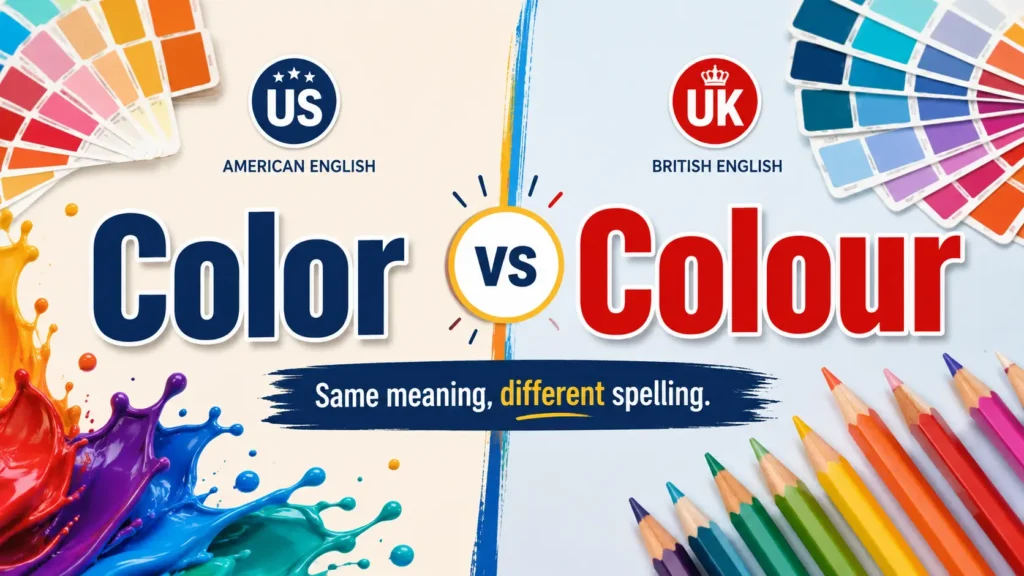
The difference between color vs colour comes from the history of English spelling and the way American English, British English, and Canadian English developed their own English varieties. In American English, color is the standard form, while colour follows UK guidelines and is common in British English and Canadian English. These spellings have the same noun meaning, and the word can also work as a verb. The two forms are generally pronounced the same, so pronunciation doesn’t explain the difference. Instead, the spelling differences reflect different spelling conventions.
A key figure in this story is Noah Webster, whose name is closely connected with the Merriam-Webster dictionary tradition. His influence helped shape American spelling, including the shorter u-less form color, while British spelling retained colour. The same pattern appears in behavior and behaviour, honor and honour, labor and labour, favorite and favourite, and favor and favour. Humor and humour also show this regional difference. As a grammar writer, I find these examples useful because they show that varied spelling isn’t necessarily an error; it often reflects the language and region behind the writing. The dictionary fame of Webster also helps explain why these forms became so established.
There are many variances between American English and British English, even when words sound the same and mean the same thing but are spelled differently. The historical distance between the two English-speaking countries helped create these differences, which can sometimes cause confusion for English language learners and other language learners. Color and colour are clear examples of this issue: color is the dominant spelling in the United States, while colour remains a popular alternative throughout the U.K. and other regions. This spelling variation is a good reminder that English language usage can change across regions without changing a word’s basic meaning.
Color vs. Colour: The Quick Answer
| Spelling | Standard Usage | Example |
| Color | American English | My favorite color is blue. |
| Colour | British English | My favorite colour is blue. |
The two spellings don’t have different definitions. They refer to the same concept: the visual quality or appearance of something based on the way it reflects or emits light.
For example:
- American English: What color is your car?
- British English: What colour is your car?
Both sentences mean exactly the same thing.
The main rule is easy to remember:
US English = color
UK English = colour
If you’re writing for Americans, color is the spelling you should normally choose.
What Do Color and Colour Mean?
Color and colour are the same word with different regional spellings. The word has several meanings depending on how it’s used.
Color and Colour as Nouns
As a noun, the word usually refers to the visual quality of an object, person, or scene.
For example:
- The color of the sky changed at sunset.
- She bought a blue shirt because she liked the color.
- Green is my favorite color.
- What color are the walls?
In British English, the same sentences use colour:
- The colour of the sky changed at sunset.
- She bought a blue shirt because she liked the colour.
- Green is my favorite colour.
- What colour are the walls?
The meaning doesn’t change.
The word can also have a figurative meaning. For instance, color can refer to something that adds interest, personality, or detail.
The journalist’s description added color to the story.
Here, color doesn’t refer to a visual shade. Instead, it means additional detail or interest.
Color and Colour as Verbs
The word can also function as a verb.
In American English:
The children color pictures after school.
She colored the drawing with bright markers.
In British English:
The children colour pictures after school.
She coloured the drawing with bright markers.
As a verb, the word generally means to add color to something or change its appearance by using a particular color.
Color vs. Colour: The Key Difference
The main difference between color vs. colour is the spelling convention used by different English-speaking regions.
Color is the preferred spelling in American English. Colour is the preferred spelling in British English.
Here’s a quick comparison:
| Feature | Color | Colour |
| Meaning | Same | Same |
| Part of speech | Noun and verb | Noun and verb |
| American English | Standard | Less common |
| British English | Less common | Standard |
| Pronunciation | Generally the same | Generally the same |
| Related adjective | Colorful | Colourful |
| Past tense | Colored | Coloured |
| -ing form | Coloring | Colouring |
So, the difference isn’t about grammar or meaning. It’s about regional spelling.
Color in American English
In the United States, color is the standard spelling.
You’ll see it in:
- American dictionaries
- School textbooks
- Newspapers
- Business documents
- Government publications
- Websites for US audiences
- Academic writing
- Everyday conversation
Examples include:
My favorite color is green.
Please choose a color for the background.
The designer recommended a darker color.
What color is your new car?
The children used color pencils for their project.
For American readers, color will almost always look more natural.
Colour in British English
In British English, colour is the conventional spelling.
For example:
My favorite colour is green.
Please choose a colour for the background.
The designer recommended a darker colour.
What colour is your new car?
British English also commonly spells related words with -our:
- colourful
- coloured
- colouring
- colourless
Therefore, if you’re writing in British English, it’s best to maintain the same spelling pattern throughout your work.
Color and Colour in Other English-Speaking Countries
English spelling isn’t divided into only two systems. Different countries have developed their own conventions.
Colour is commonly used in:
- The United Kingdom
- Australia
- New Zealand
- Canada
However, Canadian English has its own combination of spelling conventions. It often follows British spelling for words such as colour, while also using some American-influenced forms in other situations.
This is why you shouldn’t assume that every English-speaking country follows exactly the same rules.
For content aimed at a specific country, consider your audience first. A US-based website will generally use color, while a UK-based publication will generally use colour.
Are Color and Colour Pronounced the Same?
Yes. Color and colour are generally pronounced the same way.
In American English, color is commonly pronounced approximately like:
KUL-er
The spelling difference doesn’t normally create a pronunciation difference.
However, accents can affect the exact sound. A speaker from the United States may pronounce the word slightly differently from a speaker in the United Kingdom or Australia. That’s a difference in accent, not a difference caused by the letters -or and -our.
So, when you hear someone say the word, you usually can’t tell whether they would spell it color or colour.
Why Are Color and Colour Spelled Differently?
The difference between color and colour comes from the long history of English spelling.
English has been influenced by many languages, including French and Latin. Over centuries, spelling conventions developed differently in different regions.
The -our spelling became established in British English. Meanwhile, American English gradually developed preferences for shorter spellings in certain words.
One important figure in the development of American spelling was Noah Webster, an American lexicographer and educator. His dictionaries helped promote spelling conventions that distinguished American English from British English.
This helped establish forms such as:
- color instead of colour
- honor instead of honour
- favor instead of favour
- labor instead of labour
- neighbor instead of neighbour
These differences are part of a broader pattern in English.
However, American English isn’t simply “British English with letters removed.” The two varieties have developed through complex historical, cultural, and linguistic changes.
The American -or and British -our Spelling Pattern
The color vs. colour difference belongs to a group of words that often have different endings in American and British English.
| American English | British English |
| color | colour |
| honor | honour |
| favor | favour |
| labor | labour |
| neighbor | neighbour |
| behavior | behaviour |
| rumor | rumour |
| humor | humour |
For example:
American English:
The company values hard work and honor.
British English:
The company values hard work and honour.
Likewise:
American English:
My neighbor told me the news.
British English:
My neighbour told me the news.
The meaning remains unchanged.
However, don’t assume that every word ending in -or has a British -our equivalent. Many words use the same spelling in both varieties.
For example:
- actor
- doctor
- professor
- editor
- visitor
These words don’t become actour, doctour, or professour in British English.
Therefore, the -or/-our pattern applies to specific groups of words, not every word with the same ending.
Related Forms of Color and Colour
The spelling difference doesn’t stop with the basic word. Many related forms also change depending on the English variety you’re using.
Colorful vs. Colourful
American English uses colorful.
British English uses colourful.
For example:
The garden is full of colorful flowers.
The garden is full of colourful flowers.
Both words mean having many colors or being visually bright and varied.
Colored vs. Coloured
American English uses colored.
British English uses coloured.
For example:
The students used colored pencils.
The students used coloured pencils.
The meaning is the same.
Coloring vs. Colouring
American English:
My daughter enjoys coloring pictures.
British English:
My daughter enjoys colouring pictures.
Again, the only difference is the regional spelling.
Colorless vs. Colourless
American English:
The liquid was colorless.
British English:
The liquid was colourless.
The word means lacking color or, in a figurative sense, lacking interest or personality.
Discolor vs. Discolour
The same pattern can appear in less common related words.
American English:
Sunlight can discolor some fabrics.
British English:
Sunlight can discolour some fabrics.
The spelling changes, but the meaning remains the same.
Color vs. Colour Examples in Real-Life English
Seeing the words in context makes the difference easier to understand.
In Everyday Conversation
American English:
What color is your new phone case?
British English:
What colour is your new phone case?
At School
American English:
Please color the map using three different colors.
British English:
Please colour the map using three different colours.
At Work
American English:
The marketing team chose a new color for the company logo.
British English:
The marketing team chose a new colour for the company logo.
In an Email
American English:
Please let me know which color you prefer.
British English:
Please let me know which colour you prefer.
In Online Shopping
American English:
Select a color and size before adding the item to your cart.
British English:
Select a colour and size before adding the item to your basket.
Notice that the spelling difference can appear alongside other regional vocabulary differences. For example, cart is common in American online shopping, while basket is common in British English.
Should You Use Color or Colour?
The best spelling depends on your readers and the English variety you’re expected to follow.
For American English Writing
Use color when writing for a US audience.
This includes:
- American websites
- US schools
- American businesses
- US newspapers
- American academic papers
- Professional emails for US organizations
For example:
The color of the logo should match the company’s branding.
For British English Writing
Use colour when following British English conventions.
For example:
The colour of the logo should match the company’s branding.
If you’re writing for a British publication or organization, changing colour to color may make your writing look inconsistent with the publication’s style.
For International Audiences
When writing for an international audience, first identify your main target market.
If most of your readers are American, color is a sensible choice. If most are British, colour may be more appropriate.
If your organization has a style guide, follow it.
Most importantly, don’t switch randomly between spelling systems. Consistency makes writing easier to read and gives it a more polished appearance.
Color vs. Colour in Formal and Professional Writing
Neither color nor colour is inherently more formal.
The appropriate choice depends on the English variety being used.
For example, an American academic paper should normally use color:
The study examined how color affects visual perception.
A British academic paper may use colour:
The study examined how colour affects visual perception.
Both sentences are formal and grammatically correct.
The same principle applies to:
- Business reports
- Resumes
- Cover letters
- Emails
- Marketing materials
- Academic assignments
- News articles
- Technical documents
The key is to follow the expected regional standard.
A Practical Rule for Professional Writers
If you’re writing professionally, check these three things:
- Who is your audience?
- Which English variety does your organization use?
- Does a required style guide exist?
Then apply the same spelling convention consistently.
Common Mistakes With Color and Colour
Although color and colour are both correct, writers often make mistakes when they mix regional spelling systems.
Mistake: Calling Colour a Misspelling
Incorrect assumption:
“Colour” is always misspelled.
That’s not true.
Colour is the standard spelling in British English and several other varieties.
For an American writer, it may be an unexpected spelling. However, that doesn’t make it universally incorrect.
Mistake: Assuming Color Is Wrong Everywhere Outside the US
The opposite assumption is also incorrect.
British readers understand color, and the spelling appears in American English. However, colour is the conventional British form.
Therefore, the issue is usually about regional standardization, not whether readers can understand the word.
Mistake: Mixing Color and Colour
Consider this sentence:
The color of the walls matches the colour of the furniture.
The sentence is understandable, but the spelling is inconsistent if you’re following one English variety.
For American English, write:
The color of the walls matches the color of the furniture.
For British English, write:
The colour of the walls matches the colour of the furniture.
Mistake: Forgetting Related Words
A writer might correctly use color but then accidentally write colourful.
For consistent American English:
- color
- colorful
- colored
- coloring
- colorless
For consistent British English:
- colour
- colourful
- coloured
- colouring
- colourless
When proofreading, check related forms as well as the main word.
A Simple Memory Trick for Color vs. Colour
The easiest memory trick is:
US = color
UK = colour
If you remember that American English often removes the u from certain -our spellings, you can also connect color with:
- honor
- favor
- labor
- neighbor
- behavior
For example:
American English: color, honor, favor
British English: colour, honour, favour
This pattern can help you remember the spelling, although it isn’t a universal rule for every English word.
Synonyms and Related Words for Color
Depending on the context, several words can be related to color or colour.
Common Related Terms
- hue — a particular shade or type of color
- shade — a variation of a color, often darker
- tint — a color made lighter, often by adding white
- tone — a color modified by adding gray or another neutral influence
- pigment — a substance that gives something its color
- dye — a substance used to change the color of materials
- tinting — the process of adding a tint
- coloration — the appearance or arrangement of colors
These words aren’t always exact synonyms.
For example, hue can refer to a specific type of color, while pigment refers to the substance that produces color.
Therefore, choose the word based on the context rather than treating every related term as interchangeable.
Color vs. Colour: Quick Comparison
| Question | American English | British English |
| Basic spelling | color | colour |
| Related adjective | colorful | colourful |
| Past tense | colored | coloured |
| Present participle | coloring | colouring |
| Negative form | colorless | colourless |
| Pronunciation | Generally the same | Generally the same |
| Meaning | Same | Same |
| Recommended for US readers | Yes | Usually no |
| Recommended for UK readers | Usually no | Yes |
Frequently Asked Questions About Color vs. Colour
Q1. Is color or colour the correct spelling?
Both color and colour are correct spellings. Color is the standard form in American English, while colour is standard in British English and several other English varieties.
Q2. What is the main difference between color and colour?
The main difference is regional spelling. Both words have the same meaning and are generally pronounced the same. American English uses color, while British English uses colour.
Q3. Should I use color or colour in American English?
If you’re writing for a US audience, use color. It’s the standard American English spelling used in schools, workplaces, publications, websites, and everyday communication.
Q4. Is colour wrong in American English?
No. Colour isn’t an incorrect word. It’s the standard spelling in British English and other varieties. However, color is the preferred spelling when following standard American English conventions.
Q5. Is color wrong in British English?
No. British readers understand color, but colour is the usual spelling in British English. If you’re writing specifically for a British audience, colour is generally the better choice.
Q6. Are color and colour pronounced the same?
Yes. Color and colour are generally pronounced the same way. The spelling difference doesn’t normally affect pronunciation, although regional accents may slightly change how the word sounds.
Q7. Is it colorful or colourful?
Use colorful in American English and colourful in British English. Both words describe something that has many colors or appears bright and varied.
Q8. Is it colored or coloured?
Use colored in American English and coloured in British English. The two forms have the same meaning, but the spelling follows different regional conventions.
Q9. Why does American English spell color without the “u”?
The spelling color became established in American English through historical spelling preferences and reforms associated with figures such as Noah Webster. British English generally retained colour.
Q10. How can I remember color vs. colour?
Use this simple memory trick: US = color and UK = colour. If you’re writing for Americans, choose color. If you’re following British English, choose colour.
Conclusion: Color vs. Colour
Understanding color vs. colour is easy once you know the difference between American English and British English. Color is the standard American spelling, while colour is the standard British spelling. Both words have the same meaning and are generally pronounced the same way.
If you’re writing for a US audience, use color, colorful, colored, and coloring. For a British audience, use colour, colourful, coloured, and colouring. The most important thing is to choose the spelling that fits your readers and remain consistent throughout your writing.
In short, color = American English, while colour = British English. Once you remember this simple distinction, you’ll know which spelling to use in school assignments, professional writing, websites, emails, and everyday communication.
Seam vs Seem: Meaning, Difference, Examples, and Easy Rules
Setup vs Set Up: Meaning, Difference, Examples, and Easy Rule
Afterward or Afterwards: Meaning, Difference, and Easy Usage Rules
