
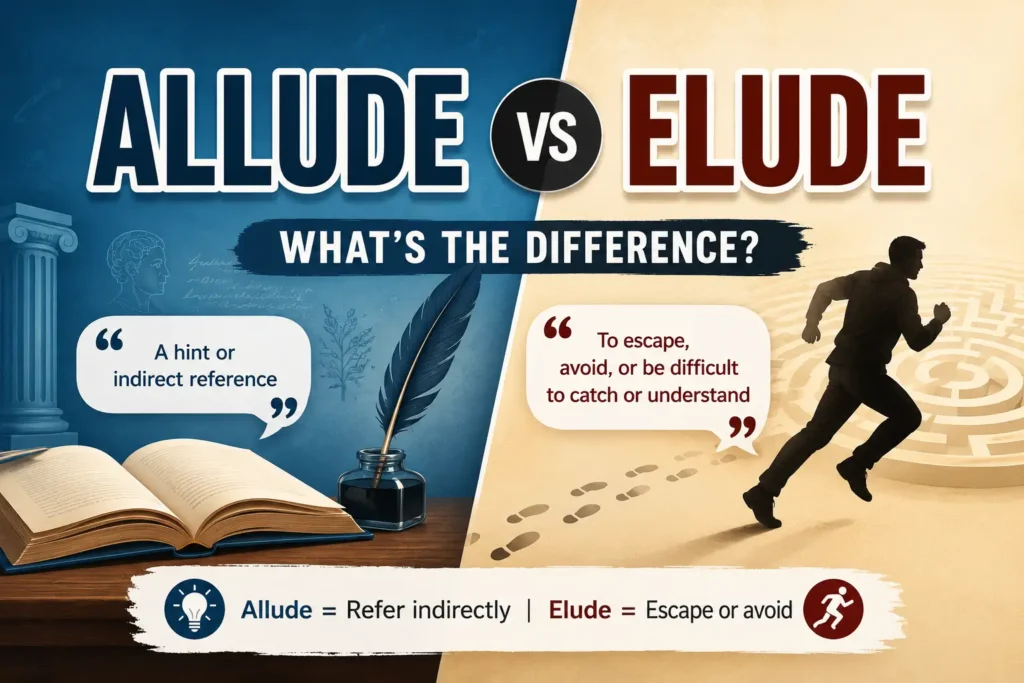
Allude vs. elude can be confusing because these words look and sound similar, but they have different meanings. Allude means to refer to something indirectly or hint at it, while elude means to escape, avoid, or remain difficult to understand or remember. For example, a writer may allude to a historical event without explaining it directly, while a suspect may elude the police. Understanding this simple difference can help you avoid common mistakes in writing and conversation.
The easiest way to remember them is to connect allude with allusion, which means an indirect reference. For elude, think of escape or evade. Once you know whether the sentence is about an indirect reference or something staying out of reach, choosing the correct word becomes much easier.
In this guide, you’ll learn the meanings, grammar, examples, common mistakes, and simple memory tricks that make allude vs. elude easy to understand.
Quick Answer: Allude vs Elude
Allude and elude are both verbs, but they describe different actions.
- Allude means to refer to something indirectly, often by hinting at it rather than explaining it clearly.
- Elude means to escape or avoid someone or something. It can also mean that something is difficult to understand, remember, find, or achieve.
- The usual construction is allude to something.
- Elude normally takes a direct object, such as elude the police, elude capture, or elude me.
| Word | Meaning | Common Pattern | Example |
| Allude | Refer to something indirectly | allude to something | The speaker alluded to the problem. |
| Elude | Escape or avoid | elude someone/something | The suspect eluded the police. |
| Elude | Be difficult to remember or understand | elude someone | The answer eluded me. |
Memory trick: Allude connects with allusion, an indirect reference. Elude connects with escape.
What Does Allude Mean?
Allude is a verb that means to refer to something indirectly. When you allude to something, you don’t explain it fully or mention it in a direct, detailed way. Instead, you give a clue or hint that allows someone to understand what you’re referring to.
The most common grammatical pattern is:
allude to + person, thing, event, idea, or subject
For example:
The manager alluded to changes coming to the company.
The manager didn’t clearly explain the changes. Instead, the manager hinted that changes were coming.
Similarly:
The author alluded to a famous historical event.
The author made an indirect reference to the event.
Allude Means “Refer Indirectly”
The key idea behind allude is indirect reference.
Compare these two sentences:
The teacher mentioned the final exam.
The teacher directly brought up the exam.
The teacher alluded to the final exam.
The teacher hinted at the exam without necessarily discussing it directly.
Therefore, allude is more specific than the general verb mention. A person can mention something openly, but to allude to something usually means to refer to it in a less direct way.
Examples of Allude
- She alluded to her childhood during the interview.
- The CEO alluded to possible changes in company policy.
- The article alludes to several historical events.
- He alluded to an argument that happened earlier.
- The teacher alluded to the answer without giving it away.
- The politician alluded to a possible change in direction.
In each case, the subject is referenced without being fully explained or stated in a direct way.
How to Use “Allude To” Correctly
One of the most important grammar points is that allude is commonly followed by to.
The basic structure is:
Subject + allude/alluded + to + object
For example:
The writer alluded to Shakespeare.
She alluded to her previous experience.
The report alluded to financial problems.
The word to is essential in these standard constructions.
Correct and Incorrect Examples
| Correct | Incorrect |
| She alluded to the problem. | She alluded the problem. |
| He alluded to his past. | He alluded his past. |
| The article alludes to the event. | The article alludes the event. |
The incorrect versions leave out to.
However, remember that allude to doesn’t mean simply “talk about.” It suggests that the reference is indirect or somewhat subtle.
Allude in Everyday American English
You might hear allude to in many situations in the United States.
At work, a manager might say:
“There may be some changes to the team structure next quarter.”
If the manager doesn’t explain what those changes are, an employee might later say:
The manager alluded to changes in the team structure.
In conversation, a friend might say:
“Let’s just say I learned my lesson last summer.”
If the friend doesn’t explain what happened, you could say:
She alluded to something that happened last summer.
The word also appears frequently in formal writing, journalism, academic work, and literary analysis.
What Does Elude Mean?
Elude is a verb with several related meanings. Its basic sense is to escape or avoid something, especially when someone is trying to catch, find, or stop you.
However, elude also has important figurative meanings. Something can elude you when it is difficult to understand, remember, find, or achieve.
Elude Means “Escape or Avoid”
In its literal sense, elude often describes someone escaping from pursuit or capture.
For example:
The suspect eluded the police.
This means the suspect escaped or avoided being caught.
You can also say:
- The criminal eluded capture.
- The runner eluded the defenders.
- The fox eluded the hunters.
- The suspect eluded authorities for several days.
In these examples, elude describes successfully staying out of someone’s reach.
Elude Can Describe Something Difficult to Understand
The meaning of elude extends beyond physical escape.
An answer, solution, meaning, or idea can also elude someone.
For example:
The solution eluded the researchers.
This means the researchers couldn’t find or discover the solution.
Another example is:
The meaning of the poem eluded me.
Here, the meaning wasn’t physically escaping. Instead, it was difficult for the speaker to understand.
Other examples include:
- The reason for the error eluded the engineers.
- A clear explanation eluded the students.
- The meaning of the message eluded him.
Elude Can Describe Memory
A particularly common figurative use involves memory.
Her name eluded me.
This means I couldn’t remember her name at that moment.
Similarly:
The answer eluded me during the exam.
The answer was difficult for me to recall or come up with.
This use doesn’t necessarily mean that you’ve completely forgotten something forever. Instead, the information is temporarily out of reach in your mind.
Allude vs. Elude: The Key Difference
The central difference is easy to understand once you focus on the action.
Allude is about communication. You indirectly refer to something.
Elude is about escape or difficulty. Someone or something gets away, stays out of reach, or proves difficult to grasp.
| Situation | Correct Word | Example |
| Indirectly referring to an event | Allude | She alluded to the event. |
| Hinting at an idea | Allude | He alluded to a possible solution. |
| Escaping from police | Elude | The suspect eluded the police. |
| Avoiding capture | Elude | The criminal eluded capture. |
| Failing to remember something | Elude | Her name eluded me. |
| Failing to understand something | Elude | The meaning eluded him. |
| Failing to achieve something | Elude | The championship eluded the team. |
Compare These Two Sentences
The speaker alluded to the problem.
The speaker indirectly referred to the problem.
The speaker eluded the reporters.
The speaker avoided or escaped the reporters.
The first sentence involves indirect communication. The second involves avoidance or escape.
That distinction is the key to choosing the right word.
Allude vs. Elude: Side-by-Side Examples
The following examples show how changing one word can completely change the meaning.
Example 1
The author alluded to the character’s difficult childhood.
The author indirectly referred to the childhood.
The character’s past eluded the investigators.
The investigators couldn’t discover or uncover the character’s past.
Example 2
The teacher alluded to the answer.
The teacher hinted at the answer.
The answer eluded the student.
The student couldn’t figure out or remember the answer.
Example 3
The manager alluded to possible layoffs.
The manager indirectly suggested that layoffs might happen.
The employee eluded the reporters.
The employee avoided the reporters.
Example 4
The article alluded to a famous novel.
The article made an indirect reference to the novel.
The meaning of the article eluded me.
I couldn’t understand what the article meant.
These examples highlight an important point: allude often involves the person doing the referring, while elude often involves the person or thing that remains out of reach.
How to Use Allude Correctly in a Sentence
When using allude, think about indirect communication.
In Conversation
My friend alluded to a surprise but wouldn’t tell me what it was.
The friend hinted at the surprise without revealing the details.
In the Workplace
During the meeting, the manager alluded to changes in the company’s benefits.
The manager suggested that changes might be coming.
In an Email
Your message alluded to a problem with the project timeline.
The message referred indirectly to the problem.
In Academic Writing
The author alludes to Greek mythology throughout the novel.
The author makes indirect references to Greek mythology.
In Journalism
The report alluded to growing concerns about the company’s future.
The report hinted at those concerns without necessarily explaining them in detail.
How to Use Elude Correctly in a Sentence
With elude, think about something being out of reach.
Physical Escape
The suspect eluded police.
The suspect avoided being caught.
Avoiding Capture
The criminal eluded capture for several months.
The criminal remained free and wasn’t captured.
Difficult to Understand
The meaning of the poem eluded the students.
The students couldn’t understand the poem’s meaning.
Difficult to Remember
The actor’s name eluded me.
I couldn’t remember the actor’s name.
Difficult to Achieve
The championship eluded the team for years.
The team tried but couldn’t win the championship.
This last use is especially useful because it shows how elude can describe an abstract goal. The championship isn’t literally running away. Instead, it remains beyond the team’s reach.
Allude vs. Mention: Are They the Same?
Allude and mention are related, but they aren’t always interchangeable.
To mention something means to bring it up or refer to it. The reference can be direct.
To allude to something means to refer to it indirectly.
Compare:
Sarah mentioned her new job.
Sarah directly brought up her new job.
Sarah alluded to her new job.
Sarah referred to the job indirectly, perhaps without explaining exactly what it was.
Therefore, if you’re simply saying that someone talked about something, mention may be the better choice. If you’re emphasizing a subtle or indirect reference, allude to is more precise.
Allude vs. Avoid: How Are They Different?
Elude and avoid can overlap, but they don’t always express the same idea.
Avoid usually means to deliberately stay away from someone or something.
She avoided talking about the issue.
Elude often suggests successfully escaping or remaining beyond someone’s reach.
The suspect eluded the police.
The first sentence focuses on choosing not to engage with something. The second focuses on escaping or avoiding capture.
In figurative contexts, elude can also suggest that something is difficult to grasp.
The answer eluded me.
You wouldn’t normally replace this with “The answer avoided me.” That would sound unnatural.
Common Mistakes With Allude and Elude
Mistake: Using “Elude” When You Mean “Allude”
Incorrect:
The speaker eluded to the problem.
If the speaker indirectly referred to the problem, the correct word is allude.
Correct:
The speaker alluded to the problem.
The speaker made an indirect reference.
Mistake: Using “Allude” When You Mean “Elude”
Incorrect:
The suspect alluded the police.
If you mean the suspect escaped the police, use eluded.
Correct:
The suspect eluded the police.
The suspect avoided capture.
Mistake: Writing “Elude To”
One of the most common errors is writing elude to when the intended meaning is “refer indirectly.”
Incorrect:
The author eluded to the historical event.
Correct:
The author alluded to the historical event.
However, elude can be followed by other objects:
The answer eluded me.
The suspect eluded police.
The meaning eluded the reader.
The basic difference is:
allude to something
elude someone or something
Mistake: Assuming Allude Means “Talk About”
Although allude can sometimes be loosely replaced by “refer to,” it usually carries the idea of indirectness.
For example:
The article mentioned the new law.
This tells readers that the article brought up the law.
The article alluded to the new law.
This suggests that the article referred to the law less directly.
Therefore, don’t use allude simply because it sounds more sophisticated. Choose it when the meaning really involves an indirect reference.
Allude vs. Elude Pronunciation
The words are pronounced similarly, which is one reason they are easy to confuse.
- Allude: /ə-LOOD/
- Elude: /ih-LOOD/
Both words have stress on the second syllable. The main difference is the vowel sound at the beginning.
In fast conversation, the distinction may be difficult to hear. Therefore, it’s useful to rely on context and meaning, not pronunciation alone.
If you’re writing, the spelling also matters because allude and elude aren’t interchangeable.
Allude, Allusion, Elude, and Illusion
Several related-looking words can cause confusion.
Allude
Allude is a verb meaning to refer indirectly.
The speaker alluded to the controversy.
Allusion
Allusion is a noun meaning an indirect reference.
The poem contains an allusion to Greek mythology.
The relationship is simple:
Allude = the action of referring indirectly.
Allusion = the indirect reference itself.
Illusion
An illusion is something that creates a false or misleading appearance.
The magician created an illusion of floating in the air.
An illusion isn’t the same as an allusion.
| Word | Meaning | Example |
| Allude | Refer indirectly | She alluded to the problem. |
| Allusion | An indirect reference | The novel contains an allusion to history. |
| Elude | Escape or remain out of reach | The suspect eluded police. |
| Illusion | A false or misleading appearance | The magician created an illusion. |
What About “Illude”?
You may occasionally encounter the word illude, but it is rare and not the word most readers need in ordinary modern American English.
For the common confusion involving allude and elude, focus on the meanings that appear regularly in everyday, academic, professional, and formal writing.
Memory Tricks for Allude vs. Elude
A good memory trick can make these words much easier to distinguish.
Remember Allude Through Allusion
Think:
Allude → Allusion → Indirect Reference
Both allude and allusion relate to referring indirectly.
So, when someone hints at or indirectly mentions something, choose allude.
Remember Elude Through Escape
Think:
Elude → Escape
If someone gets away from the police, they elude the police.
If an answer stays beyond your understanding, it eludes you.
If a goal remains out of reach, it eludes you.
The Fastest Memory Trick
Allude = hint at it.
Elude = get away from it.
This simple distinction works in most everyday situations.
A Practical Decision Guide
When you’re unsure which word to use, ask yourself what is happening in the sentence.
Use allude if:
- Someone is making an indirect reference.
- A speaker is hinting at a subject.
- A writer refers to something without explaining it directly.
- A person suggests an idea without stating it clearly.
Example:
The author alluded to the historical event.
Use elude if:
- Someone escapes capture.
- Someone avoids being caught.
- Something is difficult to find.
- Something is difficult to understand.
- Something is difficult to remember.
- Something is difficult to achieve.
Example:
The solution eluded the researchers.
This quick test will solve most allude vs. elude questions.
Practice: Choose Allude or Elude
Fill in each blank with the correct form of allude or elude.
- The speaker ________ to the company’s financial problems.
- The suspect managed to ________ the police.
- The answer ________ me during the exam.
- The author ________ to a famous American novel.
- The team worked hard, but the championship continued to ________ them.
- The manager ________ to possible changes during the meeting.
- The meaning of the poem ________ the students.
- The criminal ________ capture for several years.
Answers
- alluded — The speaker indirectly referred to the financial problems.
- elude — The suspect escaped or avoided the police.
- eluded — The speaker couldn’t remember or recall the answer.
- alluded — The author indirectly referred to the novel.
- elude — The team couldn’t achieve the championship.
- alluded — The manager hinted at possible changes.
- eluded — The students found the meaning difficult to understand.
- eluded — The criminal avoided being captured.
Here is a polished conclusion and 10 SEO-friendly FAQs for the Allude vs. Elude article:
Conclusion
Understanding allude vs. elude is easier when you focus on their meanings and how they work in a sentence. Allude means to refer to something indirectly or hint at it, and it is usually followed by to. For example, a writer may allude to a historical event without explaining it directly.
Elude, on the other hand, means to escape or avoid someone or something. It can also describe something that is difficult to remember, understand, find, or achieve. For example, a suspect can elude the police, while an answer can elude a student.
A simple memory trick can help: allude connects with allusion, which means an indirect reference, while elude can remind you of escape and evade. Keep this difference in mind, and you’ll be less likely to confuse these similar-looking words in your writing and everyday conversations.
Frequently Asked Questions About Allude vs. Elude
Q1.What is the difference between allude and elude?
Allude means to refer to something indirectly or hint at it, while elude means to escape, avoid, or remain difficult to understand, remember, or achieve.
Q2.Is it allude to or elude to?
The correct phrase for making an indirect reference is allude to. For example, “The speaker alluded to the problem.” Elude usually doesn’t take to in this meaning. You can say, “The suspect eluded the police.”
Q3.What does allude to mean?
Allude to means to refer to something indirectly without explaining or stating it clearly. For example, “The author alluded to a famous historical event.”
Q4.What does elude mean?
Elude means to escape or avoid someone or something. It can also mean that something is difficult to understand, remember, discover, or achieve. For example, “The answer eluded me.”
Q5.Is allude the same as mention?
Not exactly. Mention is a general word for bringing something up or referring to it. Allude to usually means to refer to something indirectly or hint at it rather than discussing it openly.
Q6.Can you allude to a person?
Yes. You can allude to a person by referring to them indirectly. For example, “The speaker alluded to the company’s former CEO without mentioning the person’s name.”
Q7.Can you use elude for memory?
Yes. Elude can describe something that you can’t remember or recall. For example, “Her name eluded me” means that you couldn’t remember her name at that moment.
Q8.What is an easy way to remember allude vs. elude?
Think of allude as connected to allusion, which means an indirect reference. For elude, think of escape or evade. So, allude = hint at, while elude = escape or remain out of reach.
Q9.What is the difference between allusion and illusion?
An allusion is an indirect reference to a person, event, idea, or work. An illusion is a false or misleading appearance. For example, a writer can make an allusion to Shakespeare, while a magician can create an illusion.
Q10.Is “the answer eluded me” correct?
Yes, “the answer eluded me” is grammatically correct. It means the answer was difficult for you to remember, understand, discover, or figure out. It doesn’t mean the answer literally escaped; instead, it remained out of reach mentally.
Onsite vs On Site: What’s the Difference and Which One Is Correct?
Led vs. Lead: What’s the Difference? Meaning, Pronunciation, Grammar, and Examples
Truly vs Truely: Which Spelling Is Correct? (Meaning, Rule, Examples & Common Mistakes)

1 thought on “Allude vs Elude: What’s the Difference? Meaning, Examples, and Easy Ways to Remember”