
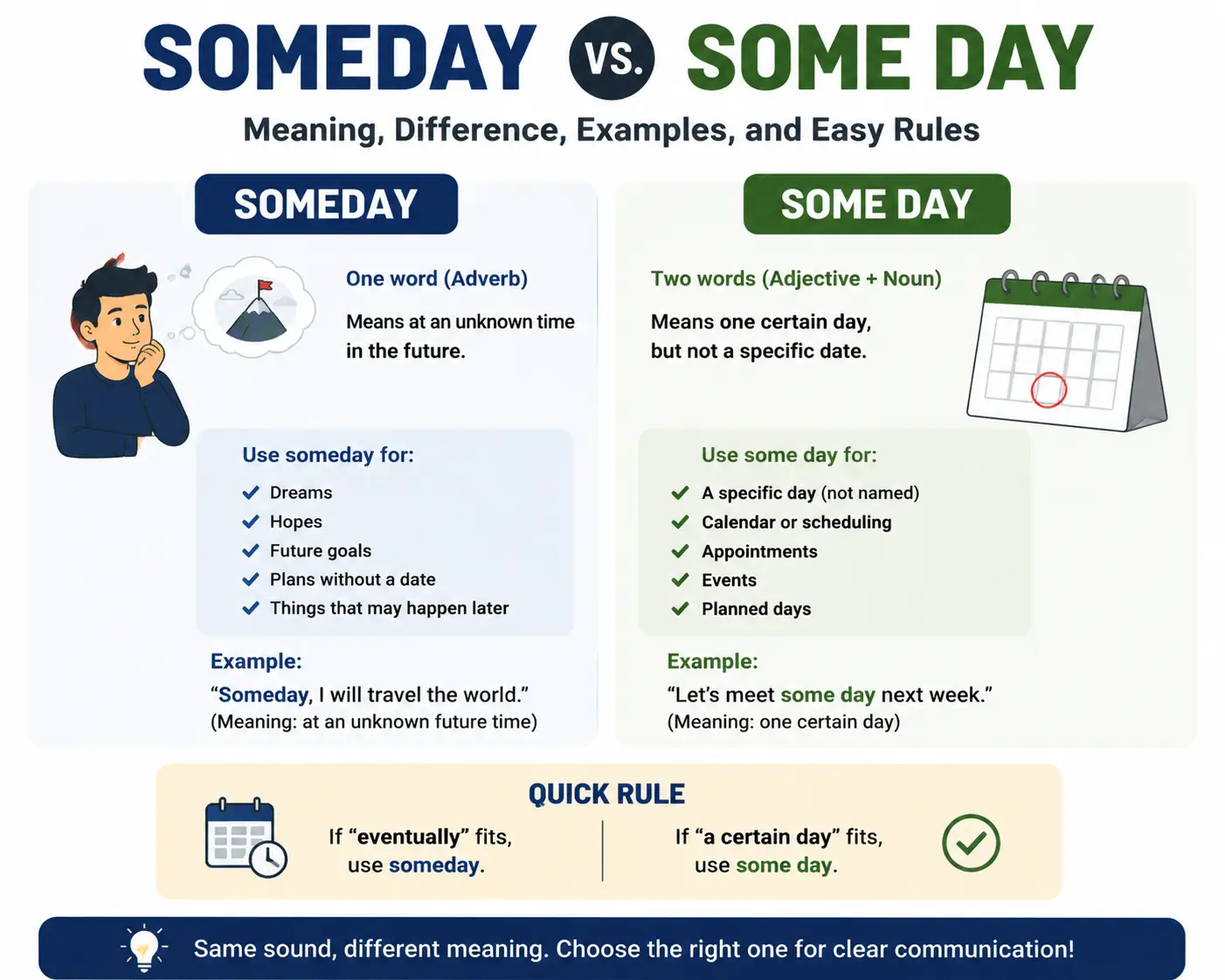
Someday vs. Some Day is one of those common English writing confusions that looks tiny but affects meaning, clarity, and grammar usage in modern English writing. In English writing, someday is a closed compound, a one-word adverb, and an adverb that points to future, future time, unspecified future time, unspecific time, future expression, future possibility, future goals, open future, and open timing. However, some day is an open compound, a two-word phrase, and a phrase where some works as an adjective and day works as a noun.
That simple word spacing, or small space, creates a real meaning difference, semantic difference, semantic context, contextual meaning, and NLP context because words differ by space, even when they have the same sound, same pronunciation, same spelling sound, and nearly identical pronunciation in spoken English.
Quick Answer: Someday or Some Day?
Here’s the fastest answer.
Someday means eventually or at an unknown future time.
Some day means one certain but unnamed day.
Use someday for dreams, hopes, goals, and future plans without a date.
Use some day for calendars, scheduling, and actual days.
| Correct Form | Meaning | Simple Example |
| Someday | At an unknown future time | “Someday, I’ll visit Japan.” |
| Some day | One certain day | “Pick some day next week.” |
A quick trick helps:
- If eventually fits, use someday.
- If a certain day fits, use some day.
Look at this example:
“Someday, she’ll start her own company.”
Now replace someday with eventually:
“Eventually, she’ll start her own company.”
That works. So someday is correct.
Now try this:
“Choose some day in June for the trip.”
Replace some day with a certain day:
“Choose a certain day in June for the trip.”
That also works. So some day is correct.
Read this also: Setup vs Set Up: Meaning, Difference, Examples, and Easy Rule
Why This Difference Matters
Small grammar choices shape how readers understand you.
If you write “We’ll fix this someday,” the sentence sounds vague. It gives no real timeline. In a personal message, that may be fine. In a business email, it sounds weak.
Now compare it with this sentence:
“We’ll choose some day next week to fix this.”
That sounds more practical. It still doesn’t name the date, but it points to a real day next week.
That’s why this rule matters. Someday floats in the future. Some day lands on the calendar.
Good writing doesn’t just avoid mistakes. It removes doubt.
When you use the right form, your sentence feels cleaner. Your reader doesn’t have to pause. The meaning clicks right away.
What Does Someday Mean?
Someday is one word. It means at some unknown time in the future.
It works as an adverb because it tells when something may happen. However, it doesn’t name a clear date or time.
You’ll often see someday in sentences about:
- Dreams
- Hopes
- Long-term goals
- Future plans
- Promises
- Possibilities
- Emotional reflections
- Life changes
Here are some examples:
- “Someday, I’ll own a small house near the lake.”
- “She wants to become a lawyer someday.”
- “They hope to travel across Europe someday.”
- “Someday, this hard work will pay off.”
- “Maybe someday we’ll laugh about this.”
Each sentence points toward the future. Still, none of them gives a date.
That’s the key.
Someday often sounds hopeful. It can also sound dreamy, emotional, or uncertain. Writers use it when they want to talk about the future without making a clear plan.
For example:
“Someday, the life you’re building now will make sense.”
That sentence doesn’t schedule anything. It offers hope. It points toward a future moment that hasn’t arrived yet.
What Does Some Day Mean?
Some day is two words. It means one certain day, even if the exact day is not named.
In this phrase, some describes day.
You can understand it the same way you understand phrases like:
- some person
- some place
- some reason
- some morning
- some evening
- some week
In each phrase, some points to one thing, but the speaker doesn’t name exactly which one.
So, some day means one day from a group of possible days.
Here are some examples:
- “Let’s meet some day next week.”
- “Choose some day in May for the event.”
- “Some day during the trip, we should visit the museum.”
- “There must be some day when everyone is free.”
- “Pick some day that works for your schedule.”
These sentences talk about real days. You could mark them on a calendar once someone chooses the date.
That’s why some day works best in scheduling and planning.
The Main Difference Between Someday and Some Day
The main difference is simple:
Someday means eventually.
Some day means a certain day.
Here’s a clear comparison:
| Term | Meaning | Grammar Role | Best Used For | Example |
| Someday | At an unknown time in the future | Adverb | Dreams, hopes, vague plans | “Someday, I’ll write a novel.” |
| Some day | One certain but unspecified day | Adjective + noun | Scheduling, dates, calendar days | “Pick some day next week.” |
The space changes the grammar.
Someday works as one complete word. It modifies the action in the sentence.
Some day works as two separate words. The word some describes the noun day.
That grammar difference changes the meaning.
Read these two sentences:
- “We should meet someday.”
- “We should meet some day next week.”
The first sentence sounds casual and vague. Maybe the meeting will happen. Maybe it won’t.
The second sentence sounds more serious. You’re talking about one possible day next week.
Same sound. Different meaning.
The Grammar Logic Behind Someday and Some Day
Grammar gets easier when you stop memorizing and start noticing patterns.
Someday acts like an adverb. It answers the question when?
Example:
“Someday, I’ll open a bakery.”
When will I open a bakery?
Someday.
The word doesn’t name a day. It simply points to the future.
Now look at this sentence:
“Choose some day next week.”
Choose what?
Some day.
Here, day is a noun. You can choose it, mark it, reserve it, or schedule it.
That’s why some day fits calendar language.
This is the grammar pattern:
| Form | Grammar | What It Does |
| Someday | Adverb | Tells when something may happen |
| Some day | Adjective + noun | Names one day without saying which day |
Once you see that pattern, the rule becomes much easier.
Use Someday for Future Dreams and Hopes
Use someday when you talk about a future dream, goal, or possibility.
This word fits when the event has no fixed date.
For example:
- “Someday, I’ll learn Spanish.”
- “He hopes to own a farm someday.”
- “They want to visit New York someday.”
- “Someday, this small idea could become a business.”
- “She believes her work will help people someday.”
These sentences all point to the future. However, they don’t point to a specific day.
That’s why someday works.
You’ll often see it near words like:
| Common Word | Example |
| hope | “I hope to see her someday.” |
| want | “They want to move abroad someday.” |
| maybe | “Maybe someday this will make sense.” |
| dream | “His dream is to build a school someday.” |
| believe | “She believes things will improve someday.” |
These words often signal a vague future idea. So, they often pair well with someday.
However, don’t use someday when you need a clear date. In that case, choose a more precise phrase.
Use Some Day for Real Days and Schedules
Use some day when you mean one actual day.
This phrase works well when you talk about scheduling, planning, or choosing a date.
For example:
- “Let’s meet some day next week.”
- “Pick some day in July for the appointment.”
- “Some day during the conference, we’ll review the budget.”
- “There must be some day when the office is quiet.”
- “Choose some day this month for the inspection.”
Each sentence points to a real day. The exact date may still be open, but the day exists as a calendar choice.
That’s the difference.
Some day often appears with time phrases like:
| Time Phrase | Example |
| next week | “Let’s meet some day next week.” |
| in April | “Some day in April would work.” |
| this month | “Choose some day this month.” |
| during the trip | “Some day during the trip, we’ll rest.” |
| before Friday | “Pick some day before Friday.” |
These phrases don’t always force some day, but they often point toward it.
The “Eventually” Test
The eventually test is the easiest way to check your sentence.
If you can replace the word with eventually, use someday.
Look at these examples:
| Sentence | Test | Correct Form |
| “I’ll learn piano someday.” | “I’ll learn piano eventually.” | Someday |
| “She’ll understand someday.” | “She’ll understand eventually.” | Someday |
| “Someday, this will feel funny.” | “Eventually, this will feel funny.” | Someday |
This test works because someday and eventually both point to an unknown future time.
Now try the test with a scheduling sentence:
“Let’s meet some day in March.”
Replace it with eventually:
“Let’s meet eventually in March.”
That sounds awkward. The sentence isn’t about a vague future hope. It’s about choosing one day in March.
So some day is correct.
The “A Certain Day” Test
The second test helps with scheduling.
If you can replace the phrase with a certain day, use some day.
Examples:
| Sentence | Test | Correct Form |
| “Pick some day next week.” | “Pick a certain day next week.” | Some day |
| “Some day in August would be best.” | “A certain day in August would be best.” | Some day |
| “Find some day when we’re both free.” | “Find a certain day when we’re both free.” | Some day |
This test works because some day treats day as a real noun.
You can choose a day. You can find a day. You can block a day. You can reserve a day.
You can’t do that with someday because someday means “eventually.”
The Dream vs Calendar Rule
Here’s the rule most people remember fastest:
Dreams take someday. Calendars take some day.
Use someday when the sentence feels like a wish, dream, hope, or future goal.
Use some day when the sentence feels like scheduling or choosing a day.
| Sentence Type | Correct Choice | Example |
| Dream | Someday | “Someday, I’ll write a book.” |
| Hope | Someday | “She hopes to visit Paris someday.” |
| Vague future plan | Someday | “We should try that restaurant someday.” |
| Calendar choice | Some day | “Choose some day next week.” |
| Meeting plan | Some day | “Let’s meet some day in June.” |
| Event schedule | Some day | “Some day during the event, we’ll take photos.” |
This trick works because it focuses on meaning, not grammar labels.
If the sentence dreams, use someday.
If the sentence schedules, use some day.
Common Mistakes With Someday and Some Day
Writers usually make mistakes with these words for one reason: both forms sound the same.
When you speak, there’s no difference. When you write, the difference matters.
Here are the most common errors.
Using Some Day for a Future Dream
Incorrect:
- “Some day, I’ll start my own business.”
- “She wants to become a doctor some day.”
- “They hope to buy a house some day.”
Correct:
- “Someday, I’ll start my own business.”
- “She wants to become a doctor someday.”
- “They hope to buy a house someday.”
Why?
These sentences talk about future goals. They don’t talk about one actual calendar day.
So someday is correct.
Using Someday for Scheduling
Incorrect:
- “Let’s meet someday next week.”
- “Choose someday in May.”
- “We need someday during the workshop for practice.”
Correct:
- “Let’s meet some day next week.”
- “Choose some day in May.”
- “We need some day during the workshop for practice.”
Why?
These sentences point to one actual day. They involve planning and scheduling.
So some day is correct.
Thinking Both Forms Are Interchangeable
They are not interchangeable.
The space changes the grammar and meaning.
Compare these two sentences:
- “I’ll call you someday.”
- “I’ll call you some day next week.”
The first sentence sounds vague. The second sentence points to one day next week.
A reader may still understand both. However, polished writing needs the correct form.
Treating It as a US vs UK Spelling Difference
This mistake appears often.
The difference is not mainly about American English or British English. Both forms exist because they mean different things.
Use someday for an unknown future time.
Use some day for one certain day.
The rule depends on meaning, not location.
Using Someday When Readers Need a Date
Someday can sound too vague in professional writing.
Weak:
- “We’ll update the report someday.”
- “The team may fix the issue someday.”
- “This feature could help users someday.”
Better:
- “We’ll update the report next month.”
- “The team plans to fix the issue this week.”
- “This feature could support future users.”
In business writing, vague time words can sound careless. Use someday only when you truly mean an unknown future time.
Side-by-Side Examples
Examples make this rule much easier.
| Sentence | Correct? | Why |
| “Someday, I’ll visit Italy.” | Correct | It means “eventually.” |
| “Some day, I’ll visit Italy.” | Usually incorrect | It doesn’t point to one calendar day. |
| “Pick some day next week.” | Correct | It means one real day next week. |
| “Pick someday next week.” | Incorrect | “Someday” doesn’t fit scheduling. |
| “They hope to retire someday.” | Correct | It expresses a future hope. |
| “Some day in October would work.” | Correct | It refers to one day in October. |
| “Someday during the trip, we’ll go hiking.” | Incorrect | The sentence refers to one day during the trip. |
| “Some day during the trip, we’ll go hiking.” | Correct | It means one actual day during the trip. |
Notice the pattern.
Someday feels open and future-focused. Some day feels tied to a real day.
Real-Life Examples in Everyday Writing
You don’t only need this rule for grammar quizzes. You also need it in real writing.
Let’s look at common situations.
Text Messages
Correct:
- “Someday, we should take a real vacation.”
- “Let’s pick some day next week for lunch.”
The first message sounds casual and open. The second one starts planning.
Emails
Correct:
- “Someday, I’d love to work on a larger project with your team.”
- “Please suggest some day next week for our call.”
The first sentence expresses future interest. The second asks for a schedule.
Social Media Captions
Correct:
- “Someday starts with one small step today.”
- “Choose some day this week to rest and reset.”
The first sentence sounds motivational. The second gives practical advice.
Business Writing
Correct:
- “We may expand this feature someday.”
- “Let’s schedule some day in March for testing.”
However, be careful. In business, readers often expect clear timing. If you can give a date, give one.
Academic Writing
Correct:
- “This method may support future research.”
- “Some day during the testing period, the control group received a second review.”
Academic writing often needs precision. So, someday may sound too casual. Use it only when the tone allows it.
Mini Case Study: How One Space Changes the Message
Imagine a freelance designer emailing a client.
Version A
“Someday, I’d love to help your team with a full brand redesign.”
This sentence sounds warm and open. The designer expresses future interest. There is no meeting request yet.
Version B
“Some day next week, I’d love to meet with your team about the brand redesign.”
This sentence feels more practical. The designer wants to choose a real day next week.
What Changed?
The space changed the purpose.
Version A shares a future possibility.
Version B suggests a calendar plan.
That small difference can change how professional your message feels. In client work, vague wording may make you sound casual. Clear wording makes you sound prepared.
A tiny space can turn a dream into a schedule.
Before-and-After Sentence Fixes
Use these examples to train your eye.
Future Goal
Incorrect:
“I want to start a podcast some day.”
Correct:
“I want to start a podcast someday.”
Why?
The sentence talks about a future goal. It doesn’t name a real day.
Calendar Choice
Incorrect:
“We should choose someday in April.”
Correct:
“We should choose some day in April.”
Why?
The sentence talks about one day in April.
Emotional Reflection
Incorrect:
“Some day, you’ll understand why this mattered.”
Correct:
“Someday, you’ll understand why this mattered.”
Why?
The sentence means “at an unknown time in the future.”
Event Planning
Incorrect:
“Someday during the retreat, we’ll discuss the budget.”
Correct:
“Some day during the retreat, we’ll discuss the budget.”
Why?
The sentence means one day during the retreat.
Vague Promise
Incorrect:
“I’ll explain everything some day.”
Correct:
“I’ll explain everything someday.”
Why?
The sentence makes a vague promise about the future.
How Native Speakers Choose the Right Form
Native speakers don’t usually stop and think, “Is this an adverb or an adjective plus a noun?”
They ask a simpler question without realizing it:
Am I talking about the future in general, or one actual day?
If the sentence feels like a dream or future possibility, they use someday.
If the sentence needs a real day, they use some day.
| Meaning in the Writer’s Mind | Best Choice | Example |
| “I mean eventually.” | Someday | “Someday, I’ll learn to swim.” |
| “I mean one day next week.” | Some day | “Choose some day next week.” |
| “I mean a future dream.” | Someday | “She wants to act on stage someday.” |
| “I mean a calendar slot.” | Some day | “Find some day in June for rehearsal.” |
| “I mean a vague future moment.” | Someday | “You’ll understand someday.” |
| “I mean one day during an event.” | Some day | “Some day during camp, we’ll hike.” |
This is why context matters more than memorizing a long grammar rule.
Tone Difference Between Someday and Some Day
These two forms also create different tones.
Someday often sounds emotional, hopeful, vague, or reflective.
Some day sounds practical, neutral, and calendar-focused.
| Form | Tone | Example |
| Someday | Hopeful | “Someday, life will feel lighter.” |
| Someday | Dreamy | “They’ll live by the sea someday.” |
| Someday | Vague | “We’ll deal with that someday.” |
| Some day | Practical | “Pick some day next week.” |
| Some day | Neutral | “Some day in July works.” |
| Some day | Schedule-based | “Reserve some day for training.” |
Tone matters because words carry attitude.
“Someday, we’ll fix it” may comfort a friend. Yet, it can annoy a customer.
A customer wants a timeline, not a cloud of hope.
When Someday Sounds Too Vague
Someday works well in personal writing. It can also work in creative writing.
However, it can weaken formal or professional writing.
Weak:
- “We’ll improve the website someday.”
- “The team may review the data someday.”
- “This approach could help students someday.”
Stronger:
- “We’ll improve the website after the audit.”
- “The team may review the data during the next planning cycle.”
- “This approach could support future students.”
The issue isn’t always grammar. Sometimes, the issue is clarity.
In professional writing, vague words can make you sound unsure. They create fog. Readers need headlights.
Use someday only when an unknown future time is truly what you mean.
When Some Day Sounds Awkward
Some day is correct when you mean one day. Still, it sounds awkward when the sentence means a vague future.
Awkward:
- “Some day, I’ll be brave enough to speak.”
- “We’ll laugh about this some day.”
- “He may understand some day.”
Better:
- “Someday, I’ll be brave enough to speak.”
- “We’ll laugh about this someday.”
- “He may understand someday.”
The two-word version feels odd here because the sentence doesn’t point to a real day. It points to the future.
That’s someday territory.
Someday or One Day: Are They the Same?
Someday and one day can overlap, but they don’t always mean the same thing.
Both can mean an unknown future time.
Examples:
- “Someday, I’ll tell that story.”
- “One day, I’ll tell that story.”
Both sentences work. Both point to the future.
However, one day has a wider use. It can also refer to one specific day in the past.
Examples:
- “One day last summer, we found an old photo.”
- “One day during college, she missed the bus and met her best friend.”
- “One day in 2019, the whole plan changed.”
You can’t replace those examples with someday.
Incorrect:
“Someday last summer, we found an old photo.”
That sentence doesn’t work because someday only points to the future.
Here’s the simple comparison:
| Phrase | Meaning | Example |
| Someday | Unknown future time | “Someday, I’ll visit Spain.” |
| One day | Unknown future time | “One day, I’ll visit Spain.” |
| One day | One specific past day | “One day last winter, the pipes froze.” |
If you mean a future hope, someday and one day can both work.
If you mean a specific day in the past, use one day.
Someday, Some Day, and Any Day
These phrases all deal with time, but they don’t mean the same thing.
| Phrase | Meaning | Example |
| Someday | At an unknown future time | “Someday, this will make sense.” |
| Some day | One certain but unspecified day | “Choose some day next week.” |
| Any day | Whichever day, or very soon | “The package could arrive any day now.” |
Any day often suggests something may happen soon.
Examples:
- “The results could arrive any day now.”
- “She’s expecting the call any day.”
- “The flowers should bloom any day.”
That’s different from someday, which can point far into the future.
Compare these:
- “The package could arrive any day now.”
- “The package could arrive someday.”
The first sentence sounds soon. The second sounds vague.
Nobody wants a delivery update that says “someday.” That’s how customer support turns into a bonfire.
Useful Facts About Someday and Some Day
Here are the most important facts in one place.
| Fact | Explanation |
| Someday is one word. | It means “at an unknown future time.” |
| Some day is two words. | It means “one certain but unspecified day.” |
| They sound the same. | Speech hides the difference. |
| The space changes the grammar. | One is an adverb. The other is adjective + noun. |
| They are not country-based spellings. | Meaning decides the correct form. |
| Someday can sound vague. | Avoid it when readers need a timeline. |
| Some day often appears with date words. | It fits phrases like “next week” or “in May.” |
The rule is simple once you focus on meaning.
Don’t ask, “Which one looks better?”
Ask, “Do I mean eventually or one actual day?”
Common Sentence Patterns With Someday
Some patterns almost always need someday.
Use it with sentences like:
- “I hope to ___ someday.”
- “Maybe someday ___.”
- “Someday, you’ll ___.”
- “They want to ___ someday.”
- “This could ___ someday.”
- “We should ___ someday.”
Examples:
- “I hope to open a café someday.”
- “Maybe someday we’ll work together.”
- “Someday, you’ll see the value of this.”
- “They want to build a farm someday.”
- “This small tool could help many people someday.”
- “We should visit that town someday.”
These sentences all point to future possibility. They don’t deal with dates or calendars.
Common Sentence Patterns With Some Day
Other patterns usually need some day.
Use it with sentences like:
- “Choose some day ___.”
- “Pick some day ___.”
- “Find some day ___.”
- “Some day in ___.”
- “Some day during ___.”
- “There must be some day when ___.”
Examples:
- “Choose some day next week.”
- “Pick some day in May.”
- “Find some day when everyone can attend.”
- “Some day in August would work.”
- “Some day during the festival, we’ll meet.”
- “There must be some day when the shop is less crowded.”
These sentences point to one real day.
Examples for Different Writing Styles
Different types of writing use these forms in different ways. Context decides what sounds natural.
Creative Writing
Creative writing often uses someday because the word carries emotion.
Examples:
- “Someday, the old house would feel like home again.”
- “She kept the letter because she believed he would return someday.”
- “Someday, the city would remember his name.”
These sentences create mood. They don’t need a date.
Business Writing
Business writing usually needs precision.
Examples:
- “Please suggest some day next week for the review.”
- “We’ll schedule some day in June for onboarding.”
- “Our team will revisit this feature during the next quarter.”
Use someday only when you truly mean a vague future.
Educational Writing
Educational writing should stay clear and direct.
Examples:
- “Someday means an unknown future time.”
- “Some day means one particular day.”
- “Use the replacement test when you feel unsure.”
This style works best with clean rules and simple examples.
Personal Writing
Personal writing can use both forms naturally.
Examples:
- “Someday, I want to live near the mountains.”
- “Let’s choose some day next month for dinner.”
- “Maybe someday this hard season will make sense.”
Personal writing often has emotion, so someday fits well.
Editing Checklist for Someday and Some Day
Before you publish, send, or submit your writing, ask these questions:
- Do you mean eventually?
- Use someday.
- Do you mean one actual day?
- Use some day.
- Does the sentence mention next week, in May, or during the trip?
- Check whether some day fits better.
- Does the sentence express a dream, hope, or vague future goal?
- Use someday.
- Would your reader expect a clear schedule?
- Avoid vague wording.
- Does the sentence sound awkward?
- Test it with eventually or a certain day.
A quick check can save your sentence. Think of it like checking your shoelaces before running. Small step. Big difference.
Practice: Choose the Correct Form
Choose someday or some day for each sentence.
| Sentence | Correct Answer | Why |
| “I hope to write a novel _____.” | someday | It means “eventually.” |
| “Let’s choose _____ in October.” | some day | It means one day in October. |
| “_____ , you’ll understand this lesson.” | Someday | It means at a future time. |
| “There must be _____ next week when we’re free.” | some day | It refers to one actual day. |
| “They want to buy land _____.” | someday | It expresses a future dream. |
| “Pick _____ during the event for photos.” | some day | It means one day during the event. |
| “Maybe _____ we’ll meet again.” | someday | It means an unknown future time. |
| “_____ in April would be better.” | Some day | It refers to one day in April. |
If you missed one, slow down and test the meaning.
Does the sentence mean eventually? Choose someday.
Does it mean a certain day? Choose some day.
Quick Recap
Here’s the short version:
- Someday means at an unknown future time.
- Some day means one certain but unspecified day.
- Use someday for dreams, hopes, and vague future plans.
- Use some day for calendars, dates, and scheduling.
- Replace someday with eventually to test it.
- Replace some day with a certain day to test it.
- Don’t treat the forms as US vs UK spellings.
- Don’t use vague words when readers need a clear timeline.
The main idea is simple:
If the sentence dreams, use someday. If the sentence schedules, use some day.
FAQs About Someday and Some Day
Q1:Is someday one word or two?
Someday is one word when it means at an unknown time in the future.
Example:
“Someday, I’ll learn to cook without burning toast.”
The sentence points to the future. It doesn’t name a day.
Q2:Is some day grammatically correct?
Yes, some day is grammatically correct when it means one certain but unspecified day.
Example:
“Choose some day next week for the appointment.”
Here, the sentence talks about one real day next week.
Q3:What is the difference between someday and some day?
The difference between someday and some day is meaning and grammar.
Someday means “eventually.” Some day means “a certain day.”
Example:
“Someday, I’ll start a business.”
“Pick some day next week for the business meeting.”
The first sentence dreams. The second schedules.
Q4:Can I use someday in formal writing?
Yes, but use it carefully.
Someday can sound vague in formal writing. If your reader expects precision, use a clearer phrase.
Instead of:
“This research may someday help teachers.”
Try:
“This research may support future teaching methods.”
The second sentence sounds clearer and more professional.
Q5:Is someday informal?
Someday can sound casual or emotional, but it isn’t wrong.
It works well in everyday writing, storytelling, speeches, captions, and personal reflections.
However, in business, legal, academic, or technical writing, you may need a more exact phrase.
Q6:Is some day the same as one day?
Sometimes, but not always.
Some day means one certain but unspecified day. One day can mean that too, but it can also refer to a day in the past.
Example:
“One day last year, we found an old photo.”
You can’t use someday there because someday only points to the future.
Q7:Why do people confuse someday and some day?
People confuse them because they sound exactly the same.
Also, both forms deal with time. That makes the mistake easy to miss, especially when you type fast.
The best fix is to test the meaning. Use eventually for someday. Use a certain day for some day.
Q8:How can I remember the difference?
Use the dream vs calendar rule.
Dreams take someday.
Calendars take some day.
That simple trick solves most mistakes.
Conclusion
someday vs Some Day looks like a small spacing issue, but it changes meaning, grammar, and clarity in English writing. Use someday when you mean future time, hope, dreams, or an unspecified future.
In real writing, someday works as a one-word adverb. It fits loose planning, future goals, and ideas that are not yet determined. For example, “I’ll clean my room someday” means you plan to do it later, but you have no scheduled day.
Use some day when you mean a specific planned day, calendar day, or appointment. It is a two-word phrase, where some is an adjective and day is a noun. So, “Let’s meet some day next week” means one real day on the calendar.