
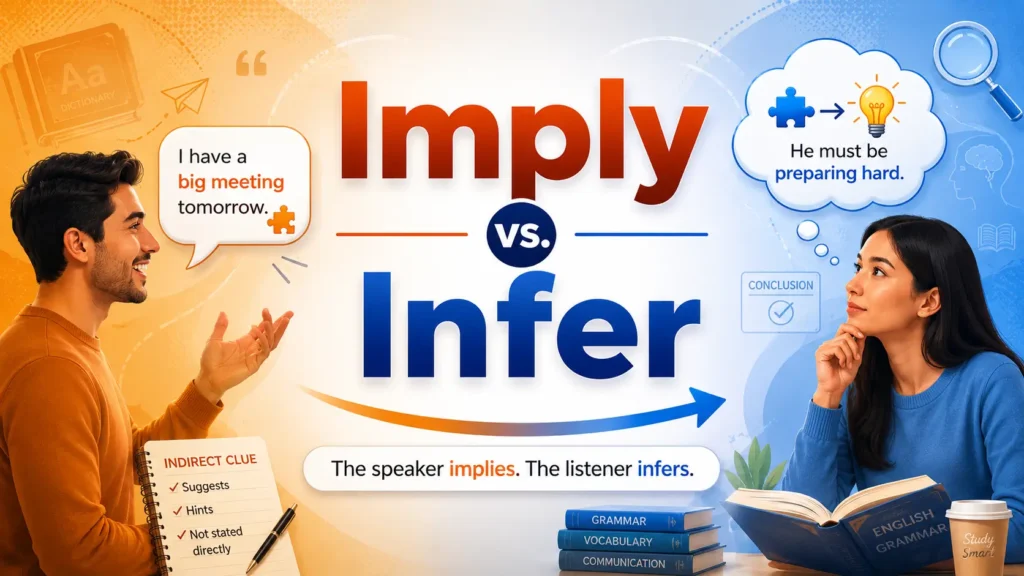
Imply vs. Infer explains two related actions in communication. To imply means to suggest an idea without saying it directly. To infer means to reach a conclusion from clues or evidence. In simple terms, the speaker implies, while the listener infers.
These words may describe the same conversation, but they show different points of view. For example, a manager may imply that a report needs changes. An employee may then infer from the manager’s words that the report isn’t ready.
Understanding the difference helps you avoid a common grammar mistake. It also makes your writing clearer in school assignments, emails, workplace messages, and everyday conversations. This guide explains the meanings of imply, infer, implied, and inferred through simple rules and practical examples.
Quick Answer: What Is the Difference Between Imply and Infer?
Imply means to suggest, indicate, or communicate something without stating it directly.
Infer means to reach a conclusion by examining words, actions, facts, or other evidence.
The sender implies. The receiver infers.
Consider this exchange:
- Mia says, “I have to wake up at 5:00 tomorrow.”
- Her comment implies that she wants to leave soon.
- Her friends infer that the evening is ending.
Mia sends an indirect message. Therefore, she implies. Her friends interpret that message, so they infer.
| Word | Basic meaning | Who or what performs the action? | Simple example |
| Imply | Suggest something indirectly | A speaker, writer, action, fact, or situation | His tone implied that he was upset. |
| Infer | Reach a conclusion from evidence | A listener, reader, observer, or researcher | I inferred from his tone that he was upset. |
Imply vs. Infer at a Glance
The easiest way to understand infer vs. imply is to follow the direction of the information.
With imply, meaning moves outward from a source. With infer, a person draws meaning inward from evidence.
| Point of comparison | Imply | Infer |
| Main meaning | Suggest indirectly | Draw a conclusion |
| Role in communication | Sends or provides a clue | Interprets a clue |
| Common subject | Person, statement, behavior, evidence, result | Person, reader, listener, researcher |
| Common pattern | imply that + clause | infer that + clause |
| Common preposition | Usually none | Often from |
| Noun form | implication | inference |
| Close everyday word | suggest | conclude |
| Past tense | implied | inferred |
| Example | The message implied urgency. | We inferred urgency from the message. |
Both words can appear in a description of the same event:
- The attorney’s question implied that the witness had forgotten an important detail.
- The jury inferred from the question that the detail mattered.
The first sentence focuses on the clue. In contrast, the second focuses on the conclusion.
The Communication Chain: How Implying and Inferring Work Together
Implying and inferring usually involve three parts:
- A person, statement, action, or fact provides a clue.
- That clue implies an unstated idea.
- Someone infers a conclusion from the clue.
Here’s a workplace example:
Carlos wrote, “We may need to revisit the budget before approving new hires.”
Carlos didn’t directly say that hiring would stop. However, his message implied that the company might delay recruitment.
After reading the message, a department manager might infer that an open position won’t be filled soon.
The implied message and inferred conclusion may differ
An inference isn’t always correct. A listener can reach a conclusion that the speaker never intended.
Suppose your coworker checks the time several times during a meeting. You might infer that the coworker is bored. However, the coworker may simply be waiting for an important phone call.
The behavior implies impatience or concern, but it doesn’t prove either one. Your inference may be reasonable, yet still wrong.
This distinction matters in professional and personal communication. It prevents you from treating an interpretation as a confirmed fact.
What Does Imply Mean?
Imply is a verb that usually means to communicate, suggest, or indicate something indirectly.
When you imply something, you don’t say it in a direct, complete statement. Instead, your words, tone, behavior, or circumstances allow another person to recognize the hidden meaning.
Compare these examples:
- Direct statement: “I don’t trust this plan.”
- Implication: “Has anyone checked these numbers a second time?”
The second sentence doesn’t openly express distrust. Still, it may imply concern about the plan’s accuracy.
Common sentence patterns with imply
You’ll often see imply in the following patterns.
Imply + noun
- The delay implies a problem.
- Her expression implied disappointment.
- The wording implies uncertainty.
Imply that + complete clause
- The report implies that sales are slowing.
- His response implied that he already knew.
- The advertisement implies that the product works instantly.
As the name implies
- A reusable container, as the name implies, can be used many times.
- A self-checkout lane, as the name implies, allows customers to scan their own items.
Be implied
- Consent shouldn’t be implied from silence.
- A promise was implied, although it wasn’t written into the contract.
Imply can describe more than spoken language
People often assume that only speakers can imply something. In fact, many sources can create an implication.
A person can imply something:
- Her question implied that she disagreed.
A written message can imply something:
- The email implied that attendance was required.
An action can imply something:
- His refusal to answer implied that the topic made him uncomfortable.
A fact can imply something:
- The empty parking lot implied that the office was closed.
A result can imply something:
- The sudden increase in returns may imply a quality-control problem.
A rule or idea can imply a consequence:
- Greater authority implies greater responsibility.
In the final example, imply means that one condition logically involves or carries another. The meaning isn’t necessarily secret or intentional.
Implying may be intentional or unintentional
A person can deliberately imply an idea.
- “Some employees arrive on time every day,” the supervisor said, implying that others were often late.
However, a person can also imply something without intending to.
- Her nervous laugh implied discomfort, even though she said she felt fine.
Likewise, an object or situation has no intention. Yet it can still provide evidence that suggests a conclusion.
- Dark clouds imply that rain may be coming.
What Does Infer Mean?
Infer is a verb that means to form a conclusion from evidence, clues, facts, or reasoning.
When you infer, you go beyond the information stated directly. You combine what you observe with what you already know.
For example:
- The lights are off.
- The doors are locked.
- No cars are in the parking lot.
From those details, you may infer that the business is closed.
The conclusion is sensible. However, it remains an inference unless a sign, employee, or official notice confirms it.
Common sentence patterns with infer
Infer + noun
- The researchers inferred a connection.
- Readers can infer the character’s motive.
- The analyst inferred a decline in demand.
Infer that + complete clause
- We inferred that the meeting had been canceled.
- She inferred that the customer wanted a refund.
- The teacher inferred that several students were confused.
Infer something from something
- You can’t infer guilt from nervous behavior alone.
- I inferred his meaning from the context.
- The doctor inferred a possible cause from the test results.
Be inferred from
- The speaker’s opinion can be inferred from her word choice.
- A person’s intentions shouldn’t be inferred from one brief message.
- The company’s future plans can’t be inferred from this announcement.
It can be inferred that
- It can be inferred that demand increased during the summer.
- From the final paragraph, it can be inferred that the narrator regrets leaving.
An inference uses evidence, but it isn’t always certain
An inference is more than a random guess. It should have some support.
- Inference: I inferred from the muddy footprints that someone had entered the house.
- Guess: I guessed that someone might stop by later.
The muddy footprints provide evidence. In contrast, the guess may come from intuition or chance.
Still, an inference isn’t automatically true. Several explanations may fit the same evidence.
For instance, a short email reply may suggest irritation. However, the writer may simply be busy. Therefore, you should avoid presenting an inference as a proven fact.
Implied vs. Inferred: Past-Tense Forms
Implied is the past tense and past participle of imply.
Inferred is the past tense and past participle of infer.
Compare these parallel sentences:
- The speaker implied that the policy was unfair.
- The audience inferred that the policy was unfair.
Both sentences concern the same unstated idea. However, the subject performs a different action in each one.
| Base verb | Third-person singular | Past tense | Past participle | -ing form | Noun |
| imply | implies | implied | implied | implying | implication |
| infer | infers | inferred | inferred | inferring | inference |
Spelling changes to remember
When you add -ed to imply, change the final y to i:
- imply → implied
- not implyed
When you add -ed or -ing to infer, double the final r:
- infer → inferred
- infer → inferring
- not infered
- not infering
The stress falls on the final syllable of infer. As a result, American English spelling doubles the final consonant before a vowel suffix.
How to Pronounce Imply and Infer
Although the words relate to communication, they don’t sound alike.
Pronunciation of imply
Imply is pronounced im-PLY.
Its American English pronunciation is /ɪmˈplaɪ/. The stress falls on the second syllable.
It rhymes with:
- apply
- reply
- supply
Pronunciation of infer
Infer is pronounced in-FUR.
Its American English pronunciation is /ɪnˈfɝ/. The stress also falls on the second syllable.
In most American accents, the final syllable sounds like the word fur.
Key Differences Between Imply and Infer
The central difference concerns direction. Still, several smaller distinctions can help you choose the right word.
Imply provides the clue
Use imply when the subject produces, contains, or communicates an unstated message.
- The article implies that the law may change.
- Her smile implied approval.
- The data implies a possible connection.
In each sentence, the subject provides information that points toward an idea.
Infer interprets the clue
Use infer when the subject examines information and reaches a conclusion.
- Readers may infer that the law will change.
- I inferred approval from her smile.
- Researchers inferred a possible connection from the data.
Here, the subject interprets the evidence.
Infer often appears with from
The preposition from commonly introduces the source of an inference.
- What did you infer from the conversation?
- We inferred the result from the available evidence.
- Nothing should be inferred from her silence.
By contrast, imply from is usually incorrect when a person is drawing a conclusion.
- Incorrect: I implied from the report that sales were falling.
- Correct: I inferred from the report that sales were falling.
Imply doesn’t mean state directly
Use imply only when the message is indirect or when one fact logically suggests another.
- The notice stated that the building would close at 6:00.
- The wording implied that the closing time might change.
The first message is explicit. The second leaves the reader to interpret it.
Correct and Incorrect Examples of Imply and Infer
The following examples show how the subject determines the correct verb.
When a speaker suggests something
Incorrect: Are you inferring that I lied?
Correct: Are you implying that I lied?
The other person is sending or suggesting the message. Therefore, implying is the right word.
However, this sentence can be correct in another context:
- What are you inferring from the evidence?
Here, the question asks about the conclusion someone has reached.
When a listener draws a conclusion
Incorrect: I implied from her expression that she was upset.
Correct: I inferred from her expression that she was upset.
The speaker interprets an expression. As a result, inferred fits the sentence.
When evidence points toward an idea
Less precise: The test results infer that the treatment worked.
Better: The test results imply that the treatment worked.
Also correct: Researchers inferred from the test results that the treatment worked.
Test results don’t perform human reasoning. Instead, they provide evidence. Researchers interpret that evidence.
In some technical contexts, writers may use infer with a system, model, or process as the subject. For general readers, however, keeping the human or analytical agent as the subject often creates a clearer sentence.
When the information is direct
Weak: The email implied that the office would close Friday.
Better: The email stated that the office would close Friday.
If the email clearly announced the closing, stated is more accurate. Use implied only when the reader must interpret the message.
When an inference goes beyond the evidence
Problematic: She didn’t answer, so I inferred that she agreed.
The grammar is correct, but the reasoning is weak. Silence can have many meanings.
A more careful sentence would be:
- I interpreted her silence as agreement, although I wasn’t certain.
Grammar and logic work together. A correctly used verb doesn’t guarantee a sound conclusion.
Real-Life Examples of Imply and Infer
The distinction becomes easier when you see the words in familiar settings.
At work
A manager says:
“We’ll review everyone’s priorities before approving overtime.”
The statement implies that overtime requests may be denied.
An employee may infer that the team needs to finish more work during regular hours.
However, that conclusion isn’t guaranteed. The manager may only be describing a standard review process.
In an email
Suppose a client writes:
“We expected the first draft yesterday.”
The message directly states that the draft was expected. It may also imply disappointment or frustration.
The recipient might infer that the relationship is at risk. Yet that conclusion could be too strong unless other evidence supports it.
At school
A teacher writes:
“Strong responses use at least two examples from the reading.”
The instruction implies that one example probably won’t earn full credit.
Students may infer that they should quote or discuss multiple passages.
In literature
An author may never write, “The character feels trapped.” Instead, the story may describe locked doors, narrow hallways, and repeated attempts to escape.
Those details imply confinement. Readers then infer that the character feels trapped.
In science and research
A set of findings may imply that a relationship exists between two variables.
Researchers may infer a possible explanation from those findings. However, they shouldn’t claim cause and effect unless the research design supports it.
For example:
- The results imply an association between sleep and test performance.
- Researchers inferred that sleep may influence concentration.
The word may matters because it avoids overstating the conclusion.
In texting
A friend replies with only:
“Fine.”
The brief response might imply annoyance. You may infer that your friend is upset.
Still, texting removes tone, facial expression, and context. Therefore, it’s wise to ask before assuming.
On social media
A company posts a covered product with the caption, “Something new is arriving Friday.”
The image and caption imply an upcoming product launch.
Followers may infer which product the company plans to release. Some guesses may be reasonable, while others may be wrong.
Common Mistakes With Imply and Infer
Most errors happen because writers focus on the hidden idea but forget who sends or receives it.
Using infer when you mean imply
Incorrect: What are you trying to infer?
Correct: What are you trying to imply?
The phrase asks what someone is trying to suggest. Therefore, imply is correct.
Use infer when asking about a conclusion:
- What do you infer from the witness’s statement?
Using imply with from
Incorrect: We implied from the numbers that demand was falling.
Correct: We inferred from the numbers that demand was falling.
The phrase from the numbers identifies the evidence. Therefore, the sentence describes an inference.
Assuming that every implication is intentional
A person’s words may imply something that the person didn’t mean.
- His joke implied that the project wasn’t important.
The implication exists in the listener’s interpretation, even if the speaker intended only to be funny.
For clearer communication, distinguish between impact and intent:
- Your comment sounded as though the project wasn’t important.
- Did you mean to suggest that the project wasn’t important?
Treating infer as a synonym for guess
An inference should come from evidence.
- I inferred from the calendar invitation that the meeting was mandatory.
- I guessed that the meeting might last an hour.
The invitation supports the first conclusion. The second statement may have little or no support.
Using imply when say is clearer
Writers sometimes choose imply because it sounds more sophisticated. However, the word becomes inaccurate when the message is direct.
- Direct: The principal said that school would close early.
- Indirect: The principal implied that an early closing was possible.
Choose the verb that accurately describes the communication.
Treating an inference as proof
Words such as infer, suggest, and imply usually signal uncertainty.
- The data suggests that customers prefer the new design.
- We inferred that customers preferred the new design.
Neither sentence necessarily proves the preference. Therefore, don’t replace cautious wording with a stronger claim unless the evidence supports it.
A Mini Case Study: One Message, Two Interpretations
Consider this message from a supervisor:
“The client presentation is Monday morning. I’ll be online this weekend if anyone needs me.”
What does the supervisor imply?
The message may imply that employees are expected to work over the weekend. However, it could also mean that the supervisor is simply available to answer questions.
What might employees infer?
- One employee may infer that weekend work is required.
- Another may infer that weekend work is optional.
- A third may infer that the supervisor expects the presentation to need revisions.
The same words can lead to different inferences. As a result, indirect communication can create confusion.
A clearer version would be:
“Weekend work isn’t required. However, I’ll be available if you choose to revise your slides.”
This example shows an important communication lesson: A speaker controls the wording, but not every conclusion the audience draws from it.
Can Infer Ever Mean Imply?
Historically, infer has sometimes been used to mean imply, indicate, or suggest. You may still encounter that use in older writing or occasional modern speech.
For example:
- His statement inferred that the policy had failed.
Some dictionaries record or discuss this meaning because it has a long history. However, many readers, editors, teachers, and style-conscious writers object to it.
In modern school, business, academic, and professional writing, preserve the clearer distinction:
- Use imply when a message is sent or suggested.
- Use infer when a conclusion is drawn.
Therefore, a clearer revision is:
- His statement implied that the policy had failed.
- Readers inferred from his statement that the policy had failed.
Using separate verbs for separate actions reduces ambiguity.
Imply, Suggest, Hint, Insinuate, and Indicate
Several words have meanings similar to imply, but their tones differ.
| Word | Main meaning | Typical tone or use |
| Imply | Communicate an idea indirectly | Neutral |
| Suggest | Present an idea, possibility, or recommendation | Broad and neutral |
| Hint | Give a small or subtle clue | Often casual |
| Insinuate | Suggest something negative indirectly | Usually critical or offensive |
| Indicate | Point toward a fact or condition | Neutral or formal |
Compare these examples:
- The email implied that the schedule might change.
- The evidence suggests that the schedule may change.
- She hinted that the schedule might change.
- He insinuated that the planner had made a mistake.
- The updated calendar indicates that the schedule has changed.
Insinuate often carries a negative tone. If someone insinuates that a coworker acted dishonestly, the suggestion is indirect and potentially insulting.
Indicate usually sounds more objective. A measurement, sign, report, or result may indicate a condition.
Infer, Deduce, Conclude, Assume, and Guess
Words related to infer also differ in precision.
| Word | How the conclusion is reached |
| Infer | By interpreting clues or evidence |
| Deduce | Through structured logical reasoning |
| Conclude | After considering information |
| Assume | By accepting something without enough proof |
| Guess | With limited information or no clear evidence |
Infer vs. assume
An inference has evidence behind it. An assumption may not.
- I inferred from the canceled reservation that they weren’t coming.
- I assumed they weren’t coming because they’re often late.
The canceled reservation supports the first conclusion. The second relies mainly on expectation.
Infer vs. deduce
Deduce often suggests a more formal chain of logic.
- From the footprints and open window, the detective deduced how the person entered.
- From the muddy floor, I inferred that someone had entered.
The meanings overlap. However, deduce often sounds more systematic.
Infer vs. conclude
Conclude is broader. It can describe a final judgment after reviewing information.
- After reading the reports, the board concluded that the project should end.
- From the reports, analysts inferred that costs would continue rising.
An inference may be one step in the process of reaching a conclusion.
Infer vs. guess
A guess may have little support.
- I inferred from her uniform that she worked at the hospital.
- I guessed that she worked nearby.
The uniform provides a clue. The guess is less grounded.
Grammar and Usage Tips for American English
Use a person as the subject of infer when possible
Because infer describes reasoning, it often sounds clearest with a person or group as the subject.
- Clear: The researchers inferred a relationship from the data.
- Less natural for general readers: The data inferred a relationship.
In technical discussions, software, algorithms, and models may also infer information. For example, a computer model can infer a user’s likely preference from past behavior. Still, use that construction only when the system truly performs an analytical process.
Use imply for evidence, wording, and behavior
Nonhuman subjects work naturally with imply:
- The figures imply lower demand.
- Her expression implied concern.
- The contract implies an obligation.
- The wording implies that exceptions are possible.
Use cautious language with uncertain conclusions
An implication or inference may not be certain. Therefore, modifiers can improve accuracy:
- may imply
- seems to imply
- could suggest
- appears to indicate
- reasonably infer
- tentatively conclude
Example:
- The results may imply that customers prefer shorter forms.
This sentence is more careful than:
- The results prove that customers prefer shorter forms.
Avoid accusatory wording in professional communication
“Are you implying that I made a mistake?” can sound defensive.
A more neutral approach is:
- Do you mean that the figures need to be checked again?
- Am I right in understanding that you have concerns about the figures?
- Should I review the figures before we continue?
Similarly, take responsibility for your interpretation:
- I inferred from your email that the deadline had changed. Is that correct?
This phrasing sounds less confrontational than:
- Your email implied that the deadline had changed.
A Fast Memory Trick for Imply vs. Infer
Use this simple formula:
You imply something to another person. You infer something from evidence.
You can also connect the first letters:
- IMply = IMpart or send a hidden message.
- INfer = take meaning IN.
Another useful test is to ask two questions:
- Is the subject sending or providing a clue? Use imply.
- Is the subject interpreting a clue? Use infer.
If the message is direct, neither word may be best. Use say, state, explain, announce, or confirm instead.
Practice: Choose Imply or Infer
Complete each sentence with the correct form of imply or infer.
- Her tone seemed to ______ that the discussion was over.
- What can we ______ from these survey results?
- Are you ______ that the report is inaccurate?
- The jury shouldn’t ______ guilt from nervous behavior alone.
- His message ______ that he wouldn’t attend the meeting.
- We ______ from the empty desks that the office had closed early.
- The final scene ______ that the main character survived.
- Readers may ______ the narrator’s feelings from her descriptions.
- The results don’t necessarily ______ that the new method is better.
- I ______ from your email that Friday was the deadline.
Answer key
- imply — Her tone provides the indirect message.
- infer — “We” are drawing a conclusion from results.
- implying — The other person is suggesting an idea.
- infer — The jury would be reaching a conclusion from behavior.
- implied — The message provided the clue.
- inferred — “We” interpreted the empty desks.
- implies — The scene suggests the character survived.
- infer — Readers draw a conclusion from descriptions.
- imply — The results may or may not support that idea.
- inferred — The writer interpreted the email.
Frequently Asked Questions
Q1: What is the main difference between imply and infer?
To imply means to send or suggest an indirect meaning. To infer means to understand or form a conclusion from that meaning.
For example:
- Her comment implied that she was unhappy.
- I inferred from her comment that she was unhappy.
The comment provides the clue, while the listener interprets it.
Q2: What is an easy way to remember imply vs. infer?
Remember this simple rule:
The speaker implies, and the listener infers.
You can also think of the words as a throw and a catch. One person throws out a clue by implying something. Another person catches the clue by inferring its meaning.
Q3: Can imply and infer be used interchangeably?
No. Imply and infer are closely related, but they aren’t interchangeable in standard American English.
Use imply when someone or something provides a clue. Use infer when a person reaches a conclusion from that clue.
- Correct: The email implied that the meeting was required.
- Correct: We inferred from the email that the meeting was required.
Q4: What does imply mean in simple English?
Imply means to suggest something without stating it clearly or directly.
For example, if someone says, “You have an early meeting tomorrow,” that person may be implying that you should go home soon.
Words, actions, facial expressions, facts, and situations can all imply ideas.
Q5: What does infer mean in simple English?
Infer means to form an opinion or conclusion from available clues.
For example, you may see dark clouds and infer that rain is coming. The clouds provide the evidence, and you use that evidence to reach a conclusion.
An inference can be reasonable without being completely certain.
Q6: What is the difference between implied and inferred?
Implied is the past tense of imply, while inferred is the past tense of infer.
- The teacher implied that the test would be difficult.
- The students inferred that they needed to study more.
The teacher suggested the idea. The students reached the conclusion.
Q7: Is “What are you inferring?” grammatically correct?
Yes, but only when you’re asking what conclusion a person is drawing.
- Correct: What are you inferring from the data?
However, use implying when you’re asking what someone is suggesting.
- Correct: What are you implying about my work?
The correct choice depends on whether the person is sending or interpreting the message.
Q8: Can facts or data imply something?
Yes. Facts, statistics, research findings, and other forms of evidence can imply a possible conclusion.
- The sales figures imply that demand is falling.
- Analysts inferred from the figures that customers were spending less.
The figures provide the clue. The analysts interpret it.
Q9: Does infer mean the same as assume?
No. To infer is to reach a conclusion from evidence. To assume is to accept something as true, sometimes without enough evidence.
- I inferred from the locked door that the store was closed.
- I assumed the store would be closed because it was Sunday.
An inference usually has clearer support than an assumption.
Q10: Can an inference be wrong?
Yes. A person can make an incorrect inference, even when the available clue seems clear.
For example, you may infer from a short text message that your friend is angry. However, your friend may simply be busy.
Therefore, don’t treat every inference as a proven fact. Ask for clarification when the meaning is important.
Conclusion
The difference between Imply vs. Infer depends on the direction of the message. To imply is to suggest or communicate something indirectly. To infer is to reach a conclusion from words, actions, facts, or other evidence.
A speaker, writer, statement, or situation can imply an idea. A listener, reader, observer, or researcher can infer its meaning. The idea may be implied, while the conclusion is inferred.
